
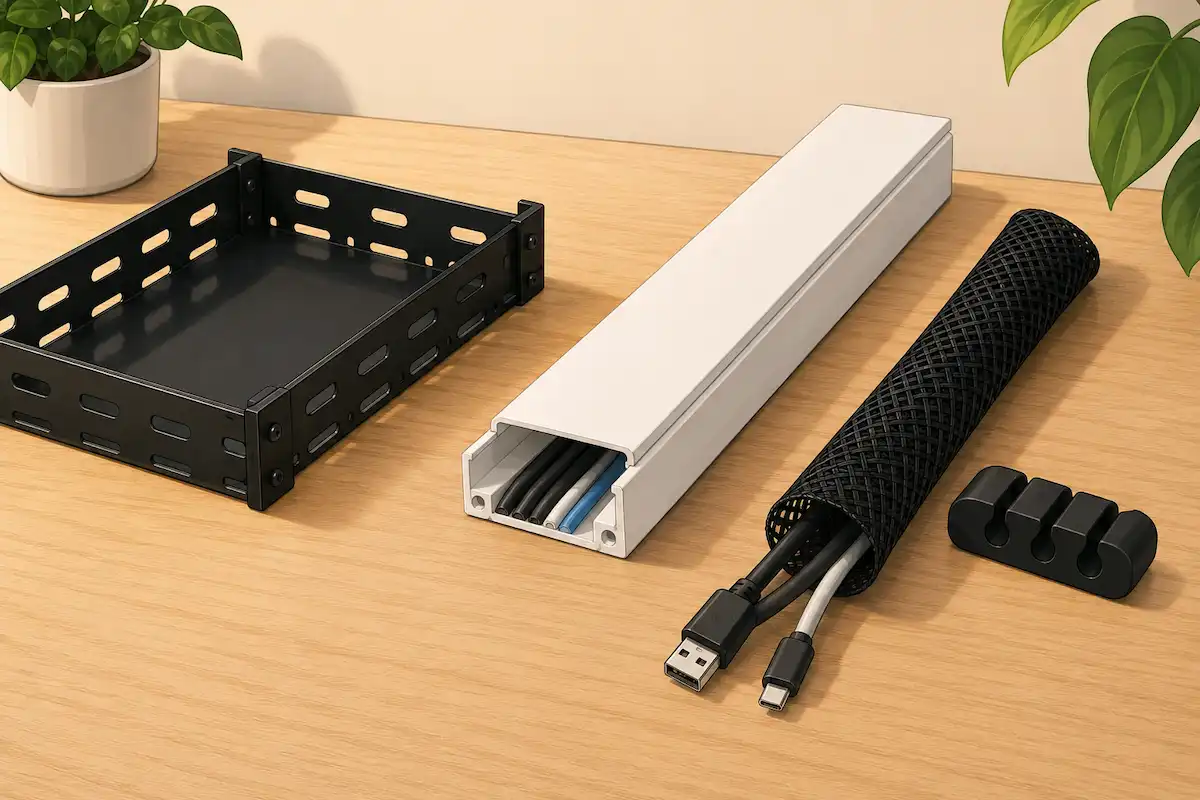
A steel tray, a PVC raceway and a polyester sleeve can all belong on the same desk. The tray carries a power strip, the raceway hides the stationary run along the wall, and the sleeve protects a group of leads that bend together. Start by deciding whether the organizer must carry weight, hold its shape or flex whenever you move the equipment.
The material name is only the beginning. Steel thickness, plastic formulation, braid density, tie width, clip geometry, coating quality, adhesive chemistry, load direction, and the surrounding environment can change durability more than a broad label such as metal, nylon, or premium silicone.
This guide compares materials before you choose a product. If you are still deciding which organizer format belongs in each part of the route, compare cable trays, raceways, sleeves, and clips. For product-level options, see our complete cable management tools guide.
Which Cable Management Materials Hold Up Best at a Glance
The best material depends on the job. Structural parts need stiffness and a verified load rating. Flexible routes need abrasion resistance and bendability. Frequently changed bundles need a closure that can be reopened without damaging the cables.
The table below compares the main material families and constructions found in desk cable management. Use it as a starting point, then verify the exact grade, dimensions, ratings, and installation requirements for the product you are considering.
Cable Management Material Comparison
| Material or Construction | Best Use | Why It Holds Up | Main Tradeoff | Specs and Claims to Verify |
|---|---|---|---|---|
| Powder-coated steel | Under-desk trays, baskets, brackets, and other parts that must support concentrated weight. | Rigid steel resists sagging, while the coating protects the surface from ordinary scuffs and indoor wear when it remains intact. | It is heavier than plastic or aluminum. A damaged coating can expose the steel, and thin material or weak bends can still flex. | Published load rating, steel thickness or gauge, weld and edge finish, coating coverage, bracket design, and mounting-surface requirements. |
| Stainless steel | Specialty ties, clamps, and supports exposed to moisture, chemicals, heat, or corrosive conditions. | The correct stainless grade provides strong corrosion resistance and retains useful performance across demanding environments. | It is expensive and often unnecessary for a normal indoor desk. Uncoated edges and overtightened metal ties can damage cable jackets. | 304 versus 316 or another stated grade, edge treatment, coating or sleeve, tensile rating, locking method, and environmental approvals. |
| Aluminum | Lightweight channels, raceways, or trays where low installed weight and corrosion resistance are priorities. | Aluminum provides useful stiffness at a lower weight than steel and does not depend on paint alone to avoid red rust. | Alloy, section shape, and wall thickness strongly affect rigidity. Thin aluminum can dent or bend and is not automatically stronger than steel. | Alloy or product grade when published, wall thickness, load rating, anodized or coated finish, joint design, and compatible fittings. |
| PVC or another rigid engineered plastic | Fixed raceways, cord covers, cable boxes, lids, and low-load channels. | Molded plastic can create a consistent enclosed shape with integrated covers, corners, and cable exits without adding much weight. | Thin walls, weak hinges, and brittle latches can crack. Heat, sunlight, and impact suitability depend on the exact formulation and product. | Named resin, wall thickness, lid and latch design, impact and temperature limits, UV or outdoor rating, fittings, and any applicable listing. |
| Polyester (PET) braid | Flexible sleeves around bundles that need abrasion protection and the ability to bend. | A well-made braid is flexible, expandable, and abrasion resistant while allowing the bundle to follow curves. | It does not support weight or hold its own route. Cut ends can fray, and dense bundles become harder to access and bend. | Bundle-diameter range, weave density, split or closed construction, finished edges, abrasion claim, operating temperature, and flame rating if relevant. |
| Polypropylene (PP) wrap | Spiral wraps and reusable protective covers that must open, flex, and resist ordinary abrasion. | PP can provide a resilient, reusable protective shape and is available in formulations with useful moisture, chemical, and temperature performance. | Some wraps become bulky or stiff when full. Not every PP product is UV stabilized, flame rated, or intended for repeated outdoor exposure. | Bundle range, wall thickness, operating temperature, UV stabilization, chemical limits, flammability, and how the wrap opens for later changes. |
| Polyamide 6.6 (nylon) | Zip ties, molded clips, anchors, and fixed indoor routes where compact strength matters. | The material can provide strong molded features and high tensile performance in a small part, with specialized heat- and UV-stabilized grades available. | Standard nylon is not the same as a weather-resistant or heat-stabilized grade. A narrow tie can also damage a cable when overtightened. | Exact grade, minimum tensile strength, temperature range, UV stabilization, releasable versus one-time closure, width, and edge finish. |
| Hook-and-loop textile | Bundles that will be reopened, resized, identified, or moved as the workstation changes. | A wide reusable strap distributes pressure across more cable jacket area and can be opened without cutting. | The hooks and loops wear with use, collect lint, and are not structural supports. Flame, UV, and weather performance vary by product. | Strap width and length, closure overlap, reuse expectations, edge softness, flame rating when needed, and whether the strap remains attached to the cable. |
| Silicone or soft elastomer | Desktop holders, flexible channels, grommet-like inserts, and contact points around sensitive cable jackets. | A soft, conformable material can grip without sharp edges and cushion the cable where a rigid part would concentrate pressure. | Soft parts can stretch, tear, attract dust, or release a cable when the opening is oversized. The adhesive base may fail before the soft clip body. | Cable-opening range, hardness or flexibility, wall thickness, tear-prone features, operating temperature, cleaning needs, and the separate mounting method. |
| Acrylic foam adhesive | Attaching lightweight clips, channels, or mounts to approved smooth surfaces without drilling. | A conformable acrylic foam system can spread stress and maintain broad contact when the correct tape is matched and installed properly. | Performance depends on surface energy, cleaning, pressure, temperature, dwell time, pad area, load direction, and removal expectations. | Exact adhesive family, approved surfaces, pad dimensions, application and operating temperatures, wait time, capacity, and documented removal method. |
Material is only one part of durability. Grade, thickness, geometry, coating, closure design, load rating, installation, and environment can matter as much as the material name.
For a normal indoor home office, powder-coated steel, rigid PVC or another named engineered plastic, PET braid, polypropylene wrap, PA66 nylon, hook-and-loop, and silicone can all hold up well when used for the job they suit. The strongest material in one category may be the wrong material in another.
Do not treat the table as a ranking from strongest to weakest. A rigid steel tray and a flexible PET sleeve solve different problems, so their durability should be judged by whether they retain their shape, access, fit, and function in the intended route.
Material Names Are Only the Starting Point
Two products made from the same broad material can perform very differently. A thick steel basket with reinforced bends is not equivalent to a thin stamped strip, and a dense self-closing PET sleeve is not equivalent to a loose decorative braid. Read the material name together with the construction details.
Grade and Formulation Change the Material
Nylon, plastic, and stainless steel each describe families rather than one fixed performance level. Nylon ties may be standard, heat stabilized, impact modified, or UV resistant. Stainless products may use different grades. Plastics may include fillers, stabilizers, flame inhibitors, or recycled content that changes how the finished part behaves.
Thickness and Shape Determine Stiffness
A material can be strong in bulk and still produce a weak cable-management product when the walls are thin, the bracket is narrow, or the latch is poorly supported. Look for wall thickness, wire diameter, gauge, ribbing, folded edges, bracket spacing, and a published load or tensile rating rather than relying on the material alone.
The Finish Protects the Base Material
Powder coat, anodizing, paint, plating, and soft inserts can improve wear resistance, corrosion behavior, cleanability, or cable protection. The benefit depends on complete coverage and an intact finish. A coating claim should not replace information about the metal underneath it or the environment the product is rated to handle.
The Weakest Part Can Decide the Product’s Life
A steel tray can outlast its clamps, a rigid raceway can outlast its lid tabs, and a silicone clip can outlast the adhesive pad beneath it. Judge the complete assembly: body, closure, mounting hardware, adhesive, fasteners, edges, and replaceable parts.
Which Metal Materials Hold Up Best?
Powder-Coated Steel Is the Best Starting Point for Structural Support
For under-desk trays, baskets, brackets, and other components that must carry a power strip, adapters, and cable slack, powder-coated steel is usually the most practical material. It combines rigidity with a protective indoor finish and can be formed into open baskets that preserve access and airflow.
The product still needs a credible load rating and mounting system. StarTech’s steel tray documentation, for example, identifies powder-coated steel, load support, and mounting details rather than presenting the material name as the entire specification.
Before buying, inspect wire diameter or sheet thickness, welds, folded edges, bracket spacing, coating coverage, and the tray’s rated load. A heavy-looking basket can still sag when its long span is poorly reinforced or its mounting points are too far apart.
Material strength does not determine how much tray capacity the setup needs. Measure the connected power strip, adapters, plug bodies, cable exits, and controlled slack using the guide to how much cable tray space you need under a desk, then confirm that the tray’s usable interior, load rating, and mounting footprint all fit the desk.
Stainless Steel Is for Corrosion and Specialty Conditions
Stainless steel is useful for specialty ties, clamps, and supports exposed to moisture, chemicals, or temperatures beyond ordinary office conditions. It is generally unnecessary for a dry indoor desk, where powder-coated steel or an engineered plastic is usually easier and less expensive.
The grade matters. HellermannTyton’s cable-tie material selection guide distinguishes stainless grades and multiple polymer formulations with different environmental ranges. Do not treat the word stainless as a complete corrosion or temperature specification.
Metal ties also need smooth edges, appropriate tension, and cable protection where required. A corrosion-resistant tie can still damage a cable jacket when it is overtightened or installed without a coated surface in a vibration-prone route.
Aluminum Is Useful When Low Weight Matters
Aluminum can be a good choice for channels, raceways, or trays that need lower installed weight and corrosion resistance. Its usefulness depends on the alloy, wall thickness, extrusion or bend profile, and joint design. A thin aluminum channel can dent or flex even though the material family sounds premium.
Compare the finished product’s load rating and section shape with a steel alternative. Aluminum is not automatically a structural upgrade; it is a different balance of weight, stiffness, corrosion behavior, and cost.
Which Rigid Plastic Materials Hold Up Best?
Rigid plastic works best where the organizer needs to hold a fixed shape without carrying a concentrated load. Raceway channels, cord covers, lids, cable boxes, grommets, and small desktop organizers often use PVC, ABS, polypropylene, or another engineered resin.
PVC Is a Common Choice for Fixed Raceway
PVC can be molded into straight channels, snap-on covers, elbows, couplings, and cable exits. Legrand identifies its CordMate II raceway as PVC, illustrating why a buyer should look for a named material and compatible fitting family rather than a listing that says only plastic.
The durability questions are wall thickness, impact resistance, cover design, fitting compatibility, adhesive or fastener method, and the approved temperature and installation environment. A raceway that stays fixed for years may fail first at a brittle lid tab or poorly supported corner.
ABS and Other Engineered Plastics Need Construction Details
ABS is common in boxes, clips, and molded housings, but the resin name does not reveal wall thickness, impact modification, UV stabilization, or the strength of the hinges and mounting points. The same is true for listings that use phrases such as high-grade plastic without naming the resin.
Look for a dimensional drawing, operating-temperature range, indoor or outdoor rating, load limit, and clear photos of the underside, hinges, and closure. For a fixed raceway, replacement fittings and a cover that can be reopened without cracking are often more important than a broad toughness claim.
Do Not Treat Plastic as an Electrical Safety Rating
A nonmetallic body does not automatically make an organizer suitable for permanent wiring, heat exposure, or a particular electrical installation. Verify the exact product’s intended use and any listing or standard that applies. A consumer cord cover may be intended only to conceal existing cords and low-voltage cables.
Which Flexible Sleeve and Wrap Materials Hold Up Best?
PET Braid Is a Strong Choice for Abrasion and Flexible Routes
Polyester, often labeled PET or PES, is a common material for expandable and self-closing cable sleeves. A well-made PET braid can protect a bundle from rubbing while remaining flexible enough to follow curves and movement.
HellermannTyton’s HEGP polyester sleeving, for example, identifies PET, abrasion resistance, bundle range, and cutting guidance. Those details are more useful than the word braided by itself.
Before buying, compare the minimum and maximum bundle diameter, weave density, expansion range, side-entry access, edge finish, operating temperature, and any flame rating. A sleeve can be durable while still becoming inconvenient when overfilled or cut without a finished edge.
Polypropylene Wrap Works Well for Reusable Protection
Polypropylene is used in spiral wraps and protective systems that can be reopened and reused. HellermannTyton’s Helawrap documentation identifies polypropylene, reusable access, abrasion protection, bundle capacities, and product-specific temperature information.
PP wrap can be easier to reopen than a closed tube, but the finished bundle may become bulky or stiff. Check how cables branch out, whether the wrap stays closed at bends, and whether the exact product is UV stabilized or approved for the environment.
Hook-and-Loop Is Best When Reopening Matters Most
Reusable hook-and-loop ties are often the most durable practical choice for bundles that will change. They distribute pressure across a wider area than a narrow zip tie and can be reopened without cutting the cable route apart.
VELCRO Brand ONE-WRAP ties, for example, are described as adjustable, reusable, and designed to wrap back onto themselves. Professional versions may also carry product-specific flame or installation ratings.
Compare strap width, usable length, overlap, edge softness, closure strength, and whether the tie stays attached to the cable when opened. Hook-and-loop is not a structural support, and the closure will eventually wear when opened repeatedly or contaminated with lint and debris.
Which Materials Work Best for Ties, Clips, and Soft Contact?
PA66 Nylon Is Useful, but the Grade Must Match the Environment
Polyamide 6.6, commonly called nylon 6/6 or PA66, is widely used for cable ties, molded clips, and anchors because it can form compact locking features with useful tensile strength. Standard indoor PA66 should not be assumed to perform like a heat-stabilized, impact-modified, or UV-resistant grade.
The HellermannTyton material guide above separates standard PA66 from heat-stabilized and weather-resistant formulations and publishes different operating ranges. A consumer listing should identify UV stabilization, temperature limits, tensile strength, and whether the closure is releasable.
For desk use, tie width and installation tension matter as much as the resin. A narrow tie pulled too tightly can deform a cable jacket even when the tie itself remains intact for years.
Silicone and Soft Elastomers Protect Sensitive Contact Points
Silicone and other soft elastomers are useful in desktop cable holders, flexible channels, grommets, and inserts that contact a cable directly. The material can conform around the jacket and reduce sharp pressure points.
HellermannTyton’s P-clamp guidance, for example, describes soft silicone inserts for protecting sensitive cable insulation. In a consumer organizer, the useful buying signals are cable-opening range, hardness or flexibility, wall thickness, tear-prone corners, and how the soft part is mounted.
Do not confuse the soft clip body with the adhesive system beneath it. A silicone holder can remain flexible while its unknown adhesive pad releases from the desk.
The Adhesive Can Fail Before the Clip Material
Adhesive-backed organizers combine at least two material systems: the clip, channel, or mount itself and the pressure-sensitive adhesive beneath it. The body may be made from durable nylon, PVC, ABS, or silicone while the installation fails because the adhesive is mismatched to the surface or load.
Acrylic foam systems can conform and distribute stress, but the exact tape still needs compatible surfaces, adequate pad area, application pressure, suitable temperature, and enough dwell time. 3M’s VHB product guide distinguishes adhesive families and surfaces rather than treating every acrylic foam tape as interchangeable.
For a full buying check, see why adhesive cable clips fail. A durable clip body cannot compensate for a dirty, porous, textured, low-energy, or fragile mounting surface that is incompatible with its adhesive.
How to Read Durability Claims Before Buying
Heavy Duty Should Lead to a Number
For trays and mounts, look for a published load rating tied to the exact mounting method and compatible surface. For cable ties, look for minimum tensile strength. For sleeves and channels, look for bundle range, wall thickness, or impact information. Heavy duty without a measurable specification is marketing rather than a buying signal.
UV Resistant and Weather Resistant Need Product-Specific Support
Black color alone does not prove outdoor durability, and an outdoor claim does not reveal how long the product was tested. Look for a stated UV-stabilized grade, outdoor-use approval, weathering test, or defined service environment. The rating should apply to the complete product, including its adhesive and closure.
Flame Retardant Is Not the Same as Fireproof
A flame-retardant claim should identify the exact product rating, test, listing, or installation category. Do not transfer a rating from one version to another color, adhesive, refill strip, or material. For an ordinary desk, the main lesson is to verify the precise model rather than assuming every PET sleeve or hook-and-loop tie shares the same rating.
Rustproof May Ignore Other Failure Modes
Plastic and aluminum do not develop red rust like unprotected carbon steel, but they can still crack, deform, discolor, loosen, or fail at their fasteners. Stainless steel can corrode in conditions beyond the chosen grade. Compare the complete environment and assembly instead of treating rustproof as permanent durability.
Eco-Friendly Does Not Predict Strength
Recycled content, recyclability, halogen-free construction, and reduced packaging can be valuable attributes, but they do not establish load capacity, impact resistance, UV life, or repeated-use performance. Ask for the same functional specifications you would require from any other material.
Match the Material to the Actual Setup
Normal Indoor Desk
Powder-coated steel trays, PVC or another rigid plastic raceway, PET sleeve, polypropylene wrap, PA66 clips, and reusable hook-and-loop ties can all work well indoors. Prioritize fit, access, load rating, and construction quality over exotic material claims.
The material list should follow the actual cable-management jobs in the setup rather than become a shopping checklist. The guide to the cable management tools a desk actually needs explains when ties, trays, clips, sleeves, raceways, boxes, and movement guides are useful and when a simpler system is enough.
Standing or Frequently Adjusted Desk
Flexible PET sleeves, PP wraps, hook-and-loop ties, and movement-compatible spines need to bend repeatedly without transferring load to connectors. Rigid steel and plastic components should stay on the moving desk or fixed room side rather than bridging the changing span. See our guide to planning standing-desk cable management.
Humid Garage, Utility Area, or Semi-Exposed Space
Verify corrosion resistance, UV stabilization, operating temperature, moisture limits, and adhesive suitability for the exact location. Powder-coated indoor steel, ordinary nylon, and consumer adhesive may not be rated for the environment even when they perform well in a climate-controlled office.
Frequently Reconfigured Workstation
Favor open steel baskets, split PET sleeves, reusable PP wraps, hook-and-loop ties, magnets on compatible frames, and replaceable adhesive systems. A slightly less concealed route may last longer in practice because it can be changed without breaking lids, cutting ties, or replacing the entire installation.
High-Heat or Specialty Environment
Do not generalize from a normal consumer product. Use the manufacturer’s exact temperature, flame, chemical, and environmental ratings. Specialty PA66 grades, PP, PEEK, stainless steel, flame-retardant PET, and other materials exist, but their performance applies only to the identified product and installation.
What to Look For Before Buying
Verify the Material and Its Grade
Prefer a listing that names powder-coated steel, PVC, PET, PP, PA66, silicone, acrylic foam, or another specific construction. When environmental resistance matters, look for the grade, stabilizer, alloy, coating, or product variant rather than accepting a generic material name.
Check the Dimensions That Create Durability
Compare steel gauge or wire diameter, plastic wall thickness, adhesive-pad area, strap width, sleeve weave, bundle range, bracket spacing, and latch geometry. These dimensions explain how the material is being used and often predict performance better than the material alone.
Require a Rating for the Actual Job
Use load ratings for trays, tensile ratings for ties, cable-diameter ranges for clips, expansion ranges for sleeves, and environmental limits for products exposed to heat, sunlight, or moisture. Confirm that the rating applies to the selected size, color, adhesive, and mounting method.
Inspect the Replaceable and Wear Parts
Look at hinges, lid tabs, clamp pads, refill strips, hook-and-loop closures, screws, magnets, and cut edges. Check whether the part most likely to wear can be replaced without discarding the entire organizer.
Match Access to the Expected Service Life
A material can last physically while the organizer fails practically because it is too difficult to open. Choose open baskets, split sleeves, removable covers, and reusable ties when the setup will change. Reserve permanent closures for routes that are genuinely stable.
Common Cable Management Material Buying Mistakes
Assuming Metal Automatically Means Stronger
A thin metal tray with weak brackets can flex more than a well-designed engineered-plastic component used within its load. Compare geometry, thickness, mounting, and ratings before treating the material family as the answer.
Assuming All Nylon or Plastic Is the Same
Standard PA66, UV-resistant PA66, heat-stabilized PA66, polypropylene, PVC, and ABS solve different problems. A listing that hides the resin, grade, or environmental limits leaves the buyer unable to judge whether the product matches the route.
Choosing a Sleeve by Appearance Alone
A dense-looking braid may be difficult to expand, while a loose braid may expose more of the cables. Compare bundle range, weave, access, bend behavior, edge finish, and abrasion specifications rather than choosing by texture or color.
Ignoring the Mounting Material
A durable clip body does not make an unknown adhesive reliable, and a steel tray does not make weak clamps suitable. Evaluate every interface between the organizer, desk, cable, and mounting hardware.
Buying for Extreme Conditions That Do Not Exist
Stainless steel, high-temperature polymers, and specialty flame-rated products may add cost or reduce convenience without improving a normal indoor desk. Buy for the actual load, movement, access, and environment rather than the most impressive material claim.
Frequently Asked Questions
What is the most durable material for an under-desk cable tray?
Powder-coated steel is usually the strongest practical starting point for a home-office tray because it provides rigidity and supports concentrated weight. The exact load rating, steel thickness, bracket design, coating, and desk mounting method still determine whether a specific tray will hold up.
Is metal cable management better than plastic?
Metal is generally better for structural trays and brackets, while rigid plastic is often better for lightweight raceways, covers, boxes, and molded fittings. Neither is universally better. Match the material to the load, access, environment, and shape the organizer must maintain.
Is PVC good for cable raceways?
PVC is a common material for fixed raceway and cord-cover systems. Check wall thickness, lid design, fittings, approved installation location, temperature limits, and any applicable listing. The material name alone does not show whether the cover will reopen cleanly or resist impact.
Is PET or nylon better for cable sleeving?
PET is a common choice for flexible abrasion-resistant desk sleeving. Nylon and other fibers may be used where a product needs a different heat, abrasion, chemical, or expansion profile. Compare the exact sleeve’s bundle range, weave, operating limits, and access rather than ranking the fiber name by itself.
Are hook-and-loop ties more durable than zip ties?
Hook-and-loop is usually more durable in a practical sense when the bundle will be reopened because it can be reused and adjusted. A properly selected nylon zip tie can remain secure for a long fixed installation, but it normally must be cut for changes and can damage cables when overtightened.
Does silicone last longer than plastic in cable clips?
Not automatically. Silicone and soft elastomers can remain flexible and protect cable jackets, while rigid plastics can hold a precise shape. Slot size, wall thickness, hardness, tearing, cable movement, and the mounting adhesive often matter more than the broad material label.
Does black nylon mean a tie is UV resistant?
No. Color alone is not a specification. Look for an explicit UV-stabilized or weather-resistant grade and the environmental limits for the exact product.
What material is best for a standing desk?
Use rigid powder-coated steel or engineered plastic for the tray and fixed supports, then use PET sleeve, polypropylene wrap, hook-and-loop, or a purpose-built flexible spine for the moving path. The organizer must be tested through the desk’s complete height range.
Which material is easiest to change later?
Open steel baskets, split PET sleeves, reusable PP wraps, hook-and-loop ties, and removable channels usually provide the best access. A durable material is not useful when the product must be broken, cut, or removed from the desk to change one cable.
The Bottom Line: Choose the Material by the Job
Powder-coated steel is the best practical starting point for load-bearing trays and brackets. PVC and other named engineered plastics work well for fixed raceways and boxes. PET braid suits flexible abrasion protection, polypropylene works well in reusable wraps, PA66 nylon fits compact ties and clips, hook-and-loop favors changing bundles, and silicone or soft elastomers protect sensitive contact points.
No material name guarantees durability. Verify grade, thickness, geometry, coating, load or tensile rating, cable fit, operating environment, mounting system, and access. The product will hold up only as well as its weakest closure, bracket, adhesive, or installation point.
Once the required material and organizer type are clear, use the complete cable management tools guide to compare product-level options.
Important: This article provides general information, not individualized medical, safety, installation, legal, or other professional advice. Product specifications, instructions, and safety information can change; verify current information with the manufacturer and consult an appropriately qualified professional when needed. See our Terms and Conditions for additional information.