
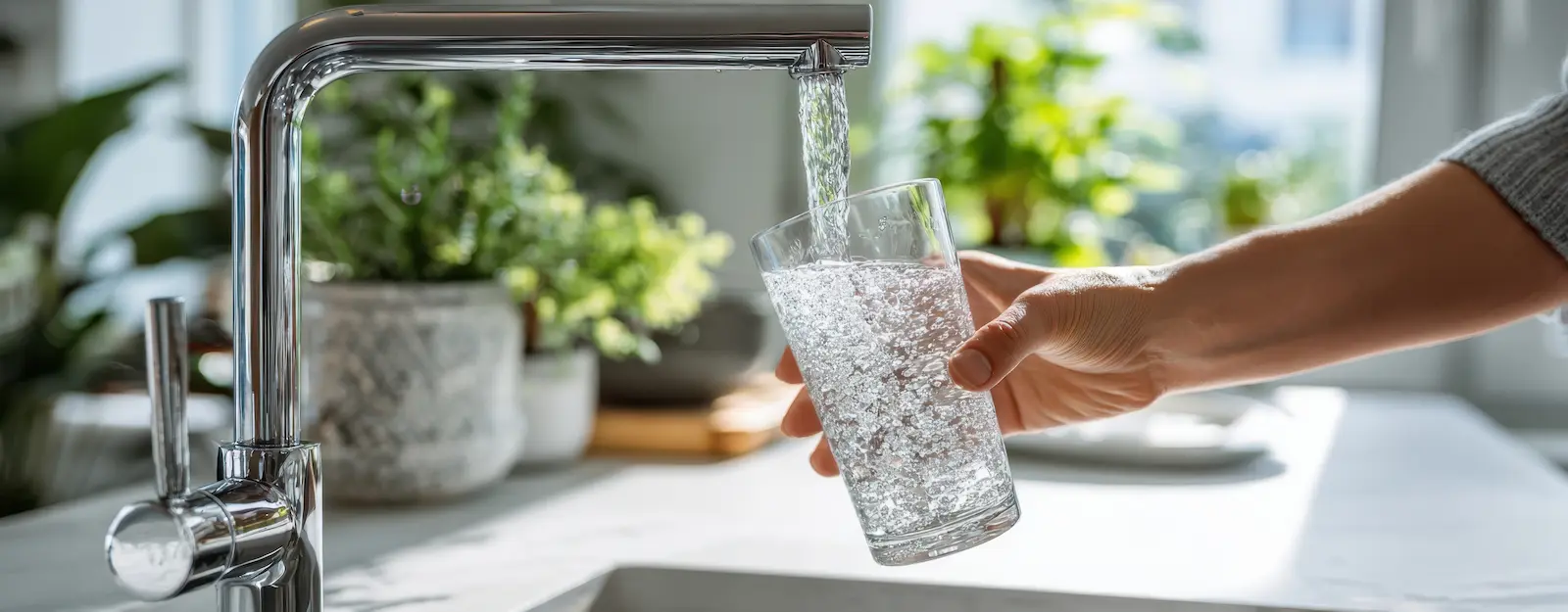
A reverse osmosis system changes a familiar kitchen habit. The water for a glass or a kettle comes from a separate faucet or a countertop carafe, after passing through a membrane and the system’s other filter stages. Two systems that make drinking water this way can occupy very different parts of a kitchen.
The reason for filtering comes first. A utility water report can identify substances in a public supply, while a concern about a private well or household plumbing may call for testing. The CDC’s guide to choosing a home water filter explains how to match a particular water concern to the treatment a system provides.
In this comparison, a tank-based installation stores filtered water under the sink, a powered tankless unit leaves more of that cabinet open, and a countertop model can fill a carafe without an under-sink installation. Space to change cartridges and the effort of refilling a countertop reservoir are the sorts of differences you’ll notice each week.
Reverse Osmosis System Comparison: Four Ways to Fit Your Kitchen
We evaluated these reverse osmosis systems using The Hearthful Standard, which considers materials, design, everyday use, durability, and the clarity of product information. We selected Waterdrop for its slim, tankless installation and faucet display, and Bluevua for countertop use with a removable glass carafe. APEC offers a conventional storage tank and separately replaceable filter stages. iSpring adds a documented mineral cartridge to that familiar under-sink arrangement.
Some links in this guide are affiliate links. If you purchase through them, The Hearthful Home may earn a small commission at no additional cost to you. As an Amazon Associate, we earn from qualifying purchases.

Best for a tankless cabinet setup
Waterdrop G3P800
The G3P800 pairs a narrow tankless housing with a display faucet and separate cartridge reminders. It suits a permanent under-sink installation with power available and room to reach the filters.
WD-G3P800 · White · Tankless under-sink system · Powered

Best for a refillable countertop setup
Bluevua RO100ROPOT-UV
The ROPOT(UV) makes water in a glass carafe from a manually filled tank. It suits a countertop routine with nearby power, room to lift the tank, and regular concentrate disposal and cleaning.
ROPOT(UV) · White · Countertop system · Glass carafe

Best for separate filter housings
APEC ROES-50
The ROES-50 uses incoming water pressure, a storage tank, and separate filter housings. It suits a cabinet with service space and an owner comfortable following conventional cartridge and housing-care instructions.
ROES-50 · Five stages · Under-sink system with storage tank

Best for an included mineral stage
iSpring RCC7AK-BN
The RCC7AK-BN combines a pressure tank, separately replaceable filters, and a mineral stage. It suits an under-sink installation where the extra cartridge and its maintenance are part of the plan.
RCC7AK-BN · Six stages · Brushed-nickel faucet · Mineral stage
What Matters When Choosing a Reverse Osmosis System
Match the Exact Reduction Claim to Your Water
Write down the substance you want to reduce and look for that named claim in the exact system’s certification listing or performance data sheet. Keep the model suffix, replacement cartridge codes, feed-water conditions, and rated service life together. A small difference in the model name can lead to a different record.
NSF/ANSI 58 covers reverse osmosis drinking-water systems, including required total dissolved solids reduction and optional claims for individual substances. NSF/ANSI/CAN 372 addresses lead content in materials. Check each standard’s purpose alongside the named claims. Our RO certification guide walks through system listings, component listings, and performance sheets.
Choose the Installation You Want to Live With
A plumbed under-sink system keeps the equipment below the counter and serves water through a dedicated faucet. Plan the cold-water connection, drain connection, faucet opening, and filter-change access together. A tankless unit may free the space otherwise occupied by a storage tank, while still needing room for its housing and connections.
None of these four is a whole-house reverse osmosis system. Each filters drinking water at one point of use. If you want filtered water in every shower and faucet, a countertop carafe or a dedicated kitchen faucet will leave the rest of the plumbing untouched. For drinking water in a rental, the Bluevua moves the work to filling and emptying its tank. For frequent use in one kitchen, the Waterdrop moves that work under the sink and requires power and a permanent installation.
A refillable countertop system moves the daily work above the counter. It needs an outlet, space to lift the feed tank, and a routine for emptying the remaining concentrate. The right arrangement depends on whether fixed plumbing or repeated refilling fits your home better. Use the under-sink installation checklist before committing cabinet space.
| Format in this guide | Space to reserve | Routine to plan |
|---|---|---|
| Waterdrop G3P800: tankless under sink | Housing, service access, faucet, drain connection, and power | On-demand dispensing, individual cartridge changes, and required flushing |
| Bluevua RO100ROPOT-UV: countertop | Counter, nearby outlet, and room to lift the tank and carafe | Refill the feed tank, discard concentrate, and clean serving parts |
| APEC ROES-50 or iSpring RCC7AK-BN: tank under sink | Filter assembly, pressure tank, faucet, connections, and service access | Draw stored water, allow the tank to refill, and maintain separate filter stages |
Read Production, Dispensing, and Storage Separately
A gallons-per-day rating describes water production under stated conditions. Check whether it rates the membrane or the complete system. Faucet delivery also depends on the system’s layout and, for a tank-based unit, the water available in its pressure tank. A countertop model adds a batch size and refill routine. Compare the figures that describe the task you actually do, such as filling a bottle or a cooking pot.
Tank size needs the same care. A nominal tank capacity includes space occupied by compressed air; the amount of water it delivers depends on operating conditions. Ask for usable storage or drawdown information if a particular volume is important to your routine. For an existing kitchen, also measure how much room the tank leaves for reaching filters and valves.
Include Water Use in the Ownership Cost
RO separates incoming water into treated water and a concentrate stream. Check the direction of an advertised ratio: treated-to-drain and drain-to-treated describe opposite arrangements. Read whether the figure includes flushing and whether it represents the installed system’s operating conditions.
The EPA’s WaterSense program for point-of-use RO systems provides an additional efficiency checkpoint. Labeled systems must meet the program’s performance requirements, including an efficiency threshold of at least 30 percent. Check the exact model in the program listing when that label is part of your shortlist. Our RO water-use calculator converts documented ratios into household planning estimates.
Price the Replacement Parts Before the System
Make a parts list for the selected system, including the membrane, sediment and carbon filters, and any mineral cartridge. A combined cartridge can cover several treatment functions; the number of advertised stages is different from the number of parts you will order. Check each part’s current price and replacement instructions.
Use the RO maintenance and running-cost planner to compare a year of ownership. It separates filter expenses from service costs and lets you enter the schedule for your model. Include installation labor and any required plumbing or electrical work in the initial purchase budget.
How We Evaluate Reverse Osmosis Water Filters
Our recommendations in this guide are research-based. Current certification listings, manufacturer performance sheets, installation manuals, exact retail configurations, and replacement-part information form the evidence base for this comparison.
Choose filtration suitability from the exact reduction claims and conditions identified in the product notes.
Materials
We assess the disclosed water-contact assembly, filter housings, tubing, tank or serving vessel, and applicable material certifications. The complete system and its components must fit the intended cleaning and handling routine.
Design & Function
We consider treatment configuration, available water, installation layout, controls and water use together. Published ratings are interpreted with their units and operating conditions.
Use & Interaction
We examine the work involved in dispensing, refilling, monitoring and changing filters. Installation and recurring tasks belong together, since a convenient faucet can still require substantial service access below the sink.
Durability & Longevity
We assess replaceable parts, housing care, maintenance access and the manufacturer’s support arrangements. The practical steps needed to keep the selected system in service matter more than the number of advertised stages.
Transparency & Trust
We check exact model identification, accessible instructions, certification scope, performance conditions and replacement codes. Clear records help the buyer connect a claim to the system being purchased.
A Closer Look at Each Pick
Best for a tankless cabinet setup
Waterdrop G3P800
WD-G3P800 · White · Tankless under-sink system · Powered
Choose the G3P800 when a powered tankless layout, an integrated display faucet, and individual cartridge reminders fit your kitchen. Confirm the required reduction claim, available service space, and replacement-cartridge budget before choosing it.
Price and availability last updated: 2026-11-25 at 17:25.
Materials
The assembly includes filter housings, polyethylene tubing, a faucet, and other working components. Waterdrop’s G3P800 performance sheet states compliance with the NSF/ANSI 372 lead-content standard alongside its treatment certifications. Evaluate this as a complete plumbed filtration assembly, with access to the connections as part of the installation plan.
Design & Function
The tankless housing brings the membrane, carbon treatment and controls together. Waterdrop’s G3P800 specifications give an 800 GPD production rating, a 3:1 treated-to-drain ratio, and a housing measuring 18.11 × 5.67 × 17.73 inches. Those figures describe the maker’s rated configuration. The slim width can help with cabinet layout; check the depth, height, and service access just as carefully.
Use & Interaction
The faucet displays TDS and filter-life information, putting routine feedback at the point where you fill a glass. The installation and operating manual covers the powered setup and individual filter indicators. This arrangement suits someone who wants reminders built into daily use and has a suitable outlet available.
Durability & Longevity
CF, CB, and G3P800-RO are separate replacement cartridges. Their service requirements and flush procedures differ, so keep each code with its instructions. Budget for the matched cartridges and preserve access to their removal path. A tidy installation leaves enough room to complete those changes without moving unrelated cabinet contents every time.
Transparency & Trust
The current IAPMO NSF/ANSI 58 record for WD-G3P800 lists reductions including TDS, lead, and fluoride. Its separate NSF/ANSI 53 record names PFOA/PFOS reduction. Match the listed replacement parts, rated capacity, and operating conditions to the claim relevant to your water.
- Narrow housing supports a tankless under-sink layout
- Faucet display and individual filter reminders
- Model-specific performance sheet and replacement codes
- Needs an outlet as well as water, drain, and faucet connections
- Ownership budget includes matched CF, CB, and RO cartridges
Best for a refillable countertop setup
Bluevua RO100ROPOT-UV
ROPOT(UV) · White · Countertop system · Glass carafe
Choose the ROPOT(UV) for countertop batch preparation and a glass serving carafe when that routine suits your home. Match any specific treatment need to evidence for this exact UV model, and leave room for repeated refilling and cleaning.
Price and availability last updated: 2026-11-25 at 17:25.
Materials
The ROPOT(UV) manual identifies a borosilicate glass carafe, alongside the feed tank and four internal filter positions. The glass is the serving vessel within a larger assembly. Plan for both comfortable pouring and a stable place to set the carafe while the tank is being refilled.
Design & Function
The selected ROPOT(UV) model combines RO with a UV feature and a mineral filter. Its manual offers 0.5 L, 1 L, and 1.7 L batch selections. That makes the serving routine concrete: choose the amount you will use, then allow the batch to finish before pouring.
Use & Interaction
The unit needs electrical power and tap water in its removable tank. Bluevua instructs users to discard the concentrate remaining after treatment before another filtering round. This is a recurring refill task, so place the appliance where carrying the tank and emptying it at the sink feels manageable.
Durability & Longevity
Bluevua sells replacement filters for ROPOT and ROPOT(UV) and provides instructions for changing them. Treat the feed tank, glass carafe, mineral filter, and internal cartridges as separate care items. The routine combines cleaning serving parts with scheduled filter maintenance, which is useful to plan before assigning permanent counter space.
Transparency & Trust
The current WQA record for RO100ROPOT(UV) lists NSF/ANSI/CAN 372 lead-content certification. Bluevua’s model-by-model certificate assigns NSF/ANSI 58 to other listed variants. For a particular contaminant, request performance evidence naming RO100ROPOT(UV); keep this model’s material certification distinct from another model’s reduction certification.
- Countertop setup avoids permanent sink plumbing
- Glass carafe with selectable batch volumes
- Replacement filters and illustrated care instructions
- Feed tank needs refilling and concentrate disposal
- NSF/ANSI/CAN 372 covers lead content in the system’s materials; confirm separate evidence for the contaminants you want to reduce
Best for separate filter housings
APEC ROES-50
ROES-50 · Five stages · Under-sink system with storage tank
Choose the ROES-50 when you want a conventional pressure-tank system with separate service parts and can make room for routine housing maintenance. Its practical appeal is the accessible arrangement of the stages and a clear replacement-parts path.
Price and availability last updated: 2026-11-25 at 17:25.
Materials
Three lower housings hold the prefilters, while the membrane and postfilter sit above them. The ROES-50 manual illustrates those components and their connections. The design gives access to individual service parts, with O-rings and housing seals included in the care routine.
Design & Function
APEC’s current specification table rates system capacity at 50 GPD with 60 psi feed pressure and 30 GPD at 50 psi, both at 77°F. The WQA listing records 34.8 GPD under its certification conditions. These production ratings describe different conditions; the pressure tank supplies stored water between refills. Plan usable storage around the installation conditions rather than treating the nominal four-gallon tank as four gallons of delivered water.
Use & Interaction
Water collects in the pressure tank between uses and dispenses from a dedicated faucet. The standard configuration operates from incoming water pressure, with no electrical connection in its installation layout. The filter assembly measures 15.5 × 5.25 × 17 inches and the separate tank 11 × 11 × 15 inches. Reserve additional room to reach valves, tubing, and the lower housings during service.
Durability & Longevity
APEC’s replacement-parts guidance identifies the prefilter set, membrane and postfilter for ROES-50. The manual also specifies care for the O-rings and a five-year replacement interval for the filter housings. These accessible service parts support continued maintenance, with a one-year limited defect warranty. Include opening, inspecting, resealing and flushing the housings in the routine alongside cartridge purchases.
Transparency & Trust
The WQA ROES-50 listing identifies a complete system with a storage tank and automatic shutoff, certified to NSF/ANSI 58 for TDS reduction. Keep that named scope with the certification. If your priority is a particular substance, compare it with the exact model’s applicable performance evidence before buying.
- Separate housings and identified replacement stages
- Pressure-tank layout serves stored water between refills
- Standard configuration runs from incoming water pressure
- Tank and filter assembly both occupy cabinet space
- Cartridge changes involve opening and resealing housings
Best for an included mineral stage
iSpring RCC7AK-BN
RCC7AK-BN · Six stages · Brushed-nickel faucet · Mineral stage
Choose RCC7AK-BN when you want a tank-based system with an included mineral cartridge and a clearly identified certification record. Confirm the BN configuration, plan for the tank and housing access, and include every stage in the replacement budget.
Price and availability last updated: 2026-11-25 at 19:10.
Materials
The assembly uses plastic housings and tubing, a pressure tank, and a brushed-nickel-finish faucet. The NSF listing for RCC7AK-BN identifies the complete system and its replacement modules, including FA15. Its lead-content certification applies to the listed assembly; retain the exact suffix when matching records and parts.
Design & Function
iSpring markets the family with a 75 GPD rating. The current NSF entry for RCC7AK-BN lists 25.41 GPD daily production under its certification conditions. Keep those ratings labeled when comparing systems. For everyday serving, also account for the separate tank and how much stored water your household draws at once.
Use & Interaction
The iSpring US manual naming RCC7AK-BN identifies the supplied faucet, tank, tubing, and installation requirements. The selected Amazon package has a top-mounted faucet fastener, which changes how the faucet is secured at the counter. Check that arrangement against your sink opening and access before planning the installation.
Durability & Longevity
The manufacturer’s current RCC7AK family page identifies the FP15, FG15, FC15, FT15, MC7 and FA15 replacement stages. Keep those codes with the exact BN system record so a bundle’s contents can be checked before ordering. The mineral stage adds another service item to the sediment, carbon, membrane and postfilter routine.
Transparency & Trust
The current NSF listing names lead, fluoride, asbestos, barium, cadmium, trivalent chromium, copper, selenium, and TDS reduction for RCC7AK-BN. That exact identification makes its record useful when matching a water concern. Check the accompanying performance conditions and replacement modules together, including the included mineral stage.
- Included mineral cartridge in the named system configuration
- Current NSF record identifies multiple reduction claims
- Separate cartridges and available replacement packs
- Tank and lower housings require usable service space
- Mineral cartridge adds a recurring replacement task
Make the System Easy to Maintain
Keep One Record for the Whole Installation
Save the exact model, cartridge codes, manual, performance sheet, and installation date together. Add the water-supply conditions or test results used to choose it. When a replacement is fitted, record its date and the next instruction-based checkpoint.
Leave Room for the Next Filter Change
Keep the filter access path usable after putting cleaning supplies back in the cabinet. For countertop units, reserve space to remove the tank and serve from the carafe comfortably. Think through the maintenance movement as well as the installed footprint.
Follow the Correct Flush and Cleaning Sequence
Initial setup, cartridge changes, membrane changes, and returning a system to use can involve different procedures. Follow the instructions for the work just completed. Include the serving vessel or pressure tank in the care routine specified for the system, and reset reminders after the corresponding maintenance task.
Keep Mineral Treatment Model-Specific
If you choose a mineral stage, record its part number and replacement schedule with the other filters. Its media and position affect what it does to the treated water. Our RO remineralization guide explains how to read mineral, pH, and compatibility information when considering that feature.
Reverse Osmosis Water Filter FAQs
Which RO system is the best fit for my home?
Start with the claim that matches your water concern. Among these layouts, Waterdrop G3P800 suits a powered tankless installation, Bluevua RO100ROPOT-UV suits countertop refilling, APEC ROES-50 offers separate serviceable housings, and iSpring RCC7AK-BN combines a tank-based system with an included mineral stage. Check installation space and recurring costs before making the final choice.
Should I choose RO or a water filter pitcher?
Compare the exact treatment claims first. A pitcher may suit the substance you want to reduce and a smaller serving routine. RO introduces a membrane, a concentrate stream, and a different installation or refilling commitment. Our water filter pitcher comparison gives you a second format to assess against the same water concern.
Does the TDS display tell me whether the water is safe?
A TDS display estimates the amount of dissolved solids and can help you follow the system’s operation as described in its manual. It does not identify individual contaminants. Use the applicable certification and performance information for reduction claims, and appropriate water testing for a specific concern.
Does an under-sink RO system work without electricity?
The selected APEC ROES-50 and iSpring RCC7AK-BN use incoming water pressure and a storage tank. The Waterdrop G3P800 needs electricity, as does the Bluevua countertop unit. Match the water-pressure requirement for a nonelectric system, and verify outlet access for a powered one.
Will an RO system treat all the water in my house?
These are point-of-use systems for a dedicated drinking-water faucet or countertop serving vessel. Whole-house treatment involves different sizing and installation decisions. Choose the treatment location that corresponds to the water you intend to use.
Can a countertop RO unit filter any water source?
Use the source water permitted by the manufacturer. The Bluevua model in this guide specifies tap water. An RO label or an added UV feature should not be treated as permission to use untreated outdoor water. During a drinking-water advisory, follow your local authority’s directions.
How often will I need replacement filters?
Use the schedule for each cartridge and membrane in your exact system. Instructions can include time, treated volume, water conditions, or an indicator, and those triggers need to be read together. A useful ownership comparison lists the individual parts and their replacement requirements before adding up the cost.
Can I connect the system to a refrigerator or ice maker?
Check the RO maker’s approved connection arrangement and the appliance’s pressure and water-quality requirements. Tubing length, storage, and available pressure affect the installation. Confirm the configuration before adding a branch to a system supplied for a dedicated faucet.
Important: This article provides general information, not individualized medical, safety, installation, legal, or other professional advice. Product specifications, instructions, and safety information can change; verify current information with the manufacturer and consult an appropriately qualified professional when needed. See our Terms and Conditions for additional information.