
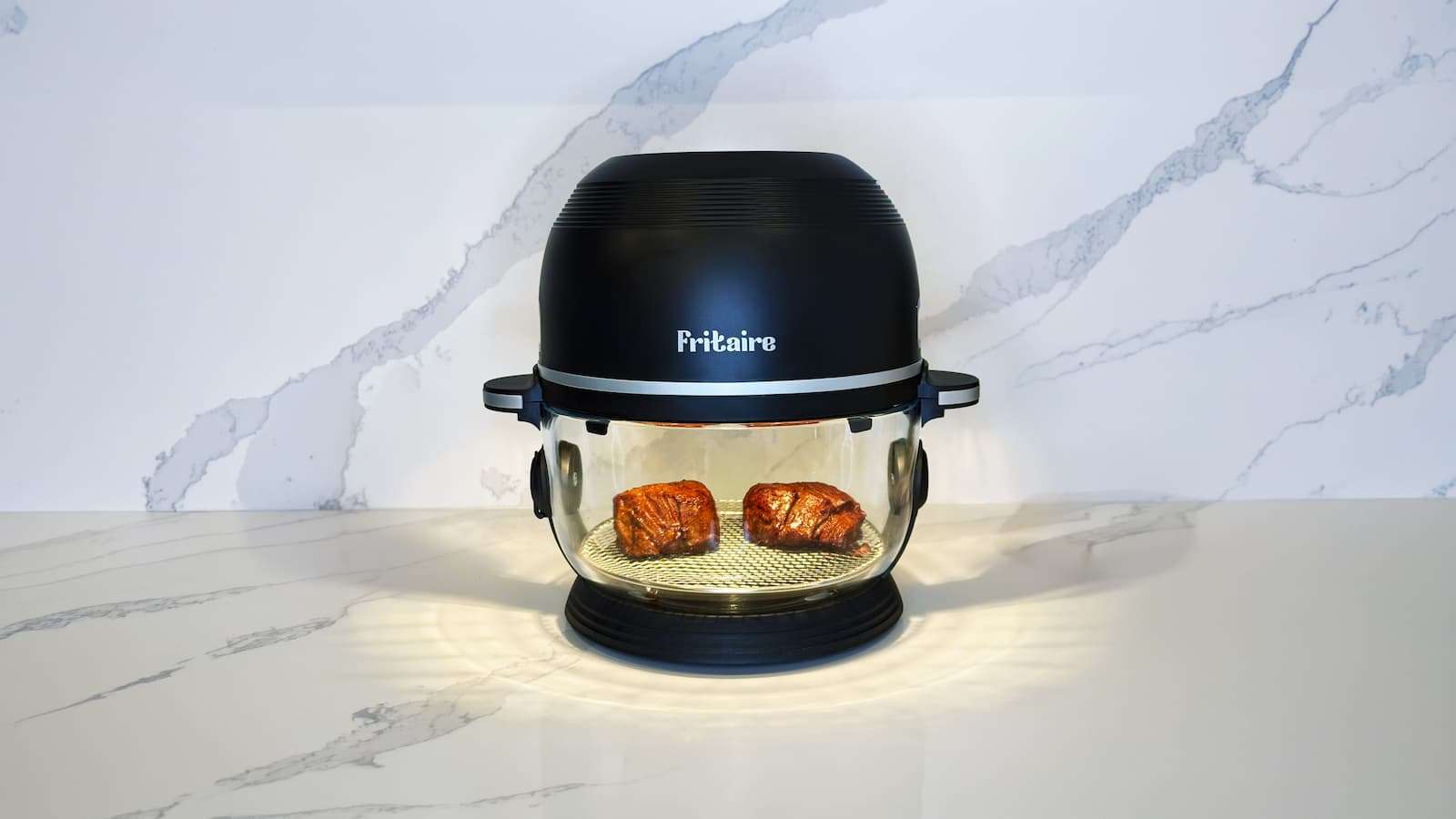
The Fritaire is a five-quart glass-bowl air fryer built around three removable cooking setups: an air stand, a motorized tumbling basket, and a rotisserie spit. After cooking four different foods and completing a separate measurement refresh, I think its rotating accessories are more useful than they first appear, but the appliance is also more involved to handle and clean than a conventional drawer-style air fryer.
The tumbler was my favorite feature. It continuously redistributed tallow-coated fries and produced an evenly crisp batch without a manual shake. The rotisserie also worked as intended with a compact whole chicken, while the air stand handled both beef tenderloin and chocolate-chip cookies.
The tradeoffs became clearer with repeated use. Moist foods can completely fog the bowl, the hot lid/heater needs a safe landing place every time it is removed, the self-clean cycle still ends with manual washing and drying, and water can become trapped in a gap beneath the bowl-support area. They matter each time the appliance is handled and cleaned.
I recommend it for particular kitchens: the Fritaire makes the most sense for a small kitchen, a household without a strong convection oven, or someone who specifically values glass visibility and the rotating accessories. It is harder to justify when a capable full-size oven already covers the same jobs or when one-handed drawer simplicity is the priority.
Review disclosure: Fritaire provided this air fryer to The Hearthful Home at no cost for hands-on testing. Fritaire did not pay for this review, review it before publication, or influence the testing criteria, measurements, scores, or verdict. This article contains affiliate links, which means The Hearthful Home may earn a commission if you buy through a link, at no additional cost to you. As an Amazon Associate we earn from qualifying purchases.
Fritaire Review at a Glance
Strong Results, Useful Extras, More Upkeep
The air stand browned beef and baked crisp cookies, the tumbler produced evenly crisp fries, and the rotisserie kept a compact chicken turning steadily. Its tumbler and compact rotisserie add real function, but the hot removable lid, extra parts, and multi-step cleanup make it more involved to own than a drawer-style air fryer.
Smaller kitchens, focused batches, coating-conscious shoppers, and buyers who value glass visibility and will genuinely use the tumbler or compact rotisserie.
The motorized tumbler kept the fries moving, cooked them evenly, and removed the normal mid-cycle basket shake.
The hot lid/heater is awkward to lift and requires a clear, heat-safe landing place every time it is removed.
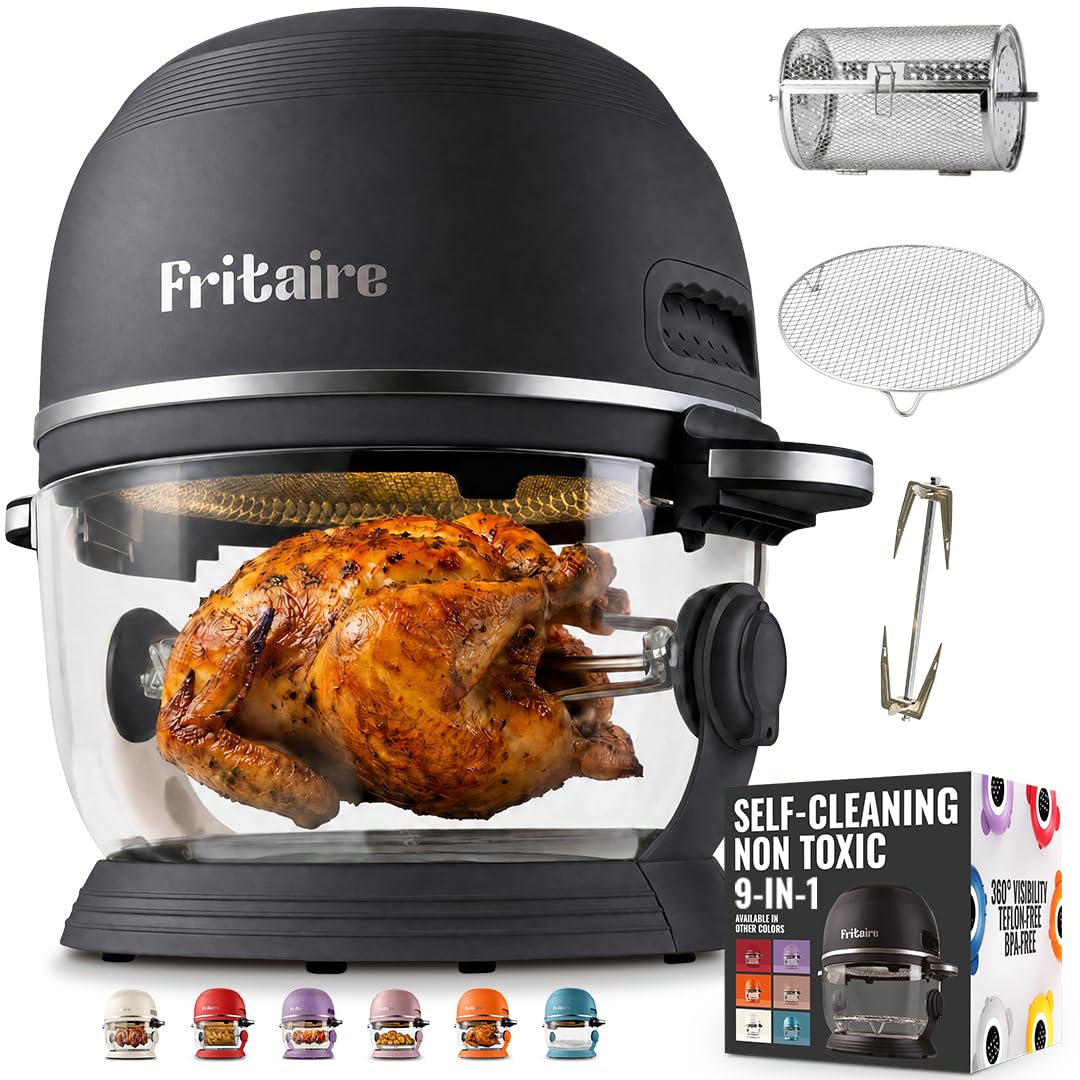
Fritaire Glass Air Fryer
Five-quart glass-bowl air fryer with an air stand, motorized tumbling basket, rotisserie system, and self-clean program.
How the Three Cooking Setups Differ
The Fritaire places its heating element and controls in a removable top lid above a transparent glass bowl. Inside that bowl, the cooking surface changes with the accessory: food can sit stationary on the air stand, rotate inside the tumbler, or turn around a central spit.
That distinction matters more than the nine presets on the control panel. The air stand is the everyday setup, the tumbler continuously redistributes smaller foods, and the rotisserie turns a balanced compact protein. The tumbler and rotisserie use the same removable side motor, which Fritaire says runs on four AAA batteries.
The reviewed black unit is labeled Fritaire-01-BL. It arrived with the glass bowl/base assembly, lid/heater, air stand, tumbler, rotisserie spit and forks, grabber, and removable motor.
One Bowl, Three Ways to Cook
Air Stand
Food stays stationary on an elevated round metal stand while hot air circulates through the bowl.
Tumbling Basket
A perforated cage rotates continuously, changing the position of smaller foods without a manual shake.
Rotisserie Spit
A centered load turns on the removable motor while remaining visible through the glass bowl.
How I Tested the Fritaire
Fritaire sent the review unit in early July 2026. I used it over roughly two months and tested every major cooking configuration. The food tests covered stationary protein cooking, small-batch baking, continuous tumbling, and whole-bird rotisserie cooking.
On August 23, 2026, I completed a separate measurement refresh focused on information a product page cannot provide on its own: actual component weights, usable dimensions, measured peak power, sound at three feet, surface temperatures during a 400°F cycle, shutdown behavior, hot-part handling, cleanup, odor, trapped water, and current condition.
This is a Hands-On Tested review under the Hearthful Standard. Materials, Design & Function, Use & Interaction, Durability & Longevity, Transparency & Trust, and Performance & Results are scored separately and weighted equally. Manufacturer claims remain attributed; measured and observed findings come from the reviewed unit.
How the Evidence Was Built
Weights, dimensions, peak watts, sound, surface temperatures, food temperatures, cook settings, and shutdown time.
Air stand, tumbler, rotisserie, controls, visibility, self-cleaning, loading, hot-part handling, and accessory cleanup.
Build quality, slight support-area flex, fogging, trapped water, lingering food odor, wear, and two-month condition.
Published capacity, rated power, temperature range, material claims, load limits, cleaning guidance, warranty, and returns.
Documented Cooking Tests
| Food Test | Amount | Setting | Time | Measured / Observed Result |
|---|---|---|---|---|
| Beef tenderloin | Two 6-oz portions | 340°F | 20 minutes | 135°F center temperature with visible exterior browning |
| Chocolate-chip cookies | 6 cookies | 400°F | 20 minutes | Crisp finished texture; residue adhered to the air stand |
| Tallow French fries | 8 oz fries + 1 tbsp tallow | 400°F | 12 minutes | Evenly crisp batch with continuous tumbling and no manual shake |
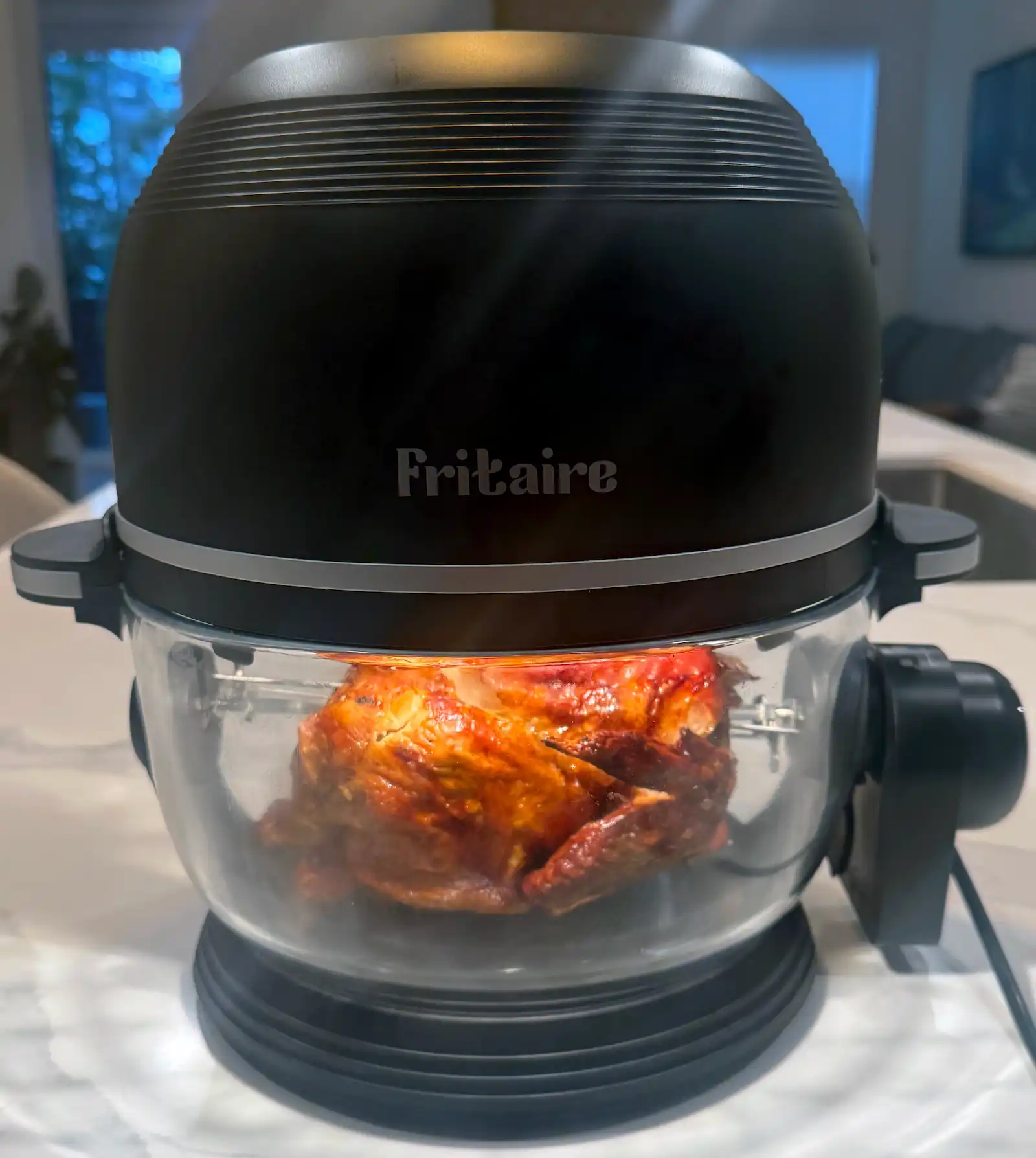
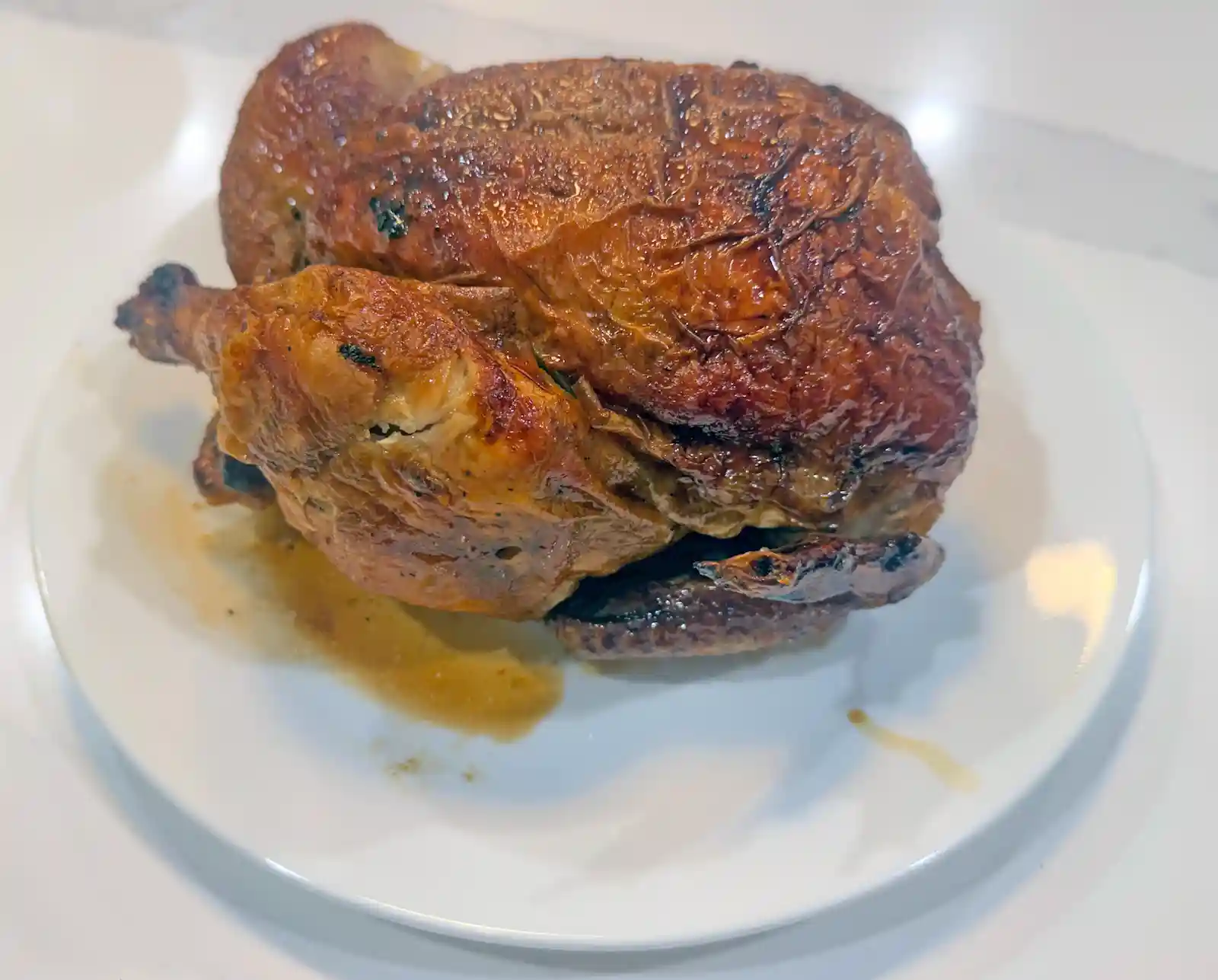
| Whole rotisserie chicken | Approximately 1.5 lb | 350°F | 45 minutes | 165°F breast temperature with substantial visible browning |
These are the settings and outcomes recorded for the reviewed unit. Food size, starting temperature, load, and appliance variation can change the time required. The recorded 135°F beef reading is below USDA’s recommended minimum for beef steaks and roasts: reach at least 145°F before removing the meat from the heat, then rest it for at least three minutes before cutting or eating. For whole chicken, USDA recommends checking the thickest part of the breast and the innermost parts of the thigh and wing, keeping the probe clear of bone. Each location should reach at least 165°F.
Fritaire Test Results and Measurements
The measurement refresh added a clearer picture of countertop fit, handling weight, noise, heat, and electrical behavior. These numbers are most useful when read with the test conditions rather than treated as isolated specifications.
Physical, Electrical, Noise, and Heat Results
Conditions: Peak power, sound, shutdown behavior, and surface temperatures were recorded during a cool-start, empty 400°F cycle set for 20 minutes. Sound was measured three feet from the unit without background subtraction. Surface readings were taken around minute 15 with an infrared thermometer. IR readings on transparent or reflective glass can vary with angle and emissivity, so the glass number should be treated as a practical surface reading rather than laboratory-grade material temperature.
Component Weights and Usable Dimensions
| Component / Measurement | THH Result | Why It Matters |
|---|---|---|
| Glass bowl and base | 91.45 oz (5 lb 11.45 oz) | The bowl/base is substantial enough that lifting and sink handling feel closer to cookware than to a lightweight air-fryer drawer. |
| Lid and heating assembly | 74 oz (4 lb 10 oz) | The hot removable lid is heavy enough that its landing place should be planned before cooking ends. |
| Tumbling basket | 8.8 oz; approximately 4.75 in diameter × 7 in long | The basket adds usable volume but needs open space inside for food to tumble rather than rotate as one packed mass. |
| Rotisserie motor | 8.85 oz | It is a separate battery-powered part that must be attached for rotating modes and kept away from water. |
| Air stand | 4.4 oz; 8.5 in diameter | The diameter, rather than the five-quart bowl label, sets the practical single-layer area for stationary foods. |
| Rotisserie spit and forks | 3.2 oz total | The hardware is light, but the complete hot load becomes awkward once a whole chicken is attached. |
| Grabber | 2.6 oz | It is part of the normal hot-accessory removal process rather than an optional extra. |
| Base surface | 82.2°F | Measured during the same 400°F empty cycle; actual results can change with food, room conditions, and placement. |
| Cord near unit | 76.7°F | Provides a direct check on the cord area during the defined cycle. |
| Plug | 80.3°F | Provides a direct check on the plug during the defined cycle; outlet condition can also affect plug temperature. |
The complete cooking-assembly weight is the combined measured weight of the glass bowl/base and lid/heater. The ambiguous cost/energy display from the watt meter was not used as a verified kWh result; only the clearly observed 1,228-watt peak is reported.
The Hearthful Assessment
The Fritaire earns an overall THH score of 8.0/10. The score is the equal-weight average of all six hands-on factors in the Hearthful Standard. Design & Function is the strongest factor because the glass bowl, tumbler, and rotisserie create meaningfully different workflows. Use & Interaction is the lowest because the hot removable lid, fogging, trapped wash water, and multi-part cleanup add repeated friction.
Fritaire Glass Air Fryer
Equal-weight average of the six hands-on factors
The six category scores total 48. Dividing by six gives 8.0 out of 10.
Scores apply to the reviewed Fritaire-01-BL unit and the official information available on August 23, 2026. A score is not a universal recommendation; buyer fit depends on which strengths and compromises matter in the intended kitchen.
Materials and Food-Contact Construction
The main material advantage is easy to see: food cooks inside a transparent glass vessel rather than a coated metal drawer. The air stand, tumbler, rotisserie spit, forks, and grabber are removable metal parts that can be inspected from multiple angles.
Fritaire identifies the cooking accessories as 304 stainless steel. Its food-contact material disclosure states that the food-contact surfaces use no applied PTFE/Teflon, PFAS, or BPA coating. Those are manufacturer disclosures; The Hearthful Home did not independently verify the alloy or perform chemical migration testing.
The company also discloses a small internal PPS component, described as food-grade and rated to 500°F, while the appliance’s published maximum setting is 400°F. That disclosure is useful because it prevents the complete appliance from being inaccurately described as literally plastic-free.
The exact glass description is less settled. Current product specifications call the bowl tempered glass, while other official Fritaire pages and articles use borosilicate language. Because those terms are not interchangeable, I describe the reviewed vessel as a glass bowl unless Fritaire provides model-specific written confirmation.
Fritaire Food-Contact Material Map
| Component | Material Finding | Evidence Status | THH Interpretation |
|---|---|---|---|
| Cooking bowl | Glass; no visibly applied food-contact coating | THH Observed | The transparent vessel is easy to inspect. The exact glass type was not independently verified. |
| Air stand, tumbler, rotisserie, and grabber | Manufacturer-identified 304 stainless steel | Manufacturer Documented | The grade is more specific than a generic stainless claim, but it was not independently alloy-tested. |
| Applied food-contact coating | Fritaire states no PTFE/Teflon, PFAS, or BPA coating on food-contact surfaces | Not Independently Verified | Useful for coating-conscious buyers, but it remains a manufacturer claim rather than a THH laboratory result. |
| Small internal component | Food-grade PPS, stated rating to 500°F | Manufacturer Documented | The cooking system should not be marketed or described as entirely glass and stainless steel. |
For broader context, see our guides to air fryer basket materials and what PFAS-free means on an air fryer.
Design and Function
The Fritaire’s best design decision is that its accessories change the cooking process rather than merely changing the shape of the rack. The air stand leaves food stationary, the tumbler performs continuous redistribution, and the rotisserie turns a centered load. In testing, those differences were easy to see and affected the amount of manual intervention required.
The transparent bowl is also functionally useful when it stays clear. It showed whether fries were moving freely and whether the chicken remained centered during a complete rotation. It also helped track surface browning without opening the appliance simply to look inside.
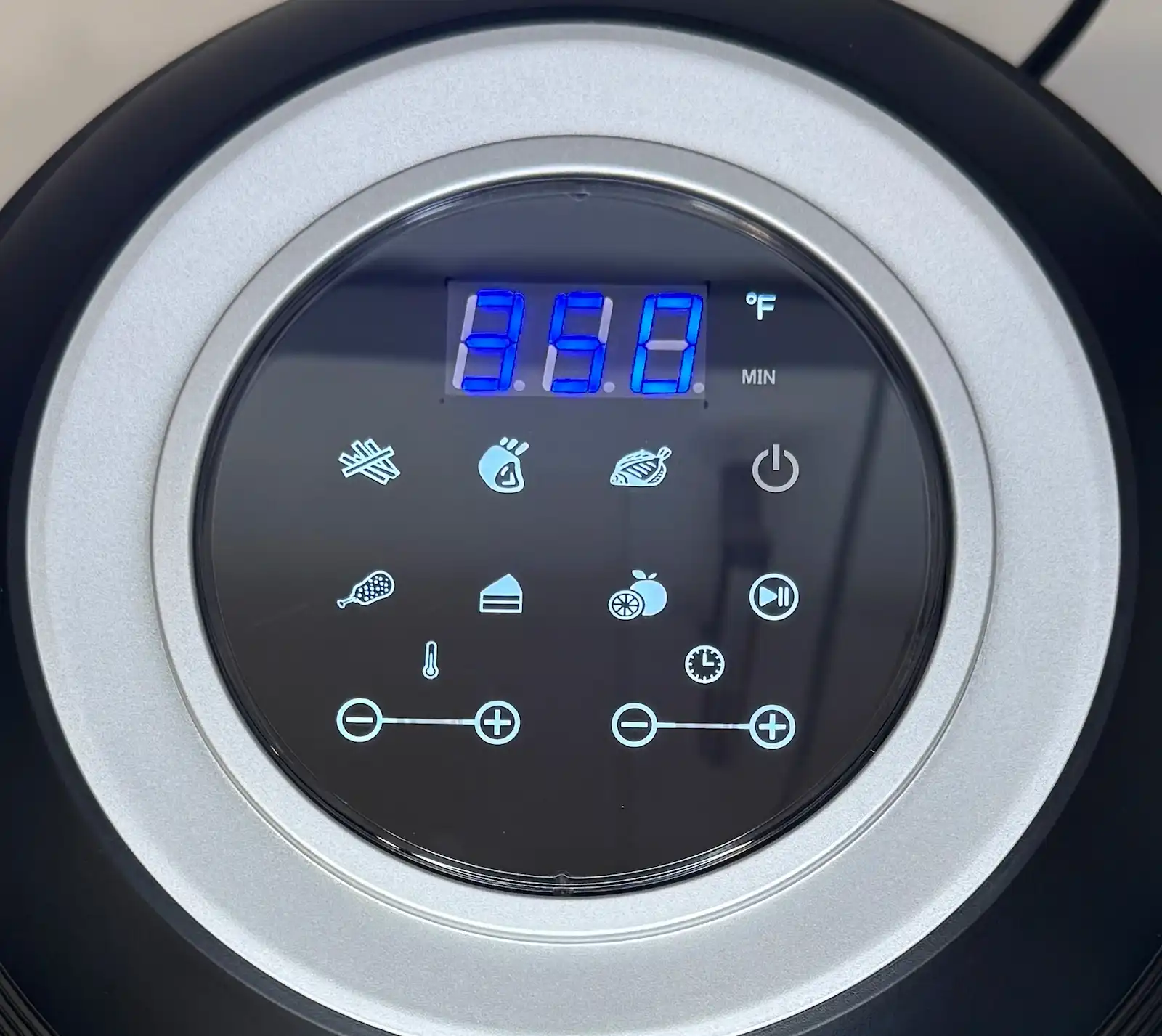
The controls were clear and easy to use, and loading food onto the air stand was straightforward. The physical layout is less conventional than a drawer: the heating element is part of the removable top, and the motor, grabber, tumbler, spit, and forks all need their own storage plan.
My measured exterior footprint was approximately 13.5 inches wide at the handles, 10.5 inches deep, and 12 inches high. Only about two additional inches were needed to physically lift the lid, but roughly six inches of open working space above the unit felt much more comfortable. Fritaire’s operating guidance separately calls for clearance around the appliance, so cabinet fit should be checked against the current manual rather than the body dimensions alone.
Capacity and Fit
Fritaire lists the bowl at five quarts, or 4.8 liters. That nominal volume is useful for comparing vessels, but the accessory geometry determines how much food can cook effectively.
The bowl opening measured approximately 9.5 by 9.75 inches, with about 5.5 inches of usable depth. The air stand measured 8.5 inches across, which is the more meaningful limit for foods that need one uncrowded stationary layer. It handled two 6-ounce tenderloin portions or six cookies, but it does not provide the uninterrupted flat area of a wide rectangular drawer.
Before you buy, mark an 8.5-inch circle on a piece of paper and set it on your counter. Picture your usual portion of tenders or cookies inside it with space between the pieces. If they would overlap, plan on cooking two batches on the stand. The bowl’s extra depth helps when an accessory rotates, but it gives stationary food no additional rack space.
The tumbler measured approximately 4.75 inches in diameter by 7 inches long. It held the tested eight-ounce fry batch with enough room to move. Fritaire’s official pages currently give two different maximum-load figures, 0.5 kilogram on the FAQ and two pounds on the how-to page, so I would prioritize free tumbling space and the printed instructions supplied with the exact unit rather than filling to the larger number.
The rotisserie is the tightest fit. Fritaire publishes a 1.5-pound maximum, and the reviewed chicken was approximately that size. Weight alone is not enough: the bird still needs to be centered, secured, and checked through a full rotation without touching the bowl or heater area.
Performance Results Across All Three Setups
The four food tests covered different uses for each configuration: beef browning and small-batch baking on the air stand, continuous redistribution of tallow-coated fries in the tumbler, and rotation and browning of a compact whole chicken on the spit.
Air Stand Test: Beef Tenderloin
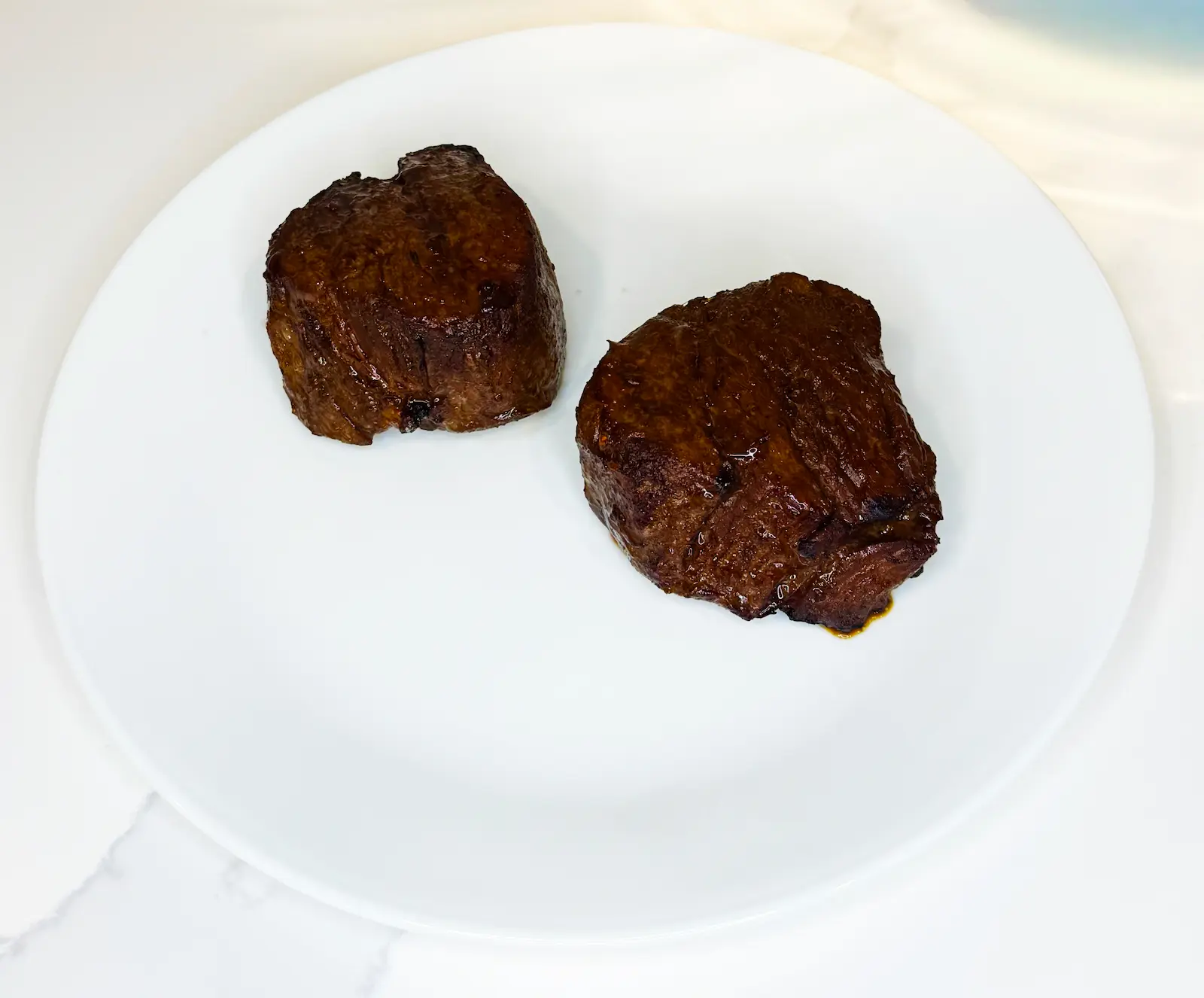
I cooked two 6-ounce beef tenderloin portions at 340°F for 20 minutes. The centers reached 135°F, and the exterior developed visible browning. The glass made color progression easy to watch, and I used a probe thermometer to measure the center temperature.
The recorded 135°F result is below USDA’s recommended minimum for beef steaks and roasts. Cook to at least 145°F before removing the meat from the heat, then rest it for at least three minutes before cutting or eating.
The test suited the round stand because the two portions could be spaced apart. The same surface would be less efficient for several wide steaks or a larger meal that depends on one broad uninterrupted layer.
Air Stand Test: Chocolate-Chip Cookies
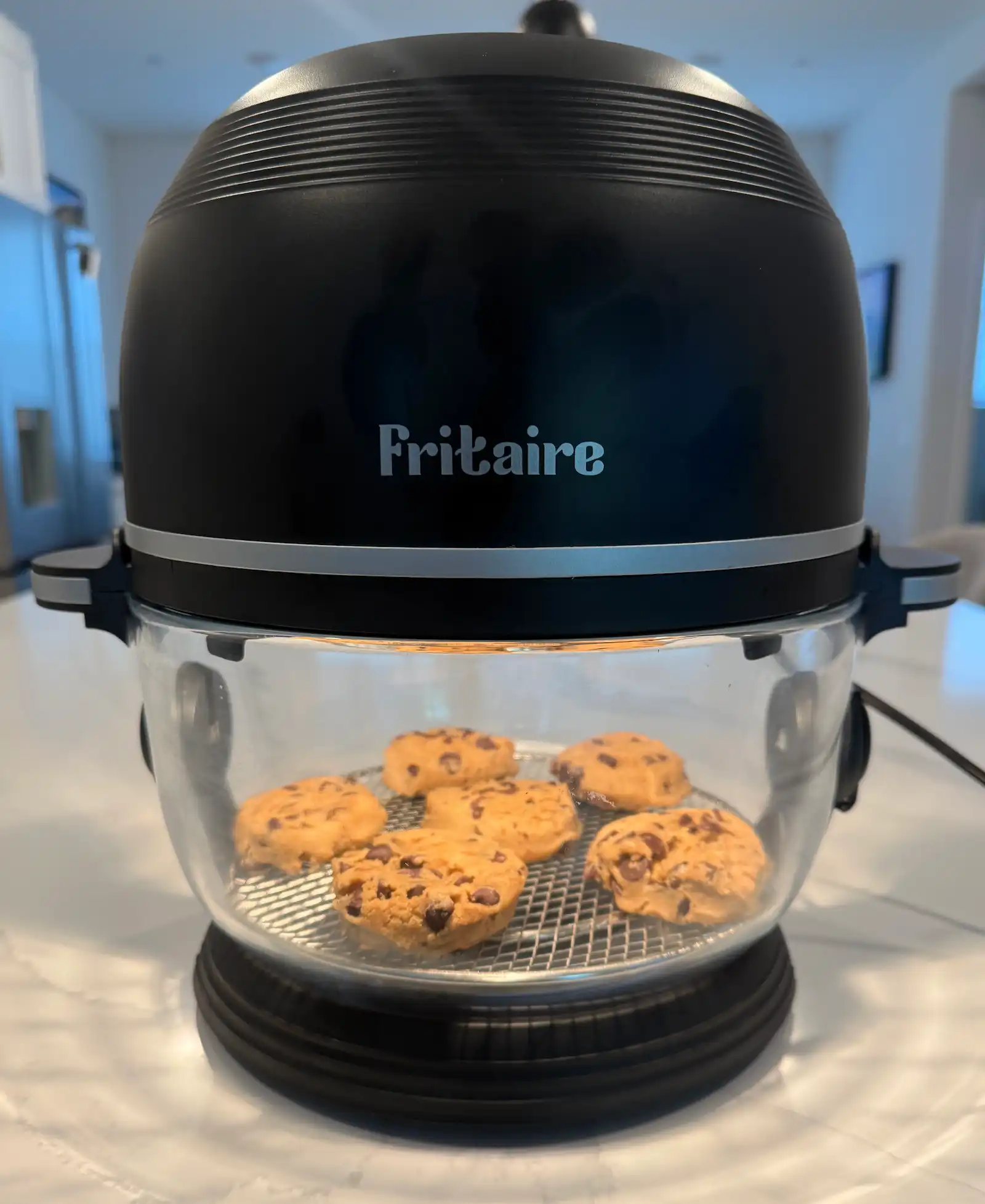
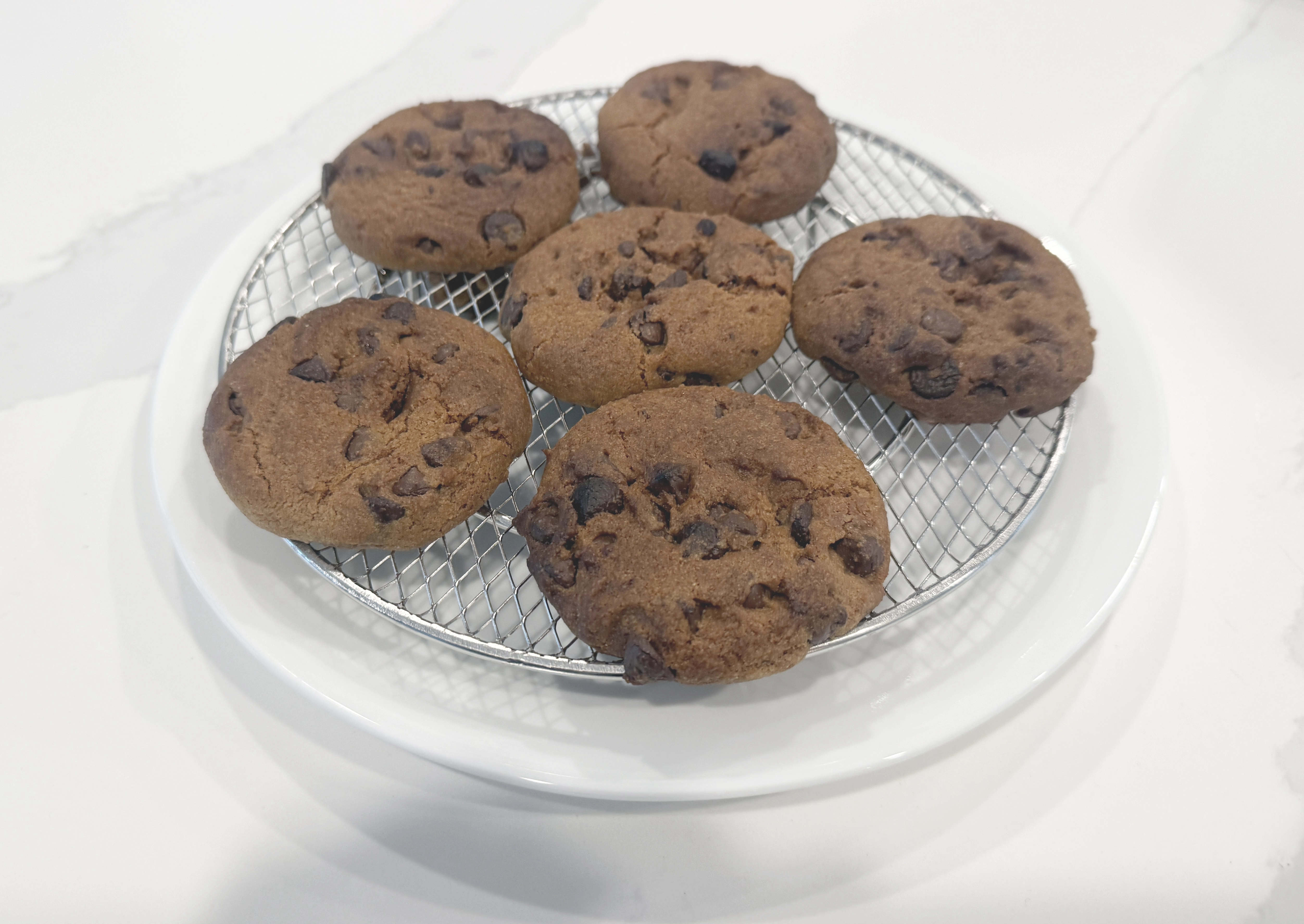
I baked six chocolate-chip cookies at 400°F for 20 minutes. They finished with a distinctly crisp texture, showing that the air stand can support a small baking batch as well as savory cooking.
The cleanup was less successful than the bake. Cookie residue adhered to the open metal stand and took more direct cleaning than expected. A compatible heat-rated liner may reduce sticking, but it should be used only when the appliance instructions permit it and it cannot block airflow or contact the heating element.
Tumbling Basket Test: Tallow French Fries
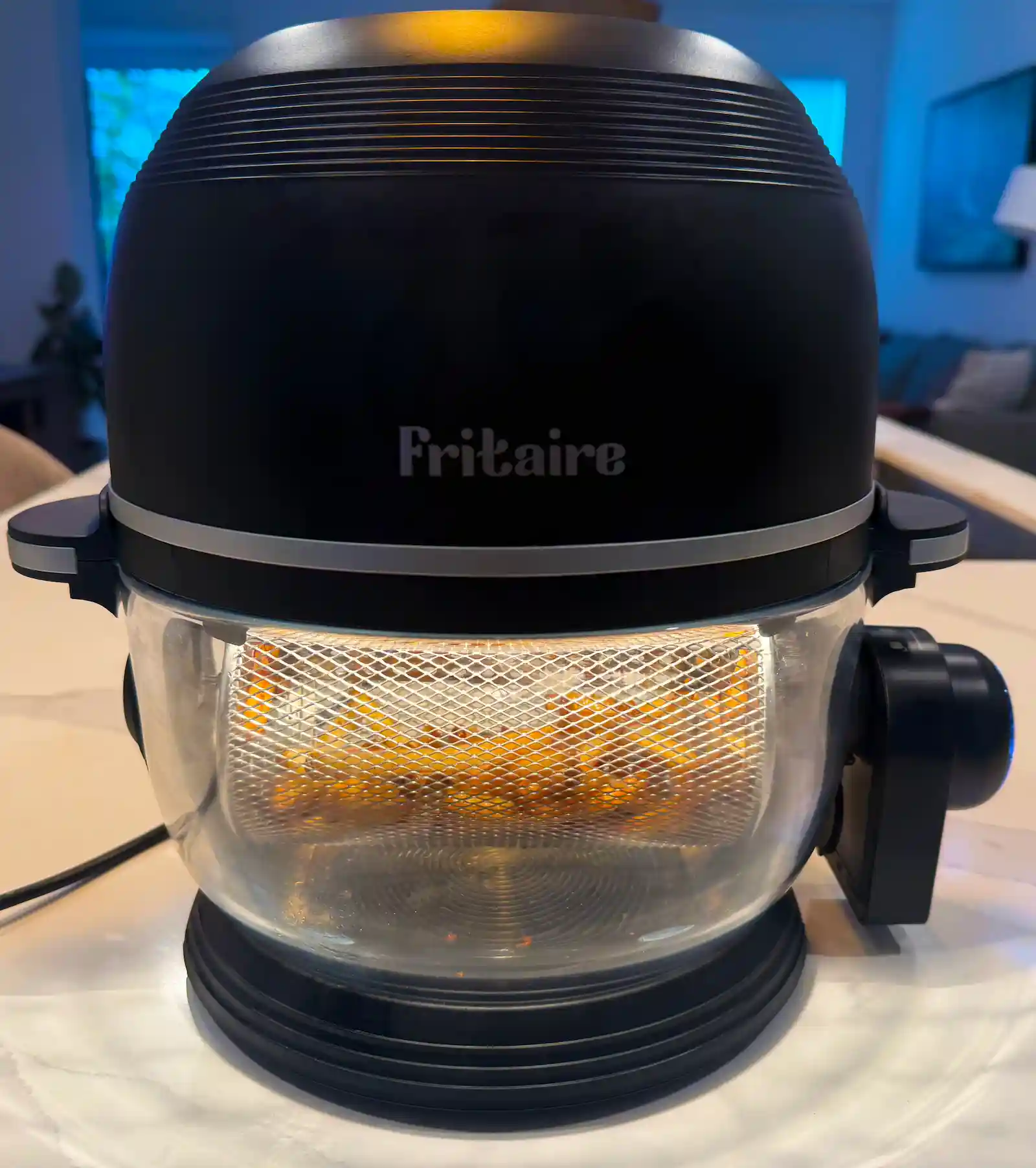
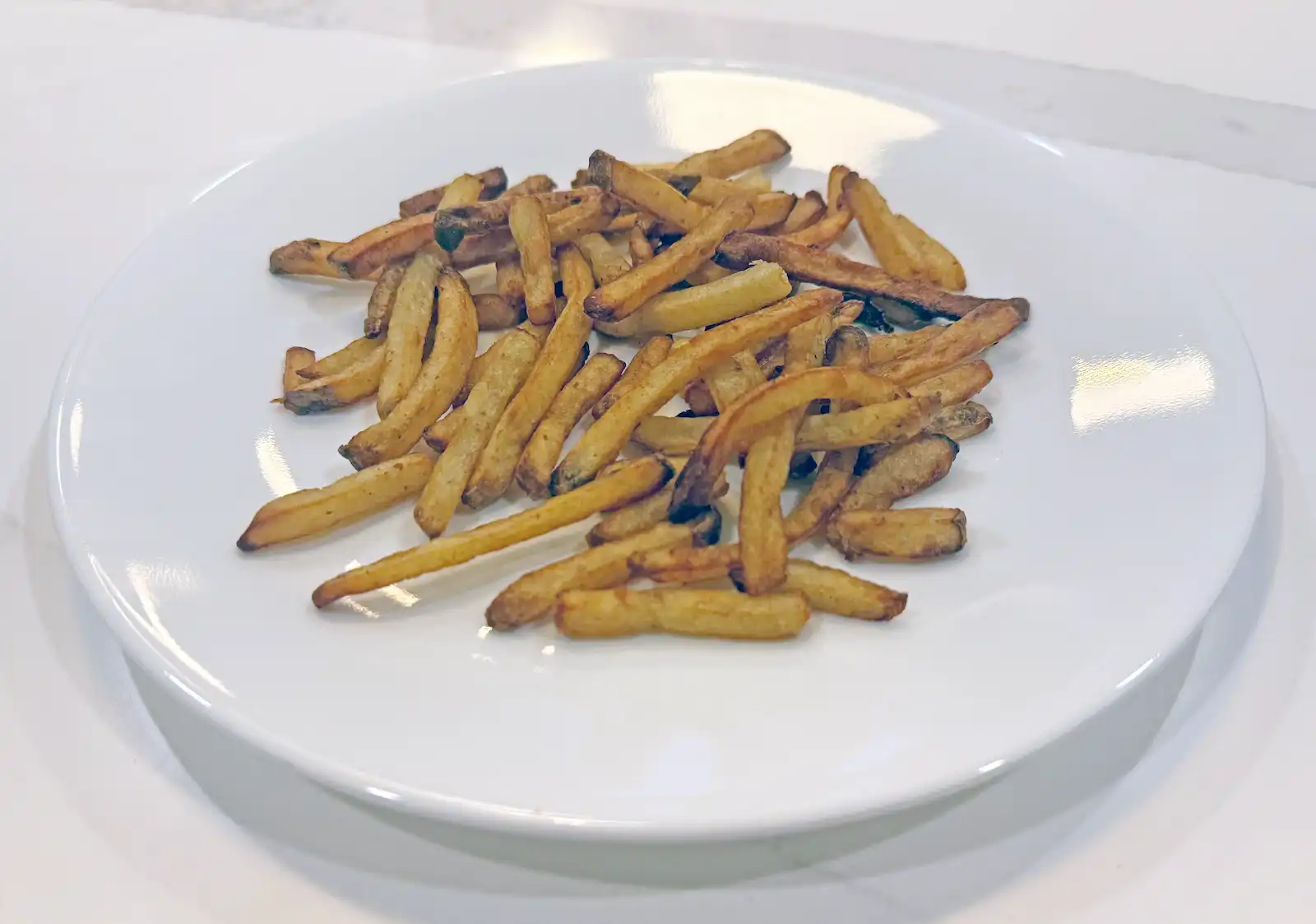
The tumbler produced the most convincing result of the review. I cooked eight ounces of fries coated in one tablespoon of tallow at 400°F for 12 minutes. The motor kept the basket turning, the fries repeatedly changed position, and the batch finished evenly crisp without a manual shake.
This was also where the glass added the most useful feedback: I could confirm that the fries were actually falling through open space rather than remaining packed together in one section. The tradeoff was cleanup. Tallow and residue collected around the perforations and seams, making the cage more work to wash than the air stand.
Rotisserie Test: Whole Chicken
I cooked a whole chicken of approximately 1.5 pounds at 350°F for 45 minutes. The breast reached 165°F, and the visible skin developed substantial browning while the motor maintained continuous rotation.
For a whole chicken, USDA recommends checking the thickest part of the breast and the innermost parts of the thigh and wing, with the probe clear of bone. Each location should reach at least 165°F; skin color and elapsed cooking time do not replace those checks.
The result confirmed that the rotisserie is functional, but it is the most setup-sensitive configuration. The chicken needed to be centered and secured between the forks, checked through a complete turn for clearance, and removed as a hot, awkward assembly with the grabber. The published 1.5-pound maximum also excludes many standard grocery-store whole chickens.
What the Four Tests Establish
The tests showed distinct uses for the three setups. The air stand browned beef and baked cookies, the tumbler delivered the clearest labor-saving benefit by moving the fries continuously, and the rotisserie kept a compact chicken turning within its published size limit.
Those observations support an 8/10 Performance & Results score. I did not run the same foods simultaneously in a leading drawer air fryer or full-size convection oven, so the score reflects this unit’s documented cooking results and accessory performance without establishing a speed or quality advantage over those alternatives.
Use and Interaction
The Fritaire is easy to start using. The touch controls and dial were clear, normal loading was straightforward, and the air stand required little setup. The rotating modes take longer because the tumbler or spit must be seated correctly and the external motor attached.
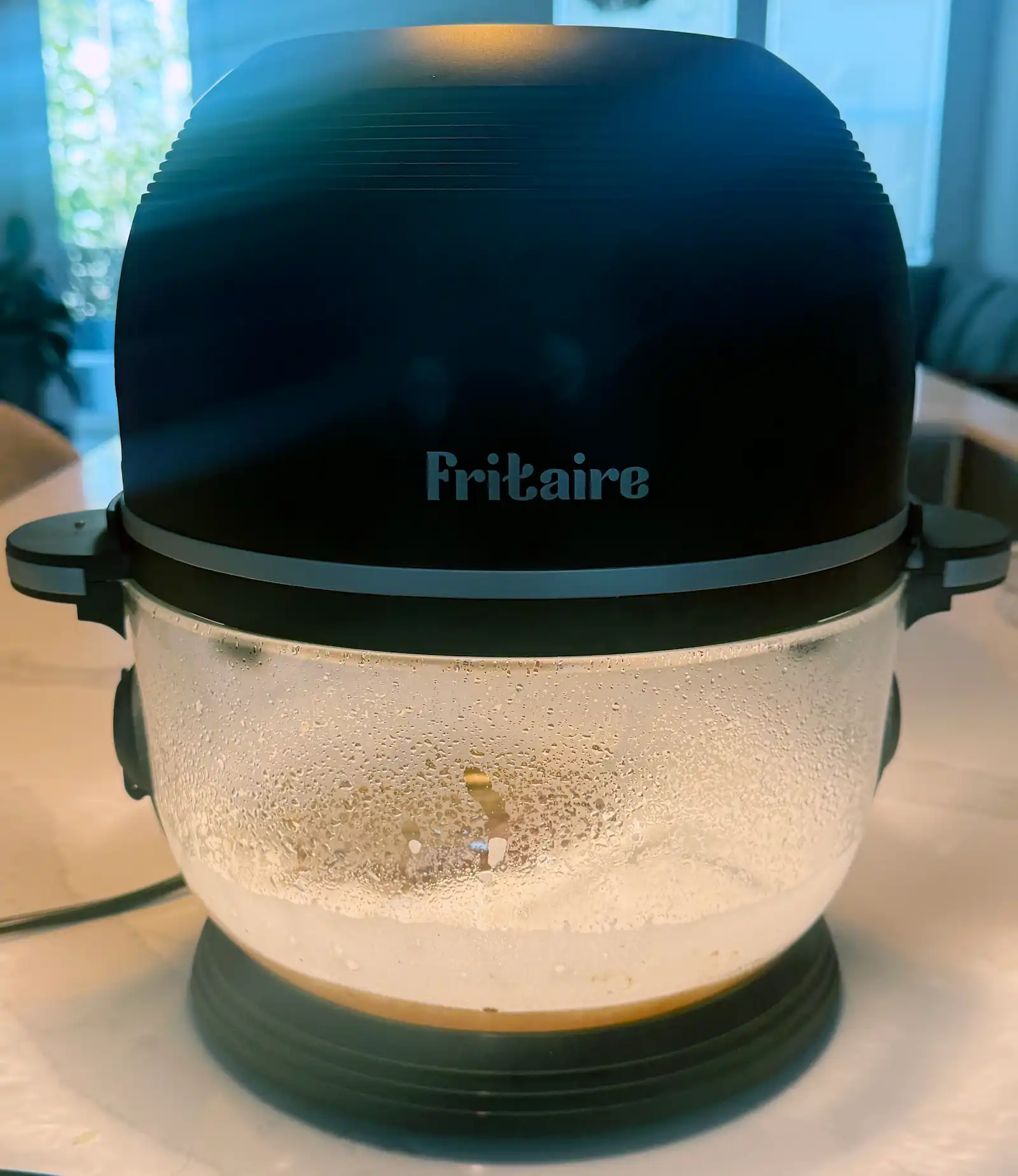
Glass visibility is valuable, but it is not constant. Dry foods and open loads remained easy to monitor. When a food released enough moisture, the bowl could become completely fogged and the view inside disappeared. Visibility should therefore be treated as conditional rather than guaranteed.
The measured sound-meter readout stayed around 49.2 dBA at three feet before rising slightly to 50.1 dBA when the fan changed near minute 13. The tone remained steady rather than rattling or pulsing. After the timer ended, the display and fan continued for roughly 30 seconds before the unit beeped several times.
The biggest repeated drawback was the removable top. The lid/heater weighed 4 pounds 10 ounces and became hot enough that I needed to decide where it would land before lifting it. That interaction is fundamentally less convenient than pulling out a drawer by one handle, especially when the counter is already busy.
I also noticed a persistent cooked-food smell around the upper heating area after use. It did not stop the appliance from functioning, but it remained noticeable and should be included in the ownership picture rather than dismissed as a one-time first-use odor. Our guide to air fryer fumes and odors explains why smell should be evaluated separately from the appliance’s headline material.
What Felt Easy and What Repeatedly Added Friction
Worked Well
- Controls were clear and easy to operate.
- Loading the air stand and bowl was straightforward.
- The tumbler removed the normal manual-shake step.
- Operating sound stayed consistent without a rattle.
- The side handles remained much cooler than the glass.
Added Friction
- The hot lid/heater needs a prepared heat-safe landing area.
- Moisture can completely fog the glass and remove the visibility advantage.
- The tumbler, motor, spit, forks, and grabber need storage.
- The rotating assemblies require more setup and hot-part handling.
- A persistent food odor remained around the upper heater area.
Cleaning and Self-Clean
The self-clean program is best understood as a heated pre-cleaning step. Fritaire’s current instructions call for one to two inches of water, a small amount of mild dish soap, a 400°F setting, and a 10-minute cycle followed by cooling, draining, rinsing, and wiping.
That description matched my experience better than the more absolute no scrubbing language used elsewhere in Fritaire’s marketing. The cycle helped with the glass bowl, but manual washing and drying were still required. The accessories also needed separate cleaning with hot water, soap, and a brush.
The tumbler was the hardest accessory to clean because its perforations, seams, and cage surface held more residue. Cookie residue also adhered to the air stand. The rotisserie spit and forks were easier because they are small and open, although they still need to cool and be washed separately.
The most frustrating cleanup detail was trapped water. The area where the glass bowl sits on the support/base has a gap that can take in rinse water. Once water entered, I could not reach it with a cloth; the assembly had to continue air-drying. That is a small design detail with repeated ownership consequences.
Fritaire describes the stainless accessories as dishwasher-safe, excluding the motor. I did not use the dishwasher during this review, so my cleanup findings are based on hand washing. The lid/heater, motor, cord, and plug should never be immersed. For liners and accessory compatibility, see our guide to air fryer liners, trays, racks, and silicone.
Durability and Longevity
After roughly two months, the reviewed unit remained fully functional. I did not need a repair, replacement part, or battery change, and the stainless accessories still felt durable. The main body and lid also felt solid overall.
I did notice slight flex in the support area where the bowl rests. That movement did not prevent use, but it is worth tracking because the same area also contains the gap that can trap wash water. The lingering food odor near the heater also remained present rather than disappearing over the review period.
The glass bowl and uncoated metal accessories avoid the familiar question of a nonstick coating gradually scratching or peeling. They are also easy to inspect. The opposing risk is more abrupt: glass can be damaged by a hard impact, and the 5-pound-11-ounce bowl/base assembly needs deliberate sink and countertop handling.
Fritaire’s current written warranty is 60 days. That is shorter than I would prefer for an appliance at this price and provides only a brief period of warranty coverage. The two-month review period is also not long enough to claim multi-year reliability.
Transparency and Trust
Fritaire deserves credit for publishing more food-contact detail than many countertop-appliance brands. The company identifies 304 stainless steel accessories, states that the food-contact surfaces have no applied PTFE/Teflon, PFAS, or BPA coating, and discloses the internal PPS component instead of presenting the cooking system as entirely glass and steel.
The weakness is consistency. Current official pages use both tempered-glass and borosilicate-glass language. The FAQ recommends a 0.5-kilogram tumbler maximum, while the how-to page lists two pounds. Those differences are material to a buyer because they affect how the product should be described and loaded.
The warranty and returns presentation is also difficult to reconcile. The written warranty provides 60 days, site navigation advertises a 90-day risk-free trial, and the formal refund policy says a return must be requested within 30 days while the item remains unused, in original condition, and in original packaging. Buyers should read the written terms rather than relying on a promotional summary.
The self-clean documentation also conflicts on settings. The current product page presents a 212°F cycle lasting five to 10 minutes, while the how-to page instructs 400°F for 10 minutes. The product page also uses no scrubbing language even though the operating instructions require cooling, draining, rinsing, and wiping. My test required manual cleanup as well. That does not make the function useless; it means the printed manual for the exact unit should control and the marketing should describe the feature as residue loosening rather than complete cleaning.
Useful Material and Operating Detail
Details a Buyer Should Not Have to Reconcile
- Tempered versus borosilicate glass terminology
- 0.5-kilogram versus two-pound tumbler maximum
- 60-day written warranty versus 90-day trial language
- 30-day unused-return conditions versus risk-free wording
- 212°F / 5–10 minute self-clean listing versus 400°F / 10 minute instructions
- No scrubbing marketing versus the manual rinse-and-wipe workflow
Pros, Considerations, and Buyer Fit
The Fritaire should be chosen for the complete system, not for the glass bowl in isolation. It is most useful for someone who will use the automatic tumbler or compact rotisserie and who does not already have another appliance that performs the same jobs well.
Who the Fritaire Fits and Who Should Choose Something Simpler
Best Fit
- A small kitchen or household without a capable convection oven
- Buyers who want to watch dry foods, movement, and rotisserie clearance
- Someone who will use the tumbler for fries, vegetables, or other small foods
- Coating-conscious shoppers who value a glass bowl and manufacturer-identified stainless accessories
- Smaller-batch cooking where an 8.5-inch round stand is enough
Consider Another Option
- You already have a strong full-size convection oven and would duplicate most of the same jobs
- You want one-handed drawer removal and the fewest possible components
- You need a wide, uninterrupted single-layer cooking surface
- You dislike planning a landing area for a hot removable lid
- You expect self-cleaning to eliminate manual washing and drying
- You want to rotisserie a standard chicken larger than 1.5 pounds
For my own kitchen, I do not think it earns a permanent place at full retail price because I already have a capable full-size oven and the Fritaire would duplicate too many jobs. That is a fit judgment, not a conclusion that the product performs poorly. For a kitchen with limited oven capacity, or for someone who will genuinely use the tumbler and rotisserie, I can still recommend it.
Need a different basket shape, capacity, or an easier cleanup routine?
Compare Non-Toxic Air FryersSpecifications and THH Measurements
The table below keeps manufacturer-published specifications separate from measurements recorded on the reviewed unit. Published details and policy terms can change, so dynamic information should be confirmed before purchase.
Published Details, THH Results, and Buying Context
| Specification | Published or Measured Detail | Evidence | THH Context |
|---|---|---|---|
| Reviewed model | Fritaire-01-BL; black finish | THH Observed | Model copied from the reviewed unit. |
| Appliance type | Glass-bowl convection air fryer with air stand, tumbler, and rotisserie | Manufacturer Documented | The three removable setups create different cooking workflows. |
| Published capacity | 5 qt / 4.8 L | Manufacturer Documented | Usable capacity changes with accessory geometry and the room required for airflow or tumbling. |
| Measured exterior size | 13.5 W × 10.5 D × 12 H in at the measured points | THH Measured | Allow additional space for ventilation and safe lid removal; the current how-to page calls for 20 cm around the appliance. |
| Measured bowl opening | Approximately 9.5 × 9.75 in; 5.5 in usable depth | THH Measured | More useful for fit than the nominal quart figure alone. |
| Air-stand diameter | 8.5 in | THH Measured | Sets the practical flat area for stationary food. |
| Tumbler dimensions | Approximately 4.75 in diameter × 7 in long | THH Measured | Food still needs open space to fall and redistribute. |
| Complete assembly weight | 10 lb 5.5 oz for bowl/base + lid/heater | THH Measured | The separate heavy bowl and lid make handling different from a lightweight drawer. |
| Published power | 1,300 W | Manufacturer Documented | Rated value; actual draw can cycle and vary. |
| Measured peak power | 1,228 W during a 400°F empty cycle | THH Measured | One reviewed unit under one defined cycle; not a substitute for electrical certification testing. |
| Temperature range | 90°F–400°F | Manufacturer Documented | Use the printed manual for mode-specific behavior. |
| Timer range | 0–60 minutes | Manufacturer Documented | Long dehydrate programs may use mode-specific behavior. |
| Programs | 9: Meat, Fish, Chicken, Fries, Bake, Dehydrate, Rotisserie, Tumbling, Self-Clean | Manufacturer Documented | The physical accessory affects the workflow more than the number of presets. |
| Bowl material | Glass; current official pages use both tempered and borosilicate terminology | Manufacturer Documented | Exact model-specific glass type remains unresolved. |
| Accessory material | Manufacturer-identified 304 stainless steel | Not Independently Verified | Alloy grade was not independently tested by THH. |
| Food-contact coating claim | No applied PTFE/Teflon, PFAS, or BPA coating on stated food-contact surfaces | Not Independently Verified | Manufacturer disclosure, not independent chemical testing. |
| Internal polymer | Small food-grade PPS component; stated rating to 500°F | Manufacturer Documented | The complete appliance is not literally plastic-free. |
| Self-clean settings | 212°F for 5–10 min on the product page ; 400°F for 10 min on the how-to page | Manufacturer Conflict | Use the printed manual supplied with the exact unit rather than combining settings from different pages. |
| Rotisserie maximum | 1.5 lb | Manufacturer Documented | Shape, balance, fork placement, and full-turn clearance also control fit. |
| Tumbler maximum | 0.5 kg on the FAQ ; 2 lb on the how-to page | Manufacturer Conflict | Use the printed instructions and preserve enough room for free movement. |
| Rotisserie motor | 4 AAA batteries | Manufacturer Documented | External and removable; never immerse it. |
| Accessory cleaning | Manufacturer describes stainless accessories as dishwasher-safe, excluding motor | Manufacturer Documented | THH hand-washed the accessories and did not independently test dishwasher exposure. |
| Written warranty | 60 days | Manufacturer Documented | Current site navigation also promotes a 90-day risk-free trial; read the written terms. |
| Formal return policy | Request within 30 days; unused, original condition, original packaging | Manufacturer Documented | The written eligibility conditions are narrower than broad risk-free language. |
Manufacturer specifications and policies were checked on August 23, 2026. Reconfirm price, warranty, returns, load limits, and care instructions immediately before purchasing.
Frequently Asked Questions
Is the Fritaire air fryer PFAS-free?
Fritaire states that its food-contact surfaces have no applied PFAS, PTFE/Teflon, or BPA coating. The Hearthful Home did not perform independent chemical testing, so this remains a manufacturer disclosure. See our guide to what PFAS-free means on an air fryer for the limits of this type of claim.
Is the Fritaire completely plastic-free?
No. Fritaire discloses a small internal PPS component that it describes as food-grade and rated to 500°F. The more accurate description is a glass bowl with manufacturer-identified stainless cooking accessories, no manufacturer-stated applied nonstick coating on the principal food-contact surfaces, and one disclosed internal polymer component.
Is the Fritaire bowl tempered or borosilicate glass?
Fritaire’s official pages currently use both terms. Product specifications identify tempered glass, while other official pages and articles use borosilicate wording. Because those terms are not interchangeable, this review uses the directly supportable phrase glass bowl unless Fritaire confirms the exact construction for model Fritaire-01-BL.
Does the Fritaire tumbling basket work?
Yes. In my test, eight ounces of fries coated in one tablespoon of tallow cooked at 400°F for 12 minutes and finished evenly crisp. The basket continuously moved the fries without a manual shake. It works best when the load has enough open space to fall rather than staying packed together.
Does the Fritaire rotisserie work for a whole chicken?
Yes, within a narrow size limit. The approximately 1.5-pound test chicken cooked at 350°F for 45 minutes, reached 165°F in the breast, and developed substantial browning. Fritaire publishes a 1.5-pound maximum, and the bird must still remain balanced and clear the bowl through a full rotation. For a whole chicken, follow USDA’s thermometer guidance: check the thickest part of the breast and the innermost parts of the thigh and wing, keeping the probe clear of bone. Each location should reach at least 165°F.
How loud is the Fritaire?
During the defined empty 400°F cycle, the sound-meter readout was typically 49.2 dBA at three feet. It rose slightly to 50.1 dBA when the fan changed near minute 13. The sound remained steady without a rattle or pulsing tone.
How hot does the Fritaire get on the outside?
At about minute 15 of an empty 400°F cycle, the infrared thermometer read 176.5°F on the glass side, 132.4°F on the motor housing near the heater, 82.2°F on the base, 80.6°F near the touch controls, 77.3°F on the handles, 76.7°F on the cord near the unit, and 80.3°F on the plug. Infrared readings on glass can vary, but the test clearly reinforces that the glass and upper assembly should be treated as hot surfaces.
Does the Fritaire clean itself completely?
No. The self-clean cycle helped loosen bowl residue, but the bowl still needed to cool, drain, rinse, receive manual cleaning where necessary, and dry. The accessories were cleaned separately, and water could remain trapped in a gap beneath the bowl-support area.
Can Fritaire accessories go in the dishwasher?
Fritaire’s current care guidance describes the air stand, tumbler, rotisserie spit, and grabber as dishwasher-safe, excluding the motor. I hand-washed the accessories during this review and did not independently test dishwasher exposure. The top lid/heater, motor, cord, and plug should never be immersed.
Is the Fritaire worth it?
It is worth considering when it fills a real gap: limited oven capacity, a small kitchen, a preference for a glass cooking vessel, or frequent use of the tumbler and rotisserie. It is less compelling for someone who already has a capable convection oven, wants a wide flat basket, or prioritizes the simplest possible handling and cleanup.
The Bottom Line on the Fritaire Glass Air Fryer
The Fritaire is more than a transparent alternative to a coated drawer. The tumbler moved fries continuously, the rotisserie kept a compact chicken turning, and the air stand handled beef browning and small-batch baking. The glass bowl made movement and browning easier to monitor when moisture did not fog the view.
The same design also asks more of the owner. The hot lid/heater needs a safe landing place, the accessory system adds setup and storage, self-cleaning does not eliminate manual cleanup, water can become trapped beneath the bowl-support area, and a food odor remained around the heater after repeated use.
That balance is why the Fritaire earns 8.0/10. Its value is highest when it fills a real gap: limited oven capacity, a smaller kitchen, or a buyer who will genuinely use the tumbler and compact rotisserie. In that setting, it offers meaningful advantages and a distinctive cooking experience; beside a capable full-size convection oven, more of its function becomes duplication.
See the current Fritaire product page, or compare it with the other models in our guide to the best non-toxic air fryers.
Important: This article provides general information, not individualized medical, safety, installation, legal, or other professional advice. Product specifications, instructions, and safety information can change; verify current information with the manufacturer and consult an appropriately qualified professional when needed. See our Terms and Conditions for additional information.