
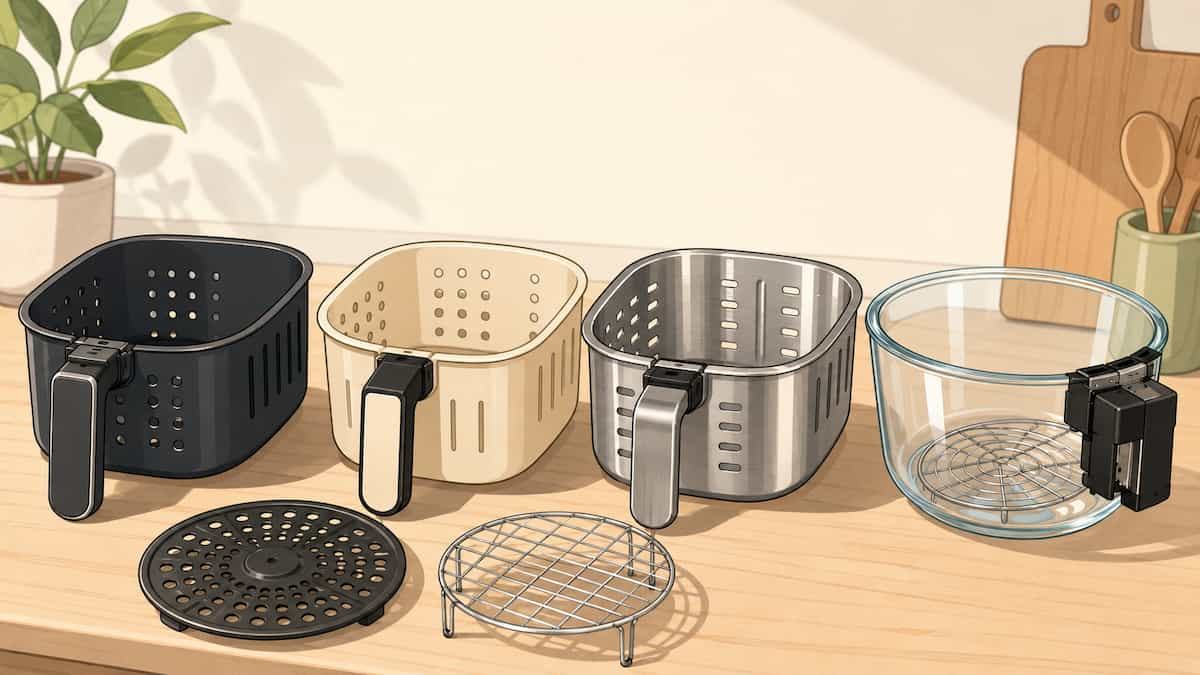
An air fryer basket can have a metal body with a separate coating on its cooking surface. A glass-bowl air fryer has a different arrangement, so check what actually touches the food in each model. The difficult part is that basket material can refer to several different layers: the metal underneath, an applied nonstick coating, a removable crisper plate, or the entire cooking vessel.
A basket described as ceramic is usually a metal basket with a ceramic-style coating rather than a piece made from solid ceramic. A stainless-steel air fryer may have a stainless exterior while using coated food-contact parts inside. A glass air fryer may use a bare glass bowl but still include a coated metal crisper plate or rack.
There is no single material that wins every category. Coated metal usually offers the easiest food release and lowest-effort cleanup. Bare stainless steel removes the coating from the equation but can require more soaking and scrubbing. Glass provides visibility and a clearly identifiable bowl surface, but it adds weight and does not tell you what the remaining accessories are made from.
This guide compares those tradeoffs without treating one material label as a complete safety rating. For full appliance recommendations, see our guide to the best non-toxic air fryers. To decode PFAS-free, PTFE-free, and PFOA-free wording specifically, read what PFAS-free means on an air fryer.
What Counts as the Air Fryer Basket Material?
Check every component that holds food, catches drippings, or is repeatedly heated with cooking residue.
- Outer drawer or cooking pan: This supports the inner basket or crisper plate and may collect grease beneath the food.
- Inner basket: This may be perforated metal, wire mesh, or a solid drawer with an applied nonstick coating.
- Crisper plate or grate: The removable insert directly beneath the food may use a different material or coating than the surrounding basket.
- Racks, trays, and mesh accessories: Oven-style air fryers commonly use several removable metal parts rather than one deep basket.
- Glass bowl or cooking container: Glass systems replace the traditional drawer with a bowl, but they usually still need a raised rack or crisper plate to create airflow beneath food.
These parts are not always made the same way. For example, Ninja discloses some models with an aluminum basket using a PTFE nonstick coating and a separate crisper plate using a PTFE-free ceramic coating. Its Crispi Pro system uses thermal-shock-resistant glass containers with aluminum crisper plates that have a nano-ceramic coating.
Those mixed constructions are not inherently unusual. They simply mean a shopper cannot determine the entire food-contact path from one phrase such as glass, ceramic, or stainless steel.
Air Fryer Basket Materials at a Glance
The main choices are conventional fluoropolymer nonstick, ceramic-coated metal, bare stainless steel, and glass. Many products combine these materials in the same cooking system.
Use the comparison below to identify the practical advantage of each construction, the care it requires, and what its material label still leaves unanswered.
Air Fryer Basket Material Tradeoffs
| Material | Typical Construction | Release and Cleaning | Heat, Care, and Wear | Best Fit |
|---|---|---|---|---|
| PTFE-based nonstick | Usually a lightweight aluminum or steel basket with an applied fluoropolymer nonstick coating. | Strong food release and low-effort grease cleanup. Often the easiest option for sticky or breaded foods. | Use within the appliance’s stated temperature limit. Avoid abrasive cleaners and tools that can scratch the coating. Verify replacement-part availability. | Easiest cleanup |
| Ceramic-coated metal | Usually an aluminum basket or crisper plate with an applied coating marketed as ceramic. It is not normally solid ceramic. | Provides a smooth release surface and relatively easy cleaning when the coating is in good condition. | PFAS-free status must be stated separately. Gentle washing and nonabrasive tools help preserve the applied surface. | Coated PFAS-free option |
| Bare stainless steel | An uncoated perforated basket, wire rack, mesh basket, or tray. It is more common in oven-style systems than deep drawer-style units. | Food can stick more readily, especially proteins and starches. Soaking or brushing may be needed around mesh and perforations. | There is no nonstick coating to scratch or lose release. The permitted temperature depends on the full appliance, not the steel alone. | Durability and clarity |
| Glass vessel | A glass bowl or container replaces the traditional drawer. A separate rack or crisper plate usually raises food for airflow. | The smooth bowl is easy to see and wipe, but it is not inherently nonstick. Cooked residue may still need soaking. | Glass is heavier and breakable. Only rely on dishwasher, freezer-to-heat, or thermal-shock claims made for the exact model. | Visibility and bowl contact |
| Mixed-material system | The main bowl, drawer, crisper plate, rack, and accessories use different materials or coatings. | Release and cleanup depend on the individual part holding the food rather than the appliance’s headline material. | Each component needs its own coating disclosure, care instructions, replacement path, and heat-use guidance. | Verify every part |
No row is a universal winner. Confirm the exact model, coating chemistry, food-contact parts, care limits, and replacement options before choosing.
The right material depends on your priorities for cleanup, coating care, weight, and visibility. A coated basket reduces sticking and cleanup work but makes coating condition part of long-term ownership. Bare stainless steel has no nonstick coating to wear, but can require more soaking and scrubbing. Glass makes the main vessel easy to identify and inspect, but the bowl is only one part of the complete cooking system.
The table should therefore be used as a tradeoff comparison rather than a safety ranking. The quality of the disclosure, construction, care instructions, and replacement support can matter as much as the material category itself.
How Air Fryer Basket Materials Are Built
An air fryer material description may refer to the visible cooking surface, the structural material beneath it, or the entire cooking vessel. A nonstick or ceramic basket is usually coated metal, bare stainless steel uses the metal itself as the food-contact surface, and a glass system replaces the traditional drawer with a separate vessel.
The diagram below shows how those constructions differ. It also illustrates why one appliance can combine several materials across its basket, crisper plate, rack, bowl, and other accessories.
Air Fryer Basket Material Layers
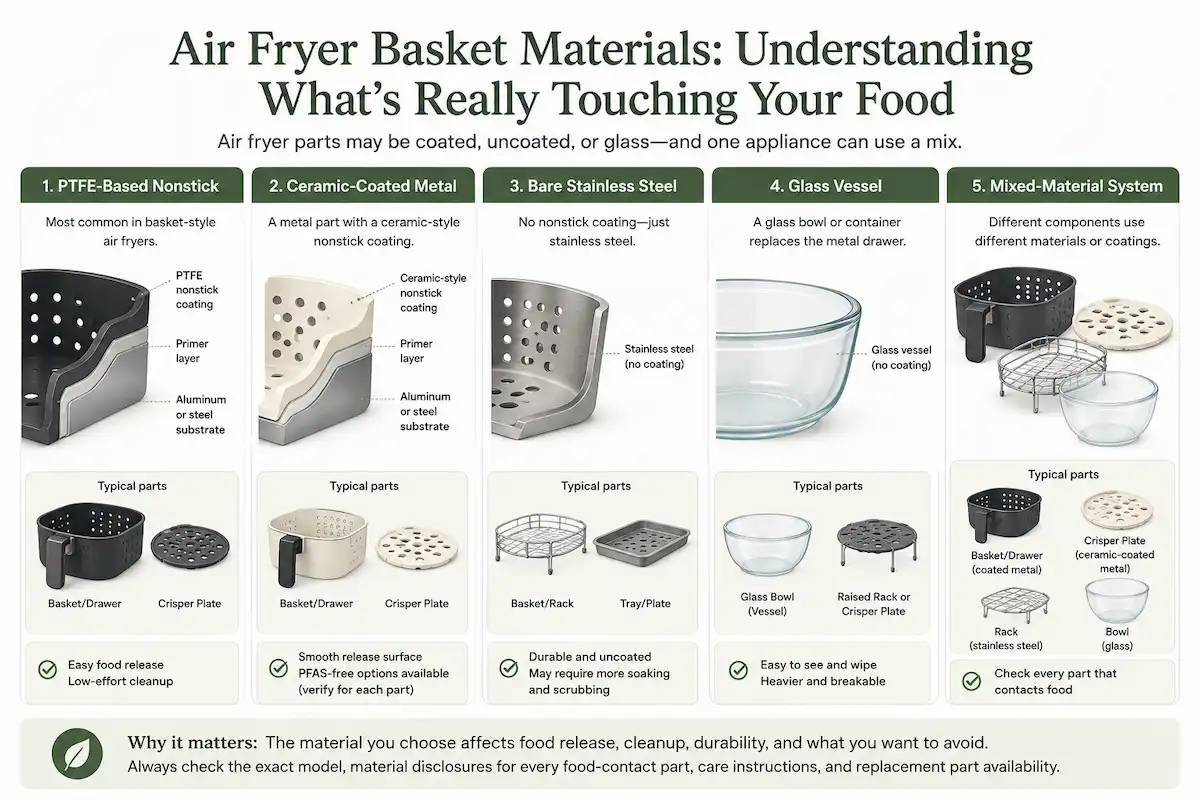
The most important distinction is between the food-contact surface and the material supporting it. PTFE-based and ceramic-style coatings sit over a metal substrate. Bare stainless steel needs no applied nonstick layer, while glass serves as the vessel but usually depends on a separate rack or crisper plate to hold food above the bottom.
Mixed-material construction is common rather than unusual. A glass bowl can be paired with a coated aluminum plate, or a coated basket can use a crisper insert with different chemistry. Check each component separately instead of applying the appliance’s headline material to the entire cooking system.
Conventional Nonstick Baskets: Easy Release With More Coating Dependence
What Conventional Nonstick Usually Means
Many basket-style air fryers use a lightweight metal basket with an applied fluoropolymer nonstick coating. Model-specific disclosures from major manufacturers commonly identify aluminum, steel, or aluminized steel beneath a PTFE-based surface.
The coating provides the nonstick surface over the metal. Food is less likely to bond tightly to the basket, grease wipes away more easily, and breaded or sticky foods can usually be removed with less scraping.
What the FDA Says About Polymerized Nonstick Coatings
The U.S. Food and Drug Administration explains that approved nonstick cookware coatings are polymerized and tightly bound to the cooking surface during manufacturing. The agency says studies show a negligible amount of PFAS capable of migrating to food from these authorized coatings under their intended use.
That does not make the coating label irrelevant. Buyers may still prefer to avoid PTFE or the broader PFAS class, and an intact coating still needs to be used within the appliance’s temperature and care instructions. The point is to compare material preferences accurately rather than treating every PFAS use or every nonstick product as chemically identical.
The Main Long-Term Tradeoff
The basket’s convenience depends on maintaining the applied surface. Abrasive pads, metal tools, repeated impacts from the crisper plate, and cleaning methods that conflict with the manual can mark or wear the coating.
Before buying, check whether both the basket and crisper plate use the same coating, whether replacements are sold separately, and whether the manufacturer identifies PTFE rather than relying on the narrower phrase PFOA-free. Our guide to air fryer coating claims explains those terms in detail.
Best fit: Buyers who prioritize easy food release, quick cleanup, a lightweight drawer, and the familiar basket-style air fryer format.
Ceramic-Coated Baskets: A Different Applied Nonstick Surface
Ceramic-Coated Does Not Mean Solid Ceramic
A ceramic-coated air fryer basket is normally a metal basket or crisper plate covered with an applied coating marketed as ceramic. The structural part may still be aluminum or steel. The word ceramic describes the cooking surface, not the entire removable component.
This construction preserves the low weight and familiar shape of a conventional drawer-style basket while offering an alternative type of nonstick surface.
PFAS-Free Status Still Needs to Be Confirmed
Some manufacturers explicitly describe their ceramic air fryer coatings as PTFE-free or PFAS-free. That is useful when tied to the exact model and component. The word ceramic by itself, however, is not a complete chemical disclosure.
Check whether the statement covers the basket, crisper plate, racks, trays, and replacement parts. One component can use ceramic nonstick while the surrounding drawer uses a different coating.
Cleaning and Long-Term Release
Ceramic-coated surfaces can provide easy release and relatively simple cleanup, but they remain applied coatings. Their long-term performance depends on the coating formulation, surface preparation, repeated heating, residue buildup, cleaning methods, and ordinary abrasion.
Even when a part is labeled dishwasher-safe, handwashing with mild soap and a soft sponge is the gentler routine. Avoid assuming that dishwasher-safe means the surface cannot gradually lose release or show cosmetic wear.
Best fit: Buyers who want a familiar coated basket and easy cleanup but prefer a model with an explicit PFAS-free and PTFE-free food-contact disclosure.
Stainless Steel Baskets and Racks: Durable but Less Nonstick
What Bare Stainless Steel Changes
A genuinely uncoated stainless-steel basket, rack, or tray removes the applied nonstick layer from that component. Scratches may change its appearance, but there is no nonstick coating on that surface to peel, lose release, or expose a different substrate beneath it.
Stainless steel is most common in oven-style air fryers, where food sits on a wire rack, mesh basket, or perforated tray. Bare stainless drawer baskets exist, but they are less common than coated aluminum designs.
The Cleanup Tradeoff
Stainless steel does not provide the same low-friction release as a dedicated nonstick coating. Proteins, starches, melted cheese, and cooked-on oil can adhere to the wires or perforations. A small amount of appropriate cooking oil, prompt cleaning, soaking, and a soft brush may be needed.
Basket geometry matters here. A wide-spaced rack can be easier to clean than fine wire mesh, while a deeply perforated tray may collect residue in dozens of small openings. The material name alone does not show how much scrubbing the design will require.
Do Not Confuse the Housing With the Basket
A stainless steel air fryer label frequently describes the exterior finish or oven interior rather than every food-contact accessory. Look for a parts list that separately identifies the air-fry basket, baking pan, rack, crumb tray, and interior walls.
Some oven-style models provide this level of clarity. For example, Cuisinart identifies both the baking pan and air-fry basket in its TOA-95NAS as stainless steel rather than relying only on the appliance’s exterior description.
Best fit: Buyers who prioritize structural durability and an uncoated food-contact surface over effortless release and the lightest possible basket.
Glass Bowls: Clear Food Contact With More Weight and Breakage Risk
What Glass Replaces
A glass air fryer usually replaces the deep metal drawer with a transparent bowl or storage-style cooking container. Food may sit directly in that vessel or on a raised rack or crisper plate that allows heated air to circulate beneath it.
The primary advantage is clarity. You can identify the bowl material immediately, inspect it for residue or damage, and watch food during cooking without opening the appliance.
Glass Does Not Make the Entire System Glass
The raised cooking insert remains important. A glass system may use a stainless-steel rack, a ceramic-coated aluminum crisper plate, a mesh basket, polymer handles, or several different accessories. Food and drippings can contact more than the bowl.
The Fritaire illustrates this distinction clearly. Its main vessel is glass, while Fritaire identifies the air stand, tumbling basket, rotisserie components, and other principal cooking accessories as 304 or 18-8 stainless steel. The company also discloses a small PPS component inside the cooking system. The full Fritaire glass air fryer review maps those components and explains why the appliance should not simply be described as entirely glass and stainless steel.
Handling and Thermal Claims Must Be Model-Specific
Glass is heavier than a thin coated metal basket and can chip or break if dropped or struck. Check the combined weight of the bowl, handles, rack, and a full batch of food, rather than relying on the empty product weight.
Do not assume every glass vessel can move directly from a refrigerator or freezer into a hot appliance. Glass construction and thermal-shock resistance are meaningful only when the manufacturer makes those claims for the exact container and provides instructions for that use.
Replacement glass is another important buying checkpoint. A modular system is easier to keep using when the bowl, handles, lids, racks, and crisper plates can be purchased individually.
Best fit: Buyers who prioritize a clearly identifiable bowl surface, visibility during cooking, and the ability to cook, serve, or store food in the same compatible container.
Why the Material Beneath a Coating Still Matters
The substrate beneath a coating affects the basket’s weight, stiffness, handling, and what may become visible as the cooking surface wears. Aluminum commonly keeps a drawer light enough to shake easily, while steel can provide a heavier and more rigid structure.
Knowing the substrate also helps you interpret changes in the surface. A mark on a coated basket may be cooked-on residue, a superficial scratch, or exposed base metal. Those conditions should not be diagnosed from appearance alone or treated with one universal rule across every coating and appliance.
Follow the care and replacement guidance for the exact model. Manufacturers may distinguish between cosmetic marks and coating damage that affects release, but those instructions are specific to the product’s materials and construction.
Replacement support is therefore an important buying consideration. A clearly documented basket or crisper plate that can be replaced separately may offer better long-term value than an ambiguously described part that requires replacing the entire appliance when the cooking surface wears.
Which Air Fryer Basket Material Fits Your Priorities?
The best choice becomes clearer when you begin with the inconvenience or uncertainty you most want to avoid.
- For the easiest food release: A well-maintained PTFE-based or ceramic-coated basket will usually require less scraping and soaking than bare stainless steel or glass.
- For the least coating dependence: Start with bare stainless steel or an uncoated glass bowl, then verify that the racks, plates, and accessories match that preference.
- For maximum structural durability: Bare stainless steel removes the applied cooking-surface coating as a wear point, although handles, welds, mesh, and the appliance itself can still age.
- For a familiar drawer-style air fryer: Coated aluminum remains the most common way to combine a deep basket, low weight, and easy cleanup.
- For visibility during cooking: Glass provides the clearest view without opening the cooking chamber, but bowl weight and replacement cost deserve attention.
- For a PFAS-free coated surface: Choose a ceramic-coated model only when the manufacturer explicitly applies the PFAS-free and PTFE-free statement to every relevant food-contact component.
A material preference should still leave room for usable capacity and counter fit, airflow, cleaning access, and replacement support. A basket made from your preferred material will not be satisfying if it is awkward to load, too heavy to handle, difficult to scrub, or too small for the foods you cook.
What to Check Before Buying
Use the exact model number and work through the following checks before relying on a basket-material claim.
Compare usable area rather than material alone. Perforation pattern, sidewall shape, rack height, and airflow can affect how much food fits in a single layer.
Identify the part that actually holds food. Determine whether food sits in a basket, on a crisper plate, on a rack, or directly in a glass bowl.
Separate the coating from the substrate. Aluminum, steel, or ceramic may describe different layers of the same part.
Check every removable component. The basket, drawer, crisper plate, racks, trays, skewers, rotisserie parts, and replacement accessories may not match.
Read the complete coating statement. PFOA-free, PTFE-free, PFAS-free, ceramic-coated, and nonstick provide different amounts of information.
Use the appliance’s temperature limit. Do not substitute a material’s theoretical heat tolerance for the manufacturer’s permitted settings for the assembled appliance.
Review the cleaning instructions. Confirm whether parts are dishwasher-safe, handwash-only, or restricted to soft tools and mild detergents.
Find replacement parts now. Check the price and availability of the basket, crisper plate, glass bowl, rack, handles, and seals before they are needed.
Consider full-batch handling. A large glass vessel or steel basket can feel very different once it contains hot food and cooking residue.
Common Air Fryer Material Labeling Mistakes
Assuming a Stainless Exterior Means a Stainless Basket
A stainless finish may describe only the housing, door, trim, or oven cavity. The basket and trays still need separate material descriptions.
Reading Ceramic as Solid Ceramic
Most ceramic air fryer baskets are coated metal. The coating and the substrate should be evaluated separately.
Assuming a Glass Air Fryer Has No Coated Parts
The glass may replace the outer bowl while the crisper plate, rack, mesh insert, or accessories use coated metal.
Treating PFOA-Free as Coating-Free
PFOA-free does not mean PTFE-free, PFAS-free, ceramic-coated, or uncoated. It excludes one chemical rather than identifying the full cooking surface.
Treating Dishwasher-Safe as Wear-Proof
Dishwasher-safe means the manufacturer permits that cleaning method. It does not promise that every coating will retain identical appearance and release indefinitely under repeated detergent, heat, and rack contact.
Choosing by Maximum Temperature Alone
A higher temperature setting does not establish a better basket. Cooking area, airflow, temperature control, food release, cleaning access, and material disclosure may matter more during routine use.
Frequently Asked Questions
Which air fryer basket material lasts the longest?
Bare stainless steel has no applied nonstick layer to lose release, which makes it the clearest choice when structural longevity is the priority. The complete part can still bend, corrode under improper care, develop residue, or fail at handles and welds, so material alone does not guarantee the appliance’s lifespan.
Is ceramic coating better than PTFE nonstick?
Neither is universally better. Both are applied nonstick surfaces. PTFE-based coatings offer familiar release, while explicitly PFAS-free ceramic coatings suit buyers who want to avoid PTFE. Construction quality, care requirements, disclosure, and replacement availability determine how useful either option will be.
Do stainless-steel air fryer baskets make food stick?
Food can adhere more readily to bare stainless steel than to a dedicated nonstick coating. Light oiling where appropriate, avoiding overcrowding, and soaking promptly after cooking can make cleanup easier. Fine mesh and small perforations may still require brushing.
Are glass air fryers completely coating-free?
A glass bowl can contain several other cooking surfaces. In our Fritaire review, fries cooked in the rotating basket and other foods used the air stand or spit. To compare two glass air fryers, list the insert you would use for each meal and look up that insert’s material and finish. That tells you more about food contact than a photograph of the bowl.
Should a scratched air fryer basket be replaced?
Follow the instructions for the exact model. A light cosmetic mark is different from coating that is lifting, flaking, bubbling, or accompanied by a change in food release. Contact the manufacturer when the condition is unclear and confirm that the replacement part matches the original model and coating.
Is handwashing better for coated air fryer baskets?
Handwashing with mild soap and a soft sponge is generally the gentler cleaning method. Use the dishwasher only when the exact manual permits it, and avoid metal scrubbers, hard brushes, or abrasive cleaners that the manufacturer prohibits.
Which air fryer basket material is safest?
No material label by itself establishes the safest complete appliance. Look for an exact-model disclosure, compliant food-contact materials, use within the stated temperature range, intact components, appropriate cleaning, and replacement guidance. Material preference can then be used to choose between coating convenience, coating avoidance, durability, visibility, and weight.
The Bottom Line
Air fryer basket materials are best understood as tradeoffs rather than a simple ranking. PTFE-based nonstick offers strong release and easy cleaning but depends on maintaining an applied coating. Ceramic-coated metal can provide a PFAS-free alternative when that status is explicitly disclosed, but it remains an applied surface. Bare stainless steel offers durability and material clarity at the cost of more sticking and cleanup. Glass provides visibility and a clearly identifiable bowl, while adding weight and leaving the accessory materials to be checked separately.
Compare all the food-contact parts before choosing an air fryer. Verify the basket or bowl, crisper plate, racks, trays, coating chemistry, care instructions, heat limits, and replacement parts for the exact model. For appliance-level comparisons using those criteria, return to our non-toxic air fryer buying guide.
Important: This article provides general information, not individualized medical, safety, installation, legal, or other professional advice. Product specifications, instructions, and safety information can change; verify current information with the manufacturer and consult an appropriately qualified professional when needed. See our Terms and Conditions for additional information.