
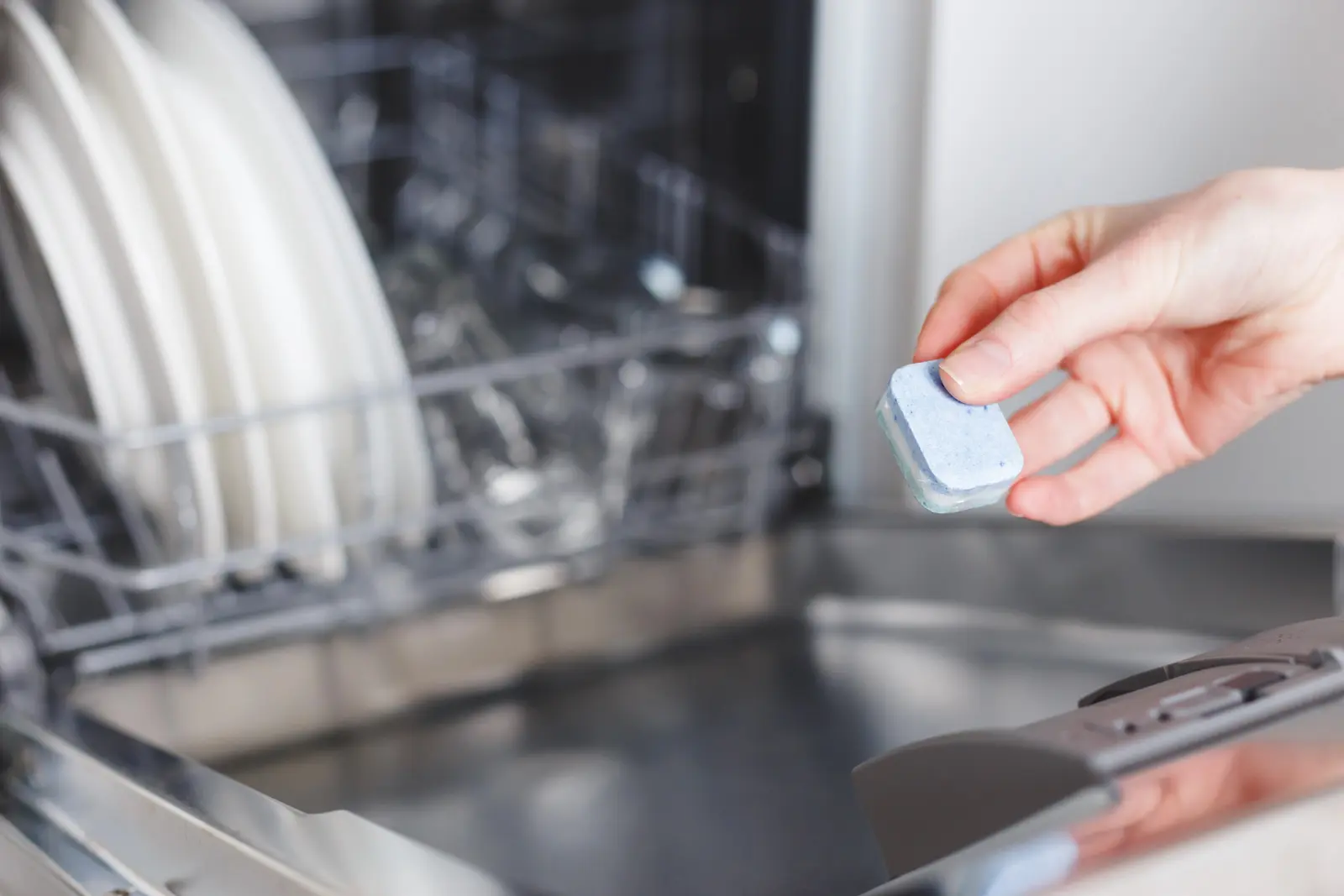
Dishwasher detergent comes in a few forms that make loading the machine feel different. A pod or tablet is already portioned for you. A loose powder or gel gives you the measuring job, which can be useful when its label calls for a different amount in hard water or for a heavily soiled load.
The small details show up at the sink. A film-wrapped pod needs dry hands. A loose tablet can go straight into the main dispenser, while a tub of powder needs space for its scoop. If you regularly wash special silverware, the detergent’s compatibility directions deserve a look as well.
We compare a scoopable powder, an unscented pod, a fragrance-free tablet and a pourable gel. Their ingredient disclosures, handling directions and suggested doses give a better sense of what each one would be like to keep by the dishwasher.
Dishwasher Detergent Comparison: Features and Tradeoffs
We evaluated these dishwasher detergents using The Hearthful Standard, considering ingredients, dosing, everyday handling, storage and the clarity of product directions. Dirty Labs gives separate scoop amounts for regular and more demanding loads, while Seventh Generation provides a pourable gel measured to the machine’s directions. Dropps supplies intact film-wrapped pods, and Branch Basics offers a whole-tablet alternative without PVA film.
Some links in this guide are affiliate links. If you purchase through them, The Hearthful Home may earn a small commission at no additional cost to you. As an Amazon Associate, we earn from qualifying purchases.

Measured powder
Dirty Labs Free & Clear
A scoop-based option with separate directions for regular loads and more demanding conditions. Check the silverware exclusions before choosing it for your household.
Bio Enzyme Dishwasher Detergent, fragrance-free, 48 advertised standard loads

Unscented premeasured pods
Dropps UltraWash Dishwasher Pods
An unscented, count-based option for a consistent dishwasher routine. The individual pods use PVA film and need dry handling.
Unscented, 64 count

Film-free tablets
Branch Basics Dishwasher Tablets
A fragrance-free tablet without the PVA film used by the selected Dropps pods. Place one whole tablet in the main dispenser and reseal the pouch after use.
Fragrance-free, 60 tablets

Measured fragrance-free gel
Seventh Generation Free & Clear Dishwasher Gel
A pourable option for readers who prefer to measure detergent for the machine. Its full disclosure names the preservatives as well as the cleaning ingredients.
Free & Clear, one 42 oz bottle
What Matters When Choosing Dishwasher Detergent
Match the Product to the Appliance and Dishes
Choose detergent specifically made for automatic dishwashers. The American Cleaning Institute explains that these formulas need very little foam, because excessive suds interfere with the machine’s washing action. A bottle of hand-dishwashing liquid is a different product, even when its front label also refers to dishes.
Check the appliance manual and the care instructions for what you wash. A detergent restriction for silver, decorated glassware, or another material belongs in the purchase decision before the first load. Keep special-care items separate when their instructions exclude the machine or the selected formula.
Choose a Measuring Routine You Can Repeat
For powder or gel, find the instructed amount and its unit. If the product refers to the dishwasher’s dispenser, locate the relevant mark in the manual. For a pod, confirm the whole-unit count and placement. Keep those instructions with the current product instead of carrying a dose over from the previous container.
The Dirty Labs powder and Seventh Generation gel let you measure detergent for the load. The Dropps pod and Branch Basics tablet come in fixed portions. If you want a counted dose and also want to avoid water-soluble film, the Branch Basics tablet addresses both preferences.
Our dishwasher detergent amount and placement guide shows how to read a label alongside a machine’s cycle-specific directions. Flexibility is useful when you can measure the permitted amount consistently. A fixed unit is convenient when that product’s instructions suit the wash you want to run.
Establish the Water Setup
Find out whether household water treatment serves the dishwasher, then check the manual for any built-in softener. Bosch’s salt guidance distinguishes models that use softener salt and directs owners to the hardness table for their machine. Do not infer that every dishwasher needs a salt refill from a hard-water label on detergent.
Use the hard-water, salt, and rinse-aid guide to separate the roles of those products. Compare your water conditions and machine settings with the detergent directions. A combination-product claim does not supply the model-specific setup instructions by itself.
Check the Formula Behind the Front Label
Match the full product name, scent, format, and country of sale to its disclosure. Decide what you need to check, such as fragrance, an ingredient restriction, or the permitted dish materials. A similarly named product can have a different formula or different directions.
Our dishwasher detergent ingredient guide explains builders, enzymes, surfactants, bleaching ingredients, and supporting components. Use those functions to interpret the complete formula. Ingredient count, a familiar name, or a broad environmental claim does not rank the finished product for your kitchen.
Read the Program Requirements
A short wash is not automatically a cooler or less intensive wash. Whirlpool describes quick programs that use more water, energy, and heat to finish sooner. The program chart for your model and the current detergent package are the relevant pair of instructions.
If you regularly choose Quick, Eco, or an automatic program, check that combination before buying a large supply. The dishwasher cycle guide explains what to compare, including drying time and detergent restrictions. It also separates a soil-sensing program from a documented automatic detergent dispenser.
Compare Cost at the Appropriate Dose
Use the pack quantity and the amount your instructions call for, with matching units. An advertised wash count may be based on a smaller dose than you use for a particular load. For a multipack, pair the total price with the total detergent quantity rather than the contents of just one package.
The dishwasher detergent cost-per-load calculator compares two suitable products and keeps other recurring product costs separate. Use it after choosing the appropriate dose. It also distinguishes complete washes from the value of usable detergent left in a pack, so a remainder does not silently disappear from the comparison.
Plan Storage Before Buying in Bulk
Check where the original package will fit, how it closes, and how you will take out the required amount. Follow its handling and storage directions. Keep the label with the supply so everyone using the dishwasher can identify the formula, amount, and placement.
A larger pack deserves the same checks as a smaller one. Compare the exact scent and formula, the space it needs, and how long your household will take to use it. Do not let an attractive unit price obscure a product restriction or a measuring routine that does not suit you.
Choose Between Measuring and Counting
Decide whether you prefer to measure detergent or use a premeasured pod, then read the relevant product profiles. Check both the detergent label and your dishwasher instructions.
Start With the Routine You Prefer
Use these two routes to find the product profiles that match how you want to handle detergent. Then compare the exact format’s dish-care and storage requirements.
- Measure powder or gel
Choose this route if you prefer to measure each wash using the product directions. Compare the package, measuring steps and storage instructions.
- Count whole pods or tablets
Choose this route if you prefer a pre-portioned product. Compare the handling and dispenser instructions for the exact version you buy.
Check the current product label and dishwasher instructions before choosing a dose. The routine helps narrow your options; the individual profiles explain the formulation and ownership tradeoffs.
How We Evaluate Dishwasher Detergents
Our recommendations in this guide are research-based. Exact-product disclosures, manufacturer directions, package identity, appliance guidance, and documented handling requirements inform this comparison. The profiles explain how that information affects selection, use, storage, and repeat purchasing.
Start with the requirements of your dishes and machine, then compare the factors that matter to that routine.
Materials
For detergent, we assess the disclosed formula and packaging. Clear ingredient identities, scent information, material restrictions, and accurate descriptions of a pod’s film help readers make specific choices. A shorter list or a natural-sounding ingredient does not automatically earn more credit.
Design & Function
We assess how the format and instructions support its intended use. Measured dosing, a defined pod count, dispenser fit, and useful conditions on the label matter when they suit a real wash. A specific instruction is more useful than a broad promise of spotless dishes.
Use & Interaction
We consider the steps required to measure or count, place the product, close the dispenser, and store the remainder. Clear directions earn credit for making the routine repeatable. Extra measuring or handling steps belong in the comparison even when the format offers more adjustment.
Durability & Longevity
For a consumable, this factor concerns keeping the supply usable and making repeat purchases understandable. Package care, storage directions, and the ability to identify the same formula matter. It does not assign a lifespan to glassware or predict a dishwasher’s reliability.
Transparency & Trust
We compare the selected retail version with current manufacturer information. Useful disclosures identify the formula, scent, package quantity, directions, and restrictions. When similarly named products or inconsistent units could confuse a purchase, the profile explains the specific check rather than assuming the versions are interchangeable.
A Closer Look at Each Pick
Measured powder
Dirty Labs Free & Clear
Bio Enzyme Dishwasher Detergent, fragrance-free, 48 advertised standard loads
Choose this powder when its measuring directions and dish-care restrictions fit your routine. Keep the formula name and scoop together, and compare its cost using the amount your loads actually require.
Price and availability last updated: 2026-11-25 at 18:49.
Materials
The Free & Clear disclosure lists protease, alpha-amylase, and sodium carbonate peroxide among its ingredients, with no added fragrance. Dirty Labs describes a cardboard container and wooden scoop. Select this variant deliberately: Aestival is the brand’s scented alternative, not another name for the same fragrance choice.
Design & Function
Dirty Labs combines its detergent and booster in one powder. The directions call for one scoop for light or regular loads and two for heavily soiled dishes or particularly hard water. Place the powder in the detergent dispenser and keep the supplied scoop with the container.
Use & Interaction
Dirty Labs excludes sterling silver and silver-plated dishes or flatware from its recommended dishwasher use. That restriction, together with measuring a loose powder, makes the format less convenient for a routine that frequently includes those pieces. Check the load before choosing the amount, and keep excluded items on their own care routine.
Durability & Longevity
The maker’s storage directions call for closing the container between uses and keeping it cool and dry. Retain the supplied scoop with the labeled container so the measure stays consistent after the packaging changes. The selected 48-load format describes supply at the standard dose, while a two-scoop wash uses twice as much powder.
Transparency & Trust
The product page provides both an ingredient disclosure and a safety data sheet identifying the Free & Clear dishwasher formula. Use those documents to check an exact ingredient or handling question. When reordering, match the dishwasher name and fragrance variant before carrying over the household’s measuring routine.
- Fragrance-free variant
- Defined scoop-based directions
- Ingredient and safety-document access
- Measuring required
- Larger doses use the supply faster
- Sterling and silver-plated items excluded
Unscented premeasured pods
Dropps UltraWash Dishwasher Pods
Unscented, 64 count
Choose Dropps for an unscented pod routine with clear handling instructions. Its practical tradeoff is fixed dosing, so compare a gel or powder if your dishwasher guidance calls for more flexible measuring.
Price and availability last updated: 2026-11-25 at 18:49.
Materials
The selected UltraWash Unscented disclosure lists sodium percarbonate, subtilisin and amylase, without SLS or added fragrance. The outer package is paperboard, while each pod uses water-soluble PVA film. Distinguish the box from the pod material if avoiding film is part of your purchase criteria.
Design & Function
The directions specify one pod in the main detergent dispenser, followed by closing its door. This gives each person loading the dishwasher the same starting instruction. Compare your machine manual with the package before buying a larger supply, particularly if you routinely use a specialized program.
Use & Interaction
Handle pods with dry hands and leave their film intact. Dropps also says not to pull apart pods that are stuck together. Keep the package within convenient reach of the loading routine, but in the secure storage position its label requires.
Durability & Longevity
Dropps specifies a closed container in a cool, dry place, away from children and pets. Its handling instructions prohibit pulling apart stuck-together pods, so a clumped supply cannot simply be separated into the intended single units. Keep the original package dry and contact the maker about damaged or stuck pods before using them.
Transparency & Trust
The selected retail disclosure identifies UltraWash Unscented and the 64-count package, while the current maker page uses the shorter Dishwasher Pods name. The selected list identifies its enzymes, cleaning ingredients and PVA film. Match the received package rather than transferring a new certification or revised formula solely because the Dropps brand name is the same.
- Unscented variant clearly identified
- Published formula and film disclosure
- Simple main-dispenser instructions
- Whole-pod dose
- Dry handling and closed storage required
- Paperboard packaging still contains PVA-film pods
Film-free tablets
Branch Basics Dishwasher Tablets
Fragrance-free, 60 tablets
Choose Branch Basics when fragrance-free, film-free tablets make your dishwashing routine simpler. Choose measured powder or gel instead when your machine and usual loads benefit from changing the instructed amount; the tablet’s convenience does not make it a flexible measuring format.
Price and availability last updated: 2026-11-25 at 19:10.
Materials
The dishwasher-tablet ingredient disclosure identifies sodium carbonate, sodium percarbonate, citrate ingredients, protease and amylase, among other components. It names sodium lauryl sulfoacetate, a different ingredient from sodium lauryl sulfate. The selected fragrance-free formula does not list SLS or added fragrance; these are ingredient-selection preferences, not a rating of individual tolerance.
Design & Function
The tablet supplies a defined whole dose without a surrounding PVA film. Branch Basics directs one tablet into the main dispenser, followed by closing the dispenser and running the preferred cycle. Check that the tablet fits the compartment and that loaded dishes leave its door clear.
Use & Interaction
Counting one tablet removes the scoop or pouring step from the routine. The tradeoff is that this format does not offer the same measured adjustment as powder or gel. Follow the whole-tablet directions rather than assuming that an arbitrary broken portion gives a dependable smaller dose.
Durability & Longevity
Reseal the original pouch after taking out a tablet and follow the maker’s cool, dry storage directions. Keep the package label with the remaining supply and store it securely away from children and pets. A larger count is useful only when the closed pouch fits that storage space.
Transparency & Trust
The maker publishes the tablet ingredients with their functions and CAS identifiers. The selected 60-count Amazon listing names the same formula. Use that exact product identity when comparing offers, since the brand also sells laundry detergent and cleaning concentrates with different directions.
- Fragrance-free and SLS-free selected formula
- Whole tablets without PVA film
- Full ingredient names and functions published
- Whole-tablet dosing rather than adjustable measuring
- Requires a compatible dispenser compartment
- Reseal pouch and keep the supply dry
Measured fragrance-free gel
Seventh Generation Free & Clear Dishwasher Gel
Free & Clear, one 42 oz bottle
Choose this gel if measuring for each load fits your routine. Compare its usable supply at your machine-directed dose with the fixed counts of pods before deciding which format offers better value.
Price and availability last updated: 2026-11-25 at 19:10.
Materials
Seventh Generation’s Free & Clear gel disclosure identifies a fragrance-free formula without SLS. It includes protease and amylase enzymes, plus benzisothiazolinone and methylisothiazolinone preservatives. Keep those named preservatives in the comparison when a specific ingredient restriction applies; fragrance-free does not mean preservative-free.
Design & Function
The directions say to fill the main dispenser according to the dishwasher’s instructions and close the door. Use the specified markings or measure for your machine. Write down that starting point if several people share the chore, so the routine does not depend on estimating a different amount each time.
Use & Interaction
Pouring gel gives you a measured alternative to counting whole pods, with no loose powder or individual film to handle. Use the dispenser markings required by your machine and wipe the bottle opening before closing it. This is automatic dishwasher detergent; keep it clearly separated from a similarly named hand-dishwashing liquid.
Durability & Longevity
The selected Amazon variant is one 42 oz bottle, and the manufacturer describes its standard gel size as 42 fl oz. Keep the original labeled bottle closed and securely stored between washes. Track supply at your machine-directed dose before setting a reorder interval, since bottle quantity does not establish a fixed wash count.
Transparency & Trust
The current manufacturer page publishes the complete formula and gives dispenser instructions, including separate loads for silver, aluminum and stainless steel. Those details provide a clear reference for choosing the gel and planning dish care. Match Free & Clear and the automatic-dishwasher designation when reordering, rather than relying only on a familiar bottle shape.
- Fragrance-free gel option
- Machine-directed measuring
- Named ingredient disclosure
- Requires a measure for each load
- Bottle size does not establish wash count
- Check the current package if you need to avoid a specific ingredient
Build a Repeatable Dishwashing Routine
Keep the Product, Amount, and Program Together
Record the current formula, instructed dose, placement, and usual program. Add any water-treatment settings relevant to the machine. When a replacement package changes, compare its directions with that note before using an amount remembered from the old product.
Check Loading and Maintenance Before Blaming the Formula
Follow the model’s loading diagram and user-maintenance instructions, including dispenser clearance. If an item remains dirty, note its position and what you observed. That information helps you distinguish a product-use question from a blocked release path or a machine-care task.
Treat Cloudiness as a Question to Investigate
Whirlpool distinguishes removable filming from permanent glass etching and also notes that persistent silica film is possible. One unsuccessful cleaning attempt does not identify every cloudy surface. Use the item’s care instructions before trying another treatment.
Our film, spots, and odor troubleshooting guide helps choose the next check. Keep a photo and a note of the starting setup. Correct an identified mismatch, then compare a similar load without changing every setting at once.
Revisit Value When the Required Amount Changes
If the instructions call for a different amount after a water or routine change, update the cost comparison. Account separately for rinse aid or other products you actually use. A low detergent-only figure and a total that includes additives answer different budgeting questions.
Dishwasher Detergent FAQs
Which of these detergents should I consider first?
Start with the handling route. Dirty Labs and Seventh Generation provide measured formats, while Dropps and Branch Basics provide whole units. Choose Branch Basics if avoiding PVA film is a priority, and check the product’s dish-care restrictions before comparing pack prices.
Are pods better than powder or gel?
A pod simplifies counting, while powder or gel lets you measure the amount directed for the wash. Format alone does not establish the cleaning result. Compare compatible products at appropriate doses, with the same kind of load and program in view.
Does a Free & Clear name always mean fragrance-free?
Check the exact product’s scent and full ingredient disclosure. The four selected versions here are identified as fragrance-free or unscented, but similarly named ranges can include scented variants. Match the full formula name and package before substituting another detergent.
Can I use a hand-dishwashing gel in the machine?
Choose a product labeled for automatic dishwashers. The Seventh Generation gel in this guide is an automatic dishwasher detergent. Hand-dishwashing liquid is a separate product with a different use, even if the bottles or scent names look similar.
Should I use more detergent whenever I see spots?
First compare the actual amount and water setup with the current instructions. A spot does not measure detergent dose or identify its cause. Use the troubleshooting guide for the observed result instead of adding more product by appearance alone.
Does a combination detergent replace dishwasher salt and rinse aid?
Check your model’s directions and water conditions. Salt belongs to a compatible built-in softener, and rinse aid has its own dispensing instructions. Our water-setup guide explains those roles and the model-specific checks before you change a refill or setting.
Can I cut a pod to suit a smaller load?
Use intact units as directed. If you want to measure an adjustable amount, compare a suitable powder or gel and follow its instructions. Rack space alone does not establish a safe fraction of a pod or the correct dose.
Will a different detergent restore etched glasses?
Etching is permanent surface damage, while a removable deposit is a different problem. Check the glassmaker’s care advice if the cause is uncertain. A product change should follow that distinction rather than assume every cloudy glass can be cleaned clear.
Is a quick cycle gentler than a normal cycle?
Do not infer temperature or intensity from duration alone. Read your machine’s program chart and the item’s care instructions, then confirm detergent compatibility. Include the selected drying option when deciding whether the complete program fits your available time.
How can I compare packs with different advertised wash counts?
Find each pack’s usable quantity and the dose appropriate for your wash. Enter those values into the linked cost calculator using matching units within each product. An advertised count is useful only when its assumed dose matches the conditions you are comparing.
Important: This article provides general information, not individualized medical, safety, installation, legal, or other professional advice. Product specifications, instructions, and safety information can change; verify current information with the manufacturer and consult an appropriately qualified professional when needed. See our Terms and Conditions for additional information.