
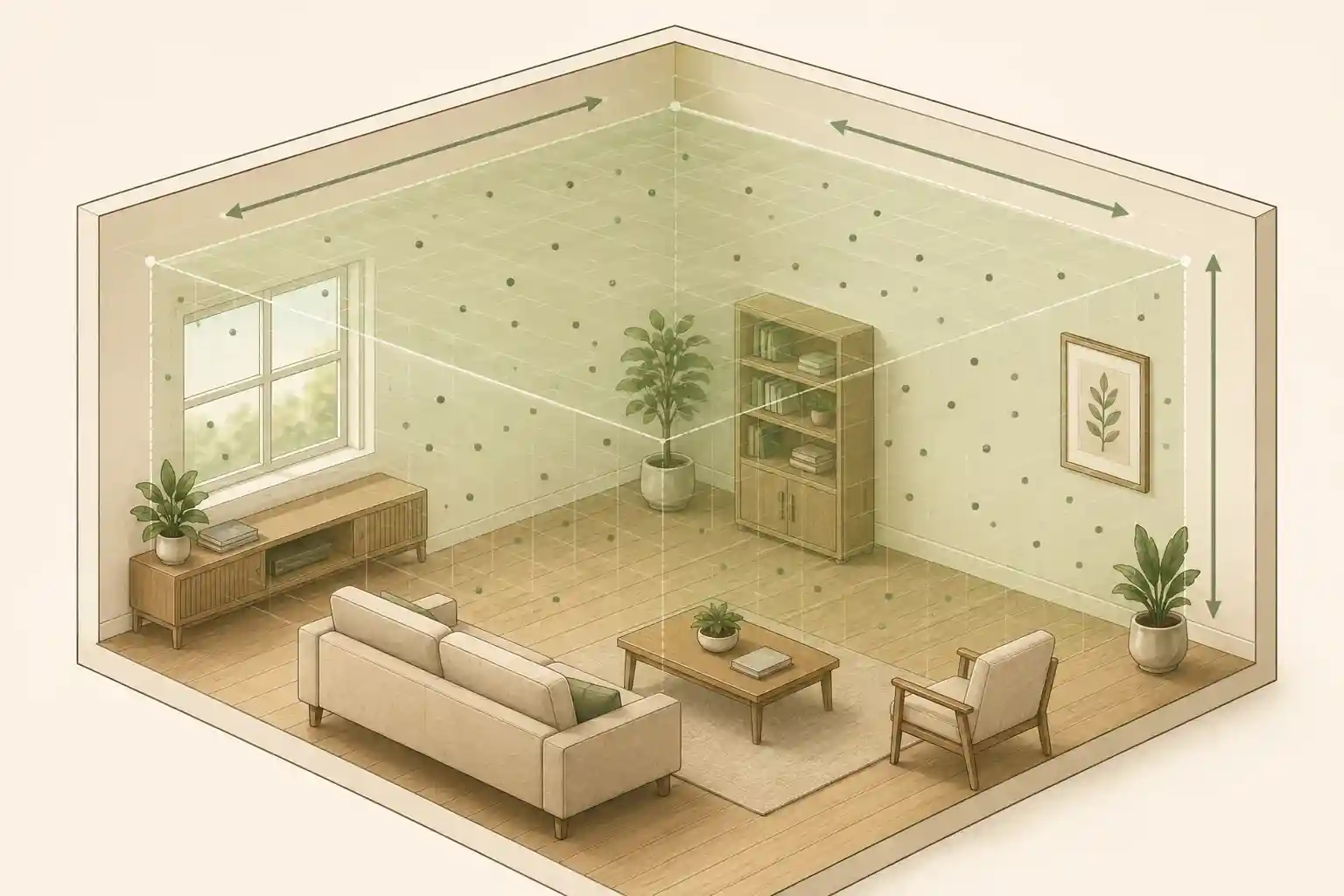
Air purifier coverage numbers can make two similarly powerful machines look as though they belong in completely different rooms. One manufacturer may base its claim on cleaning a space several times per hour, while another may advertise the much larger area the same airflow could pass through only once. Clean Air Delivery Rate, or CADR, gives you a more consistent starting point because it describes how much filtered air the purifier delivers instead of presenting a room-size number without its cleaning rate.
For a room with an 8-foot ceiling, the EPA and ENERGY STAR sizing table works out to about 65 CFM of CADR for every 100 square feet. AHAM’s consumer guidance is nearly the same: the purifier’s smoke CADR should be at least two-thirds of the room’s area. These are useful minimums for particle removal, but they do not tell you whether a purifier will be quiet enough, inexpensive to maintain, or comfortable to run at its highest speed.
The table below gives a fast answer for standard rooms, and the calculator adjusts that target for the room’s actual ceiling height without asking you to choose an air-change rate. It also shows a separate wildfire-smoke estimate based on AHAM’s more aggressive sizing guidance. Once you have the number, the rest of this guide explains how to interpret smoke, dust, and pollen CADR ratings and when extra capacity is worth buying. For complete product comparisons, see our guide to the best air purifiers.
Air Purifier CADR by Room Size
A small air purifier can be a good fit for a bedroom if its smoke CADR meets the target for the room. When a model lists smoke, dust and pollen ratings, compare the smoke figure with the calculator result. For a standard 8-foot ceiling, the EPA and ENERGY STAR table and AHAM’s two-thirds rule land within a few CFM of one another, so the targets below round upward to one practical number rather than showing two nearly identical columns.
Treat the listed CADR as the minimum to meet or exceed. If the exact purifier you are considering falls between two ratings, choose the model above the target rather than assuming a much larger advertised coverage number makes up for a lower smoke CADR.
CADR Starting Points for 8-Foot Ceilings
| Room Area | Smoke CADR to Shop For | Example Dimensions |
|---|---|---|
| 100 sq. ft. | 70 or higher | 10 × 10 ft. |
| 150 sq. ft. | 100 or higher | 10 × 15 ft. |
| 200 sq. ft. | 135 or higher | 10 × 20 ft. |
| 250 sq. ft. | 170 or higher | 12.5 × 20 ft. |
| 300 sq. ft. | 200 or higher | 15 × 20 ft. |
| 400 sq. ft. | 270 or higher | 20 × 20 ft. |
| 500 sq. ft. | 335 or higher | 20 × 25 ft. |
| 600 sq. ft. | 400 or higher | 20 × 30 ft. |
Targets are rounded upward from the EPA and ENERGY STAR sizing table and AHAM’s two-thirds smoke-CADR rule. Use the calculator below for ceilings above or below 8 feet. Wildfire-smoke sizing uses a higher target.
The table is deliberately conservative when the two published methods differ by a few CFM. Buying slightly above the target gives you more flexibility than choosing a model just below it, especially when the purifier will not always run at maximum speed.
Air Purifier CADR Calculator
Use the calculator when the room does not match one of the table’s standard sizes or when the ceiling is not 8 feet high. It starts with AHAM’s two-thirds smoke-CADR rule for a standard 8-foot room, then scales the target proportionally for the room’s actual ceiling height. This keeps the calculator aligned with the conservative sizing targets in the table while treating the height adjustment as a practical shopping estimate rather than a separate AHAM-certified room rating.
The second result applies AHAM’s more aggressive wildfire-smoke guidance, which calls for smoke CADR equal to the room’s square footage in a standard 8-foot room. The calculator scales that target proportionally for ceiling height as well.
Air Purifier CADR Calculator
Enter your room dimensions, then calculate the smoke CADR to shop for.
Enter valid room dimensions to calculate the recommended CADR.
Based on AHAM’s two-thirds smoke-CADR rule for an 8-foot room, scaled proportionally for ceiling height.
Based on AHAM’s more aggressive wildfire recommendation, adjusted proportionally for ceiling height.
Results round upward to the next 5 CFM so the recommendation does not fall below the calculated target. Compare the result with smoke CADR rather than substituting a higher dust or pollen rating.
Use the standard result for routine particle control and the higher result when wildfire smoke is the specific concern. In either case, select an actual purifier whose published smoke CADR meets or exceeds the result. CADR does not measure odor or gas removal, so carbon filtration still needs to be evaluated separately; our guide to whether air purifiers remove VOCs and odors explains that part of the decision.
What CADR Measures and Why Coverage Numbers Vary
CADR stands for Clean Air Delivery Rate. It combines airflow with particle-removal performance to estimate how much cleaned air a purifier delivers, usually in cubic feet per minute. That makes it more useful than fan airflow alone: a machine does not earn a strong CADR merely by moving a large volume of air if the filtration system removes too little of the test particle.
Models certified through the AHAM Verifide program can carry separate CADR ratings for tobacco smoke, dust, and pollen. Those test aerosols represent different particle-size ranges, so one purifier may post a higher pollen rating than smoke rating. The number is not a percentage and does not mean the purifier captures only that named pollutant; it is a clean-air delivery rate measured with a standardized test material. CADR also does not tell you everything about the filter media itself, so see our guide to what a HEPA filter actually captures for the particle-capture side of the system.
Air changes per hour, or ACH, describes the same cleaning capacity from the room’s side of the equation. CADR is the purifier’s clean-air output, while ACH compares that output with the room’s total air volume. A 300-CFM purifier therefore produces a much higher cleaning rate in a bedroom than it does in a large open living area.
This is also why square-foot coverage claims can vary so widely. In a room with an 8-foot ceiling, 300 CFM corresponds to roughly 470 square feet at 4.8 air changes per hour, but the same airflow can be presented as covering about 2,250 square feet if the claim assumes only one pass through the room’s air each hour. The purifier has not become more powerful; only the advertised cleaning frequency has changed.
When comparing products, look for the CADR itself and the ACH assumption behind any room-size claim. AHAM bases its Verifide suggested room size on 4.8 air changes per hour, while the EPA notes that CADR is typically measured at the purifier’s highest speed. A large maximum rating therefore does not guarantee the same clean-air delivery when the machine is running quietly on a lower setting.
How to Read CADR Ratings Before Buying
Use smoke CADR as the main sizing number. AHAM’s two-thirds rule is specifically based on tobacco smoke CADR, and the EPA identifies smoke as the smallest of the three particle categories commonly shown on purifier packaging. Choosing by the larger dust or pollen number can make a model appear suitable for a room even when its smoke CADR falls below the target.
Dust and pollen CADR still help distinguish models after they have cleared the room-size requirement. A buyer primarily concerned with larger pollen particles may prefer the stronger pollen performer among two adequately sized purifiers, but that comparison should come after confirming that each model has enough smoke CADR for the space. If you are trying to match filtration and performance to a particular concern, our guide to choosing an air purifier for allergies, smoke, dust, or pets separates those use cases without changing the room-size requirement.
Give more weight to independently verified numbers than to a manufacturer’s largest coverage headline. The AHAM Verifide label and searchable directory report tested smoke, dust, and pollen CADR values along with a suggested room size based on 4.8 air changes per hour. A purifier can still be useful without AHAM participation, but its performance claims are harder to compare on the same basis.
Finally, compare the rating with the way you will actually operate the machine. If maximum speed is too loud for a bedroom or office, a purifier that only barely meets the target on high may deliver less cleaning than you expect in daily use. Our guide to what makes an air purifier quiet enough for bedrooms and offices covers that operating tradeoff in more detail. Extra CADR can provide useful headroom, but it should also be balanced against power use, physical size, and the filter replacement costs that affect long-term value.
When to Size Above the Standard CADR Target
Tall or Vaulted Ceilings
The standard room-size table assumes an 8-foot ceiling, so floor area alone understates the air volume in a taller room. A 300-square-foot room contains 2,400 cubic feet of air at 8 feet high and 3,600 cubic feet at 12 feet high. Use the calculator’s ceiling-height field rather than applying the standard table unchanged.
Open Floor Plans
Size for the connected area the purifier will actually serve, not only the furniture-defined portion called the living room or dining room. The EPA recommends considering the entire served space in an open floor plan. For an irregular layout, divide the floor into simple rectangles, add their areas, and use a representative ceiling height or calculate each section’s volume separately.
Wildfire Smoke
AHAM recommends a smoke CADR equal to the room’s square footage when wildfire smoke is the concern, rather than the normal two-thirds target. That means a 300-square-foot room with an 8-foot ceiling calls for about 300 smoke CADR under the wildfire rule. The calculator displays this higher result automatically and scales it for ceiling height.
Lower-Speed or Quiet Operation
Published CADR is generally measured at the highest fan speed, while bedrooms and offices are often operated at a quieter setting. If you know the purifier will spend most of its time below maximum, buying above the minimum target gives you more room to reduce fan speed without starting from an undersized machine.
Large or Irregular Spaces
A single high-CADR purifier may not distribute cleaned air evenly through a long, divided, or unusually shaped room. The EPA notes that multiple air cleaners can be considered when an area is larger than one available product can serve. In that situation, two appropriately placed units may be more practical than relying on one distant machine and an oversized coverage claim.
Frequently Asked Questions
Is CADR the same as CFM?
CADR is commonly expressed in cubic feet per minute, or CFM, but it accounts for particle removal as well as airflow. A fan can move a large amount of air without producing an equally high CADR if the filtration system removes too little of the test particle.
Which CADR should I use for room sizing?
Use smoke CADR when applying AHAM’s two-thirds room-sizing rule or the targets in this guide. Dust and pollen ratings are useful secondary comparisons, but substituting a higher pollen number can overstate how well the purifier meets the conservative room-size target.
Is a higher CADR always better?
A higher CADR means the purifier can deliver cleaned air faster, which can be useful for larger rooms, quicker particle reduction, or quieter operation below maximum speed. Once a model comfortably meets the room’s requirement, however, more CADR should be weighed against noise, energy use, filter cost, and appliance size rather than treated as an automatic win.
Does CADR decrease on lower fan speeds?
Clean-air delivery falls as airflow is reduced, and the EPA notes that the published CADR is typically measured at the purifier’s highest speed. Manufacturers do not always publish a CADR for every setting, so buyers who expect to use quiet mode frequently may benefit from choosing more maximum capacity than the minimum calculation requires.
Can two air purifiers be used in one large room?
Yes. EPA suggests considering multiple units when one cannot serve the space. Measure the whole connected room first. An open 15 × 20 ft room with an 8 ft ceiling is 300 sq ft, giving a target of about 200 CFM of smoke CADR under AHAM’s two-thirds rule. Two 100 CFM units add up to that on paper at their rated speeds. Place them where air can circulate, and size closed bedrooms separately.
Does CADR tell you how well an air purifier removes odors or VOCs?
No. CADR is used to compare particle removal, while gases and odors require separate media such as activated carbon or another sorbent designed for gas removal. A purifier can have a strong smoke CADR and still provide limited odor or VOC control if it contains very little gas-removal material.
What if an air purifier does not have an AHAM-verified CADR?
The model may still provide useful filtration, but its claims are harder to compare with independently tested products on the same basis. Look for a clearly stated smoke CADR, the test method used, the fan speed at which it was measured, and the air-change assumption behind any advertised room size.
The Bottom Line
For a room with an 8-foot ceiling, start with roughly 65 to 67 CFM of smoke CADR for every 100 square feet. That range reflects both the EPA and ENERGY STAR sizing table and AHAM’s two-thirds rule. Use the table for a quick standard-room answer or the calculator when ceiling height changes the room’s actual air volume.
Treat that number as a minimum, not as the only feature worth comparing. Size above it for wildfire smoke, connected open space, or regular operation below maximum speed, and do not let a very large square-foot claim override a lower verified smoke CADR.
After eliminating undersized models, compare energy use and physical dimensions, then decide which air purifier features are worth paying for. Controls, sensors, displays, and apps matter most when they improve how consistently and conveniently you can use the machine. For a comparison of complete products, return to our guide to the best air purifiers.
Important: This article provides general information, not individualized medical, safety, installation, legal, or other professional advice. Product specifications, instructions, and safety information can change; verify current information with the manufacturer and consult an appropriately qualified professional when needed. See our Terms and Conditions for additional information.