
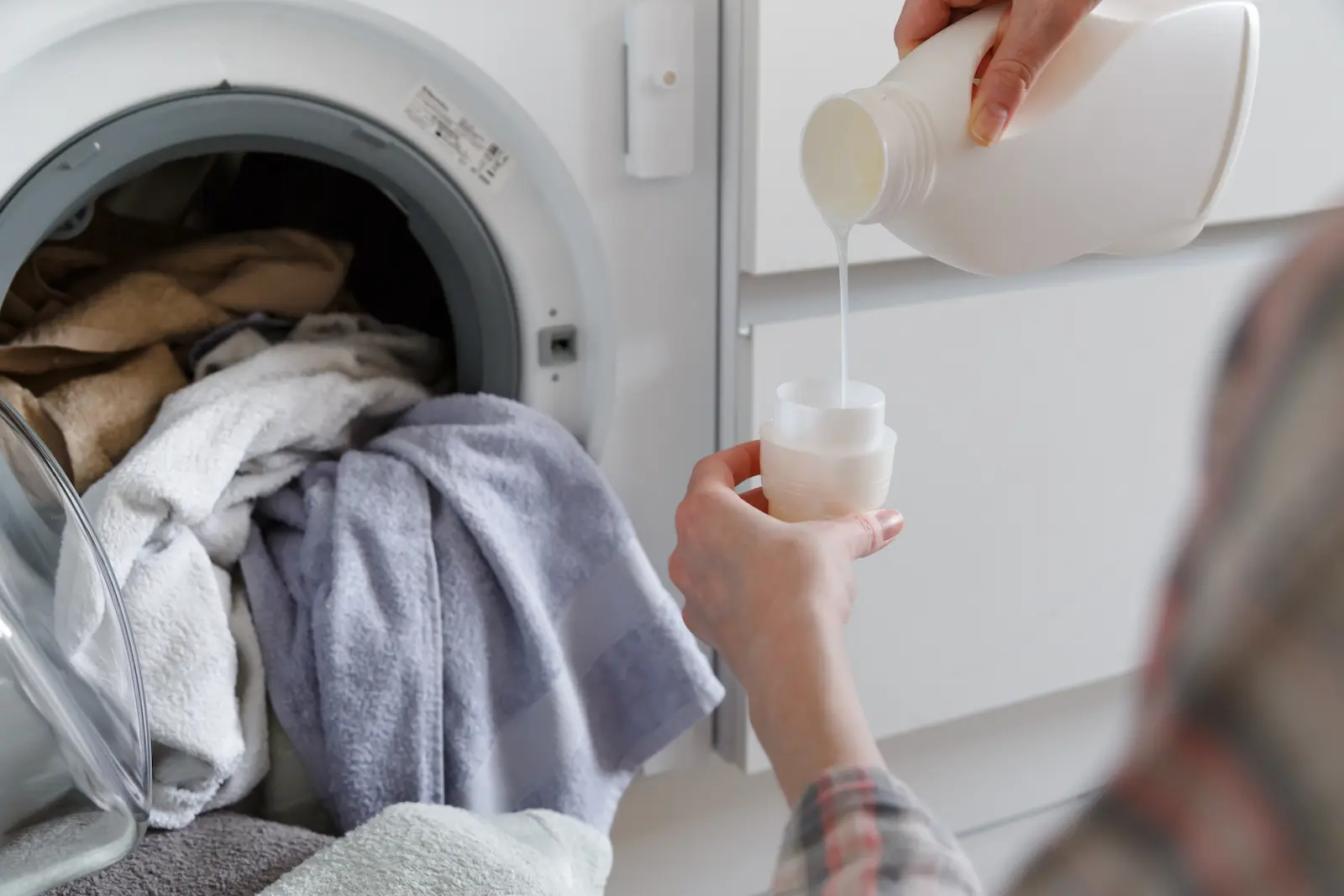
Laundry detergent earns its place in the wash routine a load at a time. A bulky scoop, a small capful of concentrate, a few pumps or a premeasured pac can all go into a washing machine, but they take different amounts of storage space and leave different jobs for the person doing the laundry.
That matters in a home that alternates between a few shirts and a full basket of towels. Package directions determine how much goes into each load. Some formulas also allow a small amount to go directly on a stain before washing, and some powders have a preparation step for cold water.
Our four fragrance-free or unscented picks span powder, liquid concentrate, pump detergent and pacs. We compare how you measure each one, where it fits into the wash and what the advertised load count means for the package you’re buying.
Laundry Detergent Comparison: Features and Tradeoffs
We evaluated these laundry detergents using The Hearthful Standard, considering exact ingredients, dosing, everyday handling, storage and product information. Molly’s Suds offers a four-ingredient powder, while Dirty Labs supports measured washing and pretreatment. Tide offers whole-pac dosing, and Puracy provides a compact pump bottle. The differences matter more than whether the front label uses a broad sensitive-skin or concentrated claim.
Some links in this guide are affiliate links. If you purchase through them, The Hearthful Home may earn a small commission at no additional cost to you. As an Amazon Associate, we earn from qualifying purchases.

Measured powder
Molly’s Suds Original Laundry Powder
A four-ingredient unscented powder measured by the scoop. Check the cold-wash preparation step and keep the pouch closed between loads.
Original Laundry Powder, Unscented, 120 advertised loads

Measured liquid
Dirty Labs Free & Clear Bio Enzyme Laundry Detergent
A fragrance-free concentrate with an 8 mL standard dose. Its directions also permit short stain pretreatment before washing, with the marked beaker helping you repeat the amount.
Free & Clear · 21.6 fl oz · 80 advertised standard loads
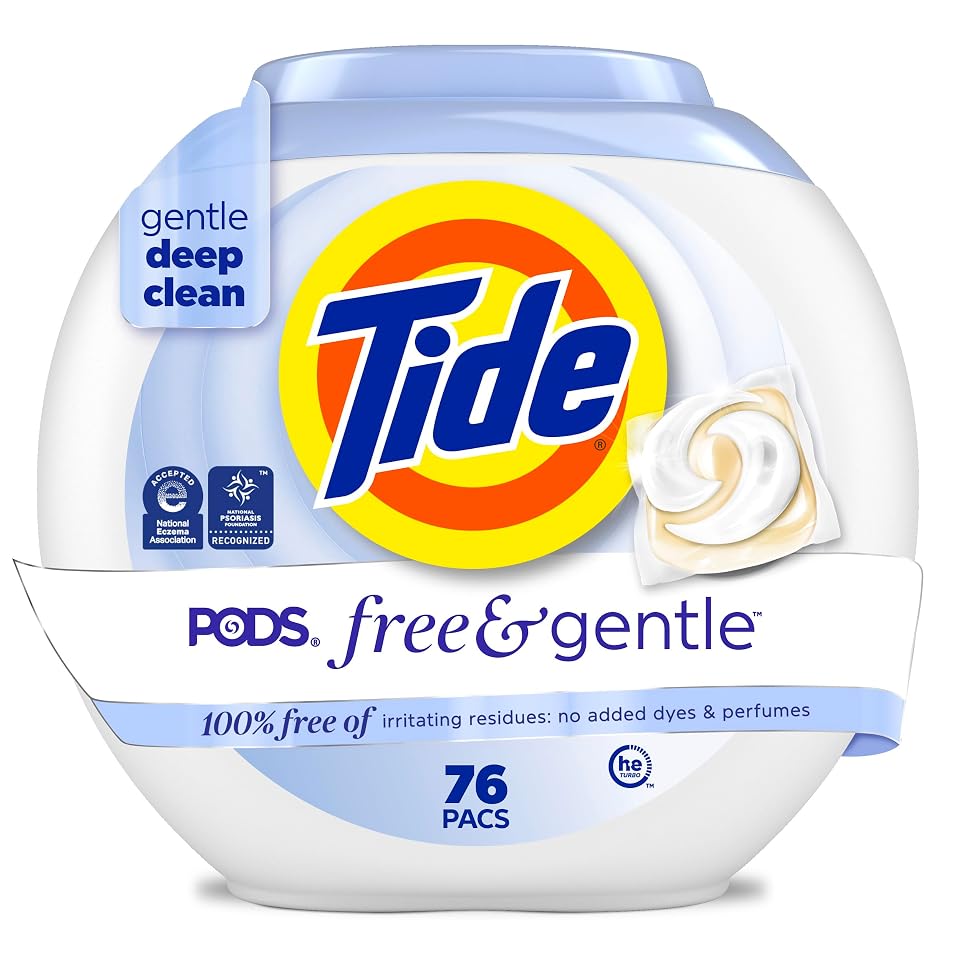
Whole-pac dosing without added perfume
Tide Free & Gentle PODS
A dye-free and perfume-free option for households that prefer counting intact pacs. The 76-count pack suits a repeatable machine-washing routine, with secure storage and the package-directed number of pacs for each load.
Free & Gentle, 76-count tub

Compact pump dispenser
Puracy Free & Clear Laundry Detergent
A compact 16 fl oz bottle with a pump dispenser. Match the pump count to your washer and load, then retain the bottle for a compatible refill.
Free & Clear · 16 fl oz · Pump bottle
What Matters When Choosing Laundry Detergent
Begin With the Washer and the Garments
Check the washer manual for the required detergent type and dispenser arrangement. Whirlpool explains that HE detergent is designed for low-water washing with controlled suds. An HE symbol addresses compatibility; it does not tell you the quantity for every formula or load.
Then separate ordinary washable clothing from items with special care requirements. Keep the garment’s instructions beside the detergent directions when checking enzymes, bleaching ingredients, pretreatment, or temperature. A formula selected for everyday cottons need not be the only detergent in a household that also washes special-care garments.
Choose a Dose You Can Measure Reliably
Compare the product’s stated load size, soil conditions, and concentration with the laundry you actually do. A scoop, cap line, pod, and sheet are different measures. Use the matching instruction for the current product rather than transferring an amount from the last container.
For a household that washes mostly small loads, compare the 8 mL standard dose of Dirty Labs concentrate with Puracy’s instructions for its pump dispenser. Tide uses intact pacs, so the dose changes in larger increments. Use the package directions for a typical load before deciding how many washes you will get.
Our detergent dosing guide explains label categories, HE use, water-hardness information, and automatic dispensers. For a purchase shortlist, the useful question is whether you can identify and repeat the intended amount without guessing.
Read Ingredients by Their Job
Look for the exact scent, format, and ingredient disclosure. A formula’s cleaning agents, water-management ingredients, enzymes, and supporting ingredients have different roles. Our laundry detergent ingredient guide explains those groups and the fabric restrictions to check.
A familiar ingredient name or a short list does not supply a complete product comparison. Decide which information matters to you, such as a known ingredient restriction or a garment-care requirement, then check it directly. Keep environmental claims separate from what an ingredient is doing inside the formula.
Keep Sensitive-Skin Claims Specific
For people with atopic dermatitis, the American Academy of Dermatology recommends fragrance-free, dye-free laundry detergent. Apply that guidance in its eczema-care context and keep any individual ingredient advice in view. A sensitive-skin label does not establish suitability for everyone.
Our guide to detergent for sensitive skin separates fragrance and dye statements, ingredient disclosures, and the scope of seals or testing claims. Include stain treatments, softeners, and dryer products in that review if you use them.
Check Cold-Water Directions for the Formula
If most of your loads use a cold setting, read the exact detergent’s instructions before deciding that a format will fit. Check any preparation step alongside the program, loading limits, and care label. A product that needs an additional step may be reasonable for one routine and inconvenient for another.
The cold-water laundry guide explains the difference between an incoming-water setting, a controlled wash temperature, and a named program. It also separates dissolving from stain removal, so the next adjustment addresses the problem you actually observed.
Compare Cost at the Dose You Will Use
Check the usable package quantity as well as the advertised number of loads. A count based on a small dose can overstate the number of your larger loads the package will cover. Keep the same price basis and comparable laundry conditions when deciding which option offers useful value.
Use our detergent cost-per-load calculator to compare two products at their label-directed doses. It works with liquid volume, powder mass, pods, or permitted sheet portions, and keeps leftover product separate from complete loads. The calculation helps compare suitable options after you have selected the appropriate dose.
Make Storage Part of the Choice
Plan where the original container will sit, how you will close it, and whether you can measure or count the product without leaving it accessible. The American Cleaning Institute advises keeping liquid laundry packets in their closed original package, out of children’s reach and sight, and handling them with dry hands. Keep packets intact.
Follow each product’s storage instructions and retain its label. A decorative container can separate a supply from its directions and product identity. Choose a pack size you can store appropriately and use at a reasonable pace, rather than buying the largest quantity solely for a lower advertised unit price.
Choose a Format for Your Routine
Use the handling difference to make an initial shortlist. Then follow the matching profile to check the selected formula, directions, and ownership details.
- Powder
- You want to measure from a loose supply. Check scoop instructions, moisture protection, and any cold-wash preparation. Start with the Molly’s Suds powder profile.
- Measured liquid
- You want a pourable dose and directions that also permit pretreatment. Keep the matching beaker with the bottle. See the Dirty Labs profile.
- Pods
- You prefer counting intact units to pouring. Check the package’s count for your load, placement, and secure storage. See the Tide pod profile.
- Pump dispenser
- You prefer counting pump strokes from a compact bottle. Match the count to the washer and load size. See the Puracy profile.
Choose a workable routine, then verify the exact formula and fabric requirements. Format alone does not tell you how well a product will clean or how your skin will respond.
How We Evaluate Laundry Detergents
Our recommendations in this guide are research-based. Exact-product ingredient disclosures, package directions, fabric and washer compatibility guidance, storage instructions, and the identity of the linked retail version inform this comparison.
Choose the format that fits your laundry loads, dosing preferences and washer.
Materials
For detergent, this factor concerns the disclosed formula and packaging rather than an appliance housing. We look for useful ingredient identities, scent information, relevant fabric restrictions, and accurate descriptions of films or carriers.
Design & Function
We assess how the format and directions support the intended laundry task. Dose flexibility, defined unit counts, permitted pretreatment, and washer compatibility matter when they suit a real routine. Extra claims receive weight only when the documentation explains what they cover.
Use & Interaction
We consider measuring, counting, placement, preparation, and everyday handling. Clear cap or scoop instructions can matter as much as compact packaging. A cold-wash preparation step belongs in the convenience assessment when it changes how the product is used.
Durability & Longevity
For a consumable, this factor concerns keeping the supply usable, retaining clear directions, and planning repeat purchases. Storage, package handling, and the ability to identify a replacement formula matter. It is an ownership assessment rather than a prediction of garment lifespan.
Transparency & Trust
We compare the selected retail identity with current manufacturer information. A clear explanation of dose, ingredients, pack quantity, and product changes helps readers buy deliberately. Ambiguous load counts or formula transitions need clarification in the profile rather than an assumed answer.
A Closer Look at Each Pick
Measured powder
Molly’s Suds Original Laundry Powder
Original Laundry Powder, Unscented, 120 advertised loads
Choose this powder if its measuring and wash-temperature instructions fit your laundry routine. For a mostly cold-wash household, decide whether preparation before each load is convenient enough to maintain.
Price and availability last updated: 2026-11-25 at 13:10.
Materials
Molly’s Suds lists four ingredients for the Unscented version: sodium carbonate, sodium bicarbonate, magnesium sulfate heptahydrate, and sea salt. It states that this variant contains no fragrance or essential oils. Select Unscented deliberately, since the scented versions have a different ingredient list.
Design & Function
The published directions cover standard and HE machines and specify one tablespoon per load, added to the drum before the clothes. Check the current package instructions when sizing your load and keep its measuring scoop with the product, especially if several people share laundry duties.
Use & Interaction
For a cold wash, Molly’s Suds recommends predissolving the powder in hot water. Allow time for that step if your garment needs a cold cycle. Its FAQ directs silk and other delicate-fabric users toward specialist washes; follow the garment label when separating those items from ordinary laundry.
Durability & Longevity
Original Powder has no anti-caking agent and can clump in its pouch, according to Molly’s Suds. Keep the pouch tightly sealed as instructed. Choose a storage position where you can close it after every load, rather than leaving an open supply beside a frequently used sink.
Transparency & Trust
Original Powder and Super Powder are separate formulas; the latter adds enzymes and uses a different scoop size. Match the name on a repeat purchase before reusing an old dosing habit. The published ingredient list makes that check straightforward and gives you specific information to compare with another detergent.
- Four disclosed Unscented ingredients
- Measured dose for standard and HE machines
- Formula-specific storage guidance
- Manufacturer recommends predissolving for cold washes
- Pouch can develop clumps
- Silk and other delicates may need a specialist wash
Measured liquid
Dirty Labs Free & Clear Bio Enzyme Laundry Detergent
Free & Clear · 21.6 fl oz · 80 advertised standard loads
Choose Dirty Labs when a measured fragrance-free liquid and permitted pretreatment match the way you wash. The main decision is whether you will keep and use the small measuring beaker; if counting pump strokes fits your space better, compare the Puracy option below.
Price and availability last updated: 2026-11-25 at 19:10.
Materials
The Free & Clear ingredient disclosure lists glucoside cleaning agents and five enzyme types, with no added fragrance, SLS or SLES. Its bottle is aluminum. Those are concrete formula and packaging choices to compare, while ingredient preferences and garment-care requirements still need to be considered separately.
Design & Function
Dirty Labs specifies standard and HE washer use and an 8 mL standard dose. Its directions also permit a small amount on a stain for five minutes before washing. That combination gives the liquid a practical advantage over an intact pac when one product needs to handle washing and pretreatment.
Use & Interaction
Use the marked beaker rather than estimating a small dose from the bottle opening. The maker assigns line 1 to a medium load and line 2 to a large or heavily soiled load. Confirm whether the selected retail package includes the beaker, especially when buying an 80-load refill bottle.
Durability & Longevity
Close the bottle and keep its label and measuring equipment together between washes. An 80-load headline is a supply estimate at the standard dose; using the larger measure changes the reorder interval. Keep the original container securely stored and record the actual load setting used in your cost comparison.
Transparency & Trust
The maker separates its Free & Clear ingredient list from Signature and Murasaki, and publishes the dose, directions and safety data sheet. The selected offer here is the 21.6 fl oz Free & Clear bottle. Match both the scent and size before a repeat order so a familiar-looking label does not change the formula or measuring plan.
- Small measured dose with marked beaker
- Directions permit detergent pretreatment
- Separate fragrance-free ingredient disclosure
- Small liquid dose needs deliberate measuring
- Check beaker inclusion with refill offers
- Use garment-care instructions for special fabrics
Whole-pac dosing without added perfume
Tide Free & Gentle PODS
Free & Gentle, 76-count tub
Choose Tide Free & Gentle PODS if you prefer counting whole pods and can store them securely. A measured liquid or powder may fit better if you need finer dose adjustments or a product for handwashing.
Price and availability last updated: 2026-11-25 at 13:10.
Materials
The exact 76-count SmartLabel disclosure lists MEA laureth sulfate, other cleaning agents, enzymes and a polyvinyl alcohol film, with no sodium lauryl sulfate or perfume listed. MEA laureth sulfate is a different ingredient from SLS, so this is not a sulfate-free selection. Compare that distinction with any specific restriction before choosing the whole-pac format.
Design & Function
The manufacturer specifies HE and conventional-machine use and cold-water dissolution. Its product overview says to use 1-2 pacs, with the actual package providing the dose instructions. Count whole units for the load you are washing; a small washer or cold cycle does not create a separate universal dose.
Use & Interaction
Keep pacs intact and place them in the drum before clothing, outside the dispenser drawer. ACI also excludes using liquid pacs for handwashing or spot pretreatment. If those jobs are common in your household, compare a formula whose directions explicitly cover them. Plan those uses before selecting a pack purely for dosing convenience.
Durability & Longevity
Handle pacs with dry hands and fully close the original labeled container after use. Store it securely beyond children’s access. The tub provides an ordinary way to retain the supply and directions; its 76 pacs cover 76 one-pac washes or 38 two-pac washes, with the appropriate count determined by the package and load.
Transparency & Trust
The 76-count SmartLabel record identifies the ingredients and the press-and-turn tub closure. That exact record gives a useful reference when checking a replacement purchase. Keep the full product name and package directions with your supply instead of applying a liquid Tide formula or dose to these pacs.
- No added dyes or perfume
- Documented HE and cold-water use
- Count-based dosing
- Whole-pac dose increments
- Secure storage and dry handling required
- Pacs are not for handwashing or spot pretreatment
Compact pump dispenser
Puracy Free & Clear Laundry Detergent
Free & Clear · 16 fl oz · Pump bottle
Choose Puracy when a compact pump bottle makes the daily measuring step easier to repeat. Dirty Labs is the more directly documented option here for detergent pretreatment, while Puracy’s current page directs that task to a separate stain remover.
Price and availability last updated: 2026-11-25 at 19:10.
Materials
Puracy’s Unscented ingredient disclosure includes cleaning agents, enzymes and the preservative benzisothiazolinone. The maker states that this version has no SLS, SLES or added fragrance. The full list remains important for a specific ingredient restriction; fragrance-free does not mean preservative-free.
Design & Function
The selected 16 fl oz pump bottle is advertised for 64 loads. Counting full pump strokes can help in a shared laundry room where a separate beaker gets misplaced. Compatible refill bottles are sold separately. Match the formula and concentration before reusing the pump directions.
Use & Interaction
Puracy’s current machine-specific directions give one or two pumps for HE loads and two or four for conventional machines, depending on load size. Put the relevant instruction where every person doing laundry can see it. Count full pump strokes consistently instead of treating an arbitrary partial press as a measured dose.
Durability & Longevity
Keep the pump opening clean and retain the labeled bottle when replenishing it with a matching refill. The compact bottle is easier to place on a small shelf, while a refill needs its own secure storage. Buy a larger supply only after confirming that the dispensing routine works for your washer and usual loads.
Transparency & Trust
Puracy publishes a detailed formula and distinguishes its Unscented and Fresh Linen options. Its 16 oz page says two pumps for most loads, while the current main page separates the count by washer and load size. Use the directions on the bottle you receive and resolve any conflicting instructions before dosing.
- Compact pump bottle
- Unscented formula with full ingredient disclosure
- Matching refill format available
- Directions differ by washer and load size
- Two official pages summarize pump counts differently
- Contains benzisothiazolinone preservative
Keep the Laundry Routine Easy to Repeat
Save the Product and Dose Together
Keep the current package directions and a short note of your usual load category. Recheck both when a refill has a different concentration, format, cap, or label. For an automatic dispenser, include the model-specific concentration and setup requirements in that check.
Investigate a Mark Before Changing Everything
If clothes have white marks, a sticky patch, or stiffness, describe the symptom and record the load conditions. Our residue troubleshooting guide helps distinguish the next checks for product placement, lint, additives, dose, and washer maintenance. Correct one identified mismatch, then compare a similar load.
Keep Special-Care Loads Separate
Choose the detergent and cycle from the garment’s care requirements before selecting an extra treatment. Keep any special-care product clearly identified so another person doing the wash can follow the same routine. A household system is easier to maintain when the exceptions are written down.
Recheck the Value When the Routine Changes
A larger load, different soil level, or new product direction can change the number of washes a pack covers. Update the cost calculation when those inputs change. Include optional additives or pretreatments separately if they are part of the routine you are comparing.
Laundry Detergent FAQs
Which format should I choose first?
Begin with the requirements of the clothes and washer, then choose the handling routine you can repeat. Compare a scoop, beaker, pump and intact pac while checking the exact formula and dose. The four-row reference above links each approach to its selected profile.
Is powder always a lower-residue choice?
A format alone does not establish that result. Check the product’s amount, preparation, placement, and compatible wash conditions. If marks are already present, use the residue guide to investigate their source before assuming a new format will solve the problem.
How much liquid laundry detergent should I use per load?
Use the dose on your current bottle for your washer and load size. Even two concentrated liquids can measure a load differently. Dirty Labs specifies a small measured volume, while Puracy gives pump counts that vary by washer and load. A larger pour does not follow automatically from a larger bottle.
Is Tide Free & Gentle fragrance-free?
Tide describes the selected Free & Gentle line as free of dyes and perfumes. Match the linked version and current package when buying. That statement addresses those ingredients; individual suitability still depends on the complete formula and any personal guidance.
Does a fragrance-free label mean every formula has the same ingredients?
No, the complete formulas still differ in cleaning agents, enzymes, preservatives and other components. Puracy’s unscented list includes benzisothiazolinone, while the selected Tide pacs include MEA laureth sulfate. Check a specific restriction against the exact formula, and do not substitute a scented or differently formulated variant just because the brand name matches.
Can I use less than the label dose to make a pack last longer?
Choose an amount supported by the product and washer instructions for your laundry. Correct an excessive or duplicate dose if you identify one, but do not invent a smaller amount simply to improve the cost figure. The dosing guide explains what to check before changing it.
Do I need a second detergent for wool or other special-care clothing?
You may, depending on the garment and the selected formula. Check both sets of instructions for enzyme, bleaching, temperature, and washing-process restrictions. A detergent that suits most everyday loads does not automatically suit every item in the wardrobe.
Should I buy the largest available pack?
Compare the price at your actual dose with the storage space and handling the package requires. Also check whether you are choosing the same formula and concentration. A larger supply is useful only when the product and storage arrangement fit the routine you will keep.
Important: This article provides general information, not individualized medical, safety, installation, legal, or other professional advice. Product specifications, instructions, and safety information can change; verify current information with the manufacturer and consult an appropriately qualified professional when needed. See our Terms and Conditions for additional information.