
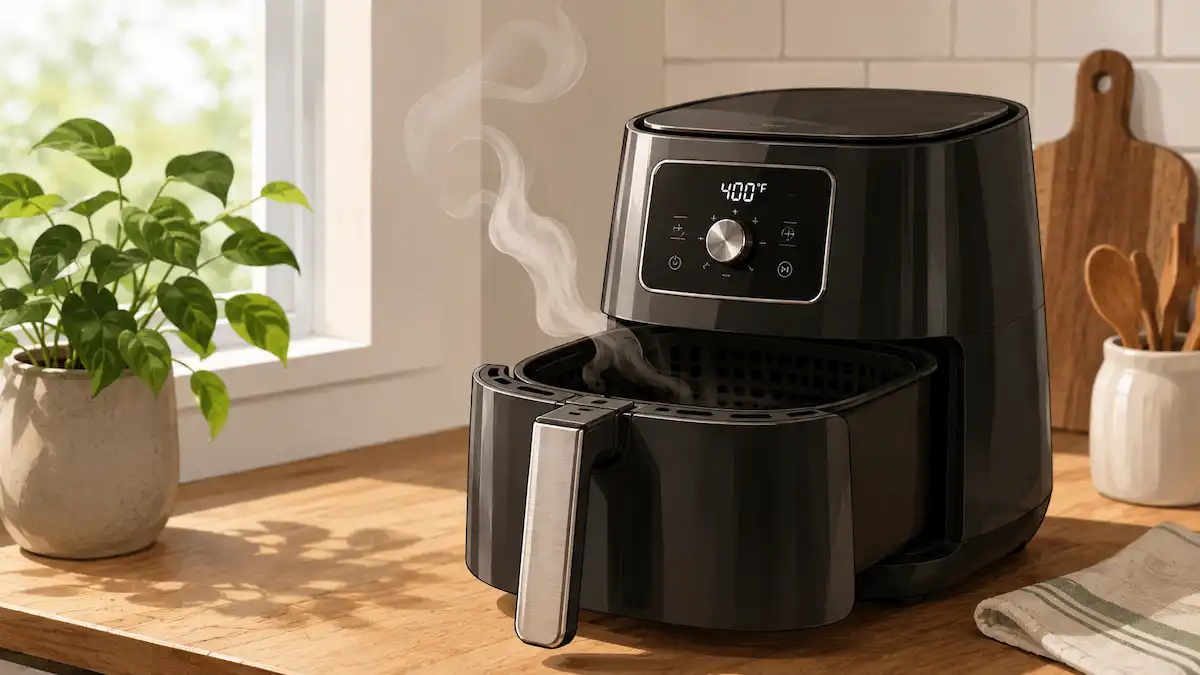
Air fryers can produce odors, steam, or smoke, but those signals do not all mean the same thing. A mild new-appliance smell may occur during early use. Steam and food aromas are normal during cooking, while light smoke often comes from rendered fat, excess oil, crumbs, or grease left inside the appliance.
A smell also cannot identify its source by itself. A plastic-like odor might come from the housing, handle, drawer, manufacturing residue, packaging, an accessory, or another heated component. It does not automatically prove that the basket coating is producing harmful fumes.
The more useful buying questions are whether the manufacturer publishes clear first-use instructions, identifies the food-contact materials, provides realistic heat limits, makes grease-prone areas accessible for cleaning, and offers a practical return or warranty path if an odor remains strong.
This guide explains those checkpoints without treating every temporary smell as dangerous or every persistent odor as normal. For complete appliance recommendations, see our guide to the best non-toxic air fryers. You can also learn what PFAS-free means on an air fryer and compare air fryer basket materials.
Do Air Fryers Release Fumes or Odors?
Yes, an air fryer can release a noticeable odor while heating or cooking. However, the word fumes is broad and does not identify what is leaving the appliance. What you notice may be ordinary steam, food aroma, a temporary new-appliance smell, oil smoke, reheated grease, burnt residue, or an abnormal electrical or melting odor.
Some manufacturers acknowledge that a light plastic-like smell may occur during the first uses of certain models. In its model-specific plastic-smell guidance, Philips identifies the plastic housing and drawer along with PTFE-coated cooking parts as possible contributors during early use. COSORI similarly explains in its new-air-fryer odor guidance that a mild initial smell may come from materials, residue, or storage and should improve rather than remain strong.
Those examples do not mean every air fryer will smell or that every odor comes from a coating. A glass-bowl model may still contain plastic handles, seals, fan components, wiring insulation, adhesives, or coated accessories. A coated basket may also operate without any noticeable coating-related smell.
That is also why a glass vessel should not be treated as a complete material description. In the Fritaire glass air fryer review, the cooking system includes a glass bowl, manufacturer-identified stainless-steel cooking accessories, and a separately disclosed PPS component. Identifying those parts describes the appliance’s construction. An odor alone cannot tell you which part produced it.
The pattern over time is more informative than the existence of any smell at all. A light odor that steadily fades after the correct setup is different from one that remains intense, becomes stronger, appears suddenly after months of use, or accompanies dark smoke, melting, sparking, or an electrical smell.
Air Fryer Odors and Smoke at a Glance
When an odor appears, note when it started, whether food was present, whether visible smoke or steam appeared, and whether the condition improves after cleaning. Those details are more useful than describing every unfamiliar smell as chemical.
The comparison below separates common cooking output from conditions that deserve closer inspection, manufacturer support, or stopping use.
Air Fryer Odor and Smoke Signals
| What You Notice | Possible Explanation | Expected Pattern | What to Check | Takeaway |
|---|---|---|---|---|
| Mild new-appliance or plastic-like odor | New materials, manufacturing residue, packaging residue, dust, plastic components, or coated parts heating during early use. | Light, most noticeable during the first uses, and gradually becomes weaker after correct setup. | Confirm the model’s first-use procedure, material disclosures, warranty support, and return window. | Usually temporary |
| Steam or normal food aroma | Moisture leaving fresh or frozen food and the ordinary aroma of ingredients cooking. | Tied to the food, appears during cooking, and fades as the appliance cools. | Check the exhaust direction, required clearance, and whether the vent points toward cabinets or seating. | Usually expected |
| Light smoke with a greasy or burnt-food smell | Rendered fat, excess oil, splatter, crumbs, or old residue heating in the basket, drawer, tray, or upper interior. | More likely with fatty food, excess oil, or areas that are difficult to clean thoroughly. | Compare grease capture, access beneath the crisper plate, crumb-tray design, and approved cleaning access. | Inspect the design |
| Persistent plastic or chemical odor | An initial smell that has not cleared, trapped residue, an incompatible accessory, blocked airflow, or a possible product problem. | Does not steadily improve after correct cleaning, drying, ventilation, and permitted first-use steps. | Review the warranty, return terms, manufacturer support, and exact-model odor documentation. | Contact support |
| Dark smoke or electrical, acrid, or melting odor | Burning food or grease, damaged wiring, overheating, blocked ventilation, or another abnormal condition. | Not a routine new-appliance condition and not something to continue testing through. | Follow the exact manual’s stop-use instructions and check the model’s recall and warranty status. | Discontinue use |
If an air fryer smells like burning plastic, the odor alone cannot tell you what material is involved. Stop using the appliance if you see melting, sparking or dark smoke, and follow the warning instructions for your exact model.
The same visible output can have more than one cause. Light smoke during a batch of bacon may come from rendered fat, while smoke during an empty cycle after weeks of use may point toward grease or crumbs left inside the appliance.
The change over time is equally important. A mild first-use smell that steadily fades is different from an odor that becomes stronger, returns during every use, or begins suddenly after a period of normal operation.
Why a New Air Fryer May Smell Like Plastic
A new air fryer heats several materials at the same time. Depending on the model, those may include a plastic housing, drawer, handle, fan shroud, wiring insulation, seal, adhesive, coating, glass window, heating-element support, and metal cooking components.
Manufacturing residue, dust, protective materials, or odor trapped inside a closed drawer can also become noticeable once warm air begins circulating. This is why first-use instructions commonly require all packaging to be removed and the food-contact parts to be washed, rinsed, and dried before cooking.
The exact procedure must come from the model’s manual. Philips provides an empty high-temperature cycle for certain listed models, while COSORI advises checking the manual before performing an empty first-use cycle. Those instructions should not be generalized across every brand, coating, or glass system.
A temporary odor should become weaker. If the smell remains strong after the correct cleaning and permitted first-use procedure, repeated maximum-temperature cycles are not the best solution. Contact the manufacturer or use the retailer’s return process while the relevant window is still open.
Does a Plastic Smell Mean the Nonstick Coating Is Releasing Fumes?
No. A plastic-like smell cannot identify whether it comes from the housing, drawer, residue, packaging, an accessory, grease, wiring insulation, or the cooking-surface coating. Smell alone is not a chemical test.
The FDA’s current PFAS and nonstick-coating explanation states that authorized nonstick cookware coatings are polymerized and tightly bound to the cooking surface during manufacturing. The agency says studies show that these coatings contain a negligible amount of PFAS capable of migrating to food under their intended use.
That does not mean material disclosure, coating condition, or temperature limits are irrelevant. Buyers may prefer a PTFE-free or broader PFAS-free system, and every appliance still needs to be used within its stated settings with intact parts and unobstructed airflow.
The correct conclusion is narrower: a temporary odor does not prove coating decomposition, and the absence of odor does not certify every material. Verify the exact coating and food-contact parts separately through the manufacturer’s disclosure.
Which Air Fryer Design Features Affect Odor and Smoke?
Materials matter, but the way the appliance handles airflow, grease, residue, and cleaning can have a larger effect on everyday cooking odors and smoke.
Exhaust Direction and Required Clearance
Air fryers move hot, moist air out through an exhaust. A rear-facing vent positioned close to a wall or cabinet can direct heat, steam, and food aroma into a confined area. Check the manual’s clearance requirements and consider where the vent will point on your counter.
Grease Capture
Fatty foods release grease that can collect beneath a crisper plate, in drawer corners, on a drip tray, or near the upper cooking area. A removable plate and clearly accessible grease path are easier to inspect than a design with narrow seams or hidden ledges.
Access Around the Heating Area
Crumbs and splatter can travel beyond the removable basket. Before buying, check whether the manual explains how to clean the upper interior or heating area after the appliance is unplugged and fully cool.
Basket and Accessory Fit
An oversized dish, loose parchment liner, or poorly fitted accessory can disrupt airflow or move toward a heating element. Before buying, check the accessory’s dimensions, heat limit, placement requirements, and whether the appliance manual permits it.
Published First-Use Instructions
A manufacturer that publishes model-specific preparation steps gives buyers a clearer standard for judging whether an initial smell is fading normally. Vague instructions make it harder to distinguish ordinary break-in from a return-worthy problem.
When an Odor or Smoke Is Not Normal
A mild early odor should not be used to explain every smell indefinitely. Stop treating the condition as routine when it includes one or more of the following:
- A strong smell that does not improve: The odor remains intense after the manufacturer’s cleaning and first-use procedure.
- Dark or black smoke: Food, grease, paper, an accessory, or another material may be burning.
- An electrical or acrid odor: The smell appears to come from the plug, cord, outlet, controls, motor area, or rear housing.
- Visible melting, warping, or scorching: Heat damage is not a normal break-in condition.
- A sudden new odor after normal operation: A smell that begins after months of ordinary use deserves a fresh inspection rather than being treated as initial off-gassing.
Follow the exact manual’s instructions. Instant Pot’s black-smoke guidance for its air-fryer lids, for example, directs users to cancel cooking, unplug the appliance, allow the smoking to stop, and wait for the unit to cool before opening and cleaning it.
If burnt food or visible residue does not explain the condition, do not keep repeating test cycles. Record the model number, date code, temperature, food being cooked, smoke color, and location of the odor before contacting the manufacturer or retailer.
What to Check Before Buying If Odor Is a Concern
Odor sensitivity cannot be judged reliably from a product photograph. The strongest buying protection is an appliance with detailed documentation, accessible cleaning, and a return path that remains open long enough to complete the first-use process.
- Find the exact manual before ordering. Look for first-use preparation, ventilation clearance, cleaning instructions, smoke warnings, and support information.
- Identify every food-contact material. Check the basket or bowl, crisper plate, racks, trays, coatings, handles, and replacement parts separately.
- Confirm the coating language. Determine whether the model uses PTFE-based nonstick, ceramic coating, bare stainless steel, glass, or a mixed-material system.
- Inspect the grease path. Look for a removable crisper plate, drip tray, crumb tray, or another accessible area where fat and residue collect.
- Check the exhaust location. Make sure the appliance can maintain its required clearance without pointing directly toward a wall, cabinet, or frequently occupied seat.
- Evaluate cleaning access. The basket may be removable while the drawer corners, upper interior, window edges, or heating area remain difficult to reach.
- Review the return and warranty terms. A persistent odor may not become apparent until the appliance has been washed and heated several times.
- Search the exact model in the CPSC recall database. Match the full model number and date code rather than relying only on the brand.
A simpler appliance with clear material disclosures, accessible grease cleanup, and responsive support may be a better choice for an odor-sensitive household than a feature-heavy model with vague documentation.
Frequently Asked Questions
Is it normal for a new air fryer to smell like plastic?
A mild plastic-like or new-appliance odor can occur during the first uses of some models. It should become weaker after all packaging is removed, the removable parts are washed and dried, and the manufacturer’s first-use procedure is completed. A strong or persistent smell deserves manufacturer support.
How long should a new-air-fryer smell last?
There is no universal number of cycles because materials, storage, ventilation, and preparation differ. Look for steady improvement. COSORI’s new-air-fryer odor guidance recommends contacting support when a strong smell remains after several properly completed cleaning and permitted heating cycles. When you contact the maker, say whether the smell started on the first use or after a particular meal, and whether it persisted after cleaning. That helps support distinguish a first-use question from a change in an appliance you already know.
Does PFAS-free mean an air fryer will have no odor?
No. PFAS-free describes the scope of a chemical claim. It does not mean the appliance contains no plastic, seals, adhesives, grease, wiring insulation, motor components, or odor-producing food.
Why does an air fryer produce light smoke?
Rendered fat, excess oil, splatter, crumbs, and old residue can create light smoke when heated. Basket geometry, grease capture, and access beneath the crisper plate affect how easily those sources can be found and cleaned.
Are glass or stainless-steel air fryers odor-free?
No. Glass and stainless steel may clarify the material of a bowl, rack, basket, interior, or exterior, but the complete appliance can still include plastic, seals, coated accessories, grease, food residue, wiring, and a motorized fan.
The Bottom Line
Air fryers can produce temporary new-appliance odors, normal food aromas, steam, or light smoke from fat and residue. A mild smell that steadily fades after correct setup is different from a persistent chemical odor, dark smoke, melting, or an electrical smell.
Smell alone cannot identify a coating or prove that an appliance is releasing harmful fumes. Before buying, verify the food-contact materials, first-use instructions, maximum settings, exhaust placement, grease-management design, cleaning access, warranty, return window, and recall status for the exact model.
For comparisons of complete appliances, return to our non-toxic air fryer buying guide.
Important: This article provides general information, not individualized medical, safety, installation, legal, or other professional advice. Product specifications, instructions, and safety information can change; verify current information with the manufacturer and consult an appropriately qualified professional when needed. See our Terms and Conditions for additional information.