
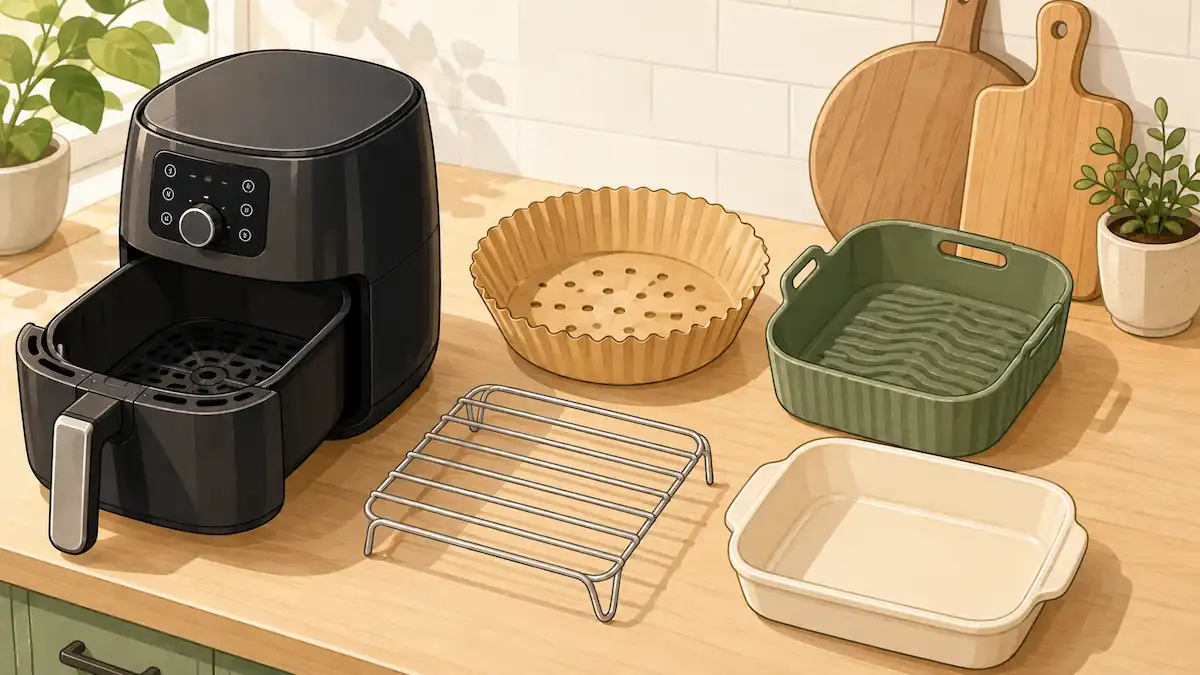
Before using a liner, tray or rack, check that your air fryer’s instructions permit it and that the accessory is rated for food contact at your cooking temperature. A product labeled oven-safe, food-grade, or made for air fryers still needs to fit without touching the heating element, blocking required airflow, or exceeding its stated heat limit.
Accessory permission is model-specific. One manufacturer may allow parchment paper or foil in a particular basket, while another may advise against covering the basket floor because it changes airflow or can lift toward the heating element. The manual for the exact model should take priority over generic accessory packaging or advice written for a different air fryer.
This article covers removable and add-on items such as parchment liners, silicone inserts, foil, racks, trays, skewers, baking dishes, and replacement parts. For the materials used in the original basket and crisper plate, see our guide to air fryer basket materials.
For complete appliance recommendations, see our guide to the best non-toxic air fryers. To interpret PFAS-free, PTFE-free, ceramic-coated, and related material claims, read what PFAS-free means on an air fryer.
Are Air Fryer Accessories Safe?
They can be, but air fryer accessories are not universally interchangeable. The important questions are whether the accessory is permitted in the exact model, intended for the selected temperature and cooking mode, correctly sized, stable inside the basket or cavity, and positioned so that hot air can still circulate as designed.
Official guidance shows why the model number matters. Philips advises against baking paper and foil in the Airfryer models covered by its guidance because covering the basket or pan can reduce airflow, and loose paper can be pulled toward the heating element. By contrast, Ninja permits parchment paper and aluminum foil in the AF150 Series basket.
Neither statement should be generalized to every appliance made by either brand. Basket-style, dual-basket, oven-style, and glass-container air fryers can use different airflow paths, heating-element locations, sensors, and accessory supports.
Start with compatibility. Find the exact manual, identify where the accessory will sit, compare its outside dimensions with the usable basket or rack space, and confirm its temperature limit before ordering.
Air Fryer Liners and Accessories at a Glance
Different accessories solve different problems. Paper and silicone can reduce direct cleanup, racks can create another cooking level, dishes can contain batter or sauce, and replacement parts can restore the appliance’s original setup.
The tradeoff is that every added surface changes fit, airflow, grease movement, or the area available for food. Use the comparison below to decide which specifications need to be verified before purchase.
Air Fryer Accessory Buying Checks
| Accessory | What to Verify | Airflow and Fit | Main Tradeoff | Best Use |
|---|---|---|---|---|
| Perforated parchment liner | Exact heat limit, basket compatibility, liner dimensions, and whether the appliance manual permits paper. | Food must weigh it down. Holes and exposed space around the liner help preserve airflow. | Reduces direct cleanup but can still reduce grease drainage or browning compared with the bare crisper plate. | Quick cleanup |
| Solid paper bowl liner | Temperature rating, wall height, base dimensions, and permission for the exact model. | Solid sides and bottom catch drips but cover more of the basket’s perforated airflow path. | Useful for wet or saucy food, with a larger potential crisping and drainage tradeoff. | Messy foods |
| Reusable silicone liner or basket | Food-contact purpose, maximum temperature, dimensions, wall height, and approved cooking modes. | A solid insert creates a second vessel inside the basket. Ribs or holes can preserve more space beneath food. | Reusable and easy to wash, but thick walls and a solid floor can change airflow and grease collection. | Reusable cleanup |
| Aluminum foil | Whether the exact manual permits foil and where it may be placed. | Do not cover required vents or leave a loose sheet where moving air can lift it. | Can shape around a small food or pan but may interrupt airflow or grease drainage when spread across the basket. | Model-specific use |
| Metal rack, tray, or skewer set | Outside dimensions, metal or coating disclosure, stability, weight limit, and heating-element clearance. | Raised racks can add cooking levels but need open space around and between foods. | Expands versatility while adding hot metal parts, cleaning seams, and another fit requirement. | Extra cooking levels |
| Glass or ceramic dish | Explicit air-fryer or exact-appliance permission, temperature limit, thermal-use instructions, and outside dimensions. | Leave the side clearance required by the appliance so air can circulate around the dish. | Contains batter, sauce, and drippings but reduces direct airflow around the food. | Baking and sauces |
| Replacement basket or crisper plate | Exact model number, correct side for dual baskets, dimensions, handle or sensor compatibility, and material disclosure. | The replacement should restore the original spacing and airflow path rather than merely fit inside the drawer. | Can extend appliance use, but a visually similar third-party part may not duplicate the original construction. | Restore original setup |
An accessory label does not override the appliance manual. Verify permission, temperature, fit, placement, and airflow for the exact model.
The accessory with the fewest tradeoffs depends on the food and the appliance. A perforated paper liner may be useful for quick cleanup, while a solid silicone basket may be better for wet ingredients but less helpful when the goal is maximum airflow around dry food.
Accessories approved for the exact model are the clearest starting point, but third-party options can still be evaluated by their dimensions, temperature rating, intended food-contact use, and placement instructions.
Parchment Liners: Check Heat Limit, Airflow, and Food Weight
Parchment liners are designed to reduce sticking and keep grease or residue from reaching part of the basket. Their convenience depends on using the correct product at the correct temperature without allowing the paper to move toward the heating element.
Reynolds air-fryer liner instructions rate that specific product to 400°F on the air-fryer setting, require food to be placed on the liner before use, and use pre-cut holes to preserve airflow. A different brand or product can have a different temperature limit, coating, size, or placement requirement.
If the air fryer needs to preheat, leave a lightweight liner out until food is ready to be added. A loose sheet can lift in the moving air. The food should cover enough of the liner to hold it flat without forcing the paper up the sidewalls or into the heating area.
Perforated liners usually preserve more of the basket’s intended airflow than a solid paper bowl. A solid liner may catch sauce and drippings more effectively, but it also covers more of the crisper plate and can keep grease beneath the food rather than allowing it to drain.
Before buying, compare the liner’s outside dimensions with the usable basket floor rather than relying on the appliance’s advertised quart capacity. A liner that folds sharply up the walls, covers too little of the base, or extends into the heating path is not a good fit.
Silicone Air Fryer Liners: Reusable, but Not Performance-Neutral
A silicone liner or reusable basket creates a second removable vessel inside the original basket. This can simplify cleanup and contain grease, crumbs, marinades, or soft ingredients, but it also changes how air reaches the bottom and sides of the food.
Do not rely on the phrase food-grade alone. The FDA’s explanation of food-contact regulation notes that authorizations are tied to specified intended uses and applicable limitations. For buyers, that means checking the liner’s stated cooking purpose, maximum temperature, and permitted appliances rather than treating all silicone products as interchangeable.
The liner’s geometry matters as much as its material. A solid floor and tall walls contain more drippings but cover more of the original basket’s perforations. Raised ribs, drainage channels, or holes may create more space beneath the food, although they do not recreate the bare crisper plate exactly.
Compare the liner’s outside width, base width, wall height, and handle tabs. It should sit flat without folding, touching the heating element, interfering with drawer closure, or reducing the usable cooking area more than expected.
Check the cleaning instructions as well. Confirm whether the liner is handwash-only or dishwasher-safe and whether any removable inserts or handles need to be cleaned separately.
Aluminum Foil Is a Model-Specific Accessory
Foil can be useful for wrapping ingredients, containing a small food, or lining a permitted pan. It should not automatically be spread across the entire basket, crisper plate, or grease-collection area.
Manufacturer instructions differ. Ninja permits aluminum foil in the AF150 Series basket, while Philips advises against foil in the Airfryer models covered by its guidance because covering the basket or pan can disrupt airflow. A general statement that foil is always permitted or never permitted is therefore not useful.
When the exact manual permits foil, keep it stable, away from the heating element, and clear of required vents. Do not leave a loose sheet inside during preheating, and do not assume that molding foil across every perforation will preserve the appliance’s original airflow or grease drainage.
Also confirm where the manual permits foil to sit. Permission inside a basket does not necessarily mean it can be placed beneath the basket, across a drip area, on a heating element, or in every cooking mode.
Metal Racks, Trays, and Skewers Must Fit the Exact Cooking Space
Metal accessories can raise food, add a cooking level, hold skewers, support a baking pan, or replace a missing tray. Their usefulness depends on stable placement and adequate clearance rather than the metal name alone.
Measure the rack or tray’s complete outside dimensions, including feet, handles, rolled edges, skewer ends, and any part that projects beyond the cooking surface. It should not scrape the basket walls, prevent the drawer from closing, or place food too close to the heating element.
Official accessory sets illustrate why sizing should be model-specific. The COSORI air-fryer accessory specifications publish different cake-pan, pizza-pan, rack, and skewer dimensions for its 3.7- and 5.8-quart accessory sets rather than treating one set as universal.
Check the material or coating of the food-contact part separately. A silver rack may be stainless steel or chrome-plated steel, while a dark tray may use an applied nonstick coating. That disclosure belongs to the accessory itself and should not be inferred from the appliance’s basket.
The Fritaire is a useful example of why accessories deserve their own evaluation. Fritaire identifies its air stand, tumbling basket, rotisserie components, and other principal cooking accessories as 304 or 18-8 stainless steel, but the three setups use the available cooking space differently and require different loading, handling, and cleaning steps. The full Fritaire glass air fryer review shows how those accessories function in the complete cooking system rather than treating them as interchangeable add-ons.
A second level also needs space between layers. Adding a rack does not double effective capacity when food is packed too closely for air to circulate or when the upper layer sits near the heater.
Glass and Ceramic Dishes Need Approval From Both Sides
Glass and ceramic dishes can contain batter, cheese, sauces, casseroles, or foods that would drip through a perforated basket. However, oven-safe does not automatically mean approved for every air fryer.
The instructions can differ even among familiar products. Philips says ovenproof glass, ceramic, metal, and silicone dishes can be used in the Airfryer models covered by its guidance. In contrast, Pyrex states that its glass dishes should not be used in an air fryer, which it characterizes as a direct heat source.
The practical rule is that both the dish manufacturer and the appliance manufacturer should permit the use. A general oven-safe statement from the dish and a generic air-fryer recipe are not enough when either manufacturer excludes the combination.
Fit still matters after material compatibility is confirmed. Philips advises leaving space around a baking tin or oven dish so air can circulate. Check the dish’s outside dimensions, rim, handles, and usable height beneath the heating element.
Do not use storage lids, plastic covers, or silicone seals during heated cooking unless their instructions specifically permit it. The cooking vessel and its lid can have different temperature and appliance restrictions.
Replacement Baskets and Crisper Plates Require an Exact Model Match
A replacement basket, drawer, tray, or crisper plate is not simply another generic accessory. It may need to align with rails, handles, sensors, magnets, safety switches, divider supports, and the original airflow geometry.
Use the complete model number from the appliance rating label or manual. Dual-basket appliances may also use different left and right parts even when the drawers look similar.
Ninja’s official air-fryer parts and accessories catalog directs buyers to search by model number and lists model-specific baskets, crisper plates, racks, containers, and related parts. That is a stronger compatibility signal than a marketplace listing that only names a quart range.
Confirm that the replacement also matches your material preference. The new part may use a different coating, substrate, color, or generation than the original. Request a written material disclosure when the listing does not identify the food-contact surface.
Physical fit alone is not enough. A third-party crisper plate that drops into the drawer may still sit at a different height, cover vents differently, rattle, interfere with removal, or change the space beneath food.
Airflow and Fit Matter More Than Accessory Size Labels
Accessory listings often describe compatibility by quart range, but a 6-quart square basket, 6-quart round basket, and 6-quart glass vessel can have very different floor dimensions and heating layouts.
Compare the accessory with the exact usable cooking area:
- Base length and width: The accessory should sit flat without forcing its corners or walls against the basket.
- Wall and handle height: Raised tabs, cups, and dish rims need clearance beneath the heating element.
- Space around the sides: Dishes and solid inserts may need open space for circulating air.
- Basket perforations: A solid liner or pan covers more of the original airflow and drainage path than a perforated liner or open rack.
- Food weight: Lightweight paper and foil need enough food to remain stable when the fan starts.
- Drawer closure: The complete loaded accessory must fit without pressure against the housing or controls.
The same principle applies to capacity. A liner or dish can reduce the cooking-floor area available to food. Compare the remaining usable space with the meals you cook most often, using our air fryer capacity guide when sizing is a major concern.
What to Check Before Buying an Air Fryer Accessory
Use the following checklist with the exact accessory and exact appliance.
- Find the appliance model number. Do not rely only on the brand, product family, or advertised quart capacity.
- Read the appliance manual. Confirm whether the accessory category is allowed and where it may be placed.
- Read the accessory instructions. Check its intended appliance, food-contact purpose, maximum temperature, and prohibited cooking modes.
- Measure the usable interior. Record the basket or rack length, width, side clearance, and height beneath the heating element.
- Compare airflow coverage. Determine how much of the crisper plate, basket perforations, vents, or grease path the accessory will cover.
- Identify every food-contact material. Check paper coatings, silicone, metal, glass, ceramic, nonstick surfaces, and painted or plated components separately.
- Check stability when loaded. The accessory should not tip, lift, rattle excessively, or move toward the heating element.
- Review cleaning instructions. Confirm whether it is disposable, handwash-only, or dishwasher-safe and whether separate pieces must be removed.
- Confirm replacement availability. For proprietary trays, racks, liners, filters, or containers, check whether the manufacturer sells extras individually.
- Keep the return window in mind. Test fit with the appliance cool and unused before cooking makes the accessory nonreturnable.
Common Air Fryer Accessory Mistakes
Assuming Air Fryer Means Universal Fit
An accessory can be intended for air fryers generally while still being too large, too tall, or incompatible with a particular heating layout.
Preheating With Loose Paper or Foil
Lightweight material can lift in the fan’s airflow. Add it only when the exact manual permits it and when food is ready to hold it in place.
Using Wax Paper or Freezer Paper
Neither product is a substitute for air-fryer parchment. Reynolds explains that wax paper cannot withstand high temperatures and can melt when exposed to excessive heat. Its separate freezer-paper guidance excludes air-fryer use because the coating can melt and the paper can catch fire.
Choosing by Temperature Rating Alone
An accessory can tolerate the selected temperature and still be a poor fit because it blocks airflow, sits too close to the heater, or is not permitted in that appliance.
Covering the Entire Airflow Path
A liner or sheet that covers every perforation changes the airflow and grease drainage the basket was designed to provide.
Using a Storage Lid During Cooking
A glass or silicone container may be heat-compatible while its plastic storage lid is not. Treat the vessel, lid, gasket, and handle as separate components.
Buying a Generic Replacement by Quart Size
Quart capacity does not confirm rail alignment, handle fit, sensor compatibility, basket height, or crisper-plate airflow.
Frequently Asked Questions
Are parchment liners safe in an air fryer?
They can be when the exact appliance permits paper, the liner is rated for the selected temperature, it fits inside the approved cooking area, and food weighs it down. Do not assume permission across models because manufacturer instructions differ.
Are silicone air fryer liners safe?
A silicone liner should be intended for heated food contact, rated above the selected cooking temperature, permitted in the appliance, and sized so it does not touch the heater or interfere with drawer closure. Food-grade wording alone does not provide all of that information.
Do silicone liners reduce crisping?
A solid silicone liner covers part or all of the original perforated cooking surface, so food receives a different airflow and grease-drainage pattern. The effect depends on the liner’s holes, ribs, wall height, food arrangement, and the appliance’s heating design.
Can aluminum foil go in an air fryer?
Only when the exact appliance instructions permit it. Keep permitted foil stable, away from the heating element, and clear of required vents. Do not assume that guidance for one brand or model applies to another.
Can you put a glass dish in an air fryer?
Only when both the dish manufacturer and the air fryer manufacturer permit that exact use. Some air-fryer manufacturers allow suitably sized ovenproof glass dishes in specified models, while Pyrex specifically states that its glass dishes should not be used in an air fryer.
Can a rack double air fryer capacity?
An approved rack gives you another level. Before counting it as twice the space, check whether your usual portions fit on both levels with the clearance the manual calls for. Then consider how you will reach them. If turning the lower portion requires lifting out a hot rack, that matters when you are choosing between an insert and a larger basket.
Are third-party replacement baskets safe?
A third-party part should match the exact model, dimensions, handle or sensor design, airflow geometry, food-contact materials, and temperature range. A listing that only says it fits a particular quart size does not establish complete compatibility.
The Bottom Line
Choose air fryer accessories by their compatibility with the exact model, intended food contact, temperature rating, dimensions, stability, and airflow. Paper and silicone can simplify cleanup, racks can add versatility, dishes can contain batter and sauces, and replacement parts can extend appliance use, but each changes the cooking setup in a different way.
Start with the appliance manual, then verify the accessory’s instructions. Measure the usable interior, leave required clearance, keep lightweight liners weighted with food, and do not assume that oven-safe glass, generic foil, or a replacement sold by quart size is automatically compatible.
For appliance-level comparisons involving food-contact materials, capacity, coatings, and accessory compatibility, return to our non-toxic air fryer buying guide.
Important: This article provides general information, not individualized medical, safety, installation, legal, or other professional advice. Product specifications, instructions, and safety information can change; verify current information with the manufacturer and consult an appropriately qualified professional when needed. See our Terms and Conditions for additional information.