
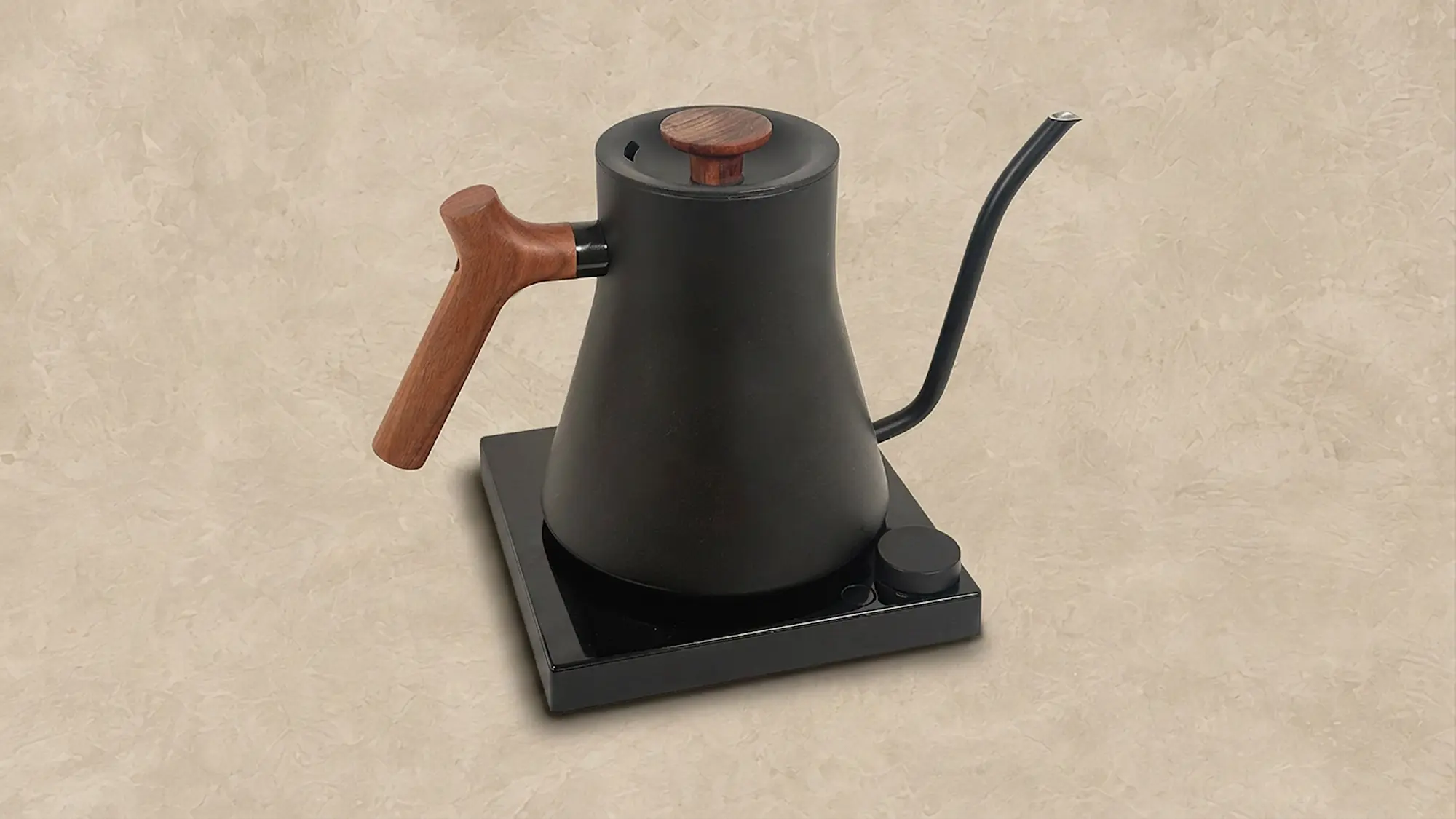
The Fellow Stagg EKG Pro Studio Edition has earned its place in my kitchen through daily use since December 15, 2023. I reach for it for both green tea and pour-over coffee, and the appeal is in the handling as much as the heating: a smooth gooseneck pour, a well-balanced kettle, and a temperature dial that makes switching between drinks straightforward. The wood on my black kettle still feels like a worthwhile part of the Studio finish each time I pick it up.
The deciding feature is the spout. I value its controlled stream for coffee, even though it fills a tea mug more slowly than I would like. In a kitchen that makes both drinks, that is a sensible tradeoff. The stronger endorsement is the ownership record: after more than two and a half years, I have had no issues, and I would choose it again.
This review brings that daily experience together with a 500 g heat-up test, separate thermometer checks, three timed pours, a 30-minute Hold check, and a full-hour energy measurement. I also recorded power, voltage, sound, exterior heat, and dimensions, and tried scheduled heating and a firmware update. Those results help explain where the Stagg earns its 8.5/10 and what matters when deciding whether its pouring style fits your kitchen.
Review disclosure: I purchased this kettle myself. Some links in this guide are affiliate links. If you purchase through them, The Hearthful Home may earn a small commission at no additional cost to you. As an Amazon Associate, we earn from qualifying purchases.
Fellow Stagg Review at a Glance
Controlled Pouring That Holds Up to Daily Use
The Stagg combines the smooth pour I want for coffee with the simple temperature selection and Hold function I use for tea. My 500 g test reached its ready signal in 2 minutes 43 seconds, and the display matched a separate probe at all three recorded Hold checkpoints. Daily use since December 2023 has brought no faults or visible finish damage. That mix of handling, useful controls, and sustained condition is why I recommend it.
A household that makes pour-over coffee as well as tea and will use the gooseneck, direct temperature selection, and timed Hold. I switch between 160°F for green tea and around 200°F for coffee with the dial, then use Hold when I want another glass. The regular Pro offers the same scheduling and timed Hold. The Studio premium buys the glass-topped base and upgraded finishes, including the wood touchpoints I enjoy on mine. Its documented capacity is 0.9 L.
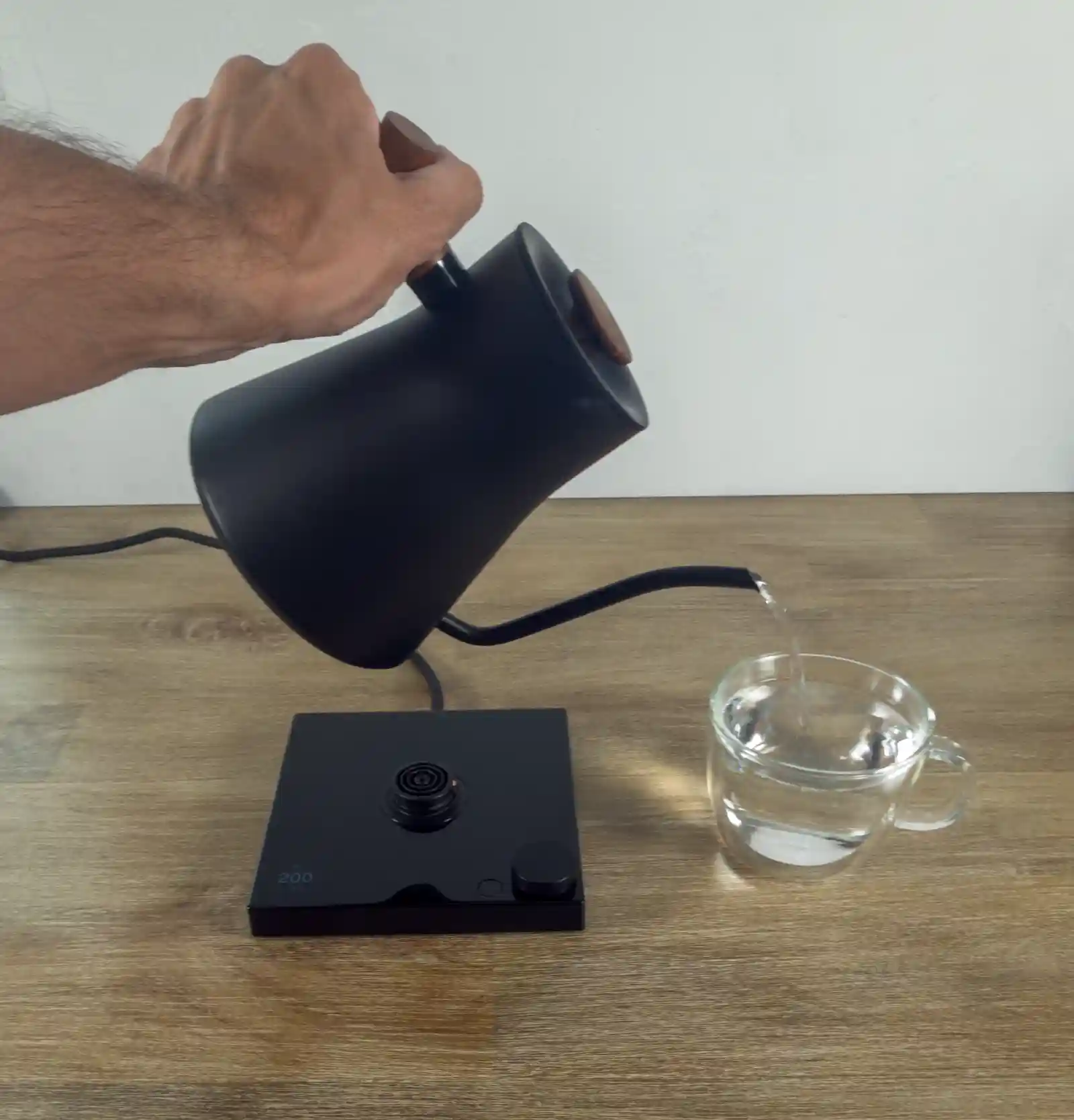
The gooseneck paired with the kettle’s balance. All three 10-second trials produced a smooth stream, and in daily use the spout stops without dripping after I finish. The full kettle feels balanced in my hand, while I especially like the feel of the wooden handle. Those details are noticeable throughout a pour, which is why the spout remains my favorite part of using it.
The restricted flow when I am simply filling a tea mug. That job takes longer than I would like, even though the same spout is a strength for pour-over coffee. A buyer who mainly wants to fill cups quickly has less reason to choose this design. The question is how often the control will be useful in your own brewing routine.

Fellow Stagg EKG Pro Studio Edition
A 0.9 L electric gooseneck kettle with adjustable temperature, a color display, timed Hold, and a glass-topped Studio base.
One Kettle for Green Tea and Pour-Over Coffee
Green tea is my most frequent drink, usually with the kettle set to 160°F. I prepare enough water for a second glass, so Hold has a clear purpose: it keeps the remaining water ready while I enjoy the first one. That makes Hold useful for the way I drink tea.
For pour-over coffee, I usually turn the temperature up to around 200°F. The dial makes that change direct and easy to follow on the display. I have not needed presets because choosing the temperature myself already suits the way I brew. These are my preferred settings; coffee, tea, and taste can call for different choices. What works here is being able to make that choice without changing appliances or working through an app.
How I Tested the Fellow Stagg
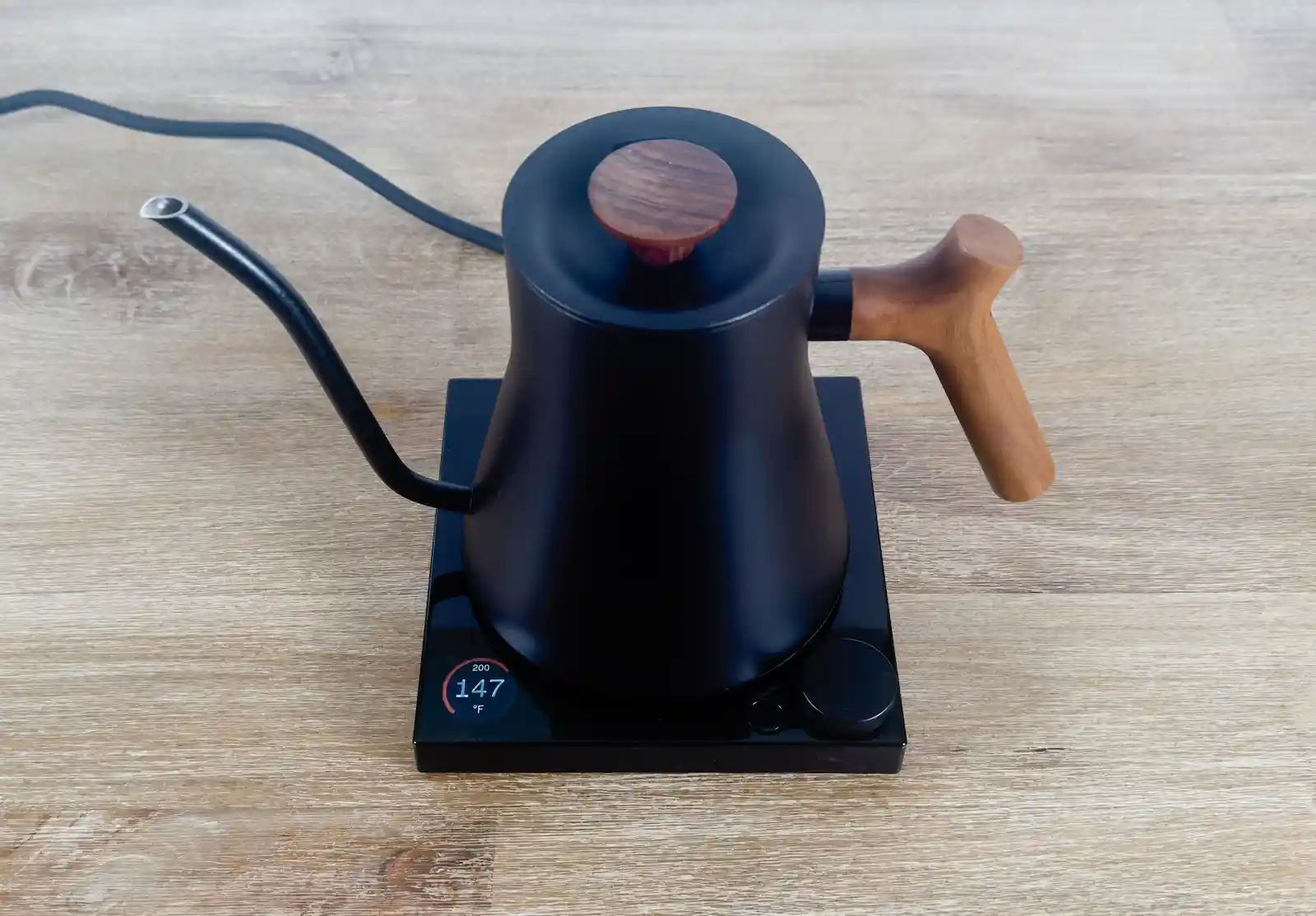
The ownership observations cover daily use since December 2023. I completed the measurement sheet on August 27, 2026, using a Hario scale, probe thermometer, phone timer, Kill A Watt meter, sound meter, infrared thermometer, and measuring tools.
I used those checks to add detail to the questions that come up in daily ownership: how the kettle heats a measured fill, how it pours, how Hold behaves, and what condition it is in after regular use. The review follows the Hearthful Standard, with six equally weighted assessment factors.
What Was Measured, Observed, and Sourced
Heat-up time, water temperature with a separate probe, poured water mass, peak input power, supply voltage, total energy over one hour, sound, exterior IR temperatures, and dimensions.
A 500 g heat-up run, a one-hour energy measurement, three 10-second pours, temperature agreement and Hold checks, app pairing and a firmware update, and scheduled heating.
Dial operation, full-kettle balance, lid handling, pour-stop drips, wood condition, and daily coffee-and-tea use.
Model identification, component materials, rated capacity and power, care instructions, and purchasing policies.
Fellow Stagg Test Results and Measurements
Heat-Up, Hold, and Pouring Results
| Test | Setup | Result | What It Establishes |
|---|---|---|---|
| Heat-up | 500 g water; 82°F start; 200°F selected | 2 min 43 sec to ready signal | One timed run from the stated starting temperature. |
| Temperature / Hold at start | 200°F setting; 0 minutes | Display: 199°F; probe: 199°F | The separate thermometer matched the display. |
| Temperature / Hold after 15 min | Same 500 g hold check | Display: 198°F; probe: 198°F | Both readings agreed at the second checkpoint. |
| Temperature / Hold after 30 min | Same hold check; reheating observed | Display: 200°F; probe: 200°F | Both readings matched the selected temperature at this checkpoint. |
| Pour trial 1 | 10-second pour | 213 g; smooth stream | Smooth flow throughout the trial. |
| Pour trial 2 | 10-second pour | 242 g; smooth stream | Smooth flow throughout the trial. |
| Pour trial 3 | 10-second pour | 237 g; smooth stream | Smooth flow throughout the trial. |
The separate thermometer and display agreed at all three recorded checkpoints. The three timed pours averaged 230.7 g in 10 seconds, approximately 23.1 g/s.
Readings From My Home Setup
| Measurement | Reading | Evidence | Context |
|---|---|---|---|
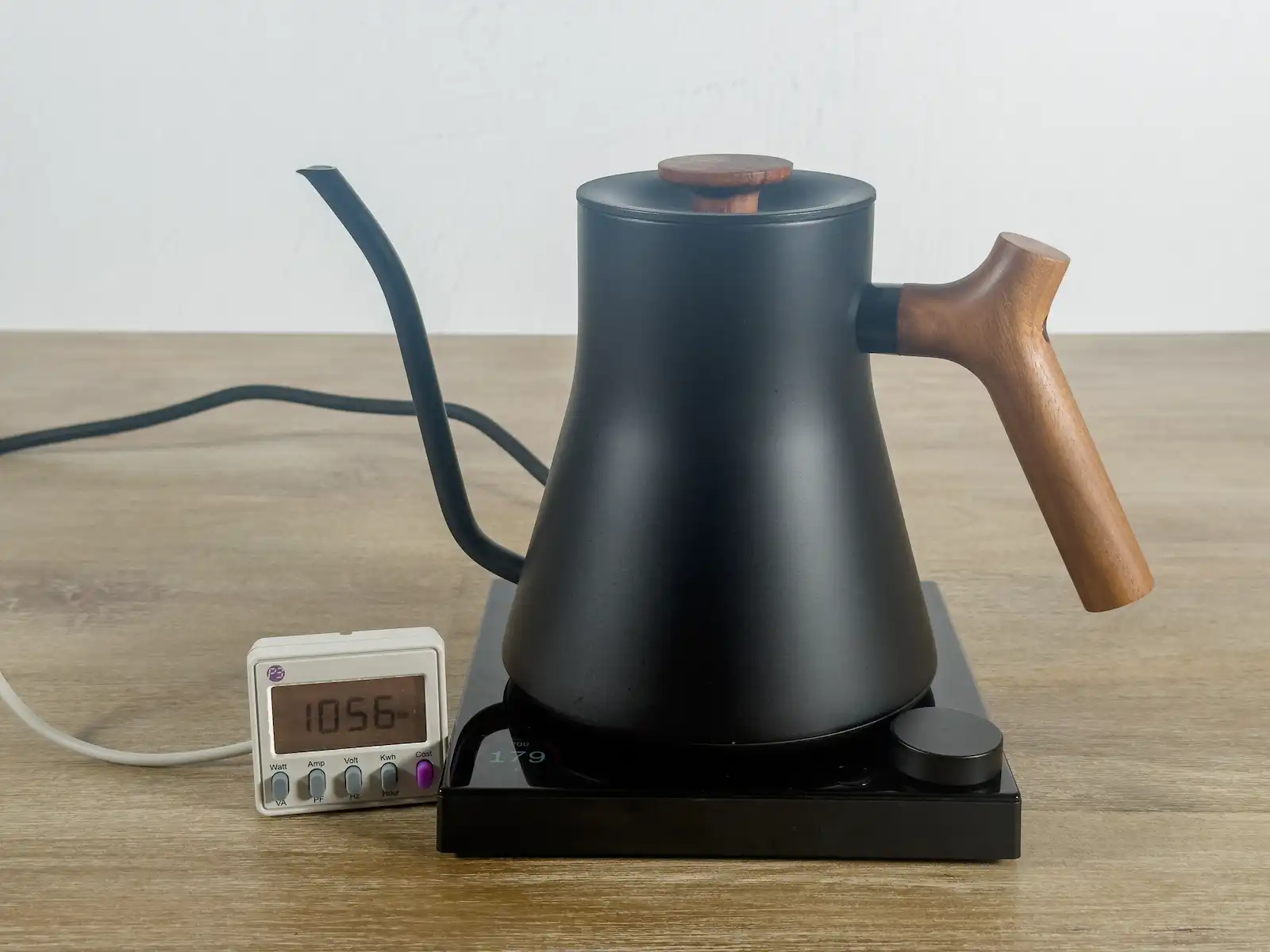
| Peak input power | 1,058 W | THH Measured | Recorded during the 500 g heat-up; different from rated power and energy consumed. |
| Supply voltage | 114.2 V | THH Measured | Recorded during the same 500 g heating test. |
| Energy over one full hour | 0.43 kWh | THH Measured | 500 g water; 200°F selected; Hold enabled. The 60-minute total includes the initial heat-up. |
| Room sound baseline | 39.6 dBA | THH Measured | Baseline for the sound check. |
| Heating sound peak | 60.9 dBA | THH Measured | Meter at 3 feet; peak rather than average heating sound. |
| Ready alert | 47.7 dBA | THH Measured | Meter at 3 feet. I describe the alert as light but audible. |
Surface Readings After Heating
| Location | IR Reading | Evidence | Handling Context |
|---|---|---|---|
| Sidewall | 198°F | THH Measured | Treat the kettle body as a hot surface. |
| Handle center | 82.3°F | THH Measured | Reading at the measured wooden grip area. |
| Lid knob | 97.2°F | THH Measured | I take care to touch only the wood when handling the lid. |
| Display/base surface | 85.9°F | THH Measured | Exterior surface temperature, not the water temperature shown on screen. |
| Cord | 77.1°F | THH Measured | One recorded location and operating condition. |
| Plug | 87.9°F | THH Measured | One recorded location and operating condition. |
These exterior IR readings were taken at the listed locations after heating. The metal body remains a hot surface even when the wooden grip feels comfortable. Follow the Fellow safety manual when lifting, pouring, and removing the lid.
The Hearthful Assessment
The Stagg’s strongest scores come from repeated, ordinary interactions: turning the dial, lifting a full kettle, directing the stream, and returning for another glass of tea. Its condition after daily use also carries real weight. The six scores below keep those ownership findings alongside the measurements and the quality of Fellow’s documentation.
Fellow Stagg EKG Pro Studio Edition
Excellent handling with a strong ownership record
The six category scores total 51. Dividing by six gives 8.5 out of 10.
Materials and Water-Contact Construction
I bought this kettle to replace a cheaper model with plastic contact parts. Fellow identifies the water chamber as 304 stainless steel, with a silicone seal around the temperature probe. Its component disclosure also separates the lid and base construction. That detail is useful when choosing a kettle around materials, because a stainless chamber is one part of the complete assembly.
Where the Main Materials Are Used
| Part | Documented Material | Evidence | Review Context |
|---|---|---|---|
| Water chamber | 304 stainless steel | Manufacturer Documented | No interior rust observed on my unit. |
| Temperature-probe seal | Compression-molded silicone ring | Manufacturer Documented | A seal inside the stainless water chamber. |
| Lid | Stainless underside; silicone gasket; polypropylene components | Manufacturer Documented | Fellow does not specify the exact position of the polypropylene within the lid assembly. |
| Pro Studio base | Polypropylene base with glass top | Manufacturer Documented | Fellow’s component guide describes this construction; other copy also names metal base parts. |
| Wood touchpoints | Real wood accents; walnut is an offered option | Manufacturer Documented | I especially like the feel of the wood. |
Material identification comes from Fellow’s component disclosure and model guide, rechecked October 20, 2026. Condition and handling observations describe my own kettle.
The component breakdown is more useful than treating the whole appliance as a single material. The chamber is stainless steel, the probe has a silicone seal, and the lid includes both a gasket and other components. The plastic described in the base is separate from the water chamber. For me, the stainless interior and the feel of the wooden grip are the meaningful everyday benefits; both have held up well in my kitchen.
Fellow’s PFAS disclosure says its external and water-contact components are PFAS-free. It separately identifies PFAS in control-board components inside the base. That distinction keeps the claim attached to the parts it describes: the disclosure does not report PFAS in kettle water.
Design, Capacity, and Fit
The wooden handle and lid knob are among the Studio details I appreciate most. The wood feels luxurious to me, and its role is practical as well as visual: it is what my hand meets when I lift the kettle or remove the lid. The full kettle also feels balanced. Together, those qualities give the design substance beyond the black-and-wood appearance on the counter.
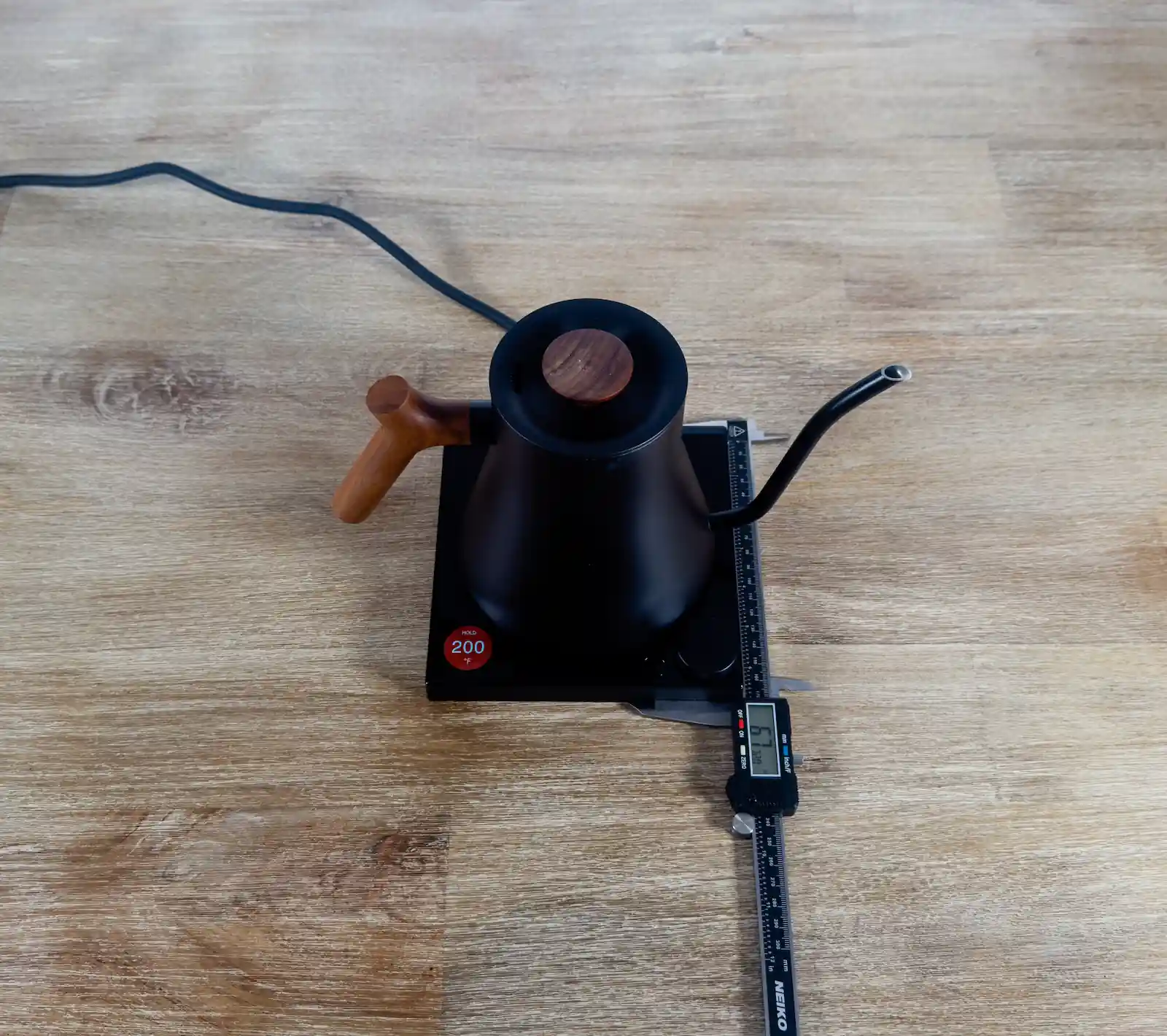
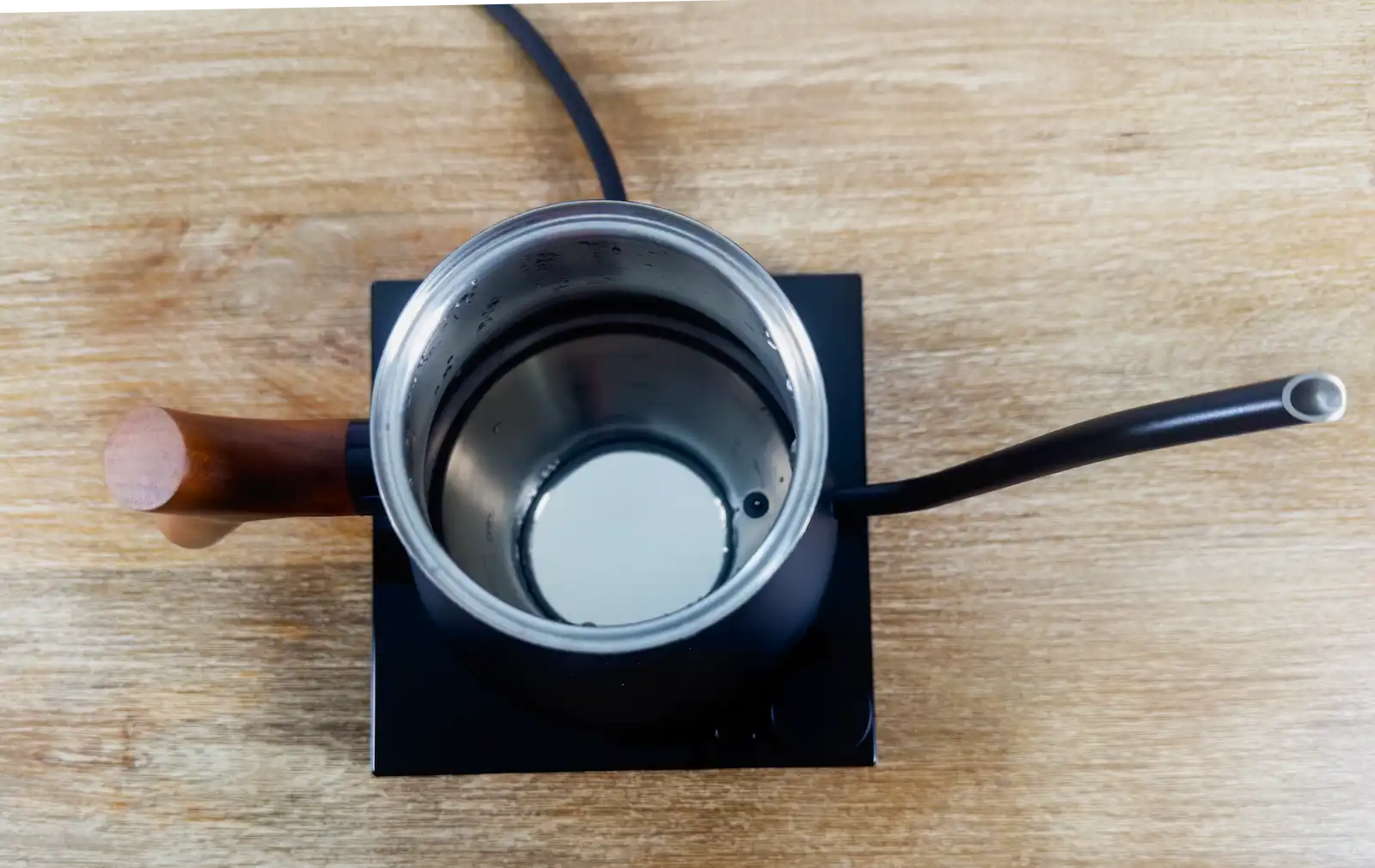
My base measured about 6.78 inches square, and the assembled height with the lid was about 7.75 inches. The handle and gooseneck extend beyond that square, so the base measurement alone is not the space to reserve on a counter. Fellow’s published overall dimensions are 11.10 × 6.77 × 7.7 inches. Leave room for those projections and for lifting the kettle and lid, particularly under a cabinet.
The lid removes easily, and the fill opening measured approximately 3.6 inches across. I have very large hands, so I deliberately keep my fingers on the wooden knob when removing the lid, clear of the surrounding hot metal. The measured opening is a useful filling and access detail; it does not change the water-level markings inside the kettle.
Base Footprint Is Not the Whole Footprint
| Measurement | Result | Evidence | Context |
|---|---|---|---|
| Base width × depth | About 6.78 × 6.78 in | THH Measured | Excludes handle and spout overhang. |
| Height with lid | About 7.75 in | THH Measured | Allow extra space to lift the lid and kettle. |
| Fill opening | About 3.6 in | THH Measured | Diameter of the opening. |
| Rated capacity | 0.9 L / 30 oz | Manufacturer Documented | Fellow’s published capacity; follow the fill markings. |
Heating, Hold, and Pouring in Practice
Heating a measured 500 g fill
The 500 g fill started at 82°F and reached the ready signal in 2 minutes 43 seconds with 200°F selected. The separate probe read 199°F at the start of the Hold check, matching the kettle display. Read together, the timer and thermometer describe both the wait to the signal and the water temperature at the recorded checkpoint.
Peak input during that heating run was 1,058 W at a supply voltage of 114.2 V. Fellow’s US/Canada Studio manual lists 1,000 to 1,200 W and 110 to 120 V, so both readings sit within its documented ranges. The useful comparison is the complete setup: water quantity, starting temperature, selected temperature, and supply conditions. The 2:43 result belongs to this 500 g run.
Energy use across a full hour
The energy measurement continued for a full hour from the start of heating. With 500 g of water, 200°F selected, and Hold enabled, my meter recorded 0.43 kWh. That total includes the initial heat-up and the rest of the session with Hold enabled. Use the full-hour total when estimating the cost of a similar session.
At an example electricity rate of $0.25 per kWh, that recorded session would cost about 11 cents: 0.43 kWh × $0.25 = $0.1075. Substitute your own rate for a local estimate. The timer’s 2:43 result describes the first heating stage, while the 1,058 W figure describes peak input. Neither of those readings separates out the energy used during the initial heat-up from the measured hour.
Hold is useful beyond the first glass
Hold earns its place by keeping water available for the next drink. I compared the display with a separate probe in stirred water, positioned in the center and clear of the metal. At the three recorded checkpoints, the two readings agreed. That makes the display useful in my routine: the temperature I was following on the base matched the separate thermometer during these checks.
With 200°F selected, both instruments read 199°F at the start, 198°F after 15 minutes, and 200°F after 30 minutes, with reheating observed. The values stayed within 2°F of the target at those checkpoints. Fellow offers 15-, 30-, 45-, and 60-minute Hold settings, letting an owner choose how long water remains ready after heating. My normal reason to use it is a second glass of green tea.
The pour is the reason to choose it
The pouring tests put numbers beside the feature I enjoy most. Three 10-second pours delivered 213 g, 242 g, and 237 g, with a smooth stream in each trial. Their average was 230.7 g over ten seconds, or approximately 23.1 g/s. In daily use, I also find that the spout stops without dripping. Smooth delivery and a clean stop are the useful results here, alongside the balance I feel while holding a full kettle. At that average flow, a continuous 300 g pour into a mug would take about 13 seconds. That estimate helps put the narrow spout in perspective when you switch from a deliberate pour-over to filling cups for tea.
That controlled flow suits pour-over coffee, where pouring is part of the brewing process. Filling a tea mug is a simpler job, and the narrow spout takes longer than I want for it. The same design has different value in those two situations. It remains a good match for my mixed routine because I regularly use the coffee-pouring control as well as the temperature settings for tea.
Use and Interaction
The ready alert is light but audible in my kitchen. It measured 47.7 dBA at three feet, compared with a 60.9 dBA heating peak and a 39.6 dBA room baseline. The peak belongs to the heating stage; the alert is a separate, quieter event. When comparing kettle sound readings, the distance and the event being measured matter as much as the number.
The exterior readings also explain the handling experience. I recorded 198°F on the sidewall, 82.3°F at the center of the wooden handle, and 97.2°F at the lid knob. The cooler wooden contact areas are useful, while the hot surrounding body still calls for deliberate handling. With my large hands, keeping my fingers on the knob is part of how I remove the lid comfortably.
Connecting the app and updating the firmware
I connected the kettle to the app easily and completed a firmware update without difficulty. That successful update is the part of the connected experience I can speak to directly. My everyday brewing still happens at the kettle, where the dial and display put the temperature choice in front of me.
Fellow describes EKG Updater as a firmware-update tool. It does not provide remote heating or temperature control, and normal kettle use does not require the app. The connection guidance specifies 2.4 GHz Wi-Fi for updates. This is useful maintenance connectivity, while Schedule and the brewing settings are handled through the kettle’s own menu.
Scheduling works, but I prefer fresh water in the morning
I filled the kettle the night before and tried scheduled heating, and it worked well. I usually prefer to fill it with fresh water in the morning because doing so takes very little time. Someone who wants water prepared ahead of time has a clear use for the feature; my preference is to fill and start the kettle when I am ready. That is a difference in routine, not a problem with how the schedule worked.
The menu adds useful choices around the dial
The Pro feature guide documents several options beyond selecting a target temperature. Guide Mode shows coffee and tea temperature suggestions, while the Brew Stopwatch times a pour-over or steep after a long press of the dial. Those are separate jobs: the temperature setting controls the water, and the stopwatch helps time what happens after pouring begins.
Schedule can be set for a single use or repeated daily after setting the clock. Altitude adjusts the available temperature ceiling for local boiling conditions. Pre-Boil changes the heating sequence by bringing water to a boil before cooling to the chosen target. These documented choices explain the menu’s breadth. My normal routine centers on direct temperature selection and Hold, with scheduling tried separately as described above.
Cleaning and Maintenance
I use only reverse-osmosis water and have not needed to descale since buying the kettle in December 2023. I empty the remaining water after use because I prefer not to leave it sitting inside, and I found no interior rust at inspection. Water supply matters to this experience: mineral deposits from harder water can create a different descaling routine.
Fellow’s care instructions recommend cleaning at least monthly. Let the kettle cool, wash the interior with soapy water and rinse, and wipe the exterior and base. Keep the electrical kettle and base out of the sink water and dishwasher, and avoid abrasive cleaning tools. Cleaning and descaling address different needs: the absence of mineral buildup in mine does not replace ordinary cleaning.
The wooden handle and lid knob still look new to me, although I have not oiled either one. Fellow’s wood-care guidance recommends food-safe mineral oil monthly, or when the wood feels dry, followed by buffing with a soft cloth. My experience shows how these particular accents have aged in my kitchen; that care advice gives a buyer a practical way to maintain the wood over time.
Durability and Longevity
By the August 2026 inspection, the kettle had seen more than two and a half years of daily use. I found no paint chips, coating wear, exterior damage, interior rust, or flex, and I have had no operating issues. The wood still looked new to me. This is a substantial part of the recommendation: the finish and handling I liked at purchase have continued to be part of daily use.
That condition also makes the Studio’s finish easier to judge. A premium appearance has more value when it survives repeated lifting, filling, pouring, and cleaning. In my kitchen, the black finish and wood have done that. The durability score reflects this ownership record and the inspection of my kettle.
For future service, Fellow’s replacement-parts page directs owners to Pro and Pro Studio kettle bodies and bases. Match the exact model before ordering: its compatibility guidance says these bodies and bases do not interchange with the original EKG generation. Being able to identify the correct assembly is useful if one part eventually needs replacing.
Parts selection and stock should be checked when a replacement is needed. I have not needed to replace the kettle or base, so my positive ownership assessment comes from the condition and operation of this unit. The next section explains where Fellow’s instructions could make that future parts search clearer.
Transparency and Trust
Fellow provides useful detail about the parts inside the kettle, the care of its wood accents, and the purpose of the app. Those disclosures help a buyer evaluate more than a product name or finish. The weakness is consistency across its own pages. I rechecked the points below on October 20, 2026; they concern finding and applying the right information, alongside my straightforward experience using the kettle.
Replacement parts: useful availability, conflicting guidance
Fellow’s Stagg gear guide says replacement kettle bodies and bases are unavailable, while its dedicated replacement-parts support page links to them for the Pro and Pro Studio. For an owner seeking a part, the dedicated support page is the useful starting point. Updating the older answer would remove an unnecessary obstacle and help someone find the correct replacement before considering a whole new kettle.
The app instructions need to agree
The pairing guide is titled for EKG Updater, but one step names the Fellow app. The separate connection troubleshooting page directs Pro owners to EKG Updater. A consistent app name would make the setup instructions easier to follow. My own connection and firmware update were straightforward; the naming discrepancy is in the written guidance.
Base materials need a more precise explanation
The gear guide describes a glass top, aluminum base, and zinc frame for Studio. The component disclosure names a polypropylene base with a glass top. Those descriptions may concern different layers of the assembly, but they leave the relationship unexplained. A labeled breakdown of the housing, frame, and upper surface would give a materials-focused buyer a clearer picture.
Warranty extensions need a purchase-date explanation
Fellow’s current warranty policy lists two years of standard limited coverage for Pro Studio, with optional paid extended protection for eligible US buyers. Its product page also links a 2022 guide offering an extra year through registration, while the newer guide linked from its gear page omits that offer. Apply the terms for the actual purchase date and seller, and keep any written extension confirmation. The current policy describes a new purchase; it does not establish the coverage status of my 2023 kettle.
What I would check before ordering
For an Amazon purchase, check the seller, model, and selected finish, and keep the invoice. Fellow’s eligibility terms call for an authorized seller and proof of purchase. Studio shares the Pro’s core brewing features, so the upgrade decision centers on the finish and touchpoints you want. My black kettle has wood accents; the product name alone does not specify every finish offered.
The 8/10 Transparency and Trust score recognizes the useful component and care disclosures while accounting for these conflicting instructions. The practical improvement would be one consistent set of buying, setup, and service information. That would make the documentation as straightforward to use as the kettle’s everyday controls have been for me.
Pros, Considerations, and Buyer Fit
Where the Stagg earns its place
The Stagg’s value is in a complete sequence: choose a temperature, lift a balanced kettle, direct a smooth stream, and return for more hot water if Hold is enabled. Each part serves something I actually do. That makes the extra control worthwhile for a household brewing both pour-over coffee and tea.
Studio’s contribution is the finish and the parts I touch. I enjoy the wooden handle and knob, and their condition after years of use gives that preference more substance than a first impression. The choice between Studio and Pro should reflect how much those details matter to you alongside the price; the core brewing features are shared.
The compromises to weigh
Start with the kind of pouring you need. A gooseneck is most compelling when you want to direct water through a coffee bed. For rapidly filling mugs, a wider spout may be a better fit. Our guide to gooseneck kettle features explains that choice in more detail.
Materials are a separate buying decision. The documented stainless chamber includes a silicone probe seal, and the lid assembly includes a silicone gasket and polypropylene components. Someone seeking to exclude those materials should evaluate that component list before purchasing. My positive view of the stainless interior does not turn the complete kettle into an all-metal appliance.
Then consider the amount of water you prepare. Fellow lists a 0.9 L maximum and a 333 mL minimum fill. Those limits matter for a small cup as well as a larger batch. Match the markings to your brewing needs, and use our kettle size guide if you regularly need more water in one fill.
Who I would recommend it to
I recommend it most strongly to someone who makes pour-over coffee regularly, also drinks tea, and wants direct temperature selection with useful Hold options. That is the routine in which its features work together. My years of use make the handling and condition central to the recommendation, alongside the measured heating and pouring results.
For Studio specifically, the decision is whether the glass-topped base and upgraded exterior details are worth paying for in your own kitchen. I appreciate those details every day, particularly the wood on my unit. A buyer mainly interested in brewing functions should also consider the standard Pro, which shares the core controls and gooseneck format.
Who This Kettle Fits
Best Fit
- A household making pour-over coffee as well as tea.
- Someone who wants to choose different temperatures with a simple dial.
- A tea drinker who values Hold for another glass.
- A buyer who appreciates balanced handling and wood touchpoints.
Consider Another Option
- You mainly fill tea mugs and prioritize a fast pour.
- You require an interior and lid assembly without silicone seals or plastic components.
- You regularly need more than the documented 0.9 L capacity in one fill.
Compare spout styles, materials, and kettle designs.
Explore Coffee and Tea KettlesSpecifications and THH Measurements
Published Details Alongside Our Results
| Specification | Detail | Evidence | Context |
|---|---|---|---|
| Reviewed model | Stagg EKG Pro Studio Edition | Manufacturer Documented | Studio model code EPS0AAUS in the US/Canada manual. The review concerns the kettle purchased in December 2023. |
| Reviewed finish | Black body; wood handle and lid knob | THH Observed | The finish on my unit. Studio listings offer different combinations; match the selected variant. |
| Maximum capacity | 0.9 L / approximately 30 fl oz | Manufacturer Documented | Published water capacity. Follow the maximum fill marking, and allow for the amount used by the brewer as well as the drink served. |
| Minimum fill | 333 mL | Manufacturer Documented | The Studio manual sets the minimum one inch above the kettle floor. Even a small serving requires water to the minimum marking. |
| Selectable temperature | 104–212°F | Manufacturer Documented | The published range spans lower-temperature tea settings through boiling conditions. Altitude can limit the reachable upper temperature. |
| My everyday settings | 160°F green tea; around 200°F coffee | THH Observed | Personal preferences selected directly with the dial. They are not universal temperature recommendations for every coffee or tea. |
| Rated electrical input | 110–120 V; 1,000–1,200 W; 50–60 Hz | Manufacturer Documented | US/Canada Studio specification. My recorded 114.2 V supply and 1,058 W peak input sit within those ranges. |
| Measured heat-up | 2 min 43 sec | THH Measured | 500 g of water starting at 82°F, with 200°F selected; timed to the ready signal. |
| Measured Hold checkpoints | 199°F / 198°F / 200°F | THH Measured | Display and separate probe agreed at 0, 15, and 30 minutes, respectively, with 200°F selected and reheating observed. |
| Available Hold durations | 15, 30, 45, or 60 minutes | Manufacturer Documented | Selectable time after heating. Choose how long water should remain ready for the next drink. |
| Full-hour energy | 0.43 kWh | THH Measured | 500 g at a 200°F setting with Hold enabled. The full 60-minute session includes the initial heat-up. |
| Published overall size | 11.10 × 6.77 × 7.7 in | Manufacturer Documented | Overall dimensions include the kettle’s projections. They describe a different footprint from measuring the square heating base alone. |
| Measured base and height | 6.78 × 6.78 in base; 7.75 in height | THH Measured | Height includes the lid. Leave additional clearance to lift the kettle off its base and remove the lid. |
| Measured fill opening | About 3.6 in | THH Measured | Diameter of the opening. Useful for filling and interior access; separate from water capacity. |
| Published assembled weight | 1,400 g, including base | Manufacturer Documented | Studio manual specification, not a THH scale result. My handling observation is that the full kettle feels balanced. |
| Published cord length | 2.5 ft | Manufacturer Documented | Consider the route from the base to the outlet. Follow the manual’s placement and cord-safety instructions. |
| Schedule | Once or Daily | Manufacturer Documented | Set the clock and schedule on the kettle. I tried overnight scheduling successfully but usually prefer filling in the morning. |
| Guide Mode and Brew Stopwatch | Temperature suggestions and a brewing timer | Manufacturer Documented | Guide Mode offers coffee and tea starting points. A long dial press starts the stopwatch for timing a brew or steep. |
| Altitude and Pre-Boil | Temperature ceiling and heating-sequence settings | Manufacturer Documented | Altitude accounts for local boiling conditions. Pre-Boil heats to boiling first, then cools to the selected temperature. |
| Connected function | Firmware updates through EKG Updater | Manufacturer Documented | Updates use 2.4 GHz Wi-Fi; normal kettle operation works without the app. I paired and completed an update successfully. |
| Replacement assemblies | Model-specific kettle bodies and bases | Manufacturer Documented | Fellow support directs Pro and Studio owners to replacements. Their bodies and bases are incompatible with the original EKG generation. |
| Current new-purchase warranty | Two-year limited warranty | Manufacturer Documented | Current terms require an eligible purchase and proof. Optional paid extended protection is offered to eligible US buyers; retain the terms for the actual purchase date. |
| Ownership and testing dates | Purchased Dec. 15, 2023; measured Aug. 27, 2026 | THH Observed | Daily coffee-and-tea use, supported by recorded heating, temperature, pouring, electrical, sound, surface, and fit checks. |
Published specifications were rechecked October 20, 2026 against the Studio safety manual, Pro feature guide, product specifications, and current warranty policy. THH measurements remain the recorded August 27, 2026 results.
Frequently Asked Questions
Is the Fellow Stagg EKG Pro Studio good for tea as well as coffee?
Yes, it fits my mixed routine well. I usually select 160°F for green tea and around 200°F for pour-over coffee, and Hold is useful for a second glass. Those are personal brewing choices. The gooseneck provides the pouring control I want for coffee; a tea-only buyer should decide whether that control is worth the slower mug fill.
What does Studio Edition add over the regular Pro?
Studio shares the Pro’s core brewing features and adds different exterior finishes and touchpoints. Fellow’s model guide identifies a glass top, metal frame details, and a metal handle end cap for Studio. I particularly like the wood handle and lid knob on my selected finish. Choose the edition for the construction and appearance you value, rather than assuming Studio brings a separately demonstrated improvement in heating or brewing.
How long does Hold keep the water hot?
Fellow offers 15-, 30-, 45-, and 60-minute Hold settings. My separate probe and the display both read 199°F at the start, 198°F after 15 minutes, and 200°F after 30 minutes with 200°F selected. I observed reheating during the check. In everyday use, Hold keeps water ready when I return for another glass of tea.
How well does the app work, and can it control the kettle?
I connected and completed a firmware update easily. Fellow’s EKG Updater app supplies firmware updates; it does not remotely start heating or change the temperature. Daily operation works from the kettle’s controls without the app. Schedule is an on-device setting.
Does scheduled heating work?
Yes. I filled the kettle the night before and scheduled it, and it worked well. I find it less practical for my routine because I prefer not to leave water sitting overnight. Filling the kettle in the morning takes very little time, so I usually do that instead.
Did the display agree with the separate thermometer?
The kettle display and a separate probe agreed at all three recorded checkpoints. With 200°F selected, both read 199°F at the start, 198°F after 15 minutes, and 200°F after 30 minutes. I stirred the water and kept the probe centered and clear of the metal. That is the temperature agreement recorded in this review, with each result tied to its time and setting.
Why was the measured peak input 1,058 W instead of 1,200 W?
My meter recorded 1,058 W peak input at 114.2 V. The US/Canada manual specifies 1,000 to 1,200 W at 110 to 120 V, so the readings fall within the listed ranges. The 1,200 W figure is the upper end of the published range; a measured heating run can draw less while operating within that specification.
How much energy did the kettle use over one hour?
I measured 0.43 kWh over a full 60-minute session with 500 g of water, 200°F selected, and Hold enabled. The meter was reset before the test, and the hour included the initial heat-up followed by holding. This is the combined energy for that full session; the initial heat-up took 2 minutes 43 seconds.
Is the inside stainless steel, and where are the seals?
Fellow’s component disclosure identifies a 304 stainless water chamber and a silicone ring around the temperature probe. The lid has a stainless underside, silicone gasket, and polypropylene components. Fellow does not locate the polypropylene precisely within that lid assembly, so the documented stainless underside should not be read as a claim that the whole lid is metal.
What does Fellow disclose about PFAS?
Fellow’s PFAS statement says the external and water-contact components are PFAS-free and separately identifies PFAS in control-board components inside the base. This is a manufacturer disclosure about specific components. It does not report PFAS in the kettle water.
Can it heat milk or brew tea directly inside?
Fellow specifies fresh, clean water only. It warns that other liquids can scorch and invalidate the warranty. Heat water in the kettle, then pour it into a separate brewer or cup containing the coffee or tea. I use mine only for water.
Why haven’t you needed to descale yours?
I use reverse-osmosis water and have not needed to descale since December 2023. Mineral buildup depends on the water used, so another household may need a different schedule. Follow Fellow’s cleaning and descaling guidance, and keep the electrical kettle and base out of water and the dishwasher.
Have the wooden handle and lid knob needed oiling?
I have not oiled either one, and both still look new to me. Fellow recommends food-safe mineral oil monthly or when the wood feels dry, followed by buffing with a soft cloth. That is the maintenance guidance to follow; my review records how my particular wood accents have held up so far.
Can you replace the kettle or base separately?
Fellow’s replacement-parts page directs owners to Pro and Pro Studio bodies and bases. Match the exact generation and finish: its compatibility guidance says Pro bodies and bases do not interchange with the original EKG generation. Check the required part and its current availability before ordering.
What warranty and return terms apply when buying through Amazon?
Fellow’s current policy lists a two-year limited warranty for Pro Studio, subject to eligibility including an authorized seller and proof of purchase. Confirm the actual Amazon seller and retain the invoice. Returns and exchanges for a retailer purchase go through that retailer; Fellow’s direct-store process applies to its own sales.
How much water does it need for a small cup?
The Studio manual specifies a 333 mL minimum fill and a 0.9 L maximum. Follow the markings even when the cup you plan to serve is smaller than the minimum. Capacity planning should include the kettle’s operating minimum as well as the amount of water your drink or brewer needs.
What is the difference between Pre-Boil and selecting a temperature?
Fellow’s Studio manual describes Pre-Boil as heating to boiling before cooling to the selected target. Direct temperature selection sets the temperature you want for brewing. Pre-Boil therefore adds a different heating sequence, which matters when you want a lower-temperature drink. The settings are available through the kettle’s menu; the review’s timed run remains tied to the recorded 500 g, 82°F start, and 200°F target.
My Final Verdict: A Gooseneck Worth Using Every Day
The Stagg EKG Pro Studio earns its 8.5/10 through controlled pouring, straightforward temperature selection, and the way it has held up in my kitchen. The measured results support that experience: a 500 g fill reached the ready signal in 2:43, all three timed pours were smooth, and the display agreed with the separate thermometer at every recorded Hold checkpoint.
The recommendation is strongest for a kitchen that regularly makes pour-over coffee and tea. The gooseneck gives me a smooth stream for coffee, the dial makes different temperatures easy to select, and Hold keeps water ready for another glass of tea. On my Studio, the wooden handle and lid knob still feel good in my hand.
After daily use since December 2023, with no operating issues or visible damage at inspection, this is a kettle I would buy again with confidence. Its appeal has lasted beyond the initial finish and feature list. It earns a place on the counter by making the steps I repeat every day comfortable, deliberate, and easy to control.
For other spout styles and kettle designs, explore our coffee and tea kettle guide.
Important: This article provides general information, not individualized medical, safety, installation, legal, or other professional advice. Product specifications, instructions, and safety information can change; verify current information with the manufacturer and consult an appropriately qualified professional when needed. See our Terms and Conditions for additional information.