
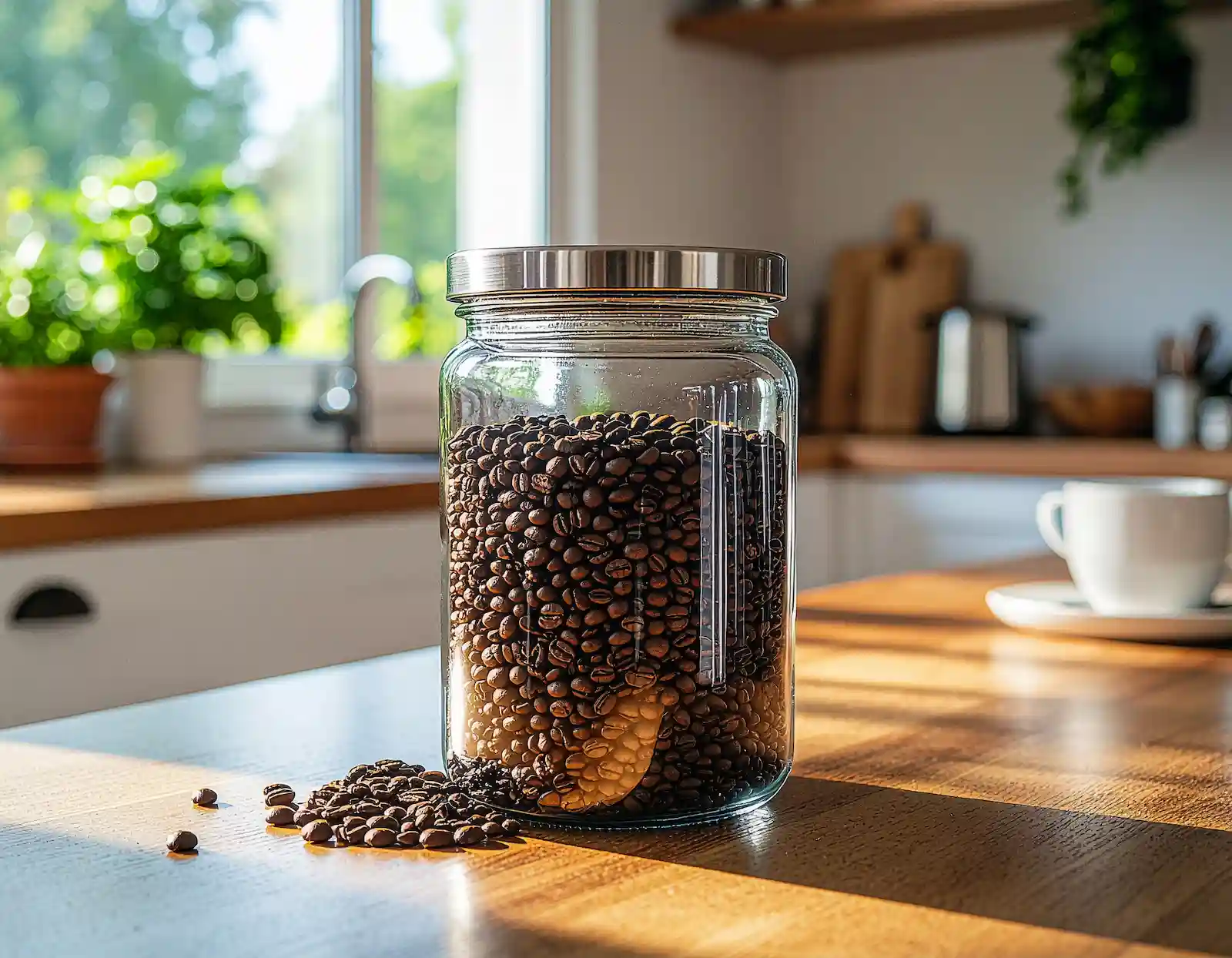
A bag of coffee is full when you open it and mostly empty by the time you grind the last few doses. What happens in the space above the beans is one difference between canisters. A fixed lid seals at the rim. A movable inner lid can follow the beans down, while a vacuum lid draws air out after you close it.
Location matters with any of those designs. The National Coffee Association recommends keeping beans in a cool, dark place away from moisture and heat. An opaque canister helps screen out light on an open shelf. In a cupboard, there’s more freedom to choose a container for the way it opens.
Capacity on the label can be surprisingly hard to translate to a bag of beans, especially if an inner lid needs room of its own. Our coffee canister size guide covers that fit, and our guide to airtight and vacuum closures explains what happens when you reseal them. The four models below also differ in the small things, like where the scoop goes or whether the lid needs charging.
Coffee Canister Comparison: Features and Tradeoffs
We evaluated these coffee canisters using The Hearthful Standard, which considers materials, design, everyday use, durability, and the clarity of product information. Fellow Electric Atmos uses a rechargeable lid to monitor and maintain a vacuum, while Airscape has an inner lid that can be lowered as the coffee level falls. OXO pairs push-button opening with a scoop stored beneath the lid. Coffee Gator offers a clamp closure and date wheel.
Some links in this guide are affiliate links. If you purchase through them, The Hearthful Home may earn a small commission at no additional cost to you. As an Amazon Associate, we earn from qualifying purchases.

Automatic vacuum, rechargeable lid
Fellow Electric Atmos Vacuum Canister
Electric Atmos pairs an opaque steel body with a button-operated vacuum lid that automatically maintains its seal. It suits whole-bean coffee when you want automatic resealing and are comfortable charging and gently cleaning the lid.
Electric lid · 1.2 L · Matte Black · Stainless steel body

Adjustable inner lid, two-part closure
Planetary Design Airscape Classic
The Airscape Classic uses a movable inner lid to reduce empty space above the coffee. Its brushed steel body and replaceable lid parts suit a daily routine with two lids to handle.
Medium · 7-inch · Brushed Steel · Standard inner plunger and outer lid

Easy daily access, mixed-material construction
OXO Steel Coffee POP Container with Scoop
The OXO Coffee POP pairs a push-button seal with a scoop stored under the lid. Its tinted plastic body suits everyday pantry use, with separate lid and gasket care.
3119200 · 1.7 qt / 1.6 L · Tinted plastic · Includes scoop

Date reminder, valve upkeep
Coffee Gator Stainless Steel Coffee Canister
Coffee Gator combines an opaque steel body, clamp closure and gas-release valve with a manual date wheel. The included scoop supports daily use, while the valve needs careful cleaning.
Silver · 22 oz size · Includes scoop
What Actually Matters in a Coffee Canister
Choose around the coffee you buy and the way you reach for it. These checks connect the product listing to filling, measuring, closing, and cleaning at home.
Choose a Closure You Can Use Consistently
An ordinary airtight lid limits air exchange through the closure. An air-displacement lid moves down toward the coffee, reducing the space above it. A vacuum mechanism removes some air after closing and lowers internal pressure. Each needs its own operating sequence after you take out a dose.
Think about who uses the coffee and whether twisting, pressing an inner lid, operating a button, or releasing a wire closure feels comfortable. Our airtight versus vacuum comparison explains what those actions accomplish. A freshness claim is more useful when you can also see what the owner has to do.
Read the Materials by Component
The body, outer lid, inner lid, gasket, and valve can use different materials. A steel accent does not establish a steel vessel, and a glass body can still have polymer or rubber parts in its closure. Look at the open container and the maker’s parts description.
The canister materials guide compares light protection, visibility, weight, breakage, and cleaning across the complete assembly. Choose the construction that suits your storage spot and handling preferences, then check the care instructions for each piece.
Match Bag Weight to Usable Capacity
A bag’s ounces or grams describe coffee weight. Liters and fluid ounces describe container volume. Different beans and grinds occupy different amounts of space, so those units do not provide a universal conversion.
A 1-pound bag contains 16 ounces of beans. Fellow’s capacity guidance puts its 1.2 L Atmos at up to 16 ounces of light or medium roast, and less for dark roast. If you usually buy a full pound of dark beans, check whether you would keep the rest in the original bag before choosing the convenience of the automatic lid.
Use a model-specific coffee-capacity estimate where one is available and leave the space required for the lid, scoop, or plunger. The size guide separates that fitting decision from the question of how much coffee to buy. A larger canister is useful when the quantity and handling both make sense.
Check Whole-Bean and Ground-Coffee Permissions
Fine grounds can enter a valve or filter that is designed around whole beans. Fellow recommends whole beans for Atmos because fine substances may clog its intake and interfere with the vacuum. That limitation belongs to the mechanism, not the vessel size.
If you buy pre-ground coffee, choose a container whose intended use allows it. Check access for the scoop and keep the sealing surface clear when filling. The available capacity is only useful if the container also suits the form of coffee you store.
Choose the Location Alongside the Container
A cupboard can keep a clear jar out of room light; a shaded counter can make daily access easier. Look at the actual location during brewing and cooking, including steam, splashes, and nearby heat. Keep the open coffee clear of wet equipment.
The coffee bean storage guide covers daily locations and sealed freezer portions for a reserve. A counter canister and a freezer package have different jobs, so follow the exact product’s storage-temperature guidance before moving it between them.
Plan for Cleaning, Drying, and Replacement Parts
Look up the lid instructions before buying. Some bodies can be washed separately from a lid that only permits damp wiping. Removable gaskets, filters, and plungers have their own care and reassembly steps.
The canister cleaning guide brings those details together. Also check whether a worn seal, damaged lid, or broken body can be replaced for the exact size. Serviceable parts can make a familiar container easier to keep using.
Keep the Original Bag in the Decision
A canister should improve something practical, such as resealing, pouring, organization, or access. Counter Culture’s freshness guidance includes keeping coffee in its resealed original bag. The usefulness of that option depends on the bag you have.
Our coffee packaging guide explains barriers, valves, and closures. If the bag already works comfortably for you, choose a canister because its features solve a particular need rather than assuming every bag must be replaced immediately.
How We Evaluate Coffee Canisters
Our recommendations in this guide are research-based. Manufacturer product documentation, care instructions, replacement-part information, and established coffee-storage guidance form the evidence base for this comparison.
We assess how well the documented design supports its intended storage role.
The stated capacities and preservation claims come from the manufacturers. A capacity figure alone tells you little about how long a batch of beans will taste fresh. The product breakdowns explain the construction and ownership considerations behind each assessment.
Materials
We examine the vessel, lid, gasket, and other relevant parts together. Light protection, handling, material disclosure, and approved cleaning all contribute to whether the construction suits dry-coffee storage.
Design & Function
We assess how the closure, opening, capacity, and controls work together. The design should support its stated role, whether that is vacuum operation, air displacement, or a straightforward gasketed closure.
Use & Interaction
We consider the documented opening and closing sequence, scoop access, filling, lifting, cleaning, and storage. Extra steps can be worthwhile when they solve a need and remain manageable in daily use.
Durability & Longevity
We look at the construction, potential wear points, compatible replacement parts, care requirements, and warranty or support arrangements. These details help explain serviceability without predicting an exact lifespan.
Transparency & Trust
We consider how clearly the maker identifies the model, materials, capacity limits, operating instructions, and ownership support. Specific documentation makes it easier to check a product against your own routine.
The individual verdicts explain which routines those combinations suit. Choose the useful fit alongside the overall number.
A Closer Look at Each Pick
Automatic vacuum, rechargeable lid
Fellow Electric Atmos Vacuum Canister
Electric lid · 1.2 L · Matte Black · Stainless steel body
Choose Electric Atmos when automatic vacuum maintenance would simplify storing whole beans and you prefer an opaque metal body. Its button operation is convenient, but charging, gentle lid cleaning and eventual whole-lid battery service belong in the decision. Airscape is the more straightforward alternative here when you prefer a completely unpowered closure.
Price and availability last updated: 2026-11-25 at 19:02.
Materials
The opaque stainless steel body keeps light from reaching the coffee through the walls. Fellow identifies the electric lid as plastic with a silicone ring, so the complete container is a mixed-material assembly. The body and replaceable closure are clearly differentiated, which makes the construction easier to assess than an undifferentiated stainless-steel description.
Design & Function
The Electric Atmos guide describes a button-operated pump that monitors the vacuum and tops it up when needed. The lid automatically maintains the vacuum between openings. Press the same button to release the vacuum before lifting the lid; the mechanism handles the pressure change rather than requiring repeated twisting.
Fellow rates the 1.2 L vessel for up to 16 oz of light or medium roast beans and explicitly excludes a full pound of dark roast. Match that capacity to your usual bag before selecting the size. Darker roasts can occupy more space, and the lid needs to seat correctly above the contents.
Use & Interaction
The model-specific care instructions call for handwashing the body and damp-wiping the lid. Neither component is dishwasher safe, and water must stay out of the powered closure. Use whole beans rather than grounds, powders or liquids, which the Electric Atmos guide excludes.
Fellow states up to three months of daily use between charges, with a flashing red indicator when the battery is low. The supplied cable connects the lid’s USB-C port to a suitable 5 V, 1 A USB source. Its green status light appears when you touch or lift the canister rather than glowing continuously on the counter, so a dark light while it sits undisturbed does not by itself signal a lost seal.
Durability & Longevity
Fellow sells compatible electric replacement lids, providing a route to keep using the steel body if its closure needs replacement. The safety manual identifies the battery as non-replaceable and prohibits attempted removal. When the battery is exhausted, replacing the powered lid may be the only service option.
The standard Electric Atmos warranty covers manufacturing defects for two years, with original-purchaser, authorized-seller, location and care conditions. The Electric Atmos manual also offers an additional year for eligible US product registration. Keep the receipt and register an eligible purchase; these support arrangements are useful without promising an unlimited service life.
Transparency & Trust
The Electric Atmos guide and safety manual identify the controls, charging requirements, contents restrictions and warranty. Those specific documents make the powered model’s operation clear, even though some combined Atmos product pages mix in manual-lid instructions. The status light reports the vacuum and battery state, which is useful feedback when deciding whether the canister is ready to put away.
- Opaque stainless steel body
- Automatic vacuum maintenance
- Button controls and status feedback
- Compatible replacement lids listed
- Whole-bean storage only
- Rechargeable, non-replaceable battery
- Powered lid requires gentle cleaning
- Full pound of dark roast will not fit
Adjustable inner lid, two-part closure
Planetary Design Airscape Classic
Medium · 7-inch · Brushed Steel · Standard inner plunger and outer lid
Choose the Airscape Classic when a steel body, an adjustable inner lid and separately available lid parts match your priorities. It offers a straightforward way to reduce the empty space above coffee, provided you are comfortable handling two lids and allowing the plunger time to dry after washing.
Price and availability last updated: 2026-11-25 at 19:51.
Materials
The Classic specification identifies a stainless steel body with a brushed interior and non-slip rubber base. Its steel walls provide an opaque enclosure and the brushed finish keeps the appearance simple. This selection is the Classic body; the larger Kilo belongs to a different product specification.
Planetary Design’s materials FAQ identifies polypropylene inner lids and acrylic outer lids. The inner lid contacts the coffee, so buyers seeking a metal vessel should also be comfortable with a plastic closure.
Design & Function
Pressing the inner plunger down displaces excess air above the contents. Its position follows the coffee level, giving it a practical advantage when a canister is only partly filled. The outer lid completes the two-part closure. We assess this as an air-displacement design, without assuming it removes every trace of oxygen between the beans.
The mechanism is useful for everyday opening because it works wherever the coffee level happens to be. It also makes the inner lid another piece to lift out, set aside and replace at each brew. Consider that sequence alongside the storage benefit.
Use & Interaction
The maker describes Medium as holding approximately one pound of beans. Treat that as a model-specific capacity estimate, since the actual fit depends on the coffee. The plunger needs room to seat above the beans. When scooping, you also need a spot beside the canister for both lids.
The product calls for handwashing. For the inner lid, the cleaning directions include rinsing, clearing vent moisture by moving it inside the body with the handle open, and drying it open for 8 to 10 hours. Plan that drying time between refills.
Durability & Longevity
A replacement standard inner plunger fits the 4-inch and 7-inch stainless canisters, and a replacement outer lid is also listed. Identifiable parts support is valuable because damage to one lid need not automatically retire the body.
Planetary Design lists a five-year warranty for stainless steel products and two years for their included lid and plunger parts. Keep proof of purchase. Those separate terms are more useful than assuming every component has the same coverage.
Transparency & Trust
The brand provides model-specific materials, care directions, replacement parts and warranty periods. That supports a clear ownership decision. Its capacity labels still need interpretation, and the documented plunger action does not establish a universal freshness extension. Judge the fit by the closure routine, usable space and parts support rather than an assumed number of extra fresh days.
- Opaque stainless steel body
- Inner lid can be lowered to the coffee level
- Separate replacement lid parts
- Published body and parts warranties
- Two lids to handle at each opening
- Inner plastic lid contacts coffee
- Handwashing and extended lid drying
- Bean capacity is an approximate guide
Easy daily access, mixed-material construction
OXO Steel Coffee POP Container with Scoop
3119200 · 1.7 qt / 1.6 L · Tinted plastic · Includes scoop
Choose the OXO Coffee POP when easy access and an included scoop are the priorities. It offers a practical daily routine, provided you are happy with a tinted plastic body and separate care for the lid.
Price and availability last updated: 2026-11-25 at 19:25.
Materials
OXO lists stainless steel, silicone and plastic for the exact US model. Its tinted plastic body provides a visible fill level, while the silicone gasket seals beneath a stainless steel lid accent. The removable gasket and dishwasher-safe body are useful details for routine cleaning, with separate handwashing required for the lid.
The tint lets you check how much coffee remains. Keep the container away from direct light and heat, and treat the tint as one design feature rather than a reason to leave it beside a sunny window.
Design & Function
The same-SKU OXO specification describes a button that seals the lid when pressed and releases it when pressed again. This is an airtight closure. It does not pump out air or move an inner lid down to meet the beans as the level falls.
OXO includes a 30 mL scoop and provides a mounting point beneath the lid. Having that accessory close at hand is useful for a scoop-based routine; a scale remains the appropriate tool when your recipe calls for a coffee weight.
Use & Interaction
OXO describes the 1.6 L size as suitable for a standard one-pound bag of beans. That is a manufacturer capacity guide, with the actual fit depending on the coffee and how it settles. Leave the seal area clean when filling.
The button provides a direct open-and-close routine without a separate pump. For cleaning, handwash the lid; the container and silicone gasket are dishwasher safe. Plan to separate those parts and let them dry completely before returning coffee to storage.
Durability & Longevity
The OXO Better Guarantee covers defects in materials or workmanship under normal household use when the product receives the specified care. Its stated remedies are replacement or refund. That supports ownership, although the reviewed terms do not establish an unconditional lifetime promise.
For a damaged seal or lid, contact OXO with SKU 3119200. Confirm the exact replacement before buying a part, since a shared POP name alone does not establish that another container’s lid will fit.
Transparency & Trust
SKU 3119200 identifies the 1.7 qt / 1.6 L coffee POP container with the scoop that stores under its lid. Check the SKU when comparing a bundle with this single-container offer.
- Push-button opening and closing
- Included scoop stores beneath the lid
- Tinted body shows the coffee level
- Published component care instructions
- Body is plastic despite the Steel name
- Does not remove air from the headspace
- Lid requires handwashing
- Tinted body is not opaque
Date reminder, valve upkeep
Coffee Gator Stainless Steel Coffee Canister
Silver · 22 oz size · Includes scoop
Choose Coffee Gator when an opaque body, clamp closure and date reminder fit your routine. It offers straightforward daily access, with a cleaning routine that requires keeping the valve dry and attending to its replacement parts.
Price and availability last updated: 2026-11-25 at 19:51.
Materials
The Coffee Gator brand listing identifies stainless steel construction and the silver finish. The opaque body shields coffee from light, which is useful on an open shelf. Keep it away from the stove and other warm spots even though you cannot see through its walls.
The lid also carries a seal, valve and date mechanism. Those working parts deserve attention alongside the metal body; stainless construction alone does not establish the durability of the complete assembly.
Design & Function
The clamp closes the lid, while a built-in valve provides a route for released gas. It does not pump air out or move down toward the coffee as the level falls. Set the date wheel to the roast date on the bag or the day you opened it. The wheel simply keeps the date you set in view.
Use & Interaction
Open the clasp, lift the lid and scoop the amount you need. Close it again after use, checking that the rim is clear. The included scoop is convenient for a scoop-based recipe; use a scale when your recipe specifies grams.
The original Coffee Gator instructions specify wiping the interior with a damp paper towel while keeping moisture out of the valve. Dry it thoroughly before refilling. The canister is not dishwasher safe, and the manual advises against refrigerator or freezer storage.
Durability & Longevity
The supplied instructions document four replacement valves and explain how to access the valve through the lid’s inner disk. That makes a working part serviceable without discarding the steel body and supports a strong longevity assessment with normal valve care. Follow the replacement procedure carefully and confirm compatible spares with Coffee Gator when the included supply runs out.
Transparency & Trust
The listing identifies the selected silver finish and 22 oz size and links the brand’s instruction sheet. That provides a useful route from the product page to its care requirements, valve replacement procedure and support contact. The reviewed documentation does not establish current replacement-lid availability or the exact warranty period for this purchase, which limits the transparency assessment rather than demonstrating a shorter service life.
- Opaque stainless steel body
- Simple clamp closure
- Manual date wheel
- Scoop and spare valves documented
- Valve needs protection from moisture
- Not dishwasher safe
- Does not remove headspace air
- Date wheel does not measure freshness
Tips for Better Coffee Canister Ownership
Keep the Coffee’s Identity With the Container
Save the bag or add a removable label with the coffee name, roast date when supplied, and opening date. Label decaf and regular coffee clearly if both are part of the setup. The roast-date guide explains how roast age and resting differ from a best-by label.
Make Closing the Lid Part of Measuring
After taking out the coffee, complete the normal closing sequence before starting the next brewing task. Lower and secure an inner lid, operate the vacuum mechanism, or close the gasketed lid as instructed. Keep dry grounds and stray beans off the rim so the parts can meet correctly.
Leave Room for the Lid
Respect the maker’s fill line and space for the closure. Do not remove an intended scoop, filter, or plunger simply to force a bag into a smaller container. Keep any remaining coffee properly sealed while you divide it between suitable containers or choose a larger size.
Clean Between Fills With Time to Dry
Emptying a bag is a useful opportunity for the prescribed care. Follow the body, lid, and seal cleaning guidance for the exact model, then allow every washed component to dry before adding coffee. Keeping the parts together during that process also makes reassembly easier.
Keep a Reserve Separate From Daily Access
If you buy more than you plan to use soon, decide how the reserve will stay closed until needed. The storage guide covers sealed portions for later. Keep a smaller amount in the daily container and leave the reserve sealed until you need it.
Explore the Coffee Canister Guides
Use these guides for the details behind the comparison, from the lid mechanism to the shelf where the filled container will live. Start with the question that would change your choice, then use the size and care advice to confirm that the shortlisted canister fits your coffee routine.
Coffee Canister FAQs
How should I choose between these four canisters?
Start with your coffee and routine. Fellow Electric Atmos suits whole-bean storage when automatic vacuum maintenance is worth charging a powered lid. The Airscape Classic suits a daily coffee routine where an adjustable inner lid and replaceable parts matter. The OXO Coffee POP suits a daily scoop routine with push-button access and a visible coffee level. Coffee Gator suits readers who want opaque storage and a manual date reminder in a single canister. Then check the bag size, space for the lid, and cleaning method before choosing.
Is a vacuum canister better than an airtight jar?
It adds active air removal and a mechanism to operate or maintain. An ordinary airtight container can be a comfortable daily option when simple access is your priority. The closure comparison helps you choose the operation you want without assuming one mechanism suits everyone.
Can I put ground coffee in these containers?
Check the exact model. Fellow advises using whole beans in Atmos because fine grounds can clog its intake. For the other designs, follow their dry-food instructions and keep grounds off the rim and sealing parts. Capacity alone does not establish compatibility.
Will a one-liter canister hold a pound of coffee?
Do not assume it will. A liter describes volume, while a pound describes weight. Roast, grind, packing, and lid clearance affect the fit. Look for a model-specific coffee capacity and use the size guide to check it against your bag.
Is a stainless steel canister completely plastic-free?
Not necessarily. Its lid, valve, plunger, or other components may use different materials. Read the parts description and look at the underside of the lid. The materials guide explains how to examine the complete container.
Does clear glass work for coffee storage?
It can be useful when you want to see the contents and have a cool, dark cupboard. Clear walls admit light, so choose the location accordingly. Keep any container away from cooking heat, direct sun, splashes, and steam.
Can I wash the complete lid in the dishwasher?
Only when the instructions for that exact lid permit it. Vacuum mechanisms, wire assemblies, gaskets, and decorated lids can have different care limits from the body. Follow the model’s cleaning and reassembly instructions rather than a general rule based on glass or steel.
Should I refill a partly empty canister with a new bag?
Finishing the current coffee first makes it easier to keep track of roast and opening dates and perform care between bags. A partly empty container is a normal part of using a supply. Follow its operating instructions at the remaining fill level.
Do I need to move every coffee out of its original bag?
No. A suitable resealable bag may already work comfortably for your routine. A canister can improve access or organization; compare that benefit with the bag’s actual closure. Our packaging guide covers the separate roles of a barrier, valve, and seal.
Can I put my coffee canister in the freezer?
Check the exact product’s temperature and mechanism restrictions first. A canister chosen for daily counter access is not automatically suitable freezer packaging. The coffee bean storage guide explains sealed reserve portions and how their handling differs from a bag you open each morning.
Important: This article provides general information, not individualized medical, safety, installation, legal, or other professional advice. Product specifications, instructions, and safety information can change; verify current information with the manufacturer and consult an appropriately qualified professional when needed. See our Terms and Conditions for additional information.