
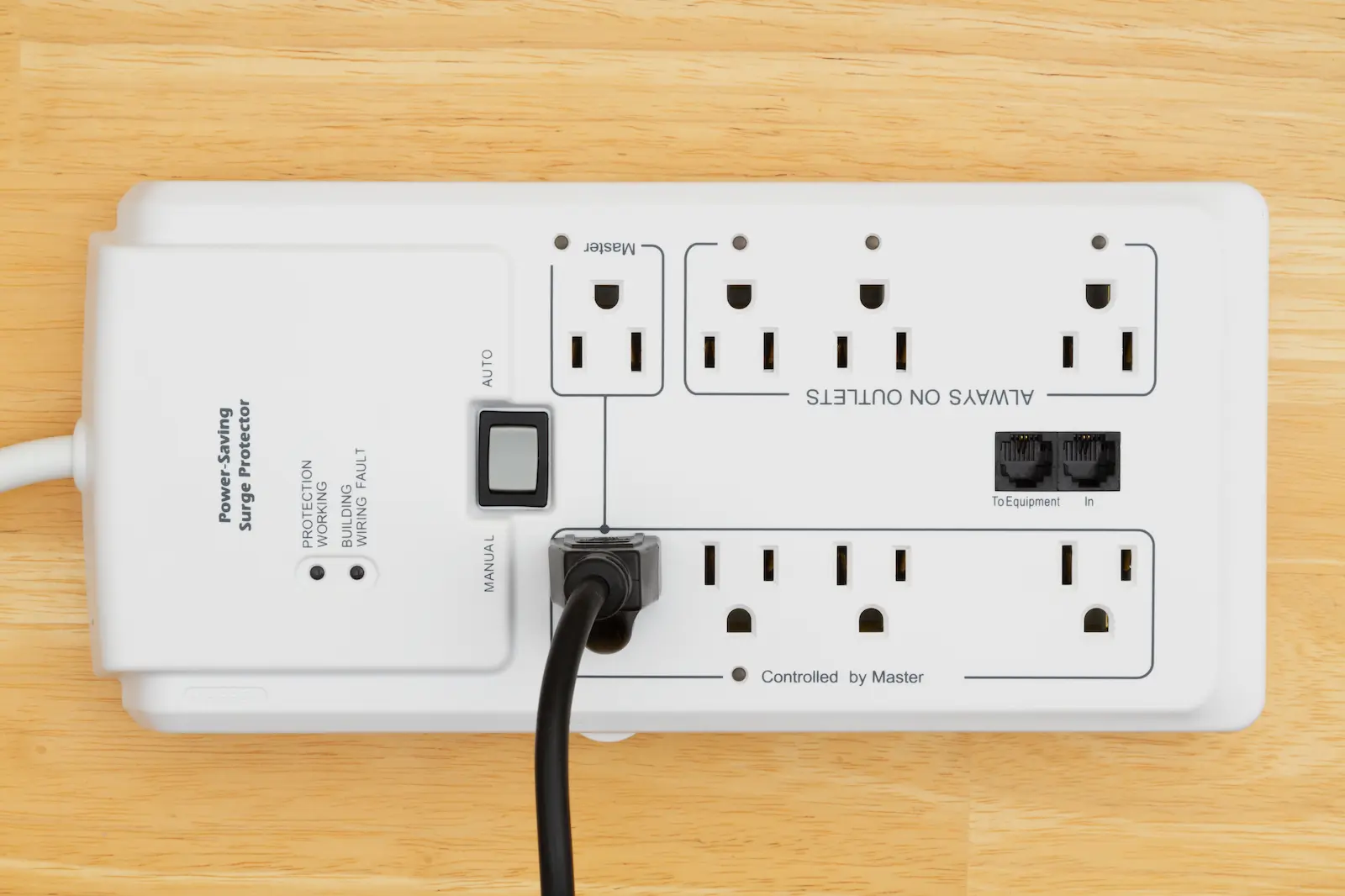
If the power strip still runs your TV but its protection light has gone out, check the indicator’s exact wording in the owner’s manual. Some models continue supplying power after protection is lost. Follow the maker’s replacement or fault instructions. Stop using a damaged, overheating or recalled unit even when its lights look normal.
Do not use one universal age limit as the entire decision. UL Solutions says power strips and surge protectors do not expire or require replacement after one fixed amount of time; instead, the strip and cord should be inspected for damage and replaced when damage is present.
The checks below help you decide whether to keep using the protector, replace it, or investigate the outlet. Use the UL 1449 guide when the question is whether the exact model is properly certified, the joules vs clamping voltage guide when comparing protection specifications, and the main surge protector guide when a replacement product actually needs to be chosen.
Surge Protector Replacement Checklist
Use this checklist from the strongest evidence downward. A recall, confirmed protection loss, automatic fault response, or physical damage is a clearer stop-use signal than age alone, while an unclear light or wiring indicator should be resolved with the exact model instructions before the cause is assumed.
Surge Protector Replacement Triggers
| Replacement Trigger | What It Means | What to Do | Why This Threshold Makes Sense |
|---|---|---|---|
| The exact product is recalled or covered by a safety warning | A regulator or manufacturer has identified a hazard or required a specific remedy for that product. | Stop using the product when the recall or warning instructs you to do so, then follow the published repair, refund, replacement, or disposal steps. | A recall is stronger evidence than an apparently normal light or undamaged enclosure because it applies to a known product hazard. |
| The protected-status light shows loss of protection | The model may be reporting that its surge-suppression network is no longer functional according to the manufacturer’s design. | Read the exact manual and replace the unit when that indicator state is defined as protection loss. | Some protectors can continue supplying ordinary AC power after surge protection is no longer available. |
| A fault alarm sounds or automatic shutoff removes outlet power | The model may be deliberately reporting a failed protection circuit or disconnecting the load because protection is incapacitated. | Follow the manufacturer instructions and replace or service the unit as directed. Do not bypass a fault response to restore power. | A documented alarm or protection-loss shutoff is a model-specific failure response, not normal operation. |
| Heat, burning odor, smoke, discoloration, melting, cracking, or abnormal noise appears | The enclosure, connections, cord, switch, breaker, or internal components may be damaged or overheating. | Stop using the unit and disconnect it only when it is safe to do so. Replace it rather than continuing to test it in service. | Physical warning signs create a separate electrical and fire concern even if a status light still appears normal. |
| The cord, plug, receptacles, or power delivery are physically unreliable | Fraying, brittle insulation, bent or damaged plug blades, loose receptacles, sparking, or intermittent power can prevent a secure electrical connection. | Replace the protector. Do not tape damaged insulation, reshape damaged contacts, or keep using a unit that depends on cord position to stay powered. | Surge suppression does not compensate for worn receptacles, damaged conductors, or unstable ordinary power delivery. |
| A grounded, line-fault, or wiring indicator reports a problem | The issue may involve the wall receptacle, grounding path, building wiring, or the protector, depending on the exact model. | Follow the manual and stop using the affected outlet until the condition is understood. Use a qualified electrician when the wiring fault remains. | A wiring fault is not the same thing as normal surge-component wear, so replacing only the strip may not correct the cause. |
| A known major surge, nearby lightning event, or connected-equipment damage occurred | The protector may have experienced a significant event even when the enclosure still looks normal. | Check the model-defined protected status, alarm or shutoff behavior, physical condition, and manufacturer instructions. Replace when the status changed, damage appeared, or the instructions call for replacement after the event. | The severity of a transient and the condition of internal suppression components cannot always be judged from appearance alone. |
| A normal outage occurred with no changed status or damage | Loss of utility power by itself does not prove that the surge protector absorbed a damaging transient. | After power returns, confirm that the model-defined status remains normal and inspect the unit for any new warning sign. | An outage and a damaging surge are different events, so an ordinary outage is not an automatic replacement trigger. |
| The unit is old or its history is unknown | Age alone does not reveal remaining protection, but missing documentation, unknown exposure, and an unreadable or absent protected indicator increase uncertainty. | Use a lower replacement threshold when the unit protects expensive, data-sensitive, difficult-to-replace, or always-on equipment and current protection status cannot be confirmed. | There is no universal calendar expiration that applies to every surge protector under every exposure history. |
| Protected status is normal and the unit is physically sound | There is no current evidence from the model-defined status, physical inspection, known history, or connected equipment that the unit has failed. | Keep using it and periodically inspect the protected indicator, cord, plug, receptacles, switch or breaker, and enclosure. | A well-documented protector does not need replacement only because it has crossed an arbitrary age threshold. |
Simple rule: follow recalls first, replace confirmed protection failures and physically damaged units, investigate wiring faults separately, and keep a protector only when its model-defined status and physical condition remain sound.
Why Can a Surge Protector Still Supply Power After Protection Fails?
A surge protector has an ordinary power path and a surge-suppression function, and those two functions are not always disabled at the same time. A lamp, router, television, or computer turning on confirms that the outlets are energized, but it does not by itself confirm that the surge-protection circuit is still available.
Eaton explains that many of its surge protectors use a Protected LED to report whether the protection circuit is functioning, while some models add automatic shutoff that permanently removes outlet power if the protection circuit becomes incapacitated. That is useful manufacturer evidence for Eaton products, but the exact behavior should not be generalized to every brand or model.
The replacement question therefore starts with the exact model manual and indicator meaning rather than a lamp test. If the unit continues supplying power but the manual says an extinguished Protected light means protection is lost, continued power is not a reason to keep using that protector for surge protection.
There Is No Universal Replacement Interval
UL Solutions does not give every power strip or surge protector one fixed expiration age. Its consumer guidance instead says to inspect the strip and cord periodically and replace the product when damage such as fraying or brittle insulation appears.
Age still matters when it increases uncertainty. An older unit with a readable model number, a clear manual-defined protection indicator, known history, secure receptacles, and an undamaged cord provides more evidence for continued use than a newer-looking unit with no readable model, no understandable protection indicator, or an unknown exposure history.
The connected equipment also changes how much uncertainty is reasonable. If protection status cannot be confirmed, a work computer, storage device, router, modem, network switch, or expensive media system can justify a more conservative replacement threshold than a low-cost charging setup.
Record the model and installation date when practical, and use the date as context rather than an automatic replacement deadline. The date helps establish how long the protector has been in service; replacement should still follow the model-defined status, physical condition, recalls, known events, and the consequences of losing the connected equipment.
Read Power, Protected, Grounded, and Fault Indicators Separately
Indicator labels are model-specific and should not be collapsed into one healthy-or-failed light. Power or On usually refers to ordinary AC power, while Protected or Protection Present can report the condition of the suppression network and Grounded or Line Fault can describe a different outlet or wiring condition.
One Eaton Tripp Lite manual illustrates the distinction clearly: its Protected LED reports the state of the surge-suppression components, while its Grounded and Line OK indicators address the wall outlet and incoming power. That example supports reading each light by function, but the wording and response still need to be confirmed for the exact protector you own.
When the protected indicator shows the manual-defined failure state, follow the replacement instruction. When a grounded, line-fault, or site-wiring indicator reports a problem, do not assume a new strip will fix it; the wall outlet or wiring may need to be evaluated instead.
The UL 1449 certification guide explains certification and standardized ratings. For an existing unit, confirm what each indicator means before deciding whether to keep using it.
Physical Damage Is a Stop-Use Signal
Physical condition can override an apparently normal protection light. Unusual heat, burning odor, smoke, melted or discolored plastic, cracks, buzzing or crackling, intermittent power, frayed insulation, exposed conductors, crushed cord sections, or a plug that no longer seats securely are reasons to stop trusting the unit.
UL Solutions specifically recommends inspecting power strips and cords and replacing a strip when it is damaged, including when the cord is frayed or its insulation is becoming brittle. Older CPSC power-strip safety guidance also documents fire, shock, and electrocution hazards associated with loose connections, faulty components, improper grounding, and undersized wiring.
Loose receptacles deserve the same treatment because the problem is mechanical as well as electrical. A connected plug should not sag, rock, spark, lose power when touched, or depend on a particular cord angle to maintain contact.
Do not treat consumer surge protectors as field-repair products when the housing, cord, plug, or receptacles are damaged. Replace the unit rather than taping insulation, bending damaged plug blades back into service, or continuing to monitor a product that has already shown a physical failure sign.
Check Recalls and Product Safety Warnings
A recall can change the decision even when the protector still looks normal and all indicator lights appear healthy. CPSC maintains a searchable recalls and product-safety-warning database with remedies that can include repair, replacement, refund, disposal, or new instructions.
Use the exact brand, model number, and any other identifying information from the product label when checking a recall. If a matching recall or safety warning says to stop using the product, follow that instruction instead of relying on the normal replacement checklist.
This check is especially worthwhile for an old, secondhand, marketplace, or poorly documented protector because ownership history may not include prior safety notices. A recall is not the same thing as ordinary surge-component wear; it is an external product-specific safety signal that should be handled according to the published remedy.
After Lightning or a Known Surge, Check the Evidence Before Guessing
A normal power outage is not automatically proof that the surge protector absorbed a damaging transient. Treat an event more seriously when there was nearby lightning, a known utility or wiring disturbance, connected-equipment damage, a changed protected indicator, an alarm, automatic shutoff, breaker behavior, physical damage, or another model-defined fault response.
Start with the connected equipment and surrounding outlet, then read the protector’s status using the exact manual. Replace the protector when the manufacturer-defined protection status shows failure, when automatic shutoff or a fault response indicates protection loss, when physical damage appears, or when the manual specifically calls for replacement after the event.
If connected equipment was damaged, preserve the protector, model information, proof of purchase, and manufacturer documentation before discarding anything when a warranty or connected-equipment claim could apply. Claim requirements vary by manufacturer and model, so the warranty terms should be read before the product is thrown away.
If the event was significant but the status remains ambiguous, uncertainty matters more for important electronics. If the unit has no understandable protection indicator or documentation, replacement may be the more cautious choice for important electronics.
Sort the Existing Protector Into One of Four States
This four-state check is a practical way to keep model-specific troubleshooting separate from obvious replacement triggers. It does not replace the manual or a qualified electrical evaluation when a wiring fault is involved.
Continued-Use Check
Keep, Check, Replace, or Investigate the Outlet
Protected status is normal, the unit is physically sound, history is known, and no recall or event problem applies.
Continue using it and inspect the status lights, cord, plug, receptacles, switch or breaker, and enclosure periodically.
The light labels are unclear, an event occurred without an obvious fault, or you do not know whether the model keeps supplying power after protection loss.
Look up the exact model and confirm indicator, alarm, breaker, and automatic-shutoff behavior before deciding.
Protection is confirmed lost, a protection-loss alarm or shutoff occurs, the product is recalled with a stop-use instruction, physical damage appears, or status is unacceptably uncertain.
Disconnect the unit safely and follow replacement, warranty, recall, or disposal instructions that apply to the exact model.
A grounded, line-fault, or wiring indicator reports a problem, or the same issue follows more than one protector at the outlet.
Stop using the affected outlet until the condition is understood, and use a qualified electrician when the fault persists.
The state can change as new evidence appears. A unit that initially falls into Check Manual can move to Keep when the documentation confirms normal status, to Replace when protection loss is confirmed, or to Check Wiring when the indicator is actually reporting a site-wiring problem.
Let Equipment Importance Change the Uncertainty Threshold, Not the Failure Rules
A failed protected indicator, dangerous physical damage, or applicable stop-use recall does not become acceptable because the connected equipment is inexpensive. Those are direct failure or safety signals and should be handled the same way regardless of whether the strip serves a television, computer, charger, or router.
Equipment importance matters when the evidence is incomplete rather than when failure is already confirmed. If an older protector has unknown history, no dependable protected indicator, and poor documentation, using a lower replacement threshold for work, network, storage, or other difficult-to-replace equipment is a risk-management choice rather than a claim that the protector has definitely failed.
For room layout and cord routing, see the surge protectors by setup type guide, and check wall clearance and cord direction in the flat plug vs traditional plug guide. A replacement also needs enough clearance to keep furniture and cable tension from stressing the plug or cord.
Bottom Line
Replace a surge protector when protection loss is confirmed, a product-specific fault or automatic-shutoff response calls for replacement, a recall tells you to stop using it, or the cord, plug, receptacles, enclosure, switch, or power delivery shows physical failure. Investigate the outlet or wiring separately when a grounded or line-fault indicator points to a site problem instead of normal protector wear.
Do not replace only because the calendar crossed an arbitrary date, and do not keep the unit only because its outlets still work. Continued use should rest on the exact model instructions, protection status, physical condition, known history, recall status, and the amount of uncertainty you are willing to accept for the connected equipment.
When replacement is the correct decision, move to the complete surge protector and power strip guide for product selection. Verify certification with the UL 1449 guide and compare protection ratings using the joules vs clamping voltage guide before choosing the new model.
Disclaimer: The content on The Hearthful Home is for general informational purposes only and reflects independent research and interpretation of publicly available information at the time of publication. It is not intended as professional electrical or safety advice. Always follow manufacturer instructions, recall notices, applicable electrical requirements, and the guidance of a qualified professional when a wiring, overheating, fire, shock, or equipment-safety concern is present.