
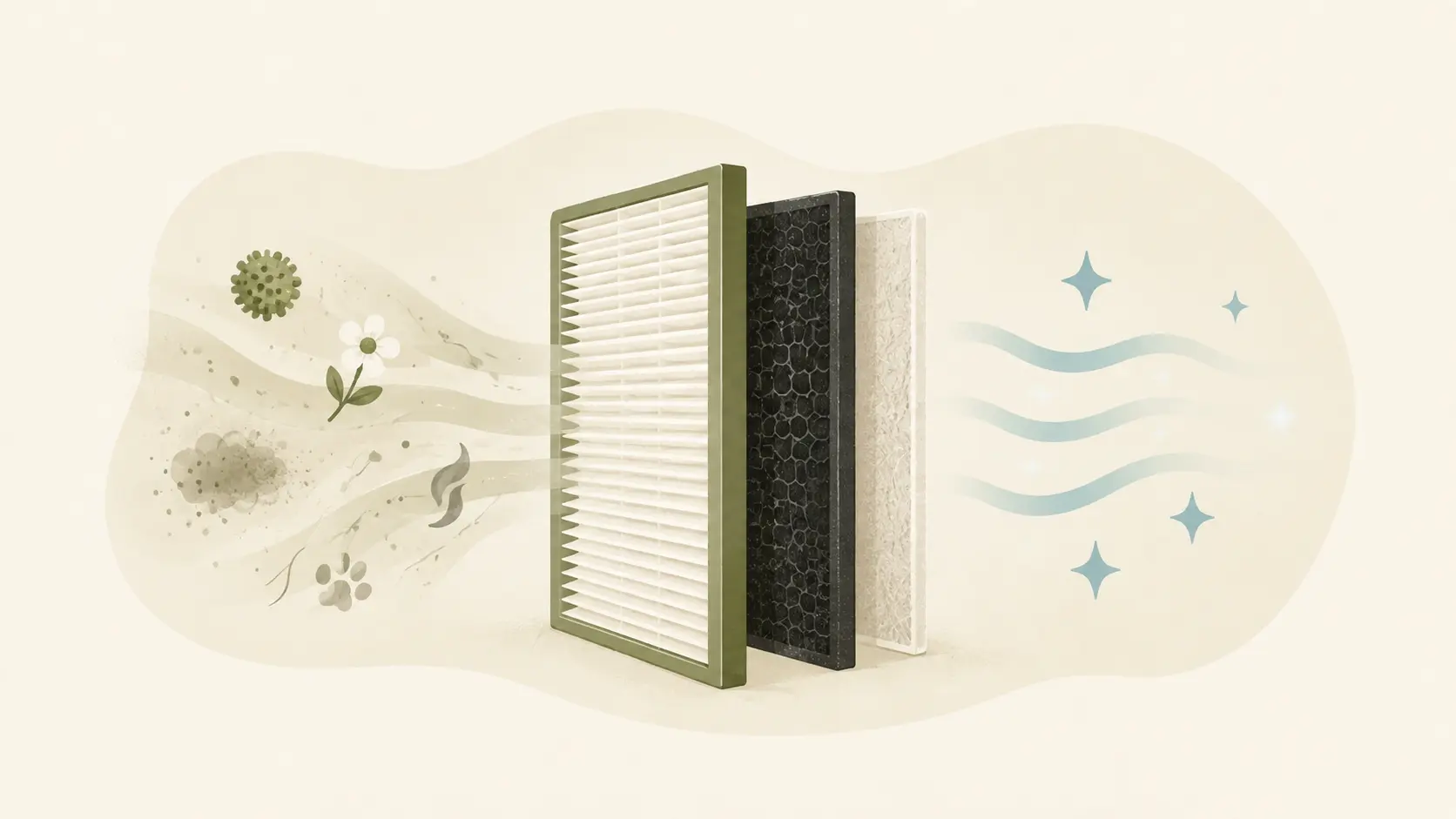
Choosing an air purifier for allergies, smoke, dust, or pets starts with identifying what you are actually trying to remove. These concerns overlap, but they are not identical. Pollen, pet dander, airborne dust, and smoke particles are particle problems, while odors and volatile organic compounds are gases. A purifier that performs well against one category does not automatically solve the other.
For most particle concerns, start with enough Clean Air Delivery Rate, or CADR, for the room and a high-efficiency particle filter. HEPA filtration is useful, but the filter label alone does not tell you how quickly the complete purifier can clean the room. Smoke also deserves special attention because its fine particles make smoke CADR the most conservative of the common CADR ratings used for room sizing.
Odors require a different layer of filtration, usually activated carbon or another gas-phase sorbent, while pet hair and much of the larger dust in a home settle onto surfaces before an air purifier can capture them. Match the purifier’s airflow and filtration system to the pollutant you care about, then make sure the machine is practical enough to run consistently. For product comparisons after you understand those requirements, see our guide to the best air purifiers.
What to Prioritize for Allergies, Smoke, Dust, and Pets
The same basic purifier can address several particle problems, but the shopping priorities change depending on what is driving the purchase. Use the table below as a first-pass filter, then follow the more specific sections for the tradeoffs that matter most.
Air Purifier Priorities by Concern
| Concern | Prioritize First | Useful Secondary Feature | Important Limitation |
|---|---|---|---|
| Allergies | Enough CADR for the room plus high-efficiency particle filtration | Quiet operation that makes continuous use practical | Pollen, dander, and other larger allergens often settle on surfaces, where an air purifier cannot capture them until they become airborne again. |
| Wildfire Smoke | High smoke CADR and effective mechanical particle filtration | Activated carbon if smoke odors or gases are also a concern | Particle CADR does not measure gas or odor removal, and electronic air-cleaning technologies can introduce separate ozone concerns. |
| Dust | Adequate CADR and a capable particle filter | An accessible prefilter that can intercept larger lint and debris before the main filter | Much household dust settles on floors and furniture, so filtration works alongside cleaning and source control rather than replacing them. |
| Pets | Particle filtration and enough CADR for airborne dander | Prefiltration for hair and carbon media when odors are part of the problem | Pet hair, settled dander, and odor are different problems and should not be treated as one filtration specification. |
These priorities separate the main filtration problem from secondary ownership features. Room sizing still comes first for particle removal, while gases and odors require separate filtration media.
The most important pattern is that allergies, smoke particles, dust, and pet dander all depend on particle filtration, so adequate airflow remains foundational. The differences appear in what else accompanies those particles: settled allergens require cleaning and source control, wildfire smoke can include gases and odors, and pets add hair and odor that place different demands on prefilters and carbon media.
Start by Separating Particles From Gases
The first useful division is not allergies versus pets or smoke versus dust. It is particles versus gases. The EPA notes that most filtration systems are designed primarily for either particles or gases, which is why many portable air cleaners combine more than one type of filter.
Particle filters are the part of the purifier that addresses airborne pollen, dust, pet dander, fine particulate matter, and smoke particles. A HEPA filter is one common high-efficiency approach, but its efficiency rating describes the filter media rather than the complete purifier’s delivered cleaning rate. For a deeper explanation of particle size and filtration limits, see what HEPA filters actually capture.
Gas-phase filtration is separate. Activated carbon and other sorbent media are used for some odors and gases, while CADR is a particle-performance metric. If smoke odor, cooking odors, pet odor, or VOCs are a primary concern, use our dedicated guide to air purifiers for VOCs and odors rather than judging that capability from the purifier’s HEPA label or CADR alone.
For Allergies: Prioritize Airborne Particle Removal
If pollen, mold particles, dust allergens, or pet dander are the reason for buying an air purifier, start with enough particle-cleaning capacity for the room. A high-efficiency filter is useful only when the purifier also moves enough room air through that filter to make a meaningful difference over time.
It is equally important to understand what filtration cannot reach. The EPA notes that pollen, house-dust allergens, some molds, and animal dander often settle onto surfaces. Once those particles have settled, a portable purifier cannot capture them unless they are disturbed and become airborne again.
That makes air filtration a supplement to source control and cleaning rather than a replacement for them. The EPA’s broader indoor-air guidance similarly places pollutant-source reduction and clean ventilation ahead of filtration where those options are practical. For an allergy-focused purchase, therefore, avoid assuming that a more expensive purifier will compensate for an undersized unit, infrequent cleaning, or a major allergen source that remains in the room.
A quiet enough machine also matters because particle filtration accumulates over time. A purifier with excellent maximum airflow that you regularly turn off because it is disruptive may be less useful in practice than a sufficiently sized model you can comfortably leave running. We handle that ownership question separately in what makes an air purifier quiet enough for bedrooms and offices.
For Wildfire Smoke: Prioritize Smoke CADR and Mechanical Filtration
Wildfire smoke creates a more demanding particle-removal problem because fine particulate matter is a central concern. The EPA identifies mechanical filters, including HEPA and other high-efficiency pleated filters, as effective at trapping smoke particles and recommends choosing portable air cleaners according to their smoke CADR.
Smoke CADR should be sized to the room rather than judged in isolation. EPA wildfire guidance recommends at least two-thirds as much smoke CADR as room area in square feet, while more aggressive wildfire sizing can justify additional capacity. Instead of repeating the formulas here, use our air purifier CADR and room-size calculator to establish the actual target for your space.
Do not confuse smoke-particle filtration with smoke-odor or gas removal. A high smoke CADR tells you about particle cleaning. Activated carbon or another sorbent is a separate consideration when gases and odors also matter, and the amount of gas-removal media is more informative than simply seeing carbon in a feature list.
Electronic air-cleaning technologies deserve additional scrutiny in smoke-focused use. EPA wildfire guidance states that electronic air cleaners are not recommended for smoke removal because their effectiveness for smoke particles is less clear and some can produce ozone. If an air cleaner uses ionization, electrostatic precipitation, plasma, UV-related technology, or another electronic process, the California Air Resources Board certification list provides an ozone-emissions check. CARB certification does not establish that a purifier is effective; it addresses the state’s ozone-emission requirements.
For Dust: Airflow Matters More Than a Dust-Specific Label
Dust is not one uniform particle size. Some airborne dust can remain suspended long enough to pass through the purifier, while larger debris settles relatively quickly onto furniture and floors. This is why a purifier can reduce airborne particulate matter without eliminating the visible dust that continues to accumulate around a room.
For the airborne portion, prioritize enough CADR and an effective particle filter rather than looking for a model marketed specifically as a dust purifier. AHAM-certified models may publish separate dust, smoke, and pollen CADR values, but those ratings are standardized test aerosols representing different particle-size ranges rather than separate filters dedicated to only those pollutants.
A removable or washable prefilter can be useful in a dusty environment because it catches larger lint, hair, and debris before they load the more expensive main filter. That can make maintenance easier, but the presence of a prefilter does not compensate for inadequate CADR or a weak primary particle filter.
Also account for filter replacement before choosing a model that will run continuously in a dusty room. Prefilter cleaning requirements, replacement intervals, and proprietary filter pricing can materially change what the purifier costs to own. Our guide to air purifier filter replacement cost and long-term value explains those ongoing costs.
For Pets: Separate Dander, Hair, and Odor
Pet air purifier is an imprecise shopping category because pets create several different filtration problems. Airborne dander is a particle problem. Hair is comparatively large and is often already on floors, upholstery, and clothing before it ever reaches an air cleaner. Pet odors involve gases and therefore depend on different filter media.
For dander, use the same foundation as other airborne allergens: adequate CADR and capable particle filtration. Do not assume that a model with a pet mode or pet-specific marketing has stronger particle performance unless the published specifications support it.
A prefilter becomes particularly practical when the room contains a lot of pet hair because it can intercept larger debris before the main filter. Look at how easily that layer can be accessed and cleaned. A permanently hidden or difficult-to-service prefilter may be less useful over years of ownership than a simple removable screen.
If odor is the main concern, carbon media becomes more relevant, but the particle-filter specification still does not tell you how well the purifier handles gases. Treat dander and odor as two separate requirements rather than paying more simply because the product is labeled for pets.
HEPA Is Useful, but It Is Not the Whole Specification
HEPA filtration is a useful signal when particles are the target, but it should not become the only shopping criterion. A purifier is a complete airflow system: room air has to enter the machine, pass through the filter, and return to the room quickly enough to produce useful clean-air delivery.
This is why two purifiers using nominally similar filter media can have very different room-size capabilities. Filter efficiency, fan output, internal resistance, leakage control, and the complete system design all affect delivered performance. CADR gives buyers a way to evaluate that complete output instead of inferring performance from the word HEPA alone.
The separate guide to what HEPA filters capture and what they do not goes deeper into filtration mechanics. For this buying decision, the simpler rule is enough: use capable particle filtration and then verify that the purifier has sufficient delivered airflow for the room.
Size the Purifier Before Comparing Extra Features
A feature-rich purifier is still undersized if it cannot deliver enough clean air for the room. The EPA recommends selecting CADR according to the room or area being served, and notes that higher ceilings, open floor plans, and larger connected spaces can require more capacity.
Use smoke CADR as the conservative sizing number when a purifier lists separate smoke, dust, and pollen ratings. If the manufacturer publishes only an enormous square-foot coverage claim without explaining the cleaning rate behind it, the number is harder to compare with a standardized CADR.
Our CADR-by-room-size guide and calculator handles the actual sizing calculation, including ceiling height and wildfire-smoke headroom.
Then Check Whether You Will Actually Run It
Once filtration and room size are adequate, ownership details become the tie-breakers. A purifier that is irritatingly loud, expensive to re-filter, difficult to clean, or unnecessarily complicated may spend more time turned off than a simpler machine that fits the room and routine.
Compare in this order
For noise, see our dedicated guide to air purifier noise in bedrooms and offices. For recurring ownership expense, use the filter replacement cost guide. Once those fundamentals are acceptable, our guide to air purifier features worth paying for separates useful conveniences from extras that should not drive the purchase.
Energy use can matter as well when a purifier will operate for long periods. ENERGY STAR evaluates room air cleaners on clean-air delivery relative to power consumption, giving buyers an additional efficiency comparison after the purifier has already met the filtration and room-size requirements.
Do Smoke, Dust, and Pollen CADR Ratings Mean You Need Different Purifiers?
Not necessarily. Smoke, dust, and pollen CADR are standardized performance measurements using different test particles. They do not mean a purifier contains three separate pollutant-specific filtration systems.
The EPA describes tobacco smoke, dust, and pollen as examples representing small, medium, and larger particle categories. Smoke CADR is therefore the most useful conservative sizing number when the goal is strong small-particle performance, while the dust and pollen values can provide additional information when comparing otherwise similar models.
For most buyers, there is no need to find a pollen-only or dust-only air purifier. First establish adequate smoke CADR and effective particle filtration. Then use the other ratings and ownership characteristics to distinguish between models that already meet the basic requirement.
Frequently Asked Questions
What type of air purifier is best for allergies?
Prioritize sufficient CADR for the room and high-efficiency particle filtration. HEPA is a useful filter specification, but the complete purifier still needs enough airflow to clean the space. Remember that pollen, pet dander, and other larger allergens often settle onto surfaces, so air filtration works alongside cleaning and source control rather than replacing them.
What should I look for in an air purifier for wildfire smoke?
Prioritize smoke CADR and effective mechanical particle filtration. Size the purifier for the room rather than relying on the largest advertised coverage claim. If smoke gases or odors are also a concern, evaluate the amount and type of gas-phase filtration separately from particle CADR.
Will an air purifier stop dust from collecting on furniture?
Not completely. A purifier can capture airborne dust that reaches its intake, but larger particles can settle onto surfaces before they pass through the machine. Regular cleaning and source control remain important even when particle filtration reduces the airborne portion.
Do I need a special air purifier for pets?
Start with what you are trying to catch. For airborne dander, compare particle CADR for the room where the pet spends time. For visible hair, a removable prefilter can make cleaning easier, while hair already on the sofa still needs to be cleaned off. For odors, check what gas-filter material the model includes and what its replacement costs. A pet label by itself answers none of those questions.
Is HEPA or CADR more important?
They answer different questions. HEPA describes particle-filter efficiency, while CADR describes how much cleaned air the complete purifier delivers. For room-level performance, you generally want capable particle filtration and sufficient CADR rather than treating either specification as a substitute for the other.
Do I need activated carbon for allergies?
Not for particle allergens themselves. Activated carbon is used for gases and odors, while pollen, dander, mold particles, and airborne dust are particle-filtration problems. Carbon may still be useful when odor or VOC removal is a separate goal.
Should I choose the purifier with the largest advertised room coverage?
No. Compare the underlying CADR and the cleaning-rate assumption behind the coverage claim. Two manufacturers can advertise very different square-foot numbers for similar airflow if they assume different numbers of air changes per hour.
Are ionizers necessary for allergies or smoke?
No. Effective mechanical particle filtration does not require ionization. Electronic technologies should be evaluated separately for both performance and ozone emissions, especially when wildfire smoke is the concern.
The Bottom Line
For allergies, dust, pet dander, and smoke particles, begin with adequate clean-air delivery and capable particle filtration. Do not let pet branding, an impressive HEPA label, or a huge square-foot claim distract from whether the purifier actually moves enough filtered air for the room.
Then add the secondary requirements created by the specific problem. Wildfire smoke may justify more particle-cleaning headroom and separate carbon filtration for gases or odors. Pets can make an accessible prefilter more valuable. Allergy and dust concerns still require cleaning and source control because many larger particles settle before the purifier can capture them.
Once a model meets those filtration and sizing requirements, compare noise, filter costs, energy use, physical size, and convenience features to decide which machine is realistic to operate consistently. For the final product-level comparison, return to our guide to the best air purifiers for cleaner indoor air.
Important: This article provides general information, not individualized medical, safety, installation, legal, or other professional advice. Product specifications, instructions, and safety information can change; verify current information with the manufacturer and consult an appropriately qualified professional when needed. See our Terms and Conditions for additional information.