
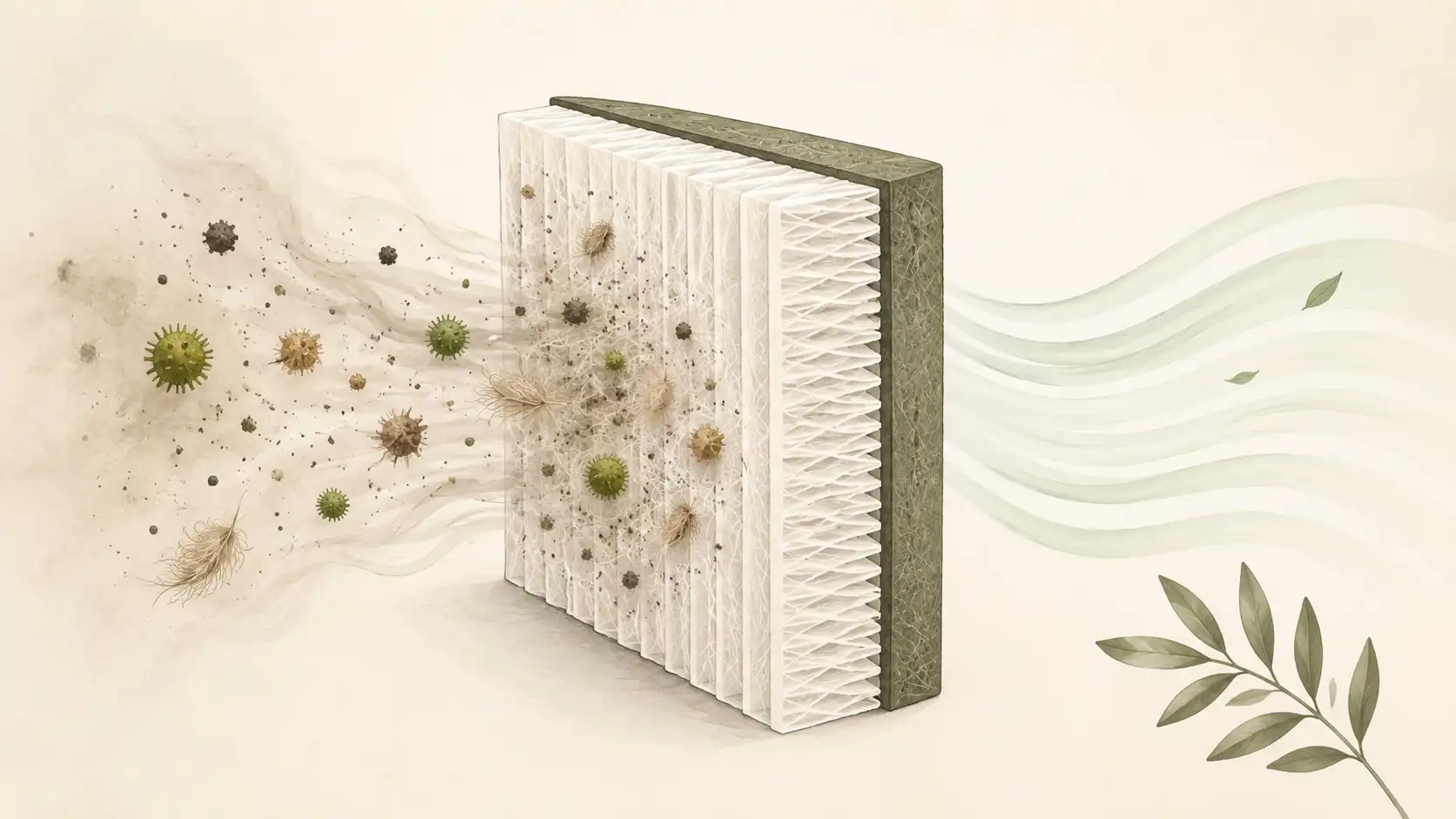
An air purifier with a HEPA filter can capture airborne particles that pass through it. Removing gases requires a different filtration mechanism. Under the U.S. Department of Energy definition described by the EPA, a HEPA filter is a pleated mechanical filter that can theoretically remove at least 99.97% of airborne particles measuring 0.3 microns. That includes particle types such as dust, pollen, mold, and bacteria that actually reach the filter.
The 0.3-micron number is often misunderstood. It is not the smallest particle a HEPA filter can capture. EPA identifies that size as the difficult, or most penetrating, reference point; particles both larger and smaller can be trapped with even greater efficiency. That is why HEPA filtration can also capture fine smoke particles and airborne particles carrying biological material even when some of those particles are smaller than 0.3 microns.
HEPA still has important limits. It does not remove VOCs, gases, or many odors on its own, it cannot capture pollen or pet dander after those particles have already settled onto a surface, and the HEPA label does not tell you how quickly an entire air purifier can clean a room. If you are deciding what filtration matters for a particular problem, see our guide to choosing an air purifier for allergies, smoke, dust, or pets. For complete product comparisons, see our guide to the best air purifiers.
What HEPA Filters Can and Cannot Capture
A HEPA filter does not recognize pollutants by name. It captures particles according to how those particles move through and interact with the filter’s dense network of fibers. The practical question is therefore whether the pollutant is an airborne particle that can reach the filter or a gas, odor, or settled contaminant that requires a different strategy.
What HEPA Filters Can Capture
| Pollutant or Particle | HEPA Capture? | What to Know |
|---|---|---|
| Pollen | Yes, when airborne | Airborne pollen that reaches the filter can be captured efficiently. Larger pollen particles often settle onto floors, furniture, and other surfaces before reaching the purifier. |
| Household Dust | Yes, when airborne | HEPA can capture the airborne fraction of household dust, but visible dust that has already settled still requires cleaning or source control. |
| Pet Dander | Yes, when airborne | Dander particles can be filtered from the air. Pet hair is much larger and is usually intercepted by a prefilter or removed from surfaces through cleaning. |
| Smoke Particles | Yes | HEPA filtration can capture fine particulate matter in smoke. Smoke gases and odors are separate pollutants and are not removed by HEPA media alone. |
| Mold Spores and Fragments | Yes, when airborne | Airborne mold particles can be captured, but filtration does not correct the moisture problem or remove mold growth from the building. |
| Bacteria and Bioaerosols | Airborne particles can be captured | HEPA filtration physically captures airborne particles carrying biological material. Capture should not be confused with killing or chemically inactivating what is collected. |
| Virus-Containing Aerosols | Airborne particles can be captured | Particles carrying viruses can be trapped by high-efficiency filtration, including particles smaller than 0.3 microns. Filtration reduces airborne particles but is not by itself a guarantee against infection. |
| VOCs, Gases, and Odors | No, not with HEPA alone | These are gas-phase pollutants rather than particles. Activated carbon or another sorbent designed for gases is required for this separate filtration task. |
HEPA filtration is a particle-control technology. Whether a pollutant is captured depends first on whether it is an airborne particle that actually reaches the filter.
The distinction between airborne and settled material is important. The EPA notes that larger particles such as pollen, house-dust allergens, some molds, and animal dander are often found on surfaces rather than suspended in the air. A HEPA filter cannot capture those particles until they become airborne and are drawn through the filter.
The 0.3-Micron Number Is Not a Capture Cutoff
The most common misconception about HEPA filters is that particles smaller than 0.3 microns simply pass through them. That is not how fibrous filtration works. The EPA describes 0.3 microns as the difficult or most penetrating particle size used for the HEPA efficiency benchmark, not as a minimum particle size the filter can capture.
A qualifying HEPA filter is rated to capture at least 99.97% of particles at that challenging reference size. EPA notes that particles both larger and smaller are trapped with even greater efficiency. The efficiency curve therefore does not behave like a kitchen strainer where anything smaller than a particular opening falls through.
This matters when thinking about fine smoke and airborne biological particles. Their dimensions can extend below 0.3 microns, but small particles do not simply follow a perfectly straight path through the filter. Their motion increases the chance that they interact with and adhere to the filter fibers.
How a HEPA Filter Captures Particles
A HEPA filter is not simply a sheet with microscopic holes. It is a dense fibrous structure, and particles can be removed from the airstream in several ways. NIOSH describes impaction, interception, and diffusion as the primary mechanical collection mechanisms in fibrous filters.
Why HEPA is not a sieve
Larger or heavier particles carry enough inertia that they cannot follow the airflow as it bends around a fiber, causing them to collide with the filter material.
A particle follows the moving air but passes close enough to a filter fiber that it touches the fiber and is captured.
Very small particles move irregularly as they are struck by air molecules, increasing the chance that they wander into a filter fiber and become trapped.
The balance between these mechanisms changes with particle size. Impaction and interception become more important for larger particles, while diffusion becomes increasingly useful for very small particles. The least-favorable region between those mechanisms is why a filter can be challenged most around the most penetrating particle size even though it performs better on particles above and below it.
Can HEPA Capture Pollen, Dust, and Pet Dander?
Yes, when those particles are airborne and reach the filter. Pollen, airborne dust, and pet dander are all particulate pollutants, so they fall within the job HEPA filtration is designed to perform.
The limitation is delivery. Many pollen grains, dust allergens, and dander particles are relatively large and settle onto floors, bedding, upholstery, and furniture. The EPA notes that these settled allergens cannot be removed by an air cleaner unless they are disturbed and suspended in the air again.
This is why HEPA filtration should be viewed as part of an allergy or dust-control strategy rather than as a substitute for vacuuming, surface cleaning, source control, or reducing the amount of material introduced into the room. If the purchase is specifically driven by one of those concerns, our guide to choosing an air purifier for allergies, smoke, dust, or pets covers the broader buying priorities.
Can HEPA Capture Wildfire and Tobacco Smoke Particles?
HEPA filtration can capture the particle portion of smoke. Fine particulate matter in wildfire smoke is one reason high-efficiency filtration is commonly recommended during smoke events. The EPA recommends high-efficiency filters and appropriately sized portable air cleaners as options for reducing smoke particles indoors.
Smoke is also a useful example of why particle filtration and gas filtration should not be treated as the same thing. A HEPA filter can capture smoke particles that reach it, but the gaseous compounds and odors in smoke pass through ordinary particle media. Those require activated carbon or another gas-phase sorbent.
For that separate question, see our guide to whether air purifiers remove VOCs and odors. And because removing smoke particles from a room depends on both filter efficiency and airflow, use the air purifier CADR and room-size guide to determine how much clean-air delivery the room actually requires.
Can HEPA Capture Mold Spores?
Airborne mold spores and fragments are particles, so HEPA filtration can capture them when they reach the filter. That does not mean an air purifier fixes a mold problem.
The EPA states that portable air cleaners and HVAC filters do not address the cause of mold. Mold growth is driven by a water or moisture problem that has to be corrected directly. Filtration can reduce some airborne particles generated by mold, but it cannot dry the building, clean the contaminated surface, or prevent continued growth when the moisture source remains.
Can HEPA Capture Bacteria and Virus-Containing Aerosols?
HEPA filters can capture airborne particles carrying bacteria, viruses, and other biological material. The important distinction is between particle capture and biological inactivation: a mechanical filter removes particles from the passing airstream by trapping them in the media; it does not need to kill or chemically neutralize them in order to remove those particles from the air.
This is another reason the 0.3-micron number should not be interpreted as a minimum capture size. CDC/NIOSH guidance recommends appropriately sized portable HEPA filtration systems for additional room air cleaning and describes HEPA units as a way to increase the removal of airborne contaminants.
Filtration is still only one part of exposure control. Capturing airborne particles does not establish that a room is sterile or guarantee that infection cannot occur, and a portable air cleaner does not replace fresh-air ventilation where ventilation is needed.
What HEPA Filtration Does Not Remove
HEPA is a particle filter, so gases are outside its core function. The EPA distinguishes filters designed for particles from filters designed for gases and recommends activated carbon or another suitable sorbent when gas removal is the goal.
- VOCs: volatile organic compounds are gases and are not removed by ordinary HEPA media.
- Many odors: odor-producing gases require gas-phase media rather than a particle filter alone.
- Other gaseous pollutants: HEPA cannot be assumed to remove gases simply because the filter is highly efficient against particles.
- Settled particles: material already resting on floors, upholstery, bedding, or furniture has to become airborne before a room air cleaner can capture it.
- The pollutant source: filtration does not correct moisture that causes mold, eliminate outdoor smoke entering through leaks, or remove the source producing a gas or odor.
A purifier can combine HEPA media with activated carbon or another filter so that the complete system addresses both particles and gases. The presence of a carbon layer, however, does not change what the HEPA layer itself does.
HEPA Efficiency Is Not the Same as Air Purifier Performance
A filter can be highly efficient without the complete purifier being powerful enough for the room. HEPA efficiency describes how well the filter captures particles that pass through its media. Room cleaning also depends on how much air the machine moves through that filter.
The EPA describes air-cleaner effectiveness as a combination of pollutant collection efficiency and the amount of air drawn through the cleaning element. That is why a small purifier cannot be assumed to clean a large room effectively simply because it contains a HEPA filter.
Clean Air Delivery Rate, or CADR, is the more useful whole-machine number for particle cleaning. It combines particle removal with airflow to estimate how much cleaned air the purifier delivers. Our CADR-by-room-size guide and calculator handles that calculation rather than treating the HEPA label as a substitute for room sizing.
Fan speed matters for the same reason. A purifier normally delivers less cleaned air when operated below maximum speed. If the machine will spend most of its time in a bedroom or office where noise determines the usable fan setting, see our guide to what makes an air purifier quiet enough for bedrooms and offices.
Filter Fit, Bypass, and Replacement Still Matter
The HEPA rating applies to air that actually passes through the filter media. A poorly fitted filter, damaged seal, or gap around the filter can allow some air to bypass the media entirely. CDC/NIOSH guidance recommends checking filter fit and minimizing air that flows around rather than through the filter.
As particles accumulate, the filter also needs maintenance or replacement. EPA advises that filters need regular replacement and that an overloaded filter will not work well. Homes with pets, heavy dust, or wildfire smoke may load filters more quickly than the same purifier operating under lighter conditions.
Before buying, check the replacement filter price, expected interval, whether the prefilter can be cleaned separately, and whether compatible replacements are readily available. Those ownership costs are covered in our guide to air purifier filter replacement cost and long-term value.
How to Read a HEPA Claim Before Buying
The clearest HEPA claim tells you what particle efficiency the filter is designed to meet rather than relying only on terms such as HEPA-style or HEPA-like. EPA’s description of the U.S. HEPA definition uses at least 99.97% efficiency at 0.3 microns as the benchmark.
- Confirm the particle-filter claim: look for a clearly stated HEPA efficiency specification rather than assuming every high-efficiency or HEPA-sounding term means the same thing.
- Check whole-machine CADR: verify that the purifier moves enough filtered air for the room.
- Check the filter installation: the media should fit securely so that air is directed through rather than around it.
- Check replacement requirements: filter cost, availability, and maintenance affect whether performance can be maintained over time.
- Evaluate gas filtration separately: a strong HEPA claim does not tell you how much activated carbon or other sorbent media the purifier contains.
After the filtration fundamentals are settled, convenience features become a separate decision. Sensors, automatic modes, displays, apps, and filter alerts may improve usability, but they do not make an undersized purifier or inadequate filter perform better. Our guide to air purifier features worth paying for handles those extras separately.
Frequently Asked Questions
Can HEPA filters capture particles smaller than 0.3 microns?
Yes. The 0.3-micron HEPA specification is not a minimum capture size. EPA describes it as the difficult reference particle size and notes that particles both larger and smaller are captured with even higher efficiency.
Can a HEPA filter remove smoke?
It can capture the particle portion of smoke, including fine particulate matter that reaches the filter. HEPA alone does not remove the gaseous compounds or many odors in smoke, which require separate gas-phase filtration.
Can HEPA filters capture pet dander?
Yes, airborne pet dander can be captured. Much dander eventually settles onto surfaces, while pet hair is considerably larger and is often intercepted by a prefilter or removed through ordinary cleaning.
Can a HEPA filter remove VOCs or odors?
No, not by itself. VOCs and many odor-producing pollutants are gases. Activated carbon or another sorbent designed for gas removal is needed for that separate job.
Does a HEPA filter kill bacteria or viruses?
Mechanical HEPA filtration is primarily a capture process rather than a killing process. It can trap airborne particles carrying biological material, but capture should not be described as sterilization or biological inactivation.
Can a HEPA filter remove mold?
HEPA filtration can capture airborne mold spores and fragments, but it cannot remove existing mold growth or correct the moisture problem allowing mold to grow. The source still has to be addressed directly.
Is HEPA more important than CADR?
They measure different parts of performance. HEPA describes particle-filter efficiency, while CADR describes the clean-air output of the complete purifier. A useful room air cleaner needs capable filtration and enough clean-air delivery for the space.
Will a HEPA purifier remove dust that is already on furniture?
Dust has to reach the filter on moving air. If the bookshelf still looks dusty after the purifier has run, clean the shelf directly. The visible layer tells you about dust that settled there, while the purifier acts on particles suspended in the air that pass through it. A clean shelf or a dusty one, on its own, cannot tell you how much particle filtration the room received.
The Bottom Line
A HEPA filter is designed for airborne particles. It can capture pollen, dust, pet dander, mold particles, smoke particles, bacteria-containing aerosols, and virus-containing airborne particles that actually pass through the filter. The familiar 0.3-micron number is the difficult HEPA test point, not a lower size limit.
HEPA does not solve every indoor-air problem. It does not remove gases, VOCs, or many odors on its own, it cannot clean particles that remain settled on surfaces, and it cannot correct the source of mold or another continuing pollutant problem.
Finally, judge the complete purifier rather than the filter label alone. Verify room-size CADR, consider the fan speed you will actually use, check filter fit and replacement cost, and then evaluate convenience features. For product-level recommendations after those requirements are clear, return to our guide to the best air purifiers for cleaner indoor air.
Important: This article provides general information, not individualized medical, safety, installation, legal, or other professional advice. Product specifications, instructions, and safety information can change; verify current information with the manufacturer and consult an appropriately qualified professional when needed. See our Terms and Conditions for additional information.