
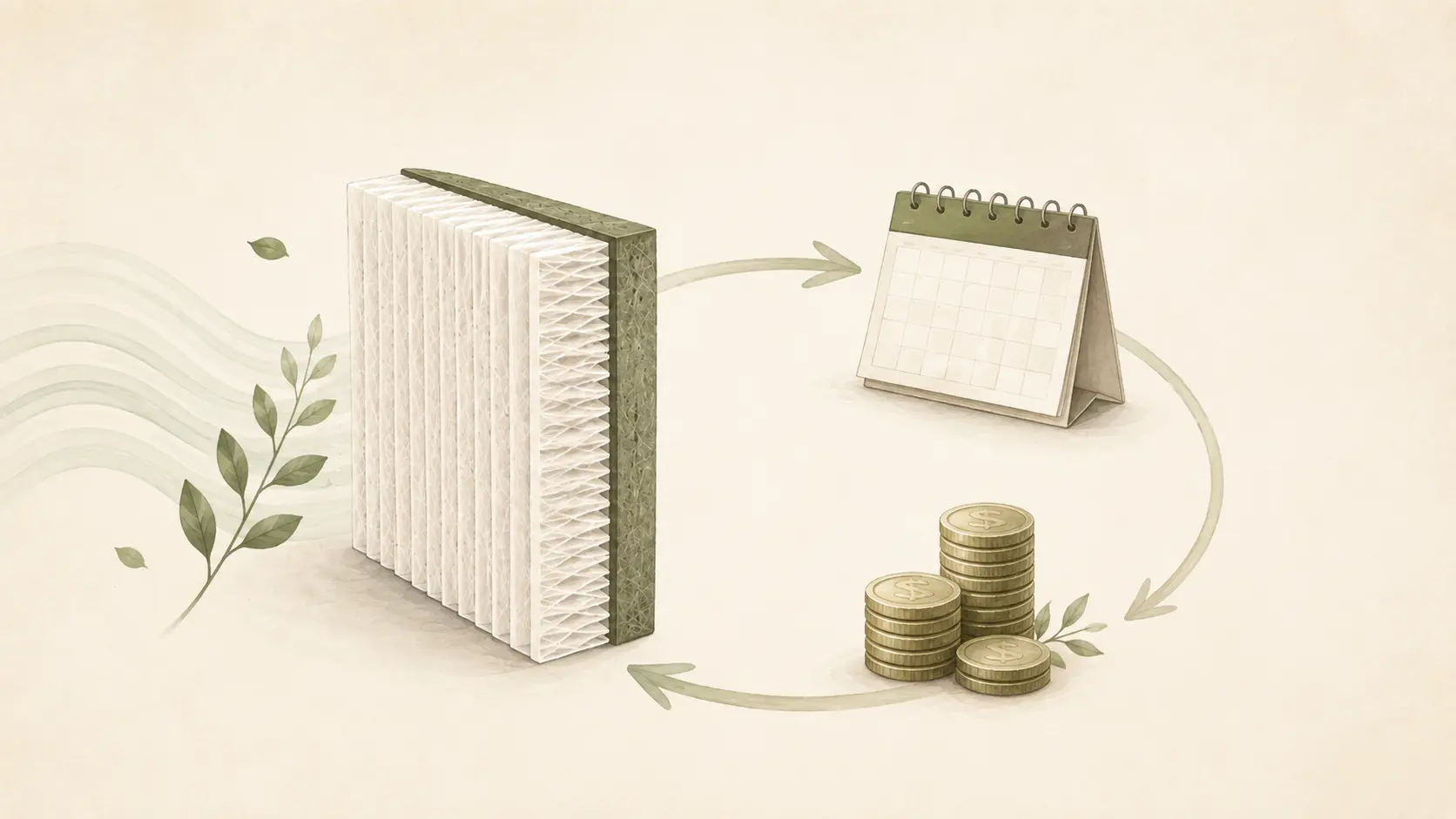
The purchase price is only one part of what an air purifier costs to own. Most filter-based purifiers require replacement media for as long as you use them, so a model with inexpensive, readily available filters can cost less over several years than a cheaper machine tied to costly or frequently replaced cartridges.
The useful comparison is not simply the price of one replacement filter. Compare the price of every consumable filter, how often each one is expected to be replaced, whether a reusable prefilter can handle larger debris, and whether the purifier depends on a proprietary cartridge that may be difficult or expensive to source later. The EPA notes that all filters require regular replacement and that an overloaded filter will not work well.
This guide turns those variables into an annual and multi-year ownership estimate. Start by making sure the purifier is actually powerful enough for the room using our CADR and room-size guide. Once two models both meet the performance requirement, filter cost becomes a useful way to distinguish their long-term value. For final product comparisons, see our guide to the best air purifiers.
What Determines Air Purifier Filter Cost?
To estimate annual air purifier filter replacement costs, price each required filter and count how many replacements its service interval calls for in a year. Two purifiers can use similarly capable particle filtration but create very different ownership expenses because one uses a long-life combined cartridge while another requires separate particle, carbon, and prefilter replacements.
What Changes Long-Term Filter Cost
| Cost Factor | Why It Matters | What to Verify Before Buying |
|---|---|---|
| Filter Price | A low purifier purchase price can be offset by expensive replacement cartridges. | Price the exact replacement filter or filter set rather than assuming generic replacements will be available. |
| Replacement Interval | The same filter price produces very different annual costs when one cartridge is replaced more frequently than another. | Read the manufacturer’s recommended interval and understand that actual loading conditions can shorten it. |
| Number of Consumables | Some purifiers replace particle and carbon media together, while others use multiple separately replaced components. | Determine whether the quoted price includes every disposable layer needed for normal operation. |
| Reusable Prefilter | A serviceable prefilter can intercept hair, lint, and larger debris before they accumulate on the primary filter. | Check whether the prefilter is removable, washable or vacuumable, and how the manufacturer instructs you to maintain it. |
| Proprietary Cartridge | A unique filter shape can tie the purifier to one replacement ecosystem for the life of the machine. | Check current availability, model compatibility, package quantity, and whether the cartridge is widely stocked. |
| Operating Environment | Wildfire smoke, heavy dust, pets, and other high-particle conditions can load filters faster. | Expect the published interval to be a starting point rather than a guarantee under unusually heavy particulate conditions. |
| Filter Bundles | A multi-pack can lower the effective cost per replacement, but only if the filters remain compatible and will actually be used. | Compare cost per complete change rather than only the package price. |
Compare the cost of one complete filter change and the expected number of changes over time. A cartridge price by itself does not show the true ownership cost.
The most important distinction is between replacement price and replacement cost over time. A $50 cartridge replaced once per year is a different ownership proposition from a $35 cartridge replaced every four months, even though the individual filter looks cheaper.
Air Purifier Filter Cost Calculator
Use the calculator to annualize the filter cost before comparing purifiers. Enter the price and replacement interval for the main cartridge. If the purifier also uses a separately replaced carbon, secondary, or other consumable filter, add that as the optional second component.
The result is an estimate rather than a prediction of exactly when a filter will become loaded. Actual replacement timing depends on the manufacturer’s instructions and the amount of particulate or gas contamination the filter encounters.
Air Purifier Filter Cost Calculator
Estimate annual, three-year, and five-year replacement-filter cost.
Main Filter
Optional Second Consumable
Enter valid filter prices and replacement intervals.
The calculator annualizes the replacement schedule so products with different intervals can be compared on the same basis. It does not assume that a filter will last exactly the advertised number of months; the actual service interval still depends on use and loading conditions.
Replacement Intervals Are Estimates, Not Guarantees
There is no single correct replacement interval for every portable air cleaner. Filter size, filter media, fan speed, operating time, pollutant concentration, and the amount of material already in the home can all change how quickly a filter loads.
The EPA recommends replacing filters according to the manufacturer’s instructions and notes that dirty, overloaded filters do not work well. Treat the published interval as the starting maintenance schedule for that specific purifier rather than as a universal lifetime for HEPA or carbon media.
This also means that comparing two filters solely by advertised life can be misleading. A physically larger or more expensive cartridge may last longer, while another filter may cost less but require more replacements. Annualizing the cost is what puts those designs on equal footing.
Heavy Smoke, Dust, and Pets Can Shorten Filter Life
The more material a filter collects, the faster it approaches the point where maintenance or replacement is needed. A purifier operating in a relatively clean bedroom therefore does not necessarily load its filters at the same rate as an identical machine exposed to wildfire smoke, renovation dust, frequent cooking particles, or a home with multiple shedding pets.
Wildfire smoke provides the clearest example. The EPA advises planning to replace portable-air-cleaner and HVAC filters more often during periods of heavy smoke and recommends earlier replacement when a filter appears heavily soiled.
That same principle is useful when comparing purifiers for dust or pets: filter expense should be considered under the conditions where the machine will actually operate. Our guide to choosing an air purifier for allergies, smoke, dust, or pets explains which filtration features matter for each concern.
A Serviceable Prefilter Can Change the Maintenance Equation
Many portable air cleaners place a coarse prefilter ahead of the main particle filter. Its job is to intercept larger material such as lint, visible dust, and pet hair before that debris reaches the denser downstream media.
From an ownership perspective, the important question is whether that prefilter is easy to access and whether the manufacturer allows it to be cleaned. A removable washable or vacuumable prefilter can be maintained without replacing the entire primary filter each time larger debris accumulates on the intake side.
Do not assume that every first-stage screen is washable. Some filter layers are permanently attached to a disposable cartridge, while others have specific cleaning restrictions. Follow the purifier’s maintenance instructions rather than washing a component merely because it looks reusable.
The prefilter also does not replace the primary filtration requirement. If the goal is pollen, smoke particles, airborne dust, or pet dander, the downstream particle filter still performs the fine-particle work. Our guide to what HEPA filters capture explains that particle-filtration role separately.
Combined Filters vs. Separate Replacement Layers
Air purifiers do not all package their filter media the same way. One model may combine prefiltration, particle filtration, and carbon into a single disposable cartridge. Another may use a long-life particle filter plus a separately replaced carbon element. Neither design is automatically cheaper.
A combined cartridge is easy to budget because one purchase renews the disposable system, but it can also mean replacing all media whenever one component reaches the manufacturer’s service interval. Separate filters can allow individual components to follow different schedules, although they create more parts and prices to track.
Gas filtration makes this distinction particularly important. Activated carbon and HEPA perform different jobs, so a purifier advertising both may package them together or separately. If gases or odors are part of your buying requirement, our guide to whether air purifiers remove VOCs and odors covers the filtration side; when comparing ownership cost, make sure every disposable gas-filter component is included in your annual estimate.
Proprietary Filters Create an Availability Risk
A proprietary filter is not inherently a problem. Custom filter shapes can be part of a well-designed purifier, and a widely supported cartridge may remain easy to buy for years. The ownership risk comes from depending on a replacement that fits only one machine or a narrow family of models.
Before buying, search for the exact replacement part and check whether it is sold independently of the purifier itself. Confirm the package quantity, compatibility list, and current availability. A replacement labeled for several similarly named models should not be assumed to fit yours unless the manufacturer specifically lists the model.
Long-term value also depends on whether replacement media remain reasonably obtainable. An inexpensive purifier loses much of its advantage if its only compatible filter becomes difficult to source, while a more expensive purifier supported by a stable replacement ecosystem may be easier to maintain over time.
Do Third-Party Filters Actually Save Money?
A lower-priced third-party replacement can reduce the apparent annual filter cost, but price alone does not establish equivalent performance. Fit, seal, media construction, carbon quantity, pressure drop, and actual particle efficiency can differ even when the cartridge dimensions appear compatible.
This matters because the purifier’s tested performance applies to the configuration used for that test. Substituting different filter media changes part of the air-cleaning system. Unless a replacement provides trustworthy performance information for the exact purifier, treat claims of equivalent filtration cautiously.
Start the cost comparison with the manufacturer-specified replacement filters. A third-party option can be considered separately, but it should not be used to make an expensive proprietary-filter design look inexpensive unless equivalent performance is actually established.
Filter Alerts Are Useful, but Know What They Measure
A filter indicator can make maintenance easier, but not every alert measures the physical condition of the filter. Some purifiers simply count operating hours or elapsed time and trigger the reminder after a programmed interval. Others may use additional operating information.
That makes the alert a maintenance prompt rather than proof that the filter is either exhausted or still clean. Check what the manufacturer says the indicator represents, inspect and maintain accessible prefilters as instructed, and follow the stated replacement guidance for the primary cartridge.
Filter alerts belong in the convenience category after filtration performance and ownership cost are already acceptable. Sensors, apps, automatic modes, scheduling, displays, and reminders are covered more fully in our guide to air purifier features worth paying for.
Filter Cost Is Only One Part of Long-Term Ownership Cost
Replacement filters may be the most visible recurring expense, but they are not the only one. A portable air cleaner also consumes electricity whenever its fan and electronics operate. That matters because effective particle filtration usually depends on running the machine for substantial periods rather than turning it on only occasionally.
ENERGY STAR evaluates room air cleaners using clean-air delivery relative to power consumption and reports that certified models can use substantially less electricity than standard models. Energy efficiency is therefore a separate ownership-cost comparison after the purifier has enough CADR and suitable filtration for the room.
Do not compensate for an undersized purifier merely because its filters or electricity are inexpensive. First establish the necessary clean-air output using the CADR-by-room-size guide. Then compare the recurring filter and energy expenses among machines that can actually perform the job.
How to Compare Long-Term Value Before Buying
A practical comparison takes only a few minutes once you stop looking at the purifier price by itself. Perform the same ownership-cost check for every model that survives your performance requirements.
Compare ownership in this order
The result may reverse the apparent value order. A purifier that costs more on day one can become the less expensive machine over several years if its consumables are cheaper or replaced less often. The opposite is also possible: a low initial price can hide a relatively expensive filter ecosystem.
Frequently Asked Questions
How much do air purifier replacement filters cost per year?
There is no useful universal number because filter prices and replacement intervals vary by purifier. Calculate the annual estimate by dividing 12 by the replacement interval in months and multiplying that result by the price of one complete replacement. Add any separately replaced carbon or secondary filters.
How often should an air purifier filter be replaced?
Follow the manufacturer’s replacement instructions for the exact filter and purifier. EPA notes that many factors affect how quickly filters become dirty and that heavily soiled filters may need to be changed more frequently.
Do air purifier filters last less time during wildfire smoke?
They can. Heavy smoke increases the particulate load reaching the filter. EPA recommends planning for more frequent filter replacement during significant smoke events and replacing heavily soiled filters sooner.
Does a washable prefilter mean I never have to replace the HEPA filter?
No. A washable or serviceable prefilter can remove larger debris before it reaches the primary particle filter, but it does not perform the same fine-particle filtration job. The downstream disposable filter still needs to be replaced according to its instructions.
Are combined HEPA and carbon filters more expensive?
Not necessarily. A combined cartridge may cost more per replacement but require only one purchase, while a purifier with separate media can involve several independently replaced components. Compare the annualized cost of the complete required filter system rather than the number of layers.
Are third-party replacement filters worth using?
A lower price can be attractive, but dimensional compatibility does not prove equivalent filtration, airflow resistance, sealing, or carbon performance. Use manufacturer-specified filters as the clean baseline when comparing purifier ownership costs unless equivalent third-party performance is independently established.
Should I buy several replacement filters at once?
First count complete changes. A $72 pack containing three compatible main filters costs $24 per change. A $45 pack containing one main filter and two prefilters supplies only one main-filter change. Check the exact model, what can be cleaned and which pieces need separate replacement. Buy ahead only for filters you are likely to use, and follow the maker’s storage directions for spares.
Does a filter replacement light know when the filter is actually dirty?
Not always. Some reminders are based primarily on elapsed operating time or a programmed maintenance interval rather than direct measurement of filter loading. Check the manufacturer’s explanation of the indicator and treat it as a maintenance prompt rather than assuming it directly measures remaining filter life.
Is the cheapest replacement filter always the best value?
No. Value depends on replacement frequency, filtration performance, fit, availability, and the complete ownership cost. A more expensive cartridge that lasts longer or maintains the purifier’s tested performance can be a better value than a cheaper option replaced frequently or of uncertain performance.
The Bottom Line
Air purifier value depends on more than the price of the machine. Price the exact replacement media, convert the manufacturer’s replacement schedule into an annual estimate, include every separately replaced filter, and check whether the cartridge is easy to obtain before committing to a purifier.
Expect the real interval to vary with operating conditions. Heavy smoke, dust, pet debris, and other high-particle environments can load filters more quickly, while a serviceable prefilter may make routine maintenance easier by intercepting larger debris before it reaches the primary media.
Most importantly, do not buy a cheaper-to-maintain purifier that is wrong for the room. Establish CADR and filtration requirements first, then compare filter cost, energy use, and convenience among the machines that meet them. For final product-level recommendations across those tradeoffs, return to our guide to the best air purifiers for cleaner indoor air.
Important: This article provides general information, not individualized medical, safety, installation, legal, or other professional advice. Product specifications, instructions, and safety information can change; verify current information with the manufacturer and consult an appropriately qualified professional when needed. See our Terms and Conditions for additional information.