
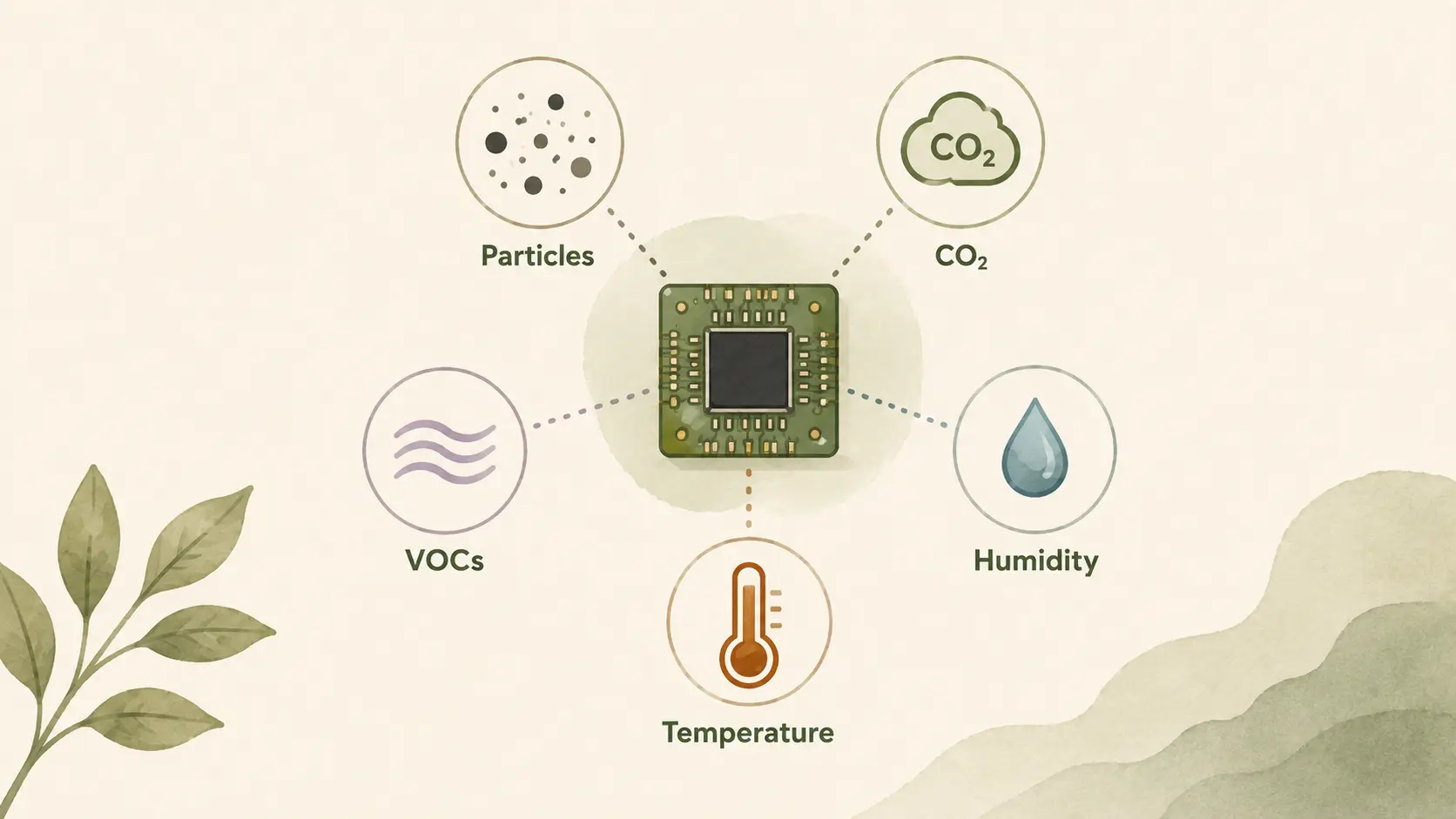
Choose an air quality sensor by naming the change you want it to detect. PM2.5 can reveal fine-particle changes from cooking, smoke, and outdoor pollution. Carbon dioxide can help you understand how ventilation changes as people occupy a room. Humidity adds moisture context. VOC, radon, formaldehyde, and other measurements can be valuable too, but they solve more specific problems.
That means a monitor with seven advertised measurements is not automatically better than one with three carefully chosen sensors. The EPA notes that consumer air monitors only detect the pollutants or environmental factors they are designed to measure, and no single monitor provides a complete picture of indoor air quality.
For a broadly useful home monitor, we would start by looking for PM2.5, a direct CO₂ measurement, and humidity and temperature. Then add VOC, radon, formaldehyde, PM10, or other specialized measurements only when they answer a question that matters in your home. Carbon monoxide deserves separate treatment because an air-quality reading must never substitute for a certified life-safety CO alarm. Once you know which measurements you need, our indoor air quality monitor buying guide compares the actual products.
Which Air Quality Monitor Sensors Matter Most?
The sensors below do different jobs. Use the table as a first-pass filter rather than treating every measurement as equally important. The right combination depends on whether you care most about particles, ventilation, moisture, combustion, radon, off-gassing, or simply understanding how conditions change throughout the day.
Air Quality Monitor Sensors at a Glance
| Sensor | What It Helps Track | Worth Prioritizing When | Important Limitation |
|---|---|---|---|
| PM2.5 | Fine airborne particles from sources such as cooking, wildfire smoke, combustion, and outdoor pollution | You want a broadly useful particle measurement or want to evaluate changes from filtration, cooking, or smoke | It measures particles, not CO₂, radon, VOCs, carbon monoxide, or the rest of indoor air quality |
| CO₂ | Carbon dioxide accumulation that can help reveal ventilation patterns in occupied rooms | You use bedrooms, offices, classrooms, meeting rooms, or other spaces where occupancy changes through the day | CO₂ is a ventilation indicator, not a direct measurement of every indoor pollutant or infection risk |
| Humidity + Temperature | Moisture and temperature conditions that provide context for comfort, condensation, and other measurements | You want useful environmental context and to track seasonal or room-to-room moisture changes | They describe environmental conditions rather than directly measuring particle or gas pollutants |
| VOC / TVOC | Broad changes in volatile organic compounds from products, cleaning, cooking, furnishings, and other sources | You mainly want to notice changing patterns or emission events rather than identify a specific chemical | A TVOC sensor does not identify every VOC or tell you which individual compounds produced the reading |
| Radon | Radon gas and its longer-term variation inside the home | You want continuous radon tracking instead of relying only on periodic passive tests | Continuous monitoring is useful, but you do not need radon built into every general-purpose air monitor to test a home |
| Formaldehyde | A specific volatile organic compound associated with some building materials, furnishings, adhesives, and combustion sources | You have a targeted reason to investigate formaldehyde rather than simply wanting general air-quality awareness | A formaldehyde reading is a specialized measurement and should not be treated as a complete VOC assessment |
| Carbon Monoxide | CO concentration when the monitor includes a dedicated CO sensor | You want supplemental trend information alongside your required household safety devices | An air quality monitor is not a substitute for a properly installed and certified carbon monoxide alarm |
| PM10 | Coarser particulate matter in addition to the fine-particle information captured by PM2.5 monitoring | Coarse dust or broader particle-size information is an important part of your specific use case | For many home buyers, PM2.5 provides the more important first particle measurement and PM10 is secondary |
You do not need every sensor in one device. Start with the measurements that answer a real question in your home, then evaluate the monitor’s implementation and usability separately.
The pattern is more useful than the sensor count. PM2.5, CO₂, humidity, and temperature answer broad everyday questions about particles, ventilation, and moisture. VOCs can add useful trend information. Radon, formaldehyde, carbon monoxide, PM10, and other specialized measurements can be valuable when you have a specific reason to monitor them, but they should not automatically push one device ahead of another.
Start With the Question You Want the Monitor to Answer
An air quality monitor contains sensors for particular pollutants or environmental conditions. A reading for one pollutant does not establish the level of another that the device does not measure.
This is one of the most important points in the EPA’s guidance on lower-cost indoor air monitors: these devices do not provide a complete representation of indoor air quality. A PM-only monitor, for example, does not tell you whether radon or carbon monoxide is present. A CO₂ monitor does not tell you the concentration of smoke particles. A TVOC sensor cannot tell you the concentration of every individual organic chemical in the room.
The sensors you need depend on the problem you want to investigate. If you want to see whether cooking or wildfire smoke is raising airborne particles, PM2.5 matters. If you are trying to understand ventilation in an occupied bedroom or office, CO₂ matters. If moisture is the concern, humidity matters. If you specifically want continuous radon information, then radon becomes a purchasing requirement rather than an optional extra.
The article on what PM2.5, VOC, CO₂, and humidity readings mean handles interpretation of those numbers. Here, the goal is narrower: decide which measurements are worth paying for before you choose the monitor.
PM2.5: The First Particle Sensor We Would Look For
PM2.5 refers to fine particulate matter with aerodynamic diameters of 2.5 micrometers or smaller. In a home, fine-particle levels can change because of cooking, combustion, wildfire smoke, outdoor pollution entering the building, and other sources. A PM2.5 sensor makes those changes visible in a way that smell or visual inspection cannot reliably do.
For that reason, PM2.5 is one of the most broadly useful measurements in a general-purpose indoor air monitor. It is particularly valuable if you want to observe what happens when you cook, run an air purifier, open windows during a smoke event, change HVAC filtration, or compare particle conditions between rooms.
Consumer PM sensors commonly use optical techniques that infer particle concentrations from the way particles interact with light. The EPA describes light-scattering and optical particle approaches used in lower-cost particle sensors. That does not make every PM2.5 monitor equally accurate, but it explains why PM2.5 can be measured continuously in relatively small consumer devices.
More decimal places do not establish greater accuracy. Sensor implementation, environmental conditions, data processing, and device quality can all affect readings. We separate that question in our guide to how accurate home air quality monitors are.
CO₂: Prioritize a Direct Measurement for Ventilation Awareness
Carbon dioxide is especially useful in occupied indoor spaces because people continuously add CO₂ to the air through respiration. As occupancy and ventilation change, the indoor concentration changes with them. The CDC notes that CO₂ monitoring can provide useful information about ventilation in a space, while also cautioning that CO₂ by itself cannot measure infection risk or describe every aspect of air quality.
If ventilation is one of your main reasons for buying a monitor, look for a device that actually measures carbon dioxide rather than presenting only a generic air-quality score. Non-dispersive infrared, or NDIR, is a widely used optical method for measuring CO₂. NIST has evaluated lower-cost NDIR CO₂ sensing technology, and NDIR remains common in dedicated indoor CO₂ monitors.
Also watch the terminology. CO₂ and eCO₂ are not necessarily the same measurement. Some sensor systems report an equivalent or estimated CO₂ value derived from another gas-sensor response rather than directly sensing carbon dioxide. If ventilation awareness is the reason you are paying for the feature, verify that the manufacturer actually identifies a CO₂ sensing method rather than relying on a calculated equivalent value.
A dedicated CO₂ monitor can therefore be a better choice than a feature-packed device that measures many unrelated parameters but does not include a direct CO₂ sensor. Sensor count should follow the question you want answered, not the other way around. Our IQAir AirVisual Pro review shows why separate particle and CO₂ readings mattered in the bedroom: PM2.5 was zero at the recorded bedtime and waking checks on both nights, while CO₂ rose.
Humidity and Temperature: Simple Sensors With Useful Context
Temperature and relative humidity are not pollutant measurements, but they are useful enough that we would generally welcome them in a home air-quality monitor. They help explain the environment surrounding the other sensors and give you a continuous view of conditions that otherwise require a separate thermometer or hygrometer.
Humidity is particularly useful because moisture conditions affect comfort, condensation, mold potential, and how a room behaves seasonally. The EPA recommends monitoring indoor humidity as part of moisture control.
Temperature and humidity can also provide context when another measurement changes. That does not mean you should diagnose a particle or gas reading from humidity alone, but seeing the environmental conditions next to the pollutant trend makes the data easier to evaluate.
Because temperature and humidity sensing is common in multi-sensor monitors, we would not usually pay a large premium just to add them. They are best treated as useful foundational context rather than the reason to choose an otherwise weaker monitor.
VOC Sensors Are Best Treated as Broad Trend Sensors
Volatile organic compounds are not one pollutant. The category includes many different chemicals emitted from materials and activities such as paints, adhesives, furnishings, cleaners, fuels, personal-care products, and other indoor sources.
This creates an important limitation for consumer monitors. A display labeled VOC or TVOC should not be interpreted as a laboratory analysis identifying every organic compound in the room. The EPA explains that VOC measurement methods are selective and that no single method measures all VOCs present in indoor air.
The EPA’s Enhanced Air Sensor Guidebook likewise notes that common lower-cost total-VOC sensors can respond differently to different compounds and that the reported concentration generally cannot be assigned to one specific chemical. That makes a consumer VOC sensor more useful for observing patterns than for identifying a particular chemical.
That can still be valuable. A VOC sensor may reveal a repeatable increase after cleaning, painting, using solvents, bringing in new furnishings, or performing another activity that releases organic vapors. You can then compare what happens when the source is removed or ventilation changes.
We would therefore treat VOC capability as a useful secondary sensor for many buyers, but not as a substitute for PM2.5, direct CO₂, or targeted testing when a particular chemical is the concern.
Radon Testing Is Separate From Choosing a General Air Monitor
Radon deserves separate treatment because it is not simply another convenience metric. It is a naturally occurring radioactive gas that can enter buildings from the ground, and the only way to know the level in a particular home is to test.
The EPA specifically says its radon-zone map should not be used to decide whether an individual home needs testing. The agency recommends testing homes regardless of geographic zone because neighboring houses can have different radon levels.
That does not mean every general-purpose air quality monitor needs an integrated radon sensor. Passive radon test kits are inexpensive, and continuous radon monitors are also available as dedicated devices. The buying decision is whether you want radon incorporated into the same long-term dashboard as PM2.5, CO₂, humidity, and other measurements.
If you want to observe radon over seasons, compare floors, or keep a continuous long-term record, an integrated or dedicated continuous monitor can be useful. If you mainly want to establish whether the home has a radon problem, a properly performed radon test may answer that question without forcing radon capability into every future air-quality purchase.
Formaldehyde Is a Specialized Sensor, Not a Requirement for Every Monitor
Formaldehyde is a specific volatile organic compound. Indoor sources can include some pressed-wood products, adhesives, furnishings, building materials, coatings, smoking, and unvented fuel-burning appliances. The EPA identifies pressed-wood products and other household materials among potential indoor formaldehyde sources.
A formaldehyde sensor therefore answers a more targeted question than a general TVOC sensor. It can make sense when formaldehyde itself is the reason you are monitoring, such as when investigating emissions associated with new materials or furnishings.
An HCHO label in a long specification list is not, by itself, a reason to pay more. A dedicated formaldehyde channel is only useful if you need that measurement and have confidence in how the particular device obtains it. More displayed pollutants do not automatically mean better measurement quality.
Likewise, do not assume that a generic TVOC number tells you the formaldehyde concentration. They are different measurements, and formaldehyde is one specific chemical within the larger group of volatile organic compounds.
Carbon Monoxide in an Air Quality Monitor Does Not Replace a CO Alarm
Some multi-sensor air quality monitors include carbon monoxide. That can provide additional information, but it creates a safety distinction that should never get lost in a feature comparison.
The EPA explicitly distinguishes lower-cost air pollution monitors from emergency-alert devices. Air-quality-monitor alerts are not designed to provide the same immediate life-safety warning as a certified household carbon monoxide alarm.
The EPA separately recommends using CO alarms certified to the applicable safety standard and installing them according to their instructions. A monitor with a carbon-monoxide number should therefore be considered supplemental information, not permission to remove or skip the dedicated alarms protecting the home.
That makes CO a poor sensor to use as the deciding factor between otherwise similar general-purpose air quality monitors. Buy and maintain the proper safety alarms independently. Then evaluate whether having additional CO trend information in the air-quality dashboard provides value for your use case.
Do You Need PM10 if the Monitor Already Measures PM2.5?
PM10 adds information about a larger particle-size category, while PM2.5 focuses on fine particulate matter. Having both can be useful when coarse dust or broader particle-size behavior is part of the reason you are monitoring.
For a typical home buyer choosing a first general-purpose monitor, however, we would prioritize PM2.5 before paying extra solely for PM10. Fine-particle monitoring is highly relevant to combustion, wildfire smoke, cooking emissions, outdoor particle intrusion, and air-cleaner performance, making it a strong everyday measurement.
PM10 becomes more compelling when the use case specifically involves coarse dust or when you want additional particle-size information. Do not treat the presence of PM1, PM2.5, PM4, and PM10 as four completely independent air-quality systems simply because the display lists four numbers.
The quality of the underlying particle measurement matters more than maximizing the number of size fractions printed on the product page.
AQI Is an Index, Not Another Sensor
Air Quality Index, or AQI, often appears beside the sensor list on consumer monitors. That can make it look like another pollutant measurement. It is not.
The U.S. AQI is an index used to communicate outdoor air-quality conditions. Pollutant concentrations are converted into standardized index values. A monitor displaying an AQI therefore needs an underlying pollutant measurement from which that index or a similar score is calculated.
Consumer manufacturers may also display proprietary indoor-air scores, colors, or good, fair, and poor labels derived from several sensors. Those summaries can be convenient, but they should not distract you from checking what the device actually measures.
If two monitors both advertise AQI, but one measures only PM2.5 while the other measures PM2.5, CO₂, VOCs, humidity, and radon, the AQI label does not make their sensing capabilities equivalent. Read the underlying sensor list first; the index is a way of displaying information from those measurements.
What About NO₂, Ozone, and Other Specialty Sensors?
Some higher-end or specialized air monitors add nitrogen dioxide, ozone, carbon monoxide, or other gas sensors. These measurements can be useful, but they move the purchase away from a general home dashboard and toward a more specific monitoring goal.
For example, someone investigating combustion emissions or pollution near a roadway may care about a different sensor mix than someone who mainly wants to understand bedroom ventilation and wildfire smoke. The EPA’s air-sensor resources emphasize defining the measurement question before choosing the sensor because different technologies target different pollutants and have different limitations.
We would not reject a monitor because it lacks every specialty gas sensor. Instead, decide whether the pollutant is part of the reason you are buying the device. If it is not, adding another number to the dashboard can create cost and complexity without adding much decision value.
A Practical Sensor Set for Most Homes
If the goal is broad everyday awareness rather than investigating one known pollutant, we would build the sensor set in layers. PM2.5 tracks fine particles, and direct CO₂ helps show ventilation patterns. Humidity and temperature add inexpensive environmental context. That combination already reveals a great deal about how an occupied home changes through cooking, closed-room use, outdoor pollution events, HVAC operation, and ventilation.
VOC becomes the next useful addition when you want to see broad changes related to cleaning products, furnishings, solvents, cooking, and other emissions. Radon is worth adding when you specifically want continuous long-term radon tracking. Formaldehyde, PM10, NO₂, ozone, and other specialty measurements should then earn their place based on the problem you are trying to investigate.
Build the sensor set in this order
That order prevents a common shopping mistake: paying for a long sensor list before establishing whether the device measures the few things you actually care about. Once the sensor mix is right, then compare the ownership side. Our guide to air quality monitor apps and alert features handles logging, notifications, smart-home integration, subscriptions, data export, and other connected features separately.
Do Not Buy Sensors Without Thinking About Where the Monitor Will Go
The same sensor can produce less useful information when the monitor is placed in a location that does not represent the room. A device beside a stove, directly under an HVAC supply, against an open window, or immediately next to an air purifier is measuring that localized environment rather than necessarily describing the air where people spend their time.
The EPA recommends placing indoor air sensors where they have free airflow and where conditions are reasonably representative of the occupied space, while avoiding localized pollution sources, air cleaners, windows, doors, and HVAC effects when the goal is general room monitoring.
That matters to the buying decision because a portable battery-powered monitor may be better for comparing several rooms, while a plug-in model can work well as a permanent dashboard in one representative location. A sensor list that looks perfect on paper can still be a poor fit if the device cannot be positioned where you need it.
Our separate guide to where to place an air quality monitor handles height, vents, windows, kitchens, bedrooms, air purifiers, and room-to-room placement in more detail.
The Sensor Should Lead to a Useful Decision
A measurement becomes valuable when it changes what you do. PM2.5 can help show whether a particle event is occurring. CO₂ can reveal ventilation patterns in occupied rooms. Humidity can show changing moisture conditions. VOC trends can help identify recurring emission events. Radon monitoring can reveal longer-term variation.
But the correct response is not the same for every sensor. Opening a window may help with an indoor CO₂ buildup while being a poor choice during a severe outdoor smoke event. An air purifier can reduce particles without lowering CO₂. A dehumidifier addresses moisture but does not remove radon. Source control can matter more than filtration for some gaseous pollutants.
For help choosing a response to a reading, use our guide to when air quality readings call for purification, ventilation, or another response.
Frequently Asked Questions
What sensors should an air quality monitor have?
For broad everyday home monitoring, PM2.5, direct CO₂, humidity, and temperature form a practical starting set because they cover fine particles, ventilation patterns, and environmental context. VOC can add useful trend information. Radon, formaldehyde, PM10, carbon monoxide, and other specialty sensors should be added when they match a specific monitoring goal.
Is PM2.5 or CO₂ more important?
They measure different things, so neither replaces the other. PM2.5 tracks fine particles, while CO₂ can help you understand ventilation patterns in occupied spaces. If you care about both particle pollution and ventilation, a monitor that measures both is more informative than choosing one measurement as a universal air-quality score.
Should I buy an air quality monitor with a VOC sensor?
A VOC or TVOC sensor can be useful for observing broad changes after activities such as cleaning, painting, cooking, or bringing new materials into a room. It should not be treated as a laboratory identification of every VOC present, and it does not replace a targeted measurement when one specific chemical is the concern.
Do I need a radon sensor in my air quality monitor?
You should test your home for radon, but the test does not have to be built into your main air quality monitor. Passive test kits and dedicated continuous radon monitors are alternatives. Integrated radon sensing becomes particularly useful when you want continuous long-term radon data in the same dashboard as your other indoor-air measurements.
Is NDIR important for a CO₂ monitor?
NDIR is a well-established optical method used in many dedicated CO₂ monitors. If ventilation awareness is your goal, the more important shopping rule is to verify that the device directly measures CO₂ rather than presenting only an equivalent or estimated CO₂ value derived from another sensor.
Is eCO₂ the same as a real CO₂ measurement?
Look up what sensor produces the number. An eCO₂ figure can be an estimate derived from another sensor, such as a VOC sensor. A model that identifies a direct CO₂ sensing method, such as NDIR, is measuring a different quantity even when both screens say ppm. If you are buying a monitor to follow overnight bedroom CO₂, look for the sensor type and its accuracy range in the specifications before comparing app features.
Do I need both PM2.5 and PM10?
Not always. PM2.5 is the first particle measurement we would prioritize for broad home use. PM10 can add useful information about coarser particles and dust, but it should not automatically outweigh a better monitor that measures PM2.5, CO₂, humidity, and other measurements more relevant to your needs.
Does AQI count as another air quality sensor?
No. AQI is an index calculated from pollutant concentrations rather than a separate physical pollutant sensor. Check which underlying measurements the monitor actually collects instead of counting AQI or a proprietary air-quality score as another sensor.
Can an air quality monitor replace a carbon monoxide detector?
No. A consumer air quality monitor should not replace properly installed certified carbon monoxide alarms. A built-in CO sensor may provide supplemental information, but emergency CO alarms are designed and certified for life-safety warning in a way general air-quality dashboards are not.
Is a monitor with more sensors automatically better?
No. A larger sensor count can be useful only when those sensors answer questions you care about and the measurements are implemented well. A focused monitor with strong PM2.5 and direct CO₂ capability may be a better fit than a device advertising many measurements that are irrelevant to your home.
The Bottom Line
Choose an air quality monitor around the pollutants and conditions you want to understand. For broad home monitoring, PM2.5 tracks fine particles and direct CO₂ helps reveal ventilation patterns. Humidity and temperature provide useful context alongside them.
Then add sensors deliberately. VOC monitoring is most useful for broad trends rather than identifying individual chemicals. Continuous radon monitoring can be valuable, but radon testing does not have to be integrated into your primary monitor. Formaldehyde, PM10, NO₂, ozone, and other specialty measurements should earn their place based on a specific need. Carbon monoxide capability is supplemental and never replaces certified CO alarms.
Once you have the right sensor mix, compare accuracy, placement requirements, data history, alerts, app dependence, and other ownership features before choosing the device. For the product-level decision, return to our guide to the best indoor air quality monitors for home use.
Important: This article provides general information, not individualized medical, safety, installation, legal, or other professional advice. Product specifications, instructions, and safety information can change; verify current information with the manufacturer and consult an appropriately qualified professional when needed. See our Terms and Conditions for additional information.