
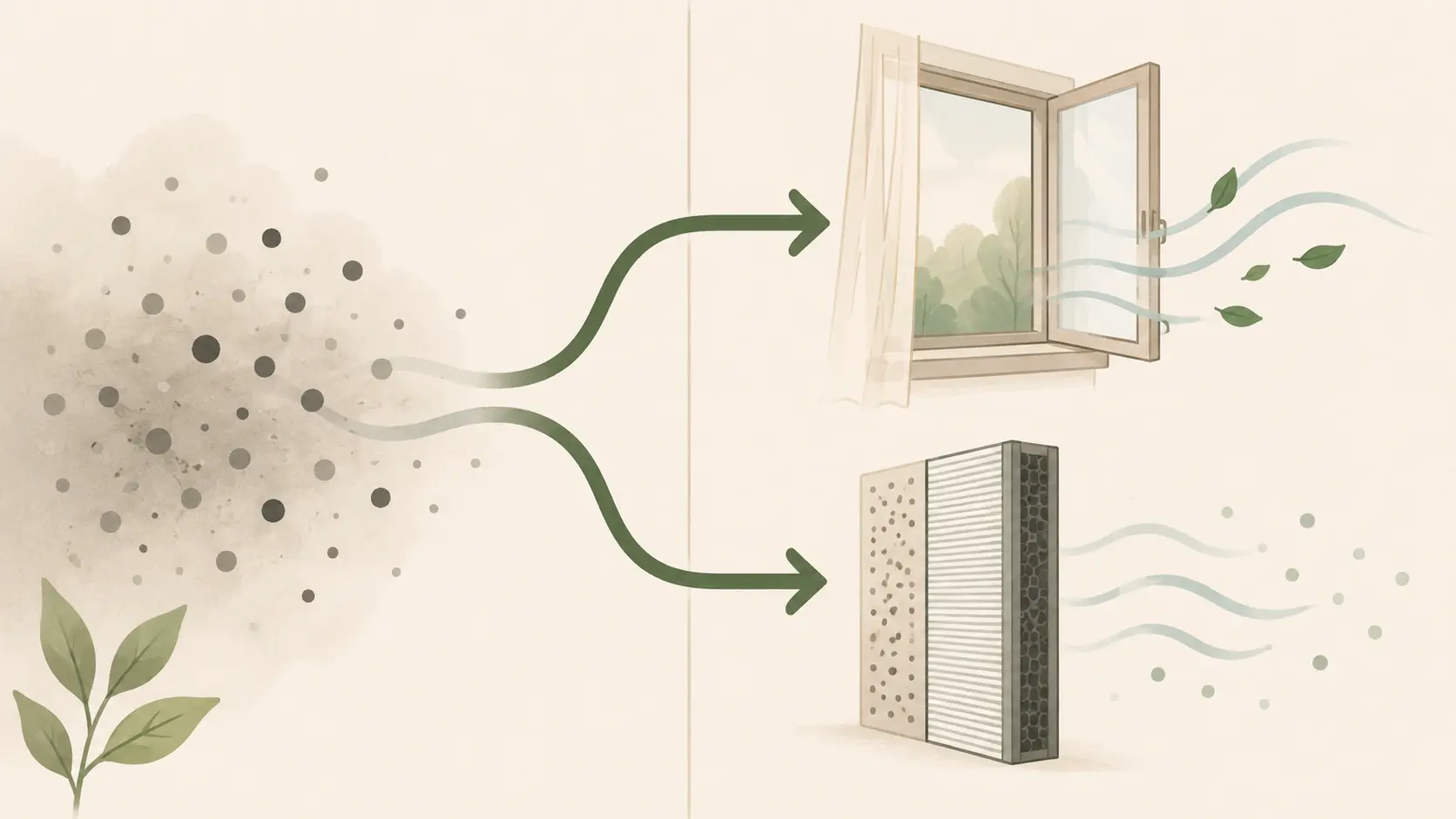
An air quality monitor can tell you that something changed, but the number does not automatically tell you which appliance to turn on. A rising PM2.5 reading points toward a particle problem. Rising CO₂ in an occupied room points toward ventilation. A VOC increase usually calls for identifying and controlling the source before relying on filtration. High humidity is a moisture problem, not something a particle air purifier can solve.
The outdoor environment matters too. Opening windows can be useful when indoor pollutants are building up and outdoor air is cleaner, but the same action can make conditions worse during wildfire smoke, high outdoor pollution, extreme humidity, or other unfavorable conditions. The right response depends on what is elevated, where it is coming from, whether the change is temporary or persistent, and what the outdoor air is like at that moment.
This guide focuses on that decision: filtration, ventilation, source control, or humidity management. If you first need help understanding the numbers themselves, see what PM2.5, CO₂, VOC, and humidity readings mean. If you are still choosing which measurements to buy, start with which air quality monitor sensors actually matter.
Match the Reading to the Right Response
The simplest way to avoid overreacting to a monitor is to separate the problem into four different control strategies. Particle filtration is effective for airborne particles. Ventilation exchanges indoor air with outdoor air. Source control stops or reduces the pollutant before it spreads through the room. Humidity control changes the amount of moisture in the air.
Reading → response
The same response does not work for every elevated reading. Start with the control method that actually acts on the pollutant or condition being measured.
More than one strategy can be appropriate at the same time. EPA’s general indoor-air framework prioritizes source control, clean-air ventilation, and supplemental filtration, with moisture control added when humidity is the problem.
The most important distinction is that an air purifier is not a universal response to an air-quality alert. It is a tool for pollutants its filtration system can actually remove. The EPA organizes indoor-air improvement around source control, improved ventilation, and air cleaning or filtration, and generally identifies source control as the most effective first strategy when a pollutant source can be eliminated or reduced.
PM2.5: Filtration Is the Direct Air-Cleaning Response
When PM2.5 rises, the monitor is detecting more fine particulate matter. That makes particle filtration the most directly relevant air-cleaning technology. Mechanical filters capture particles as room air passes through them, which is fundamentally different from trying to dilute the room with outdoor air.
The EPA recommends choosing portable air cleaners according to their particle-cleaning capacity and room size. A purifier with sufficient Clean Air Delivery Rate, or CADR, can progressively lower airborne particle concentration as it circulates and filters room air.
You do not need to wait for one universal PM2.5 trigger number before using filtration. Indoor PM2.5 varies throughout the day, consumer monitors have measurement uncertainty, and short spikes differ from sustained elevations. A practical signal is a clear particle rise above the room’s usual baseline that persists after the source has ended or that repeatedly occurs during a known event.
If PM2.5 rises every time you cook, source control should accompany filtration. A kitchen exhaust hood that actually vents outdoors can remove contaminants closer to where they are produced. Stopping the source prevents the purifier from having to clean particles that did not need to accumulate in the room in the first place.
If the source has ended but PM2.5 remains elevated, filtration can continue reducing what is suspended in the air. For help sizing a purifier, use our air purifier CADR and room-size guide.
PM2.5 Does Not Always Mean Keep the Windows Closed
Ventilation can also reduce indoor particle concentrations when the particle source is indoors and the outdoor air is cleaner. If cooking creates a large indoor particle spike on a day with clean outdoor air, exhausting the source and bringing in cleaner air can help move the indoor concentration back toward outdoor conditions.
The direction reverses when outdoor air is the problem. If wildfire smoke or another outdoor pollution event is producing the elevated PM2.5, opening windows can bring more particles into the home rather than remove them.
This is why an indoor PM2.5 reading should be interpreted alongside outdoor conditions. The EPA recommends checking current outdoor air quality before increasing ventilation when outdoor pollution may be elevated. During wildfire smoke, the agency recommends reducing smoke entry and using effective indoor filtration rather than deliberately pulling smoky outdoor air into the home.
A high indoor PM2.5 reading does not, by itself, tell you whether to open or close a window. That decision depends on whether cleaner air is available outside.
Wildfire Smoke Is the Clearest Case for Filtration Over Open-Window Ventilation
During a wildfire-smoke event, outdoor PM2.5 can be substantially worse than indoor air. The goal changes from exchanging indoor air freely with outdoors to limiting smoke entry while filtering the particles that make it inside.
The EPA recommends high-efficiency HVAC filtration, appropriately sized portable air cleaners, or suitable temporary DIY air cleaners for reducing indoor wildfire-smoke particles. For portable units, EPA recommends selecting enough smoke CADR for the room and running the cleaner as much as possible during smoke events.
This creates an important situation where two monitor readings can appear to argue for opposite actions. CO₂ may climb because doors and windows are closed while PM2.5 outside remains high. Opening windows could lower CO₂ while worsening particle exposure. A conventional particle purifier can lower PM2.5 but cannot lower CO₂.
There is no single consumer-device automation that can resolve that tradeoff without knowing outdoor conditions. During a temporary smoke event, controlling particle entry and maintaining clean indoor air may require a different ventilation strategy than on a normal day, especially in homes without filtered mechanical outdoor-air ventilation.
CO₂: Ventilation Is the Response, Not a Particle Air Purifier
Carbon dioxide behaves differently because people continuously add CO₂ to occupied indoor spaces through respiration. When indoor CO₂ rises substantially above its usual occupied-room level, the useful question is whether enough outdoor air is reaching that space for its occupancy.
The CDC describes CO₂ monitoring as one way to evaluate ventilation patterns. It gives below 800 ppm as one potential baseline target used to represent good ventilation, while explicitly warning that a single CO₂ value is not appropriate for every space type and occupancy.
The CDC’s example is not a universal threshold for opening a window. Establish the room’s normal behavior with similar occupancy, decide what ventilation target is appropriate for the space, and look for persistent or repeatable increases rather than treating one instantaneous reading as a failure.
If occupied CO₂ remains higher than the target you are using, the direct way to lower the CO₂ concentration is to increase appropriate outdoor-air exchange. Depending on the home, that could involve opening windows when conditions allow, using an existing mechanical ventilation system correctly, or addressing a ventilation-system problem.
A HEPA purifier can continue cleaning particles in that same room, but it will not make the CO₂ reading fall simply by recirculating indoor air through a particle filter. This is a major reason not to treat a purifier’s automatic air-quality mode as a replacement for ventilation. In our IQAir AirVisual Pro review, bedroom CO₂ rose even though PM2.5 was zero at the recorded bedtime and waking checks.
VOC: Find the Source Before You Shop for a Filter
A VOC increase should usually start a different investigation. Volatile organic compounds can come from paints, cleaners, solvents, furnishings, adhesives, fuels, personal-care products, hobby materials, and many other indoor sources.
The EPA recommends increasing ventilation when using products that emit VOCs and, where practical, identifying and reducing the source itself. Its broader indoor-air guidance places source control ahead of relying solely on air cleaning.
This is especially important because a generic consumer VOC or TVOC reading usually does not identify which individual compound produced the response. A recurring spike can tell you that something changed, but it cannot by itself determine that a particular carbon filter is matched to the gas that caused it.
If a VOC rise repeatedly appears when one product or activity is introduced, start there. Stop using the source when practical, close or seal containers, follow the product’s ventilation instructions, or move the activity outdoors when appropriate. If the source has already been removed, bringing in cleaner outdoor air can help dilute what remains.
Gas-phase filtration can supplement those steps. EPA notes that activated carbon or other sorbent filters can remove some gases when the filter is designed for them and contains a meaningful amount of media. But there is no widely used residential CADR-style performance rating for gas removal, and a thin carbon sheet should not be assumed to provide the same gas capacity as a substantial sorbent bed.
A particle-focused HEPA filter may be excellent for PM2.5 while doing little for a gaseous pollutant unless the purifier also contains effective gas-phase media. Our air purifier buying guide handles product selection after the pollutant requirement is established.
Humidity: Change the Moisture Conditions, Not the Particle Filter
Relative humidity is not an airborne pollutant concentration, so a normal particle air purifier is not the direct response to a high or low humidity reading. The problem is moisture balance.
The EPA recommends keeping indoor relative humidity below 60 percent when possible and ideally between 30 and 50 percent. A brief rise above that range during a shower is different from a bedroom, bathroom, basement, or living area remaining persistently humid. Our indoor humidity guide explains how seasonal conditions and condensation affect the target.
If humidity is repeatedly high, first identify the moisture source. Showers, cooking, wet materials, plumbing or envelope leaks, poorly vented dryers, humid outdoor air, and insufficient dehumidification can all produce different patterns. Bathroom and kitchen exhaust can remove moisture close to where it is generated, while persistent whole-room humidity may require air conditioning or dedicated dehumidification.
Opening windows is not automatically the answer. EPA notes that in warm, humid climates, outdoor air can add additional moisture indoors. Ventilation is useful for humidity only when the replacement air and weather conditions make it an effective moisture-control strategy.
At the other end of the range, persistently dry indoor air may justify controlled humidification where appropriate. The objective is not to maximize humidity but to keep it in a reasonable range without creating condensation or new moisture problems.
A purifier may still be useful in the same room for an independent particle problem, but it does not correct the underlying moisture condition. EPA similarly cautions that air cleaners do not solve mold problems caused by moisture; the moisture source itself has to be addressed.
Before You Open a Window, Check the Outdoor Air
Ventilation replaces some indoor air with outdoor air. That is valuable only when the replacement air improves the problem you are trying to solve. Outdoor pollution, smoke, pollen, heat, cold, and humidity can all change the decision.
The outdoor-air check
Indoor CO₂, VOC, or particle source is elevated
Outdoor-air ventilation can dilute indoor pollutants after source control when weather and outdoor conditions are appropriate.
Likely useful: ventilation, local exhaust, and source control.
Wildfire smoke or outdoor pollution is elevated
Opening windows can increase the particle load indoors even if the room feels stale or indoor CO₂ is rising.
Likely useful: reduce smoke entry and prioritize effective indoor particle filtration.
Indoor humidity is already high
Warm humid outdoor air can add moisture rather than remove it, even when opening windows would increase air exchange.
Likely useful: exhaust moisture at its source, air conditioning, or dehumidification.
The EPA similarly recommends avoiding outdoor-air ventilation when outdoor pollution or pollen is high or when temperature and humidity conditions make it inappropriate. The agency points consumers to AirNow and local weather conditions before deciding whether additional outdoor air is helpful.
What if More Than One Reading Is Elevated?
Real homes do not produce one pollutant at a time. Multiple readings can rise together, and that is where a monitor becomes more useful than a single alarm light.
PM2.5 and VOC rising during cooking: address the cooking source and use effective local exhaust first. Particle filtration can reduce PM2.5 that escapes into the room, while ventilation can help dilute gaseous contaminants when outdoor air is appropriate.
CO₂ and humidity rising overnight: occupancy is adding both exhaled CO₂ and moisture. Improved ventilation may influence both readings, but the usefulness of open-window ventilation still depends on outdoor temperature and humidity. Persistent humidity can require separate moisture control.
PM2.5 high while CO₂ is also rising during wildfire smoke: the readings create competing priorities. Outdoor-air ventilation can reduce CO₂ but may introduce smoke particles. Particle filtration can reduce PM2.5 but will not lower CO₂. This is precisely why outdoor conditions belong in the decision rather than allowing either indoor number to control an automation by itself.
VOC rises but PM2.5 remains low: do not assume the purifier’s HEPA filter will address the problem merely because the device calls itself an air cleaner. Investigate the gaseous source and the purifier’s actual gas-phase filtration capability.
The measurements also need to be trustworthy enough to support the decision. If a reading behaves unexpectedly or disagrees sharply with known conditions, see our guide to how accurate home air quality monitors are before reacting to one questionable number.
No Single Threshold Fits Every Home
A fixed threshold is easy to automate, but the same reading can call for different responses depending on its source, duration, and outdoor conditions.
PM2.5 interpretation depends on the averaging period, normal baseline, source, outdoor conditions, and duration of the increase. CO₂ targets depend on space type and occupancy. Consumer VOC monitors may use manufacturer-specific indexes that cannot be transferred directly from one brand to another. Relative humidity has a clearer general target range, but a transient shower spike is still different from persistent whole-room humidity.
A useful trigger considers how far the reading changed, how long the change lasted, and the conditions around it. A repeatable departure from baseline that continues after the source should have ended deserves more attention than one brief unexplained fluctuation.
If the monitor has configurable alerts, use them as prompts to investigate rather than treating every notification as proof that one predetermined action is correct. Our guide to air quality monitor app and alert features covers those notification and automation tools in more detail.
Automatic Purifier Control Makes the Most Sense With Particle Data
If you want to automate a response, PM2.5 and a particle air purifier are a direct match. The monitor detects a particle increase, and the purifier is specifically designed to remove airborne particles. That relationship is direct enough to support useful automation when the sensor is reliable and appropriately placed.
Even then, automatic control has limits. A sensor immediately beside the purifier may see artificially clean air and lower the fan too soon. A monitor next to a stove may trigger aggressively from a localized plume that does not represent the rest of the room. Placement therefore becomes part of the automation design.
For CO₂, an automation that increases mechanical outdoor-air ventilation can make sense when the ventilation system supports it. Turning on a recirculating HEPA purifier from a CO₂ trigger does not solve the elevated CO₂ itself.
VOC automation requires more caution because consumer TVOC sensors may respond to many compounds, and the best response is often source-specific. Humidity automation is usually better paired with dehumidification, air conditioning, exhaust, or controlled humidification than with an air purifier.
Before building automations around any of these measurements, position the sensor where it reasonably represents the occupied space. See where to place an air quality monitor for the separate siting rules.
Carbon Monoxide and Radon Need Different Rules
Not every sensor reading should enter a normal purifier-versus-ventilation decision tree. Carbon monoxide and radon are two important exceptions.
A general indoor air quality monitor does not replace certified household carbon monoxide alarms. If a CO alarm sounds, do not wait to see whether a purifier or open window changes a dashboard number. The U.S. Consumer Product Safety Commission says never to ignore a sounding CO alarm and to move outside to fresh air and contact emergency services.
Radon also requires its own mitigation approach. The EPA recommends fixing a home when radon is 4 pCi/L or higher and considering mitigation between 2 and 4 pCi/L. EPA does not recommend ordinary air cleaning as the primary way to address elevated radon; established radon-reduction systems are designed to reduce radon entry into the home.
Those cases illustrate the larger rule: identify what the sensor is measuring before assuming one piece of indoor-air equipment can address every elevated number.
Frequently Asked Questions
What PM2.5 reading should turn on an air purifier?
There is no universal indoor PM2.5 switch point that fits every monitor and home. Look at the room’s baseline, the size and duration of the increase, the accuracy of the sensor, and outdoor particle conditions. A clear or persistent PM2.5 increase is a logical reason to increase particle filtration, especially when cleaner outdoor ventilation is not available.
Should I open a window if PM2.5 is high?
Only when the outdoor air is cleaner and conditions make ventilation appropriate. If an indoor cooking event caused the particles and outdoor air is clean, ventilation can help. If wildfire smoke or outdoor pollution caused the elevation, opening windows can introduce additional particles and filtration becomes the more useful response.
Will an air purifier lower CO₂?
A conventional particle air purifier will not meaningfully lower room CO₂ because it recirculates indoor air rather than replacing it with outdoor air. Ventilation is the direct control strategy for occupant-generated CO₂. A purifier can simultaneously reduce airborne particles, but the CO₂ number itself requires air exchange to fall.
Should I ventilate when CO₂ reaches 800 ppm?
CDC identifies below 800 ppm as one potential baseline target used to represent good ventilation, but it explicitly states that one concentration is not appropriate for every space and occupancy. Treat 800 ppm as context rather than a universal automatic threshold. Repeated occupied-room readings above the target appropriate for your space are more useful for evaluating whether outdoor-air delivery should be improved.
Will an air purifier remove VOCs?
A purifier needs gas-phase filtration such as activated carbon or another suitable sorbent to target VOCs. A HEPA or particle filter by itself is designed for particles. Even with carbon, performance depends on the compound, quantity and type of sorbent, airflow, and filter design, so source control and clean-air ventilation remain important.
Should I open windows when VOC readings are high?
Ventilation can help dilute VOCs from indoor sources when outdoor air is cleaner and weather conditions are appropriate. First stop or reduce the source when possible. Avoid treating window opening as automatic if outdoor pollution, smoke, extreme humidity, or other outside conditions would create a different indoor-air problem.
Will an air purifier lower humidity?
A standard particle air purifier does not meaningfully control room humidity. High humidity calls for moisture-source control, exhaust, air conditioning, or dehumidification as appropriate. Low humidity may call for controlled humidification. EPA recommends keeping indoor relative humidity below 60 percent and ideally around 30–50 percent.
Should I run an air purifier and open windows at the same time?
It depends on outdoor air. If outdoor air is clean and ventilation is helping remove an indoor source, both can be useful. If outdoor PM2.5 is elevated, an open window can continuously introduce particles and make the purifier work against the incoming pollution. During wildfire smoke, EPA recommends reducing smoke entry and emphasizing effective indoor filtration.
Why is my PM2.5 low but CO₂ high?
A particle filter can remove airborne particles while people in the room keep exhaling CO₂. In a closed bedroom, low PM2.5 alongside rising CO₂ is therefore quite possible. Check occupant count, door position and the outdoor-air supply before increasing a recirculating purifier’s speed. If outdoor smoke levels are high, follow local smoke guidance when deciding how and when to ventilate.
Why did my air purifier lower PM2.5 but not VOCs?
Particle filters and gas filters solve different problems. The purifier may have an effective HEPA or other particle filter but little gas-phase media. VOC reduction requires filtration designed for gases, and source control or ventilation may still be more effective depending on the source.
Can I automate my purifier from an air quality monitor?
Yes, particularly when a reliable PM2.5 measurement controls a purifier designed to remove particles. Make sure the sensor is placed where it represents the room rather than directly beside the purifier or pollution source. CO₂, VOC, and humidity usually call for different equipment or controls that also account for the source and surrounding conditions.
The Bottom Line
Choose the response based on the pollutant or condition being measured. A sustained PM2.5 increase points toward particle-source control and effective filtration, with ventilation added when outdoor air is cleaner. Rising CO₂ in an occupied room points toward outdoor-air ventilation because a normal particle purifier does not remove CO₂. VOC increases usually call for source control first, followed by clean-air ventilation and, where appropriate, substantial gas-phase filtration. High or low humidity requires moisture management rather than particle filtration.
Then check the conditions outside before bringing outdoor air in. Clean outdoor air can dilute indoor pollutants. Wildfire smoke and outdoor particle pollution can reverse that logic, while warm humid outdoor air can make a moisture problem worse. When several readings are elevated at the same time, more than one control strategy may be necessary.
An air quality monitor is most useful when it helps you recognize those patterns rather than convincing you that every elevated number has the same solution. For monitor selection, return to our indoor air quality monitor buying guide. For sensor reliability, see how accurate home air quality monitors are, and for alerts and automations, continue to our guide to air quality monitor app and alert features.
Important: This article provides general information, not individualized medical, safety, installation, legal, or other professional advice. Product specifications, instructions, and safety information can change; verify current information with the manufacturer and consult an appropriately qualified professional when needed. See our Terms and Conditions for additional information.