
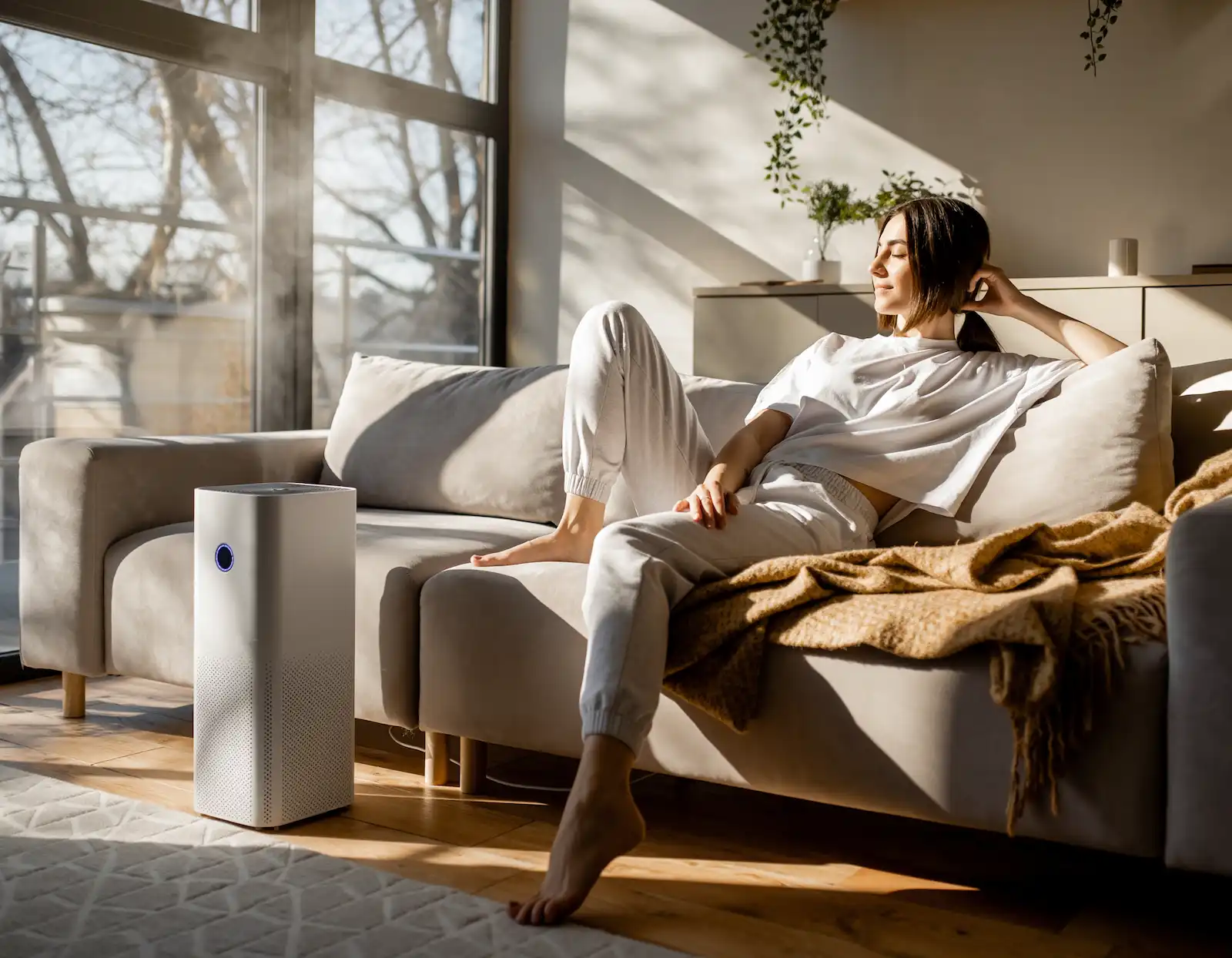
The air purifier that feels right in a home office may have a hard time keeping up in an open living room. A portable purifier draws room air through a filter and sends it back out again. How much air it can clean in a given time matters just as much as the filter inside.
Clean Air Delivery Rate, usually shortened to CADR, is a useful way to compare that capacity for airborne particles. The published rating is only part of living with the machine. In a bedroom, the sound of the fan at the setting you plan to use every night deserves as much attention as what it can do on high.
The four purifiers here offer different ways to keep that fan running comfortably. Some can be scheduled from a phone. Others put automatic modes and controls on the unit itself. We also look at the filters you’ll have to buy again, what can be washed, and how much room the machine needs beside a desk or bed.
Top Picks: Air Purifiers for Cleaner Indoor Air
We evaluated these air purifiers using The Hearthful Standard, which considers materials, design, everyday use, durability, and the clarity of product information. Blueair combines a light body with substantial published particle CADR, while Coway offers several automatic modes without requiring an app. Honeywell adds VOC-responsive operation and longer warranty coverage; Levoit offers dust-sensor automation and connected controls in a smaller-room format.
Note: Some of the links in this post are affiliate links. If you decide to buy through them, I may earn a small commission, at no extra cost to you. As an Amazon Associate, I earn from qualifying purchases. Thanks for supporting The Hearthful Home.

Balanced Medium-Room Pick
Blueair Blue Pure 311i Max
A light, app-connected purifier for medium rooms with automatic fan control. Its HEPASilent system combines mechanical and electrostatic filtration.

Premium Automation Pick
Coway Airmega 250
Choose it for particle sensing and several automatic operating modes with local controls. Its washable prefilter sits ahead of a combined HEPA and carbon cartridge.

High-Capacity Console Pick
Honeywell HPA5300B
A larger console with three HEPA filters, a replaceable carbon prefilter, and a five-year limited warranty. Its automatic mode responds to VOCs, so it is a different proposition from a particle-sensing purifier.
Smaller-Room Smart Pick
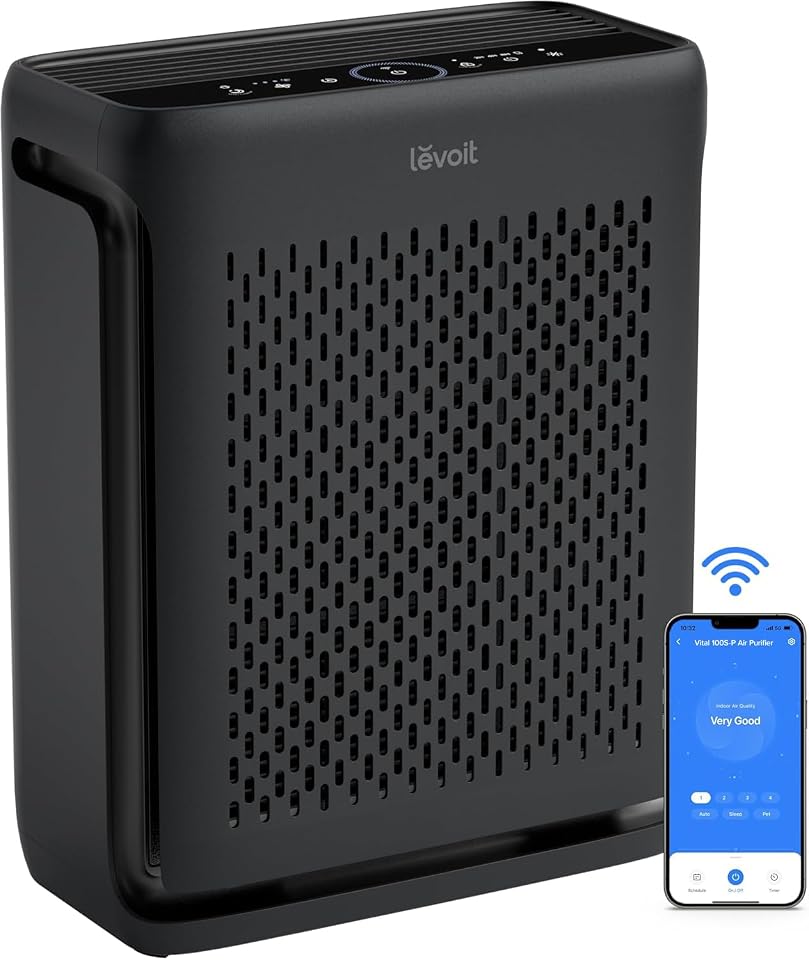
Levoit Vital 100S-P
A smaller-room option with a washable prefilter, dust sensor, and VeSync scheduling. Its 222-square-foot recommendation at 4.8 ACH is the sizing figure to compare with your room.
What Actually Matters in an Air Purifier
An air purifier should be treated as a complete airflow-and-filtration system. The filter media, fan, room volume, fan setting, air path, maintenance requirements, and pollutant type all have to work together. A strong specification in one category cannot automatically compensate for a weakness somewhere else.
Start With CADR and Room Size
Particle-cleaning capacity comes first. The EPA recommends choosing CADR according to the room or area being served, while AHAM uses smoke CADR as the basis of its consumer room-sizing guidance. Large square-foot marketing claims can become misleading when different manufacturers assume very different numbers of air changes per hour.
Two of the app-connected choices illustrate the difference. Blueair lists the 311i Max for 439 square feet at 4.8 air changes per hour, while Levoit lists the Vital 100S-P for 222 square feet at the same rate. A 20-by-15-foot room is 300 square feet. At that target it falls within the Blueair figure and exceeds the Levoit figure. Compare operating noise next if the unit is going beside a bed.
Use our air purifier CADR and room-size guide to calculate the actual requirement, including ceiling height and a higher wildfire-smoke target. Once a purifier meets that threshold, the other differences become meaningful.
Match the Filter to the Pollutant
Dust, pollen, pet dander, smoke particles, and other particulate matter require particle filtration. Gases and many odors require a separate sorbent such as activated carbon. Our guide to choosing an air purifier for allergies, smoke, dust, or pets explains how those priorities change by use case.
Do not treat a HEPA claim as a complete description of room performance. What HEPA filters actually capture explains particle-capture mechanics and why 0.3 microns is not a lower capture cutoff. The purifier still needs enough airflow to deliver that filtered air to the room.
Likewise, particle CADR does not tell you how well a purifier handles gas-phase pollutants. If odors, smoke gases, or VOCs matter, use the HEPA vs. activated-carbon guide to evaluate that filtration layer separately.
Judge Noise at the Fan Speed You Will Use
The quietest advertised dB figure usually comes from a low fan setting, while maximum CADR comes from much stronger airflow. EPA notes that lower fan speeds filter less air. That makes a purifier’s usable operating point more important than either extreme specification by itself.
For sleeping and focused work, use our guide to air purifier noise for bedrooms and offices. Compare fan speed, measurement distance, sound character, sleep behavior, and placement so the quiet setting also fits the cleaning task.
Price the Filters Before You Buy the Machine
Replacement filters can materially change long-term value. Check the exact cartridge, expected replacement interval, whether the prefilter can be cleaned separately, and whether the purifier depends on a proprietary filter format. A cheaper purifier can become the more expensive machine after several years of consumables.
Our air purifier filter replacement-cost guide includes an annual and multi-year cost calculator. Enter the exact filter quantity and interval for each machine so the different systems can be compared on the same basis.
Treat Smart Features as Tie-Breakers
Particle sensors, automatic modes, apps, display-off controls, scheduling, and filter reminders can improve everyday use after the purifier already meets the room-size and filtration requirement. They do not make an undersized purifier larger or a thin carbon layer more capable.
Use our guide to air purifier features worth paying for to compare the available controls. Start with the settings you will actually use, then check whether those functions require an app, a sensor, or a particular operating mode.
Check Energy and Electronic Filtration Separately
Because portable air cleaners often run for long periods, efficiency matters after the performance requirement has been met. ENERGY STAR evaluates room air cleaners on clean-air delivery relative to power consumption; the label is an energy-efficiency certification, not a guarantee that one purifier cleans the air better than another.
Electronic filtration also deserves its own check. CARB maintains the California certification list for portable air-cleaning devices. CARB distinguishes mechanical models from electronic models and explicitly notes that certification addresses ozone-emission requirements rather than establishing pollutant-removal effectiveness.
How We Evaluate Air Purifiers
Our recommendations in this guide are research-based. Manufacturer documentation supplies the product specifications and care instructions. EPA, AHAM, ENERGY STAR, and CARB references help interpret room sizing, filtration, efficiency, and certification scope.
Room size, the pollutant of concern, noise and the cost of replacement filters all affect which purifier makes sense.
Manufacturer specifications and warranty claims remain attributed to their source. Authoritative programs are used where they add a standardized reference point, and conflicting or changing product information remains visible instead of being silently reconciled.
Materials
We assess the housing, filter media, prefilter construction, and accessible components for their intended use. A washable first stage can simplify coarse-dust care, while the disposable particle and carbon media need their own replacement plan.
Design & Function
We assess CADR, room-size assumptions, filtration architecture, sensors, and control design together. A larger capacity or more elaborate automatic mode earns its place when it solves a clear room or operating need.
Use & Interaction
We consider fan control, published sound, footprint, filter access, displays, and connected features. The useful comparison is how readily a reader can place, operate, and maintain the purifier in the intended room.
Durability & Longevity
We assess warranty scope, filter availability, and the documented maintenance path. Longer coverage can be a meaningful ownership advantage, but ordinary replaceable filters or a plastic enclosure do not by themselves establish a durability weakness.
Transparency & Trust
We examine model-specific CADR, coverage assumptions, filter requirements, operating modes, and warranty documentation. Where two sources disagree about a material, we explain what each says for the selected model.
A Closer Look at Each Pick
The room-size figures use different air-change rates. Blueair, Honeywell and Levoit give coverage at 4.8 air changes per hour, while Coway publishes figures at one, two and four. Smoke CADR gives you a common basis for comparing the four purifiers.
Balanced Medium-Room Pick
Blueair Blue Pure 311i Max
Choose the Blue Pure 311i Max when you want a relatively compact medium-room purifier with strong CADR, quiet low-speed operation, automatic control, and a washable exterior prefilter. Its main tradeoffs are reliance on Blueair’s proprietary filter ecosystem, a shorter warranty than Honeywell’s, and an electronic filtration architecture that will not appeal to buyers who specifically want mechanical-only air cleaning.
Price and availability last updated: 2026-11-25 at 11:19.
Materials
Blueair’s HEPASilent system combines mechanical filtration with electrostatic assistance. The 311i Max uses a cylindrical replaceable particle-and-carbon filter surrounded by a removable washable fabric prefilter. The fabric layer catches larger dust, lint, pollen, and pet hair before they reach the main cartridge, which makes routine maintenance simpler. Blueair also offers alternative AllergenBlock and SmokeBlock cartridges, so the exact media and carbon level depend on the filter selected.
Design & Function
The Blueair Blue Pure 311i Max is rated for a 439-square-foot room at 4.8 air changes per hour. Blueair lists clean air delivery rates of 283 CFM for smoke, 314 for dust and 365 for pollen. Its three manual speeds, Auto mode and Night mode run within a published 23–50 dB sound range, and the listed power draw is 32 watts.
The standard filter combines particle filtration with carbon intended for lighter household odors. Blueair separately sells a SmokeBlock version with more activated carbon, which is an important distinction if gases and odors are a major purchase reason. The VOC and odor guide explains why carbon quantity should be evaluated separately from CADR.
Use & Interaction
The 19-inch height, top discharge, 7.8-pound weight, washable outer prefilter, automatic fan control, and Blueair app make it a practical option to move between rooms and manage through an app. Blueair’s RealTrack system estimates remaining filter life using fan speed, usage time, and pollution levels rather than relying only on a fixed calendar interval.
The 23-dB low-speed specification is attractive for bedrooms and offices, but the same rule applies here as with every purifier: low-speed noise and maximum CADR describe different operating points. Use the air purifier noise guide to judge whether the fan setting you can tolerate still provides enough cleaning for the room.
Durability & Longevity
Blueair states that the standard warranty is one year and can be extended to three years after product registration. The filter ecosystem is well documented, with separate replacement cartridges and washable fabric prefilters currently available directly from Blueair. Blueair estimates up to nine months of life for the main filter under its RealTrack system, although actual loading conditions still determine replacement timing.
The proprietary filter shape creates an ongoing dependence on the Blue Pure 311i Max cartridge family, so replacement price and availability belong in the ownership calculation. See the filter replacement-cost guide before treating the initial purifier price as the complete cost.
Transparency & Trust
Blueair publishes the main operating specifications and explains that its CADR and room-size figures were updated for newer DOE requirements. We use the current technical table’s 439-square-foot figure rather than an older coverage headline. The CARB record identifies the 311i Max as electronic, consistent with Blueair’s disclosed electrostatic assistance. CARB tests electronic air cleaners against California’s ozone-emission limit.
- Strong smoke, dust, and pollen CADR relative to its compact footprint.
- 23–50 dB published sound range with Auto and Night modes.
- Washable fabric prefilter is easy to access and maintain.
- App control and RealTrack filter-life estimation help with settings and filter reminders.
- HEPASilent uses electrostatic assistance rather than purely mechanical filtration.
- Standard and SmokeBlock cartridges have different carbon configurations.
- Uses a proprietary replacement-filter cartridge.
- Three-year registered warranty is shorter than Honeywell’s coverage.
Premium Automation Pick
Coway Airmega 250
Choose the Airmega 250 when you want mechanical filtration, several automatic modes, and a washable prefilter without an app requirement. Compare the current machine price together with the recurring Max2 cartridge cost. The standard 250 lacks Wi-Fi, so consider the separate 250S only if connected controls would be useful in your routine.
Price and availability last updated: 2026-11-25 at 11:19.
Materials
The filtration system combines a washable prefilter with Coway’s Max2 cartridge, which contains an activated-carbon stage and a HEPA particle filter. The removable first stage gives hair, lint, and coarse dust a serviceable layer before they reach the more expensive disposable cartridge.
Design & Function
The Airmega 250 provides three manual fan speeds plus Auto, Sleep, Eco, and Rapid modes. Its current manual explains that Eco stops the fan after the monitored air remains good for more than ten minutes, then restarts when pollution is detected or after a thirty-minute pause. That behavior suits automatic operation, while manual speed selection is available when you prefer continuous airflow.
Unlike the 250S, the standard Airmega 250 does not add Wi-Fi or smartphone control. That keeps the control system relatively self-contained while still providing automatic operation. If app control matters, treat it as a separate feature preference rather than assuming the 250 includes the connected functions of the visually similar 250S.
Use & Interaction
Coway’s manual bases its approximately twelve-month Max2 estimate on eight hours of daily use at maximum speed. The washable prefilter can be cleaned separately, making regular coarse-dust care straightforward. At 20.5 pounds, the 250 is the heaviest of the Blueair, Coway, and Levoit options, so it makes more sense in a settled location than as a frequent room-to-room mover.
Its automatic behavior is useful only if the sensor thresholds and fan changes match your routine. For a bedroom or office, evaluate the sound at the fan setting you will actually keep running rather than relying only on the 22-dBA minimum.
Durability & Longevity
Coway’s current U.S. warranty table lists one year of coverage for internal and functional parts on Airmega models and three years for motor and electronic parts on models such as the Airmega 250 that are not in the five-year subgroup. Coway also conditions parts of its warranty on authorized sellers, proper maintenance, and genuine filters, which should be reviewed before relying on the headline warranty alone.
The Max2 cartridge is proprietary and currently sold directly by Coway, while the prefilter is washable rather than regularly discarded. That combination gives the machine a clear maintenance path, but the replacement cartridge is a meaningful recurring expense.
Transparency & Trust
The Coway Airmega 250 has published CADRs of 249 CFM for smoke, 261 for dust and 230 for pollen. Coway rates the same purifier for 465 square feet at four air changes per hour, 930 square feet at two and 1,860 square feet at one. The CARB registry identifies model AP-1720H as mechanical.
- CARB-listed mechanical filtration with a washable prefilter.
- Auto, Sleep, Eco, and Rapid modes provide broad operating control.
- Washable prefilter reduces routine large-particle loading on the Max2 cartridge.
- Clear ACH-based room coverage makes sizing claims easier to interpret.
- Compare the current purchase price alongside the Max2 cartridge cost.
- Standard Airmega 250 has no Wi-Fi or app control.
- Proprietary Max2 replacement cartridge adds a meaningful recurring cost.
- Larger and heavier than the Blueair and compact Levoit options.
High-Capacity Console Pick
Honeywell HPA5300B
Choose the HPA5300B for substantial particle-cleaning capacity, local controls, and the longest stated warranty among these four choices. Allow for the console footprint and recurring prefilter changes. Its VOC-responsive Auto mode is useful to understand before choosing it over a particle-sensing alternative.
Price and availability last updated: 2026-11-25 at 19:10.
Materials
The filter system uses three Honeywell R HEPA filters behind one A prefilter. Optional S filters add a separate odor-and-VOC layer and are sold separately. The HPA5300-series manual distinguishes these components, which helps avoid buying a single R filter when the console requires three.
Design & Function
Three cleaning levels plus Turbo, a timer, and a dimmable display provide direct control at the machine. Auto mode uses a VOC sensor, so its color indication and fan changes are not measurements of airborne particle concentration. If dust or smoke particles are the main concern, select an adequate manual airflow rather than assuming a green VOC indicator means particle levels are low.
The Honeywell HPA5300B runs from controls on the console. Honeywell rates it for 500 square feet at 4.8 air changes per hour, and the model’s published smoke CADR is 323 CFM. The InSight display shows both the selected cleaning level and the VOC sensor’s air-quality indicator.
Use & Interaction
The HPA5300B needs a clear floor location for its console body and front intake. Its display can be dimmed, although the manual explains that the dimmer button retains a low light so it can still be found. That detail matters if a completely dark bedroom is a priority.
Honeywell’s normal replacement guidance is approximately twelve months for the R filters and three months for the prefilter, with earlier replacement possible under heavier loading. These media are disposable, not washable or intended to be vacuumed. Price a full three-filter R set plus the recurring prefilter when comparing annual ownership cost.
Durability & Longevity
The five-year limited warranty is a concrete ownership advantage within this group. It covers qualifying defects for the original purchaser, with normal filter consumption excluded. The shared R and A replacement-filter families also give owners a defined maintenance route across several Honeywell console models.
Transparency & Trust
Current HPA5300B product and support pages identify the room-size basis, controls, filter quantities, and warranty. The manual specifically identifies the sensor as VOC-based, an important distinction from the particle sensors in the other automated options. Read that sensor description alongside the particle CADR when judging what Auto mode will respond to.
- Published 323-CFM smoke CADR and 500-square-foot rating at 4.8 ACH.
- Local controls, timer, display dimmer, and VOC-responsive Auto mode.
- Established R HEPA and A prefilter replacement families.
- Five-year limited warranty is the longest documented warranty in this group.
- Console body needs a clear floor location.
- VOC sensing does not measure particle concentration.
- Three HEPA filters plus recurring disposable prefilters.
- Dimmer button retains a low light when other display lights are off.
Smaller-Room Smart Pick
Levoit Vital 100S-P
Choose the Vital 100S-P when the room fits its 222-square-foot high-frequency rating and you want connected controls with a serviceable prefilter. Its strength is the combination of local automation and convenient scheduling in a relatively small body. For larger rooms, start with the higher-capacity options instead of relying on a large one-ACH headline.
Price and availability last updated: 2026-11-25 at 19:10.
Materials
A removable washable prefilter sits ahead of the main particle-and-carbon filter. This lets you clean the coarse-dust layer without replacing the whole assembly. Levoit describes the original filter as HEPA-grade during Sleep mode, so that stated test condition should stay attached to the claim.
Design & Function
The Levoit Vital 100S-P has a published clean air delivery rate of 143 CFM and a recommended room size of 222 square feet at 4.8 air changes per hour. The linked Vital 100S-P manual describes an infrared dust sensor that adjusts the fan in Auto mode. It also explains that standard Auto does not use Turbo. Choose a suitable manual speed when you want sustained airflow instead of relying entirely on the sensor’s response.
VeSync adds remote settings, schedules, and supported voice-assistant control. The dust sensor responds to particles rather than smells, so a low particle indication does not establish that gases or odors have been removed. Evaluate the carbon stage separately when those pollutants drive the purchase.
Use & Interaction
At approximately 12.6 by 6.3 by 16 inches and 8.6 pounds, the Vital 100S-P is relatively easy to place in a smaller bedroom or office. Its front prefilter access and app controls suit a routine where the machine stays in one location. Leave the intake and outlet clear rather than choosing a spot solely because the body fits.
Sleep and display controls can make operation less intrusive at night. The available light-detection behavior can also limit fan speeds in darkness, so check that setting if you want more airflow while sleeping. Quiet operation and maximum cleaning capacity describe different operating choices.
Durability & Longevity
The Vital 100S-P manual provides a two-year limited warranty and separates washable-prefilter care from main-filter replacement. Its guidance calls for regular prefilter cleaning, with the main cartridge replaced according to loading and the filter indicator. Follow the delivered unit’s instructions for the exact care interval.
The Vital 100S replacement-filter family is a recurring ownership expense, with standard and specialized carbon options listed by Levoit. Compare the exact cartridge you intend to use rather than assuming all versions cost the same or address the same odor load. Routine filter replacement is normal upkeep for this design.
Transparency & Trust
The selected black offer identifies model LAP-V102S-KUS and lists 42 watts. Levoit’s family product page instead identifies LAP-V102S-WUS at 35 watts, and its linked US manual identifies LAP-V102S-AUSR at 32 watts. These references do not give a consistent exact-model power figure for the selected offer, so use the received rating label before estimating electricity cost. Keep the model code with the supplied instructions when checking revision-specific settings.
- Relatively compact 8.6-pound body for smaller rooms.
- Dust-sensor Auto mode plus VeSync scheduling and remote settings.
- Separate washable prefilter simplifies coarse-dust care.
- 222-square-foot room recommendation at 4.8 ACH.
- 143-CFM capacity remains the lowest of these four options.
- Main filter is a recurring proprietary-cartridge expense.
- Standard Auto mode does not use Turbo; quiet settings reduce airflow.
- Linked product and manual records identify different model codes and power ratings.
Tips for Better Air Purifier Setup
Even a well-chosen purifier can underperform when it is undersized, obstructed, run only occasionally, or maintained poorly. Set up the machine around the room and pollutant problem rather than treating it as a self-contained appliance that works equally well anywhere.
Size the Room Before Choosing the Fan Setting
Measure the complete space the purifier will serve, including connected areas and ceiling height. Establish the smoke-CADR target first, then use fan-speed headroom to balance cleaning rate and sound rather than buying a low-CADR purifier simply because its lowest setting is quiet.
Keep the Intake and Outlet Clear
Follow the manufacturer’s placement and clearance instructions. Do not wedge the purifier behind a sofa, inside a tight corner, beneath furniture, or against a surface that blocks the intake or clean-air outlet simply to hide the machine.
Use Source Control Alongside Filtration
The EPA places source control and clean outdoor-air ventilation ahead of filtration when those options are practical. An air purifier cannot clean settled pet hair from upholstery, fix a moisture source causing mold, exhaust cooking emissions at the stove, or stop a high-emitting product from releasing VOCs.
Maintain the Prefilter and Main Filter Separately
Clean serviceable prefilters according to the manufacturer’s instructions so larger debris does not unnecessarily load the downstream filter. Replace disposable particle or carbon media on the model-specific schedule and sooner when heavy smoke, dust, or another high-load event makes that necessary.
Run a Useful Speed Consistently
EPA notes that higher fan speeds and longer run times increase filtration. That does not mean every purifier must remain on maximum at all times, but it does mean a purifier only filters air while air is actually moving through it. A sustainable medium setting can be more useful than repeatedly turning an intrusive high setting on and off.
Air Purifier FAQs
What is the most important specification when choosing an air purifier?
For airborne particles, start with a smoke CADR that suits the room. The published rating usually comes from the purifier’s highest fan speed. If you’re choosing a purifier for a bedroom, check how loud it is at the setting you plan to use overnight. Filter costs and any need to remove gases are separate buying considerations.
What CADR do I need for my room?
For an 8-foot ceiling, the EPA/ENERGY STAR sizing table and AHAM’s smoke-CADR guidance both land around the mid-60s CFM per 100 square feet. Tall ceilings and wildfire smoke can justify more capacity. Use the CADR calculator for the exact room.
Is HEPA enough for allergies, dust, or pets?
High-efficiency particle filtration is useful for airborne pollen, dust, and dander, but the complete purifier still needs enough airflow for the room. Many larger allergens also settle onto surfaces before reaching the purifier. See the allergies, smoke, dust, and pets guide for the full buying logic.
Can HEPA filters capture particles smaller than 0.3 microns?
Yes. The 0.3-micron HEPA benchmark is not a minimum capture size. EPA describes it as the difficult reference point; particles larger and smaller can be captured efficiently through the different mechanical filtration mechanisms. See what HEPA filters actually capture for the detailed explanation.
Do air purifiers remove VOCs and odors?
HEPA filtration alone does not remove gas-phase VOCs. Activated carbon or another suitable sorbent is needed for gas and odor removal, and the amount and type of media matter. There is no widely used residential gas-removal rating equivalent to particle CADR. See the VOC and odor guide.
How quiet should an air purifier be for a bedroom?
There is no universal dBA cutoff. Compare the sound at the fan speed and distance you will actually use and make sure that setting still provides enough cleaning capacity for the room. Minimum noise and maximum CADR usually describe different settings.
How often should I replace air purifier filters?
Follow the manufacturer’s instructions for the exact cartridge. Replacement intervals vary by filter design, operating time, fan speed, pollutant load, pets, dust, smoke, and other conditions. Use the filter cost and replacement guide to compare ownership expense before buying.
Are smart air-purifier features worth paying for?
They can be when they reduce real friction. Auto mode, useful sensors, display-off controls, filter reminders, apps, and scheduling can improve consistency, but they should come after CADR, filtration, noise, and ownership cost. See the air purifier features guide.
Does ENERGY STAR mean an air purifier cleans better?
No. ENERGY STAR certification concerns energy efficiency. It can help compare electricity use among purifiers that already meet your performance requirements, but the label does not establish that one unit removes pollutants more effectively than another.
Does CARB certification mean an air purifier is more effective?
No. CARB states that its air-cleaner certification addresses California’s electrical-safety and ozone-emission requirements. It does not evaluate pollutant-removal effectiveness or constitute a general endorsement of the purifier.
Do I need an air purifier in every room?
Not automatically. Size the purifier for the space it can actually serve. Closed bedrooms and offices often function as separate zones, while a connected open floor plan may need a larger purifier or multiple units depending on total volume and airflow distribution.
Important: This article provides general information, not individualized medical, safety, installation, legal, or other professional advice. Product specifications, instructions, and safety information can change; verify current information with the manufacturer and consult an appropriately qualified professional when needed. See our Terms and Conditions for additional information.