
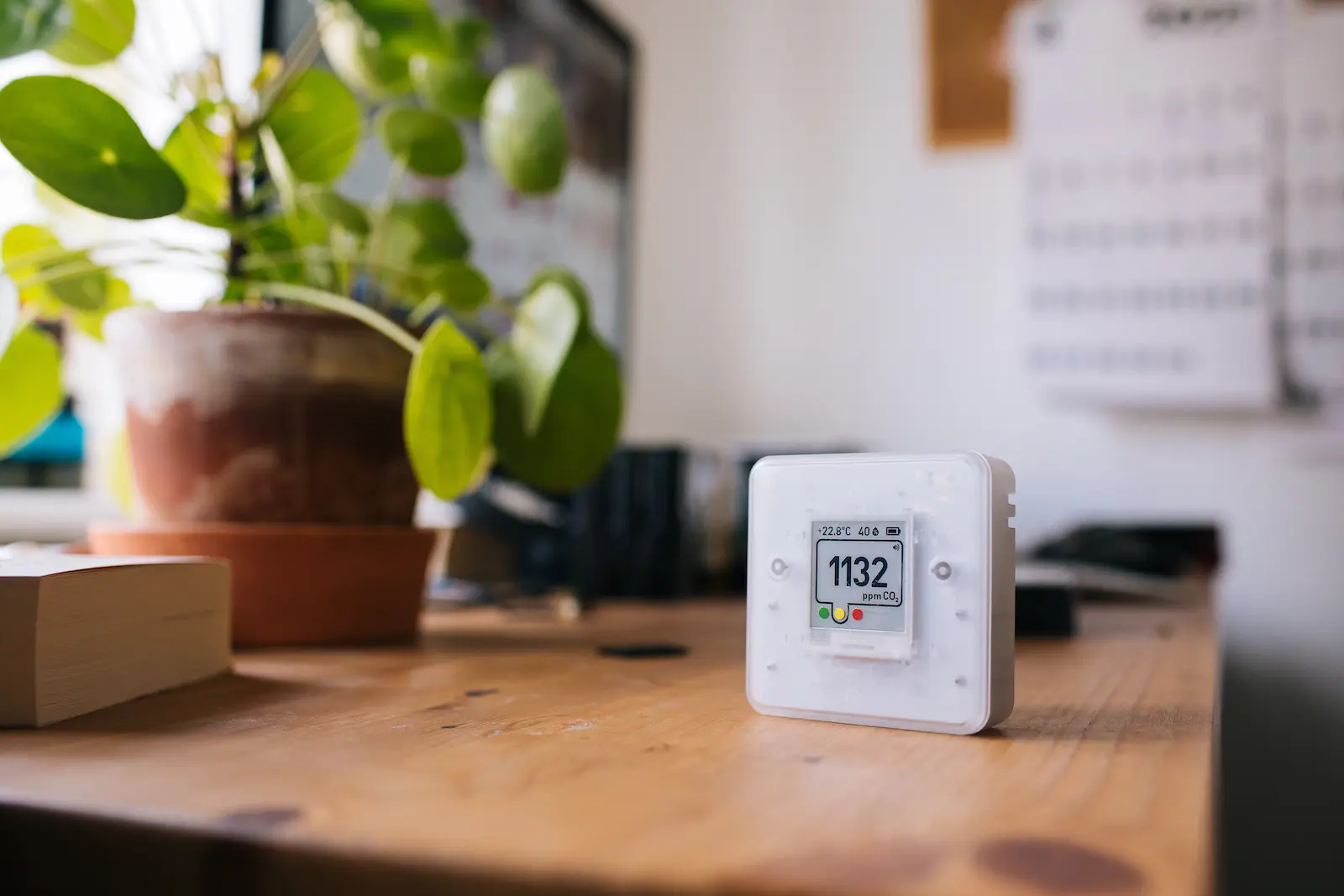
A room can feel stuffy by morning or look hazy for a few minutes after cooking. Those are different questions for an indoor air quality monitor. A carbon dioxide sensor can show how a bedroom changes overnight. A particle sensor can show a rise in airborne particles in the kitchen and how long that rise lasts.
What shows up on the screen depends on which sensors are inside. The EPA explains what lower-cost indoor air monitors can measure and why one instrument gives only a partial view of a room. A carbon dioxide reading, for instance, tells you nothing directly about the radon level.
The four monitors here fit different ways of keeping track. One stays in place to build a longer record, including radon. A handheld meter can move from room to room, a small CO₂ display shows a reading at a glance, and an Alexa-connected monitor keeps its history in the app. None takes the place of a working carbon monoxide alarm.
Top Picks: Best Indoor Air Quality Monitors
We evaluated these monitors using The Hearthful Standard, which considers materials, design, everyday use, durability, and the clarity of product information. We selected Airthings for combining radon, particle, and CO₂ monitoring; Temtop for its handheld design and built-in screen; Amazon for its lower price and Alexa features; and Aranet for CO₂ readings that stay visible without opening an app.
Note: Some of the links in this post are affiliate links. If you decide to buy through them, I may earn a small commission, at no extra cost to you. As an Amazon Associate, I earn from qualifying purchases. Thanks for supporting The Hearthful Home.

Long-term radon, particles and CO₂
Airthings View Plus Air Quality Monitor
Long-term monitor for radon, PM2.5, CO₂, VOC trends, humidity, temperature, and pressure, with an e-paper display and Wi-Fi access to history.

Handheld particle and gas readings
Temtop LKC-1000S+ 2nd Gen
Handheld meter for PM2.5, PM10, formaldehyde, TVOC, temperature, and humidity, with a color display, PM2.5 histogram, and USB export.

Alexa routines and app-based readings
Amazon Smart Air Quality Monitor
Alexa-connected monitor for particles, VOCs, CO, humidity, and temperature, with app history and routines. It has no numerical screen and does not replace a CO alarm.

CO₂ on a battery-powered display
Aranet4 HOME
Portable CO₂ monitor with a direct NDIR sensor, e-ink display, replaceable AA batteries, and Bluetooth history for checking ventilation patterns.
What Actually Matters in an Air Quality Monitor
An air quality monitor should be treated as a measurement system rather than a gadget that produces one definitive health score. The sensing technology, pollutant coverage, calibration, placement, data history, display, software, and the decision you intend to make all affect how useful the product becomes.
Start With the Sensors You Actually Need
PM2.5, CO₂, VOC, humidity, radon, formaldehyde, carbon monoxide, and PM10 are not interchangeable measurements. A bedroom-ventilation question calls for a different sensor mix than wildfire-smoke monitoring or long-term radon tracking.
For a bedroom ventilation question, the Aranet4 HOME gives you a direct CO₂ reading on its own display. For a radon trend as well as CO₂ and particles, the Airthings View Plus has the broader sensor set. The Temtop handheld serves a different job when you want to carry the meter from spot to spot and export the readings. Compare the sensors for your question before comparing the app dashboards.
For broad home monitoring, PM2.5, direct CO₂, humidity, and temperature form a useful foundation. VOC can add trend information, while radon, formaldehyde, PM10, CO, and other measurements become more important for specific use cases. Our guide to which air quality monitor sensors you actually need separates those roles before you pay for extra channels.
Do Not Count Scores and Derived Values as Extra Sensors
AQI, proprietary air-quality scores, color bands, and other summaries are interpretations of underlying measurements. They are not additional physical sensors. Likewise, an estimated or equivalent CO₂ value should not automatically be treated as the same thing as a documented direct carbon-dioxide measurement.
Check the underlying sensor list and sensing method before comparing feature counts. A monitor that directly measures PM2.5 and CO₂ answers fundamentally different questions from a monitor that measures PM2.5 and VOCs and then combines those readings into one air-quality score.
Look for Measurement Evidence, Not Decimal Places
Consumer-monitor performance varies by sensor technology, calibration, environmental conditions, time in use, placement, and manufacturer data processing. The EPA notes that monitor price does not necessarily indicate how well a device will perform and that accuracy and precision can be affected by temperature, relative humidity, location, processing methods, age, and other contaminants.
More transparent manufacturers publish the sensing technology, measurement range, stated accuracy, calibration behavior, and operating limits rather than relying only on a broad accuracy claim. Our dedicated guide to how accurate home air quality monitors are covers calibration, drift, PM sensing, CO₂ measurement, VOC uncertainty, and the difference between useful trends and absolute accuracy.
Historical Data Is Usually More Valuable Than One Live Number
A current value tells you what the monitor is reporting now. A historical graph tells you whether that value is normal, how long an event lasted, whether it repeats, and what happened after something in the room changed. Our IQAir AirVisual Pro review shows how cooking observations and overnight CO₂ checks helped us interpret readings at home, including the limits we encountered when revisiting older app history.
Check how much history is retained, whether individual measurements remain available, whether you can export the data, and which functions depend on the manufacturer keeping a cloud service alive. Our guide to air quality monitor app and alert features covers history, export, notifications, automations, subscriptions, privacy, and cloud dependence.
Placement Can Make an Accurate Sensor Misleading
A monitor can accurately measure the air immediately around it while that location poorly represents the rest of the room. The EPA recommends representative indoor placement near the typical breathing zone, generally around 3–6 feet, with free airflow and away from strong local sources and sinks.
That means avoiding obvious HVAC streams, window air, cooking plumes, air-purifier discharge, humidifier output, enclosed corners, and blocked sensor inlets when you want a representative room reading. Use our guide to where to place an air quality monitor for room-by-room guidance.
Understand the Number Before Acting on It
PM2.5, CO₂, VOC, and humidity do not share one universal interpretation. PM2.5 represents fine particles. CO₂ can reveal ventilation patterns in occupied rooms. Consumer VOC measurements are generally better suited to trend detection than identifying individual chemicals. Relative humidity describes moisture conditions and changes with temperature. Use our guide to what PM2.5, CO₂, VOC, and humidity readings mean before treating a round number or app color as a complete verdict.
Match the Response to the Pollutant
Particle filtration can lower PM2.5 but does not remove room CO₂. Outdoor-air ventilation can lower occupant-generated CO₂ but may bring in wildfire smoke or outdoor pollution. VOC increases often call for source control and appropriate ventilation before filtration. High humidity requires moisture management.
Our guide to when air quality readings call for an air purifier, ventilation, source control, or humidity management keeps those responses separate. If particle filtration is part of the solution, continue to our air purifier buying guide.
Do Not Replace Life-Safety Alarms With an Air Quality Monitor
A general air quality monitor does not replace certified smoke or carbon-monoxide alarms. EPA distinguishes consumer pollution monitors from emergency-alert devices. Even products that include a CO sensing channel should be evaluated as supplemental environmental monitors rather than replacements for required household safety alarms.
How We Evaluate Air Quality Monitors
Our recommendations in this guide are research-based. Manufacturer technical documentation plus EPA and other authoritative measurement guidance form the evidence base for this comparison.
A monitor’s usefulness depends on whether it measures the pollutant you need to track.
Manufacturer specifications, warranties, accuracy claims, and calibration information remain attributed to their source. EPA does not endorse individual consumer air quality monitors, and manufacturer accuracy specifications are not treated as independent validation. When documentation conflicts or leaves uncertainty unresolved, that uncertainty remains visible rather than being silently reconciled.
Materials
We assess the enclosure, protection of the sensing system, display, power supply, battery access, mounting and physical controls. We distinguish the materials the manufacturer identifies from details it leaves unspecified.
Design & Function
We consider the sensor selection, measurement method, stated accuracy and range, sampling, calibration, display, connectivity and storage. These features must work together for the intended monitoring task, with direct measurements distinguished from calculated summaries.
Use & Interaction
We examine on-device readability, portability, setup, history, alerts, data export and smart-home features. The day-to-day work of reaching and interpreting a reading matters alongside the available controls.
Durability & Longevity
We consider warranty coverage, battery replacement, calibration, service options and firmware support. Local displays, data export and cloud dependence also affect how the monitor can remain useful over time.
Transparency & Trust
We check sensing methods, stated accuracy, ranges, calibration, sampling, operating limits, warranty and software requirements. Differences between technical documents belong in this assessment, with the exact model and conditions kept visible.
A Closer Look at Each Pick
Two similarly named readings serve different purposes here. Amazon’s monitor measures carbon monoxide (CO). Airthings and Aranet measure carbon dioxide (CO₂), which is relevant when comparing ventilation.
Long-term radon, particles and CO₂
Airthings View Plus Air Quality Monitor
Choose the View Plus when you want one long-term monitor to cover radon, PM2.5, direct CO₂, VOC trends, humidity, temperature, and pressure with a readable display and deep historical data. Its biggest advantages are measurement breadth, data access, and warranty. Its tradeoffs are higher cost, connected-software complexity, different calibration behavior across sensors, and more capability than a buyer who only needs one measurement may use.
Price and availability last updated: 2026-11-25 at 19:51.
Materials
The View Plus uses a slim tabletop-or-wall-mountable enclosure, a low-power e-paper display, six replaceable AA batteries, and optional USB power. Standard replaceable batteries are easier to replace than a sealed rechargeable pack, while the e-paper display remains visible without an always-lit screen. Airthings provides limited detailed disclosure about the specific enclosure polymers and internal structural materials, so the Materials assessment is driven more by physical architecture, replaceable power, display design, installation flexibility, and documented operating limits than by a complete bill of materials.
Design & Function
The Airthings View Plus measures seven things. It uses NDIR for carbon dioxide, laser scattering for PM2.5 and passive-diffusion alpha spectrometry for radon. Separate channels track VOCs, temperature, relative humidity and atmospheric pressure.
Airthings’ View specifications list an NDIR CO₂ range of 400–5000 ppm and an optical PM2.5 range of 0–1000 µg/m³. CO₂ and VOC sensors need about seven days for initial calibration. The sampling guide distinguishes five-minute CO₂/VOC samples from 2.5-minute temperature/humidity samples and hourly radon samples. PM sampling is every 2.5 minutes on USB power, or every 10 minutes or hour under the documented battery settings.
Battery and USB operation create different ownership modes. USB power is better suited to permanent high-frequency monitoring, while battery operation provides a cleaner installation and portability at the cost of greater sensitivity to sampling and connectivity settings.
Use & Interaction
The customizable e-paper display keeps the physical device readable without trying to show every measurement simultaneously. The Airthings app and web dashboard provide deeper historical data, alerts, reports, and longer-term analysis.
Wi-Fi makes the View Plus particularly well suited to permanent monitoring because measurements can be accessed away from the room. That is different from the direct-Bluetooth architecture of the Aranet and the USB-export workflow of the Temtop.
The monitor is portable enough to move, but long-term comparisons become easier when it remains in one representative location. If it is moved, treat the location change as part of the data rather than assuming the graph still represents the same environment.
Durability & Longevity
Replaceable AA batteries and optional USB power provide two ways to keep the monitor powered. Airthings offers five-year total warranty coverage for eligible consumer monitors purchased from an authorized source and registered within 30 days. Keep the purchase receipt and registration confirmation with the device record.
The larger ownership dependency is software. Remote history, account access, alerts, and much of the connected experience rely on the Airthings ecosystem. The physical e-paper display still preserves useful local functionality, which makes the monitor less dependent on software than a product whose detailed measurements exist only inside an app.
Transparency & Trust
Airthings documents sensing methods, sampling, calibration, power, connectivity and warranty in detail. That information is useful when choosing which measurements to display and how to power the monitor, but the current CO₂ accuracy documents disagree.
The live product specifications state CO₂ accuracy of ±50 ppm plus 3% after initial calibration at 10–35°C and 0–80% relative humidity. The March 2024 product sheet still linked from that page states ±50 ppm plus 5%, with an accuracy range of 500–2000 ppm at 10–35°C and 0–85% relative humidity. Ask Airthings to confirm the applicable specification if that difference affects your choice.
- Seven documented measurement channels cover particles, CO₂, radon, VOCs, moisture, temperature, and pressure.
- Direct NDIR CO₂ measurement and detailed sensor documentation.
- E-paper display plus connected historical monitoring.
- Replaceable AA batteries or continuous USB power.
- Free five-year warranty available with eligible registration.
- Higher purchase cost than the focused or budget options.
- CO₂ and VOC measurements require an initial calibration period.
- Power configuration affects sampling and connectivity behavior.
- Connected history and remote access depend on the Airthings software ecosystem.
- The current product page and linked sheet give different CO₂ accuracy specifications.
Handheld particle and gas readings
Temtop LKC-1000S+ 2nd Gen
Choose the Temtop when you want to carry one meter between rooms and inspect PM2.5, PM10, formaldehyde, TVOC, temperature, and humidity directly on a large screen. Its strengths are portability, immediate visibility, and USB export. Its tradeoffs are no direct CO₂ or radon monitoring, modest battery runtime, a one-year warranty, and some unresolved inconsistency in the current manufacturer specifications.
Price and availability last updated: 2026-11-25 at 19:51.
Materials
The LKC-1000S+ uses a handheld enclosure, TFT color screen, physical controls and a USB connection. Its built-in 3000 mAh rechargeable battery supports carrying it between rooms, while the screen keeps readings visible without a phone. The documented construction fits that portable role; battery replacement access is a separate long-term consideration.
Temtop lists approximately six to eight hours of operation per charge. Plan charging around room comparisons or longer monitoring sessions, and use the supplied power instructions when leaving it in one place.
Design & Function
Temtop publishes separate PM2.5 and PM10 ranges and accuracy specifications, plus an electrochemical formaldehyde channel, TVOC measurement, temperature and humidity. Its formaldehyde table names interfering gases, including ethanol and methanol. Treat a change on that channel in the context of the room’s recent activities, since another gas can influence the reading.
The current product specification lists PM2.5 accuracy of ±10 µg/m³ from 0–100 µg/m³ and ±10% from 100–500 µg/m³. PM10 carries wider manufacturer-stated tolerances. Those specifications are manufacturer claims rather than independent validation, but they provide more information than a generic high-accuracy label.
The Temtop LKC-1000S+ 2nd Gen displays an AQI readout and a histogram alongside the individual measurements. The index summarizes sensor data, and the graph plots it. Both use readings from the sensors already listed. A bedroom ventilation check calls for a separate direct CO₂ reading.
Use & Interaction
Portability is the core advantage. Temtop currently publishes roughly six to eight hours of battery operation after a full charge, which suits temporary investigations and room comparisons better than long unattended battery-powered monitoring.
The large color screen presents several measurements directly without requiring a phone. USB data export is also unusually practical and keeps the device’s core workflow independent of a proprietary cloud account.
The tradeoff is that the Temtop does not provide the polished remote history, alerts, multi-room cloud dashboard, or automation ecosystem of the connected monitors here. That is acceptable when investigation rather than permanent smart-home monitoring is the goal.
Durability & Longevity
Temtop currently lists a one-year warranty for the LKC-1000S+ 2nd Gen. The manufacturer also promotes the service life of its laser particle sensor, but the complete monitor additionally depends on the internal rechargeable battery, display, formaldehyde sensing system, and electronics.
The internal battery is the main long-term serviceability tradeoff. The lack of mandatory cloud connectivity is an advantage in the opposite direction: the basic measurement, screen, and USB workflow do not rely on a remote service remaining available.
Transparency & Trust
Temtop publishes useful PM measurement ranges and accuracy, formaldehyde accuracy, interfering gases, battery capacity, runtime, operating conditions, data-export information, and warranty terms. The current product page gives a formaldehyde range of 0–2 mg/m³ in one table and 0–5 mg/m³ in another. Confirm the specification for the supplied version if formaldehyde measurement is central to the purchase. The conflicting range lowers the documentation assessment, while the clearly stated PM specifications, interference list and USB instructions remain useful.
- PM2.5, PM10, formaldehyde, TVOC, humidity, and temperature in one portable meter.
- Large color screen exposes measurements without requiring a phone.
- Rechargeable design is convenient for moving between rooms.
- USB data export avoids mandatory cloud dependence.
- Manufacturer publishes PM accuracy and formaldehyde interference information.
- No direct CO₂ sensor for ventilation monitoring.
- No radon measurement.
- Six-to-eight-hour published battery runtime is aimed at temporary testing.
- Internal rechargeable battery is less serviceable than replaceable cells.
- Manufacturer pages list conflicting formaldehyde measurement ranges.
Alexa routines and app-based readings
Amazon Smart Air Quality Monitor
Choose the Amazon Smart Air Quality Monitor when price and Alexa integration matter more than a stand-alone display or direct CO₂ monitoring. It provides useful PM, VOC, CO, humidity, and temperature awareness with trends, alerts, and routines. Its tradeoffs are no CO₂ or radon measurement, no numerical screen, strong Alexa dependence, and less technical sensor documentation than the premium or specialist picks.
Price and availability last updated: 2026-11-25 at 19:51.
Materials
The hardware is compact and plug-in, with a multicolor status indicator and a fixed USB power connection. This suits a permanent position near an outlet and removes the need to recharge a battery. The physical enclosure and power arrangement support that role; detailed readings are accessed through Alexa.
A fixed power supply makes outlet placement part of the purchase. Choose a position with free airflow where the cable can remain connected without crossing the room’s walking path.
Design & Function
The five measured factors cover particles, VOC response, CO, humidity and temperature. Its main design compromise is the lack of a numerical screen, which makes detailed information dependent on Alexa access. Choose a separate direct CO₂ instrument when ventilation is your main question; the sensor list defines this model’s role.
Amazon combines the available measurements into a broader air-quality interface. Treat that score as a summary of what the device actually senses rather than evidence that pollutants outside the sensor list have also been evaluated.
Amazon’s safety and compliance information says this model is not a certified carbon-monoxide alarm. Maintain the household’s dedicated CO alarms independently of its environmental readings.
Use & Interaction
Alexa is where this monitor becomes compelling. The software provides measurement history, notifications, voice interaction, and Alexa routines that can connect air-quality changes with other compatible smart-home equipment.
That is useful if your household already uses Alexa. It is much less attractive if you want a stand-alone monitor that remains fully informative without a phone, account, or ecosystem.
The on-device indicator is intentionally simple. Detailed measurements require Alexa, so app dependence is not a secondary convenience feature here; it is part of the basic product experience.
Durability & Longevity
There is no filter or routinely replaced battery, so physical maintenance is minimal. The main long-term dependency is software. Detailed measurement access, historical data, alerts, and routines depend on Amazon continuing to support the relevant Alexa functionality.
Amazon continues to maintain Smart Air Quality Monitor support inside its Alexa smart-home support system, which is a positive current signal. The lack of a numerical physical display still means software-service changes would affect the product more heavily than they would a stand-alone meter.
Transparency & Trust
Amazon clearly identifies the measured factors, Alexa requirements, historical-monitoring features, notification system, and the safety limitation of the CO measurement. That safety disclosure is important.
Amazon publishes less detail than Airthings or Aranet about sensing technology, measurement uncertainty, calibration behavior and long-term sensor characteristics. Check whether the published sensor detail is enough for the decisions you intend to make.
- Lower-cost entry into PM, VOC, CO, humidity, and temperature monitoring.
- Alexa trends, notifications, voice access, and routines.
- Compact fixed-location design with very little physical maintenance.
- Useful fit for households already built around Alexa.
- Amazon clearly states that the CO function is not a certified alarm.
- No direct CO₂ sensor.
- No radon measurement.
- No on-device numerical display.
- Detailed use depends heavily on Alexa software and services.
- Less detailed sensor documentation than Airthings or Aranet.
CO₂ on a battery-powered display
Aranet4 HOME
Choose the Aranet4 HOME when direct CO₂ measurement is the main reason you are buying a monitor. It combines an excellent stand-alone display, NDIR sensing, strong technical documentation, replaceable batteries, local Bluetooth operation, and exportable data. Its limitation is intentional: it does not measure particles, VOCs, radon, or CO, so it should be paired with another instrument if those pollutants are part of the question.
Price and availability last updated: 2026-11-25 at 19:51.
Materials
Aranet’s datasheet identifies a polycarbonate enclosure, an e-ink display and two standard AA batteries. These documented materials and replaceable batteries suit a lightweight indoor meter. The direct display and cable-free operation contribute to its design and everyday-use advantages.
The physical architecture is simple: no fan, no pump, no touch screen, and no mandatory wired connection. Its IP20 rating also makes its intended environment clear: this is an indoor monitor rather than rugged outdoor equipment.
Design & Function
The Aranet4 HOME measures carbon dioxide directly with an NDIR sensor and keeps that number visible on its e-ink screen. It also measures temperature, relative humidity and atmospheric pressure. The pressure measurement helps compensate the CO₂ reading.
The datasheet gives a CO₂ range of 0–9999 ppm, with a stated accuracy of ±30 ppm plus 3% of the reading over 0–5000 ppm at 15–35°C and 0–80% relative humidity. Its notes distinguish those calibrated conditions from readings above 5000 ppm and require drift to be considered when evaluating total error. Keep the range and accuracy conditions together when choosing it for a particular room.
The user can choose 1-, 2-, 5-, or 10-minute measurement intervals. Shorter intervals provide finer time resolution but use more battery and reduce the amount of historical data retained directly on the device.
Use & Interaction
The e-ink screen is one of the strongest physical interfaces in this comparison because CO₂ remains visible without opening an app. Color coding and an optional buzzer provide additional quick context.
Bluetooth connects directly to the Aranet Home app. Current Aranet documentation lists real-time readings, historical charts, configurable measurement intervals, threshold settings, notifications, device configuration, firmware updates, and CSV export.
The Aranet Home app can retain extended history, while the amount held directly on the device depends on the selected measurement interval. That is a useful and clearly documented tradeoff between resolution, history, and battery life.
Durability & Longevity
Two replaceable AA batteries make it straightforward to replace the power source when needed. Aranet publishes battery-life estimates that vary according to measurement interval, Bluetooth use, and battery chemistry rather than presenting one universal number.
The HOME model’s core function does not require continuous cloud service. The display works directly on the device, Bluetooth is optional, and measurements can be exported to files the user controls. That reduces service dependence compared with products whose detailed output exists only in a remote account.
Aranet provides firmware updates, calibration instructions, support documentation and an RMA process. Its support FAQ explains an additional 12 months of warranty through eligible registration.
Transparency & Trust
Aranet provides one of the strongest technical documentation packages in this group. Its datasheet and support materials publish measurement method, range, accuracy, sampling intervals, battery assumptions, calibration settings, Bluetooth behavior, enclosure material, and operating limits.
Aranet documents factory, manual and automatic calibration. Its HOME default settings specify automatic CO₂ calibration disabled and a five-minute measurement interval. Read the calibration instructions before changing that setting so the reference conditions fit where the device is used.
- Direct NDIR CO₂ measurement with detailed published specifications.
- Excellent always-visible e-ink display.
- Two standard replaceable AA batteries.
- Direct Bluetooth app access without mandatory continuous cloud operation.
- Charts, configurable intervals, alerts, calibration controls, and CSV export.
- Detailed sensor, calibration, and battery documentation.
- No PM2.5 or PM10 measurement.
- No VOC, radon, formaldehyde, or CO sensor.
- Bluetooth is less convenient for always-remote monitoring than native Wi-Fi cloud access.
- Battery life and stored history change with the selected measurement interval.
Tips for Better Indoor Air Monitoring
A capable monitor becomes more useful when you treat the measurements as a time series rather than a collection of alerts. Establish what normal looks like, keep the location consistent enough to build a baseline, and investigate meaningful changes instead of chasing every small fluctuation.
Leave the Monitor in One Location Long Enough to Learn the Pattern
Continuous monitors are easiest to interpret when they remain in one representative location long enough to capture occupied and unoccupied periods, cooking events, overnight changes, HVAC cycles, and outdoor-air changes. A portable device like the Temtop can still be moved intentionally for comparisons. Just record where it was located and recognize that a kitchen-source measurement is not the same dataset as the bedroom baseline.
Learn the Baseline Before Chasing Thresholds
A repeating pattern is often more informative than one isolated number. PM2.5 may spike while cooking. Bedroom CO₂ may rise overnight. Humidity may increase during a shower and fall afterward. VOC readings may respond repeatedly to one cleaner, furnishing, or activity. The PM2.5, CO₂, VOC, and humidity guide explains why the unit, averaging period, baseline, duration, and recent activity belong in the interpretation.
Keep Outdoor Conditions in the Decision
Opening a window can lower indoor CO₂ or dilute an indoor source when outdoor air is clean. The same action can bring in wildfire smoke, outdoor PM2.5, heat, or moisture under different conditions.
An indoor monitor tells you what is happening where it sits. It does not automatically establish that outdoor air is the better replacement. Use the purify-versus-ventilate guide when deciding which response matches the pollutant.
Do Not Assume One Monitor Represents the Whole House
Closed bedrooms, kitchens, offices, upstairs rooms, basements, and open living spaces can behave differently. A hallway monitor may miss overnight CO₂ buildup behind a closed bedroom door or the particle spike created at the stove.
If you own one portable monitor, rotate it between important rooms for multi-day comparisons. If simultaneous room-to-room behavior matters, multiple monitors provide a clearer picture.
Preserve the Data if Long-Term Trends Matter
Exportable data becomes more valuable the longer you own the product. CSV or spreadsheet files can preserve months or years of measurements if you later change brands, stop using a service, or want to analyze a pattern that the manufacturer’s built-in charts cannot show.
That is one reason data export adds long-term value beyond the quality of the app itself. The app and alert feature guide goes deeper into data retention, subscriptions, cloud dependence, smart-home integrations, and privacy.
Air Quality Monitor FAQs
What is the best indoor air quality monitor for most people?
There is no single best sensor combination for every home. The Airthings View Plus is the broadest monitor in this comparison, but the Aranet4 HOME can be the stronger purchase if CO₂ and ventilation are your main questions. Start with the measurements you need rather than the longest feature list.
Which air quality monitor sensors are most useful?
For broad general-purpose home monitoring, PM2.5, direct CO₂, humidity, and temperature form a useful core. VOC can add trend information, while radon, formaldehyde, PM10, CO, and other specialty measurements should match a specific use case. See which air quality monitor sensors matter for the complete breakdown.
Are home air quality monitors accurate?
Some consumer monitors provide very useful data, but accuracy differs by pollutant, sensing technology, calibration, environment, age, and product. EPA notes that lower-cost consumer monitors are not equivalent to regulatory instruments and that performance can vary. Useful trend detection is still possible even when an absolute concentration carries some bias. See our air quality monitor accuracy guide.
Do I need PM2.5 and CO₂?
They answer different questions. PM2.5 tracks fine particles, while CO₂ can help reveal ventilation patterns in occupied rooms. A purifier can reduce PM2.5 without lowering CO₂, which is why having both measurements can provide much more context than treating either one as a universal air-quality score.
Do I need a radon sensor?
Your home should be tested for radon, but that measurement does not have to be integrated into your main air quality monitor. The EPA recommends fixing a home when radon is 4 pCi/L or higher and considering mitigation between 2 and 4 pCi/L. Integrated continuous monitoring is most useful when you want long-term radon trends in the same dashboard as other indoor-air measurements.
Is Aranet4 better than Airthings View Plus?
They solve different problems. Aranet4 HOME is the more focused CO₂ instrument with an excellent stand-alone display, detailed NDIR documentation, replaceable batteries, and direct Bluetooth access. The Airthings View Plus measures far more parameters, including PM2.5, radon, VOCs, and direct CO₂, and provides a deeper Wi-Fi-connected monitoring ecosystem.
Does the Amazon Smart Air Quality Monitor measure CO₂?
No. Amazon’s documentation lists particulate matter, VOCs, carbon monoxide, humidity, and temperature. CO₂ is not one of its measured factors. Buyers interested in ventilation should choose a monitor with a documented direct CO₂ sensor.
Can the Amazon Smart Air Quality Monitor replace a carbon monoxide alarm?
No. A general air quality monitor should not replace a certified carbon-monoxide alarm. Maintain the required household CO alarms independently of environmental monitoring equipment.
Is the Temtop LKC-1000S+ good for CO₂ monitoring?
No. The LKC-1000S+ 2nd Gen in this guide does not contain a direct CO₂ sensor. Its strength is portable PM2.5, PM10, formaldehyde, TVOC, temperature, and humidity monitoring. Temtop sells other models with CO₂, but this specific product should not be purchased for ventilation analysis.
Where should I place an air quality monitor?
For representative room monitoring, place it near the occupied breathing zone with free airflow and away from strong localized sources, windows, doors, HVAC streams, air cleaners, and other conditions that could dominate the reading. EPA gives roughly 3–6 feet as a general breathing-zone range. See our complete placement guide.
Should an air quality monitor have an app?
Not necessarily. An app becomes valuable when you want history, alerts, remote access, multi-room comparison, data export, or automation. A strong physical display may matter more if your main goal is immediate local information. Evaluate app dependence separately from sensor quality.
Can an air quality monitor automatically control an air purifier?
Some can, either directly or through a smart-home platform. The pairing makes the most sense when a reliable PM2.5 measurement controls equipment designed to remove particles. CO₂, VOC, and humidity usually call for different equipment or more contextual logic. See which readings should trigger filtration or ventilation.
Does a more expensive air quality monitor mean better accuracy?
No. EPA states that monitor cost does not necessarily indicate performance. Price can also reflect the display, housing, number of sensors, connectivity, software, battery design, and cloud features. Technical documentation and independent performance evidence are better accuracy signals than price alone.
Important: This article provides general information, not individualized medical, safety, installation, legal, or other professional advice. Product specifications, instructions, and safety information can change; verify current information with the manufacturer and consult an appropriately qualified professional when needed. See our Terms and Conditions for additional information.