
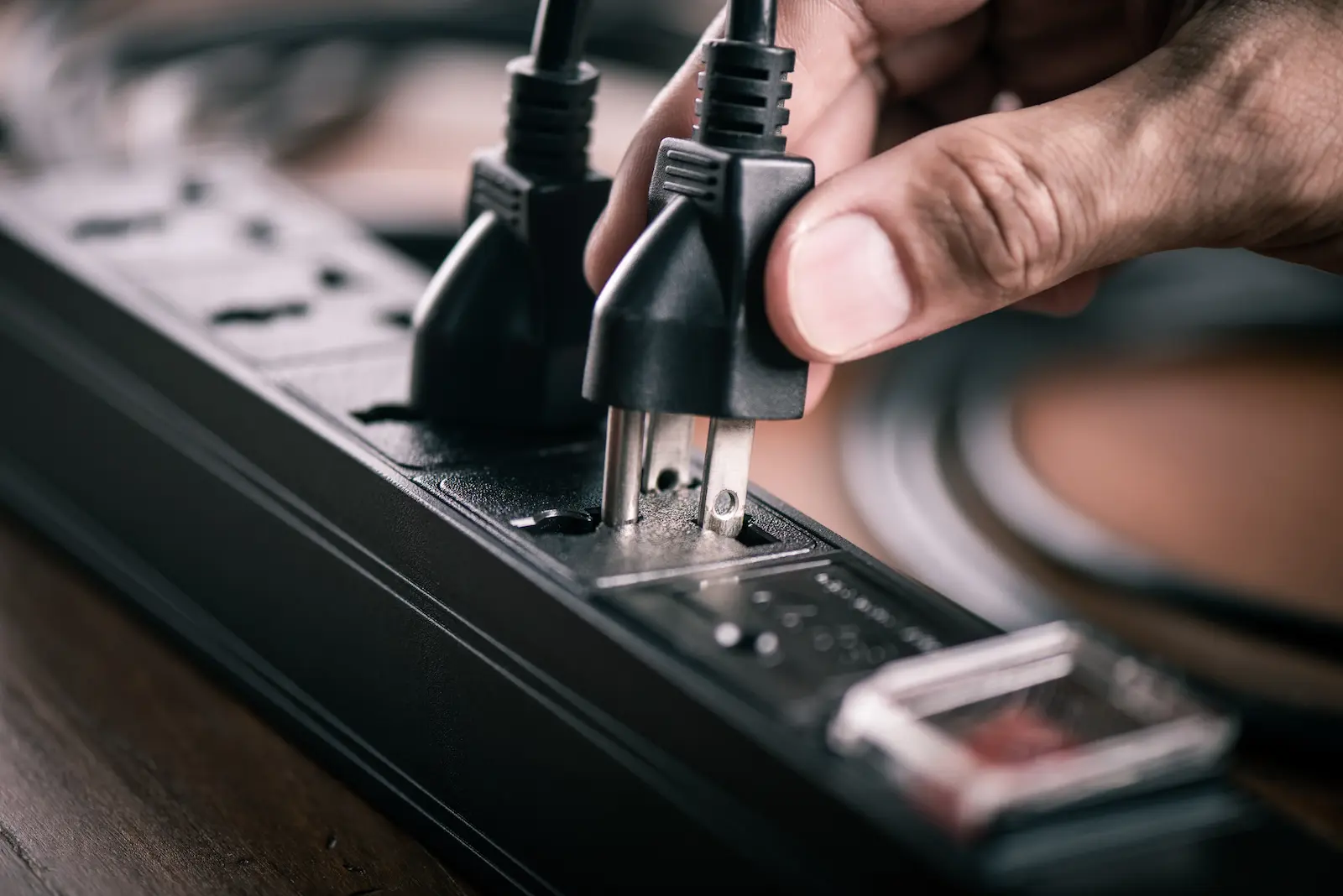
Look at the outlet from the side and follow the path the cord would take behind the furniture. A surge protector with a flat plug can fit behind a cabinet where a straight plug sticks out too far. Check where the cord leaves the plug, though. It may run into a cabinet leg or block the other receptacle. Allow room for the cord’s natural bend and enough access to unplug it without pulling on the cord.
The physical details matter because the plug is only useful if the cord leaves the wall naturally, the neighboring receptacle remains usable, furniture does not press on the connection, and the plug can still be reached later. A flat plug that points the wrong way can create more bending and interference than a straight plug in an open installation.
This guide explains how to check wall projection, cord direction, neighboring-outlet access, furniture clearance, movement, and access to the plug. For exact-model certification use the UL 1449 certification guide, for protection-number interpretation use the joules vs clamping voltage guide, and for product recommendations use the complete surge protector and power strip guide.
Flat Plug vs Traditional Plug: What Actually Changes
Use this comparison to judge plug geometry separately from surge protection. Plug shape changes clearance, cord direction, neighboring-outlet access, and serviceability, while certification and protection ratings remain separate exact-model questions.
Flat Plug vs Straight Plug Comparison
| Fit Factor | Flat or Right-Angle Plug | Traditional Straight Plug | What to Check |
|---|---|---|---|
| Wall projection | The cord turns alongside the wall at or near the plug body, so the connection can require less open depth than a straight plug. Exact projection still depends on the molded plug and strain relief. | The plug body projects outward before the cord can bend toward its route, so more open depth is usually required. | Measure the complete plug body, strain relief, cord thickness, and furniture gap on the exact model. |
| Cord exit direction | The molded design largely determines the first direction of travel. A low-profile plug helps most when that direction already matches the planned cable route. | The cord can curve toward different directions after enough open space is provided for a gradual bend. | Check receptacle orientation and trace where the cord needs to go before choosing the plug style. |
| Adjacent receptacle access | A wide right-angle body can overlap the neighboring receptacle, wall plate, switch, or bulky adapter depending on its orientation. | A narrower face may leave more wall area open, although a large molded straight plug can still cause interference. | Test the top and bottom receptacles as a pair rather than assuming low profile means better outlet access. |
| Furniture clearance | Often works better behind furniture when the plug fits the available gap and the cord exits naturally without being trapped. | Needs more depth so the plug, strain relief, and first cord bend remain free of furniture pressure. | Leave actual clearance around the connection. Do not use furniture to hold either plug style against the wall. |
| Cord movement and strain | The initial bend is built into the plug geometry, but tension can return if the cable is pulled opposite the molded exit direction. | Offers more routing freedom when the cable has enough space to bend gradually and remain free of tension. | Include standing-desk travel, rolling furniture, repeated unplugging, and any equipment that moves after installation. |
| Plug access and removal | A very low-profile body can be harder to grip when it sits close to furniture or the wall plate. | Open installations often leave more room to grip the plug body, although more pull-out clearance is needed. | Make sure the plug remains reachable enough to inspect and remove by the plug body rather than by pulling the cord. |
| What plug style does not tell you | Plug geometry does not establish UL 1449 certification, Voltage Protection Rating, joule rating, electrical load rating, indicator behavior, or service life. | Plug geometry does not establish UL 1449 certification, Voltage Protection Rating, joule rating, electrical load rating, indicator behavior, or service life. | Compare electrical protection and continued-use evidence separately after the physical fit is solved. |
What to prioritize: choose the geometry that gives the cord a natural path, preserves neighboring-outlet access, avoids furniture pressure, and remains reachable. Verify certification and protection specifications separately.
Flat Plugs Work Best When the Cord Exit Matches the Route
A flat plug is most useful when the wall gap is tight and the molded cord direction already follows the route toward the equipment. Eaton’s surge-protector guidance specifically points to right-angle plugs when furniture needs to sit close to the wall, which supports treating low-profile geometry as an installation feature rather than a protection feature.
The cord direction can matter as much as the plug depth. A right-angle body that sends the cord upward when the cable needs to travel downward may force an immediate reversal, cover the neighboring receptacle, or create a bend next to the strain relief.
Do not assume every right-angle plug has the same wall profile. Compare exact-model dimensions when they are available, and look at product photos closely enough to see where the cord leaves the molded body and how much wall area the plug occupies.
Straight Plugs Work Best When Open Depth and Routing Freedom Matter
A traditional straight plug needs more open depth because the body projects outward before the cord can bend. That extra space can be a reasonable tradeoff when the outlet is exposed, recessed, or otherwise free of furniture pressure.
Once enough clearance is available, the cord can usually curve toward whichever direction the installation needs rather than following a fixed molded exit. This can make a straight plug easier to route around unusual wall plates, recessed receptacles, nearby equipment, or cable paths that may change later.
Open access can also make the plug easier to inspect and remove by the plug body. That matters for a surge protector because replacement, troubleshooting, and a room-layout change should not require pulling on the cord or moving heavy furniture just to reach the connection.
Furniture Pressure and Cord Condition Matter More Than Low Profile
A low-profile plug should create clearance, not become a spacer that furniture presses against. The U.S. Consumer Product Safety Commission advises keeping flexible extension cords out from under furniture and inspecting them for damage, which reinforces the same practical principle for any corded installation: the cord and plug need room to remain undamaged and observable.
CPSC household cord guidance also highlights an easy-to-grasp plug face and recommends inspecting the cord along its length. For this comparison, that means serviceability is part of fit: the plug should remain reachable enough to inspect and remove without using the cord as a handle.
Movement can change the calculation after installation. A standing desk, rolling cabinet, adjustable monitor setup, or frequently moved device can pull on a cable that looked relaxed while everything was stationary, so trace the full movement range before securing the route.
Four Physical Checks Before Choosing Plug Shape
Check the wall connection and cord route, then verify the product’s electrical protection separately.
Physical Fit Sequence
Four Checks Before You Choose Plug Shape
Measure the wall gap
Measure from the receptacle face to the nearest furniture or obstruction, then include the complete plug body, strain relief, cord thickness, and a small amount of open clearance.
Trace the first cord direction
Check whether the cord needs to travel up, down, left, or right from the outlet. A flat plug loses much of its advantage when its molded exit points against the required route.
Protect access and movement
Check the second receptacle, furniture movement, standing-desk travel, and whether the plug body will still be reachable for inspection and removal.
Verify protection separately
After the geometry fits, compare the exact model’s certification, Voltage Protection Rating, electrical rating, protection indicators, and documented replacement behavior.
If the room itself creates more constraints than plug geometry alone can solve, use the surge protector setup guide. It explains the broader requirements for desks, media systems, networking equipment, bedrooms, shared charging areas, and fixed installations.
What Plug Shape Does Not Tell You
Flat versus straight does not tell you whether the exact model is certified to UL 1449, how its Voltage Protection Rating compares, how the manufacturer reports joule capacity, or whether its normal electrical rating matches the connected load. Those are separate evidence questions, and a better-fitting plug should never be treated as proof of better surge performance.
The UL 1449 guide explains certification and standardized VPR ratings, while the joules vs clamping voltage guide explains how to compare protection numbers. Keeping those questions separate makes it easier to find a surge protector that both fits the wall and has the documentation you want.
Plug geometry also does not establish when an existing unit should be retired. If the issue is a failed protection indicator, physical damage, abnormal heat or odor, loose receptacles, or uncertainty after a surge event, use the surge protector replacement checklist instead.
Bottom Line
Choose a flat or right-angle plug when wall projection is the real constraint and the molded cord direction matches the route you need. Choose a traditional straight plug when the outlet has enough open depth and flexible cable direction or easier plug access matters more than minimum projection.
Neither design is universally better, and neither one tells you how strong the surge-protection system is. The better choice is the geometry that leaves the cord unpinched, preserves neighboring-outlet access, remains reachable, and fits the room without forcing the cable into an unnatural route.
After the wall fit is solved, use the complete surge protector and power strip guide for actual product recommendations. That keeps the installation decision separate from the product-level evaluation of materials, design, use, durability, transparency, and protection documentation.
Disclaimer: The content on The Hearthful Home is for general informational purposes only and reflects independent research, experience, and opinions at the time of publication. It is not intended as medical, professional, or safety advice. Always follow manufacturer instructions and consult a qualified professional before starting any new product, routine, or practice. Product details, specifications, and prices are subject to change by their respective manufacturers or retailers. The Hearthful Home participates in the Amazon Associates Program and other affiliate programs, and may earn a small commission from qualifying purchases at no extra cost to you.