
When a surge protector lists joules and a clamping voltage, look for its standardized Voltage Protection Rating (VPR) before comparing the voltage figure with another model’s. The joule figure reports a manufacturer’s energy claim. VPR describes voltage limiting under a standardized test. Compare VPR for the same protection mode on the two models and leave remaining service life out of the calculation.
That distinction matters because a larger joule number can look stronger while telling you very little about how tightly the device limits voltage. The NEMA Surge Protection Institute warns that joule comparisons can be misleading and says VPR provides a standardized way to compare like SPDs, so compare results from equivalent tests rather than choosing by the largest joule number.
This guide explains what joules, VPR, and clamping-voltage claims can tell you when comparing surge protectors. None of these numbers guarantees a lifespan or protection against every event. Verify the exact model’s UL 1449 certification first with the UL 1449 guide, then use this page to interpret VPR, generic clamping or let-through language, joules, protection modes, and the surrounding specs that make the comparison meaningful.
Joules vs. Clamping Voltage: Quick Spec Decoder
Use this table to distinguish surge-protector specifications that measure different things. Voltage Protection Rating, or VPR, comes from the UL 1449 test framework and supports like-for-like voltage-limiting comparisons, while joule ratings are manufacturer-published energy claims that are much less standardized across brands.
Surge Protector Spec Decoder
| Spec or Claim | What It Represents | How Much Weight to Give It | Do Not Assume |
|---|---|---|---|
| Joule Rating | A manufacturer-published energy figure for the surge-suppression network. The result depends on surge current, duration, voltage, and the method used to calculate or test it. | Use cautiously as supporting context when the test basis is clear. NEMA warns that cross-product joule comparisons can be misleading because there is no single clear energy-measurement standard used across all published claims. | Exact lifespan, remaining capacity, a fixed number of future surges, or tighter voltage limiting. |
| Voltage Protection Rating (VPR) | A standardized UL 1449 voltage-limiting rating based on measured limiting voltage under defined surge-test conditions. | Give it more weight for voltage-limiting comparison, but compare like with like: the same nominal voltage, SPD type, and protection mode. | The component turn-on voltage, a universal hard ceiling for every event, remaining life, or energy capacity. |
| Clamping or Let-Through Claim | A broad voltage-limiting term that may come from a manufacturer test, another industry waveform, or shorthand for VPR. | Use it only when the test method, waveform, system voltage, and protection mode are identified. If the basis is missing, do not treat it as interchangeable with VPR. | An apples-to-apples comparison simply because two listings both use the word clamping or let-through. |
| Protection Mode | The electrical path associated with a result, such as line-to-neutral, line-to-ground, or neutral-to-ground. | Match the same mode when comparing voltage-limiting data. A product can publish different results for different paths. | That the lowest number shown for one mode describes every protection path in the device. |
| Nominal Discharge Current (In) | A standardized UL 1449 test rating that exercises the complete SPD through repeated surge-current exposures at a selected level. | Use it as standardized repeated-withstand context when it is published. It answers a different question from both VPR and joules. | Normal load current, a joule rating, exact service life, or a direct measure of clamping voltage. |
| UL 1449 Certification | The exact model or covered family was independently evaluated to the surge-protector standard by the certifying laboratory shown in the record. | Treat it as the prerequisite before interpreting the performance numbers. Use the separate UL 1449 guide to verify the certifier and exact model. | That every certified protector has the same VPR, durability, indicator behavior, or physical quality. |
| Normal Electrical Rating | The voltage, current, or wattage the product is designed to carry during ordinary operation. | Use it to confirm that the connected load fits the product. Keep this check separate from transient-surge performance. | How tightly the product limits a surge or how much transient energy its suppression network can handle. |
Simple rule: verify UL 1449 first, compare VPR only on a like-for-like basis, and treat joules as a weaker supporting claim rather than a lifespan score. Nominal discharge current, normal electrical rating, protection mode, status behavior, and physical fit answer separate questions.
The Core Difference: Energy Claim vs Voltage-Limiting Rating
A joule is a unit of energy, so a joule rating describes an energy quantity associated with the suppression network and the method used to produce the claim. It does not directly tell you the voltage that reaches the load during the standardized UL 1449 test, and it does not tell you how much protection remains years later.
VPR answers a different question. NEMA’s surge-protection FAQ describes VPR as the rounded-up average measured limiting voltage produced under the UL 1449 6 kV, 3 kA combination-wave test and says the standardized rating allows direct comparison between like SPDs.
Generic clamping-voltage and let-through-voltage claims sit between those two ideas because the terms can describe voltage-limiting performance without telling you which test produced the number. If a listing does not identify the test basis, nominal voltage, waveform, and protection mode, do not silently convert that claim into a VPR.
How Clamping Actually Works During a Surge
A surge protective device uses nonlinear components to limit transient overvoltage by diverting or limiting surge current. NEMA identifies metal-oxide varistors, avalanche breakdown diodes, and gas discharge tubes among common surge-protective technologies, with MOVs widely used on AC power circuits.
Surge Clamping Process Diagram
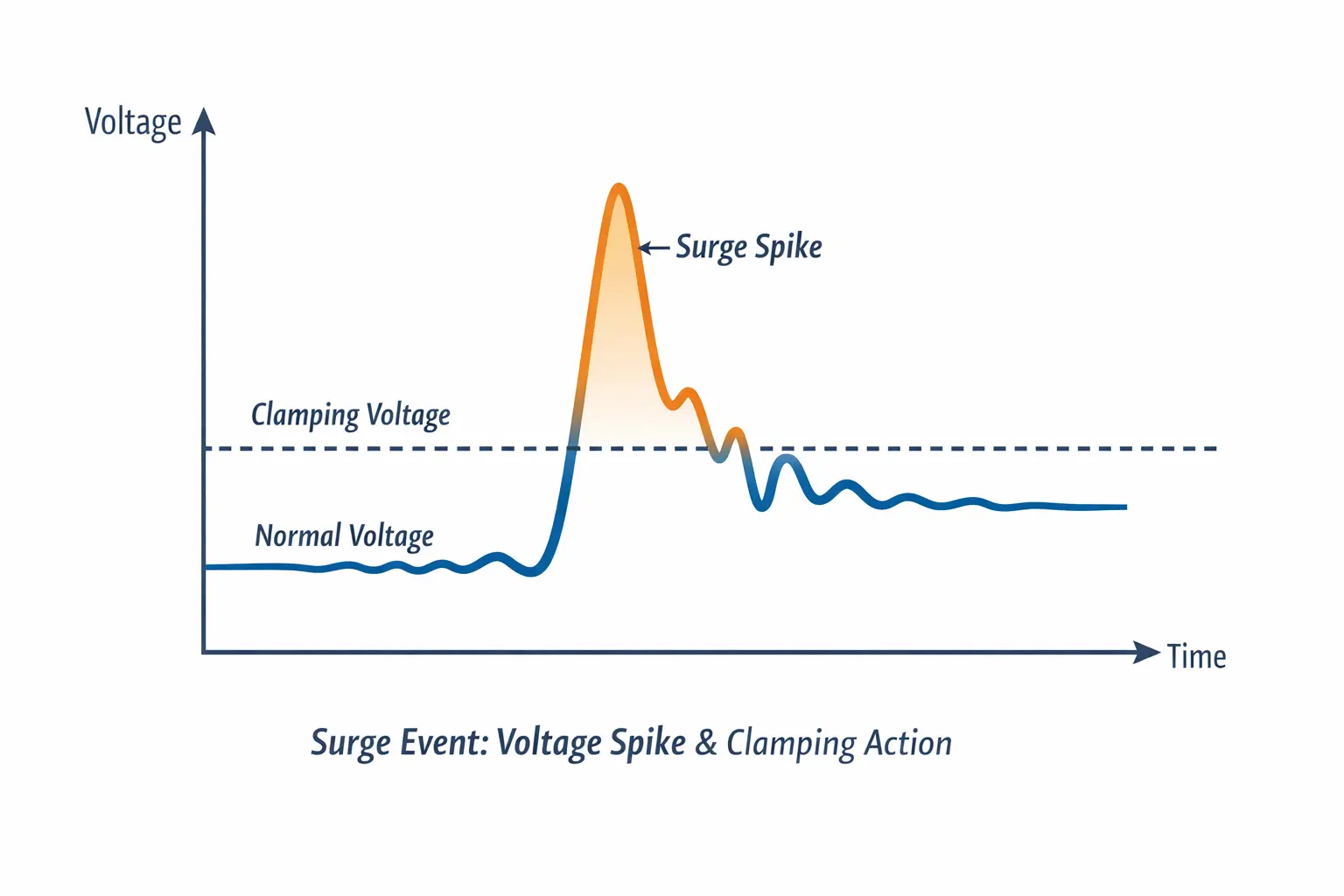
A voltage transient reaches the protector
The incoming voltage briefly rises above the normal operating range. Surge events can differ in peak current, duration, waveform, source, and electrical path.
The suppression network conducts
The nonlinear protection network changes its conduction behavior as the transient rises and diverts or limits surge current through the paths built into the SPD.
A reduced transient reaches the load
The protector reduces the transient rather than erasing it. The measured or real-world result depends on the event, protection mode, SPD design, installation, and connected wiring.
A surge protector therefore should not be pictured as holding every event beneath one perfectly flat voltage ceiling. NEMA describes SPD performance as a function of the surge-protective components, mechanical structure, connection to the electrical system, and the surge environment, so the real installation still matters after the standardized rating is known.
This is the practical difference between the headline specifications. VPR is built for standardized voltage-limiting comparison, while a joule claim describes energy in a way that is far less reliable for cross-brand shopping unless the underlying method is disclosed.
What Joule Ratings Tell You, and Why the Comparison Is Weak
A published joule number can tell you that the manufacturer is assigning an energy-handling figure to the suppression network. It can be useful as product-family context when the manufacturer uses a consistent method, but the number becomes much weaker when products from different companies are compared as though every joule claim came from the same test.
NEMA says joule comparisons can be misleading because there is no clear common energy-measurement standard across those claims and because the result depends on surge current, duration, and clamping voltage. NEMA further notes that industry standards and guidance focus more heavily on standardized performance tests such as VPR and nominal discharge current rather than using joules as the main comparison.
Eaton reaches the same practical conclusion in its technical guide to surge suppression. Eaton explains that manufacturers may use different surge waves when publishing joule figures and gives an example in which a higher-voltage MOV can carry a higher joule rating while also allowing a higher let-through voltage.
That does not make a higher joule number bad, and it does not mean a lower number is automatically better. It means the figure should not outrank standardized voltage-limiting data or be used as a shortcut for overall protection quality.
A Joule Rating Is Not a Lifespan Clock
A 2,000-joule protector should not be interpreted as lasting exactly twice as long as a 1,000-joule protector. Surge events vary in magnitude, waveform, duration, path, repetition, and surrounding electrical conditions, so two protectors can age very differently even when their printed energy ratings suggest a simple ratio.
NEMA’s technical material also describes SPD end-of-life as a result of more than one mechanism, including repetitive surges and temporary or sustained overvoltage conditions that can age surge-protective components. Those effects cannot be reverse-calculated from the original retail joule number into a trustworthy remaining-capacity percentage.
If the question is whether an existing unit should still be trusted, use the surge protector replacement checklist. Protection-status behavior, recalls, physical condition, event history, model instructions, and uncertainty are better continued-use evidence than dividing an assumed energy budget by past surge events.
What VPR Tells You More Reliably
VPR is useful because it belongs to a defined certification test framework rather than an open-ended marketing calculation. NEMA’s UL 1449 reference says the VPR is obtained during the nominal discharge current test using a 6 kV, 3 kA combination-wave generator.
A lower VPR generally represents a lower voltage-limiting category under that standardized test, but only a like-for-like comparison is useful. Match the nominal system voltage, SPD type, and protection mode instead of comparing the best advertised number from one product with a different electrical path or category on another.
VPR still is not a universal hard ceiling for every real surge, and it is not the exact point where an MOV or another component begins to conduct. The rating tells you what happened under the standardized test framework; it does not reveal remaining service life, joule capacity, or a guaranteed outcome for every connected device and transient.
The UL 1449 certification guide explains exact-model verification, SPD types, and how VPR appears in a certification record.
Protection Mode Can Change the Number
Line-to-neutral, line-to-ground, and neutral-to-ground are different electrical paths, so a product can publish different voltage-limiting values by mode. A retailer that surfaces one favorable number without the associated mode can make two products look more directly comparable than the underlying data supports.
When two models are being compared, record the VPR for the same mode on both products and note when a mode is missing or undisclosed. If the documentation is incomplete, keep that uncertainty visible instead of substituting another product’s value or assuming the lowest listed VPR applies to every path.
This is also why the phrase lower clamping voltage is not enough by itself. The lower number becomes useful only after you know what test created it and what electrical path it describes.
Clamping Voltage and Let-Through Voltage Need a Test Basis
Clamping voltage is often used as broad shorthand for the voltage-limiting behavior of an SPD, while let-through voltage can describe the voltage that remains after the device acts during a particular test. Neither phrase guarantees that the number shown in a retail listing is the product’s UL 1449 VPR.
Eaton’s technical material, for example, discusses let-through voltage under test methods other than the UL 1449 VPR framework. That does not make those measurements invalid, but it means the method and waveform must travel with the number if the result is going to be compared responsibly.
When the test basis is absent, treat the claim as manufacturer-reported but not directly comparable. When the listing explicitly identifies UL 1449 VPR, the standardized rating has a much clearer role in the comparison.
How to Compare Two Surge Protector Listings
Start with certification, then compare standardized ratings and check whether the device suits your equipment and space.
- Verify the exact model to UL 1449. If certification is unclear, stop and resolve it with the UL 1449 guide before comparing performance claims.
- Compare VPR like with like. Match nominal voltage, SPD type, and protection mode rather than choosing the smallest isolated number on either page.
- Identify whether clamping or let-through claims use the same test. If one number is VPR and the other comes from an unspecified waveform, do not rank them as equivalent measurements.
- Check nominal discharge current when it is published. Treat it as standardized repeated-withstand context, not as a substitute for VPR and not as normal load current.
- Treat joules cautiously. Use the number as manufacturer-published context only after the standardized data is clear, and avoid turning a higher joule figure into an automatic win.
- Finish with ownership requirements. Normal electrical rating, protected-status behavior, outlet spacing, plug shape, cord route, mounting, replacement guidance, and room fit still determine whether the technically credible protector works in your setup.
The surge protectors by setup type guide covers room and equipment requirements after the technical comparison is complete. The flat plug vs traditional plug guide explains wall projection, cord direction, furniture clearance, and access to the plug.
Common Joules and Clamping-Voltage Mistakes
The most common comparison errors come from turning incomplete or unlike specifications into a single ranking. Each mistake below removes context that the number needs before it can support a buying decision.
- Treating more joules as automatically better. A higher energy claim can coexist with a higher let-through or limiting voltage, so the larger number does not establish tighter voltage limiting.
- Using joules as an expiration clock. The original energy claim does not reveal remaining capacity, years of life, or the number of future surges the product can survive.
- Treating generic clamping voltage as VPR. A clamping or let-through claim needs its test method, voltage, waveform, and mode before it can be compared with a standardized UL 1449 rating.
- Comparing unlike VPR values. Match the nominal voltage, SPD type, and protection mode instead of comparing two isolated numbers that were not produced in equivalent contexts.
- Treating VPR as the component turn-on voltage. VPR is a standardized measured-limiting-voltage rating, not the exact instant when one internal protection component begins conducting.
- Treating VPR as a universal ceiling. A standardized rating is not a promise that every real surge, wiring path, and connected load will remain below that exact number.
- Confusing normal load with surge performance. Amps and watts describe ordinary electrical load limits, while VPR, nominal discharge current, and other surge ratings answer different transient-performance questions.
When documentation is incomplete, uncertainty is itself useful information. The Hearthful Standard keeps manufacturer claims, independent technical sources, and unresolved gaps distinct, so a missing VPR or undefined joule method should remain a limitation rather than being filled with assumptions.
Bottom Line
For surge-protector shopping, VPR is the more useful voltage-limiting comparison because it sits inside a standardized UL 1449 test framework. Compare it only between sufficiently similar products and protection modes, and do not reinterpret it as the component turn-on voltage or a guaranteed ceiling for every event.
Joule ratings are much weaker as a cross-brand ranking tool. NEMA warns that the claims can be misleading because the measurement basis is not standardized in the same way, and Eaton’s technical guidance shows why a higher joule figure can coexist with a higher let-through voltage.
Check the exact model’s certification first, then compare VPR for the same protection mode and test conditions. Use joules only as supporting information when the measurement method is clear. After the technical evidence is clear, use the complete surge protector and power strip guide to choose the product whose electrical limits, indicators, physical design, and installation tradeoffs fit the actual room.
Disclaimer: The content on The Hearthful Home is for general informational purposes only and reflects independent research and interpretation of publicly available information at the time of publication. It is not intended as professional electrical or safety advice. Always verify the exact product documentation, certification record, ratings, installation instructions, and applicable electrical requirements before relying on a surge protective device.