
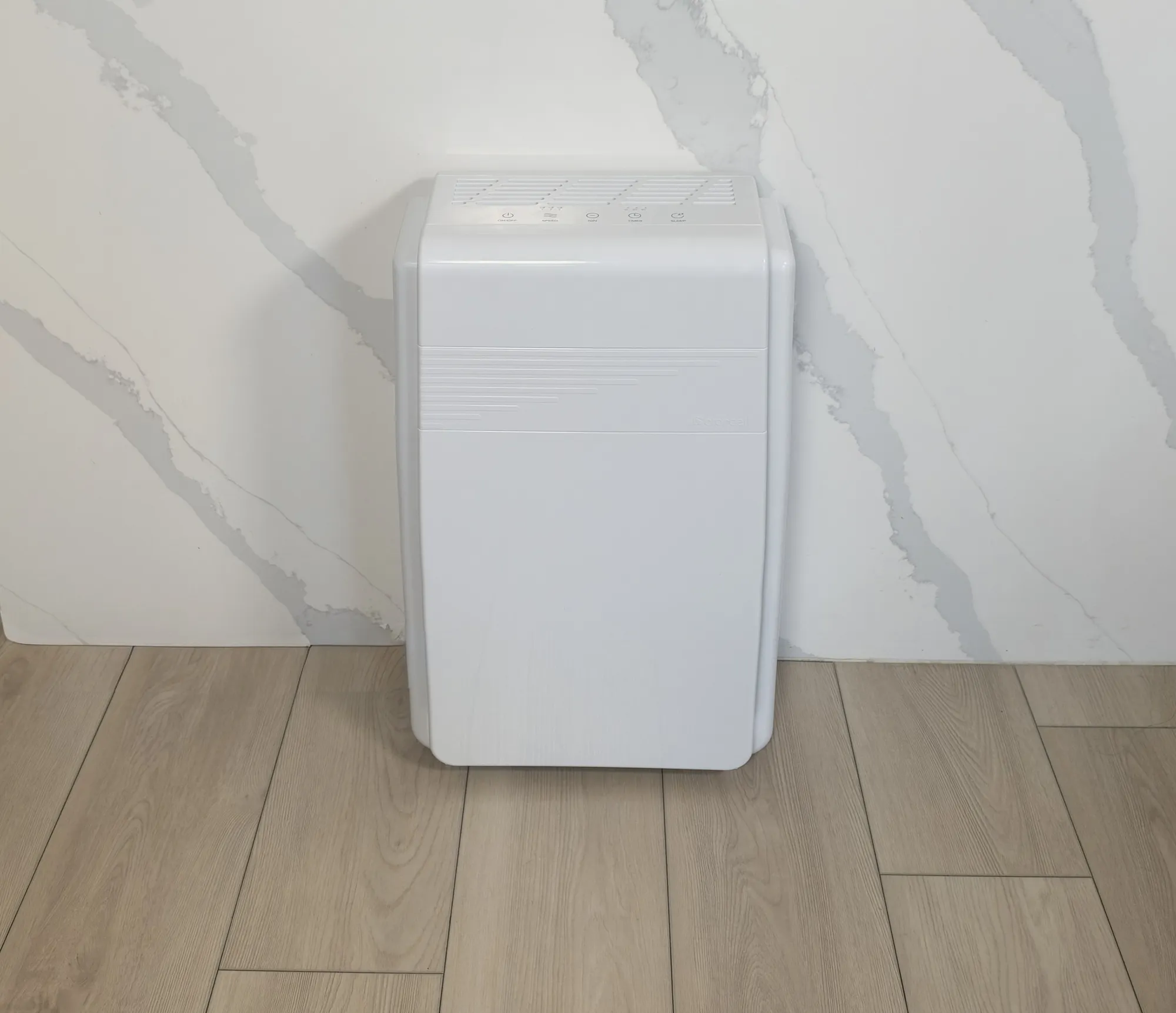
The Brondell Horizon P200 puts much of its appeal into everyday basics: a shallow body, controls on the unit, and one filter assembly to maintain. After four weeks in my home, I could see its appeal for a bedroom or office. It was easy to carry between rooms, Sleep mode did not wake us, and I could reach the filter without working through several separate panels or filter pieces.
Speed 2 became my usual daytime setting, while Sleep was the setting I preferred overnight. That distinction matters more than a single advertised noise figure. I measured sound and power in each mode, weighed and measured the unit, and checked how the cover, controls, and filter worked during regular use. Together, those details show what the Horizon asks of your space and routine.
There were compromises. My sample had a rough top edge with plastic shavings, a front cover that felt slightly loose, and a power button that often responded better when I tapped above its printed symbol. I could work around those issues, but they made the purifier feel less polished than its clean-looking white housing suggests.
The buying decision also reaches beyond the cabinet. Brondell’s coverage figures change with the number of air changes per hour, its published filter specification is HEPA-type, and replacement filters are a substantial part of the ownership budget. My recommendation is strongest for a small enclosed room where simple operation matters and the purchase price leaves room for upkeep. The review below explains that fit through my daily experience, recorded measurements, and the model’s documented specifications.
Review disclosure: Brondell provided this white Horizon P200 sample in October 2026. This review reflects my experience with that unit, including measurements, bedroom and office use, and a cooking-related air-quality observation. Some links in this review are affiliate links. If you purchase through them, The Hearthful Home may earn a commission at no additional cost to you. As an Amazon Associate, we earn from qualifying purchases.
Brondell Horizon P200 Review at a Glance
Good value for small bedrooms and offices
For a small bedroom or office, the Horizon offers good bang for the buck. I liked its portability, straightforward filter maintenance, and comfortable Sleep mode. It is a practical choice for simple, everyday use.
Someone furnishing a small enclosed bedroom or office who prefers choosing the fan setting on the unit. Brondell lists 140 square feet at four air changes per hour; the larger 560-square-foot claim is at one. Use those published coverage ratings to judge room fit, and leave the intake clearance specified in the manual even though the body is shallow.
The single PHZF-21 filter assembly. Its pull tabs make removal straightforward, and the particle and odor-control layers stay together during handling. That made maintenance easy to understand. Brondell calls for vacuuming the filter faces every two to four weeks; the entire assembly is replaced when due, so convenient access still comes with regular upkeep.
The fit and control response on my sample. The power button often worked better when I tapped above the printed icon, while the front cover had a slight gap and rattled when touched or moved. I also found a rough top edge with plastic shavings. Those details were disappointing even though the other controls were more accurate in my use.

Brondell Horizon P200
A compact purifier with three manual fan speeds, Sleep mode, a shutoff timer, and a separately controlled Ion function.
Design, size, and build quality
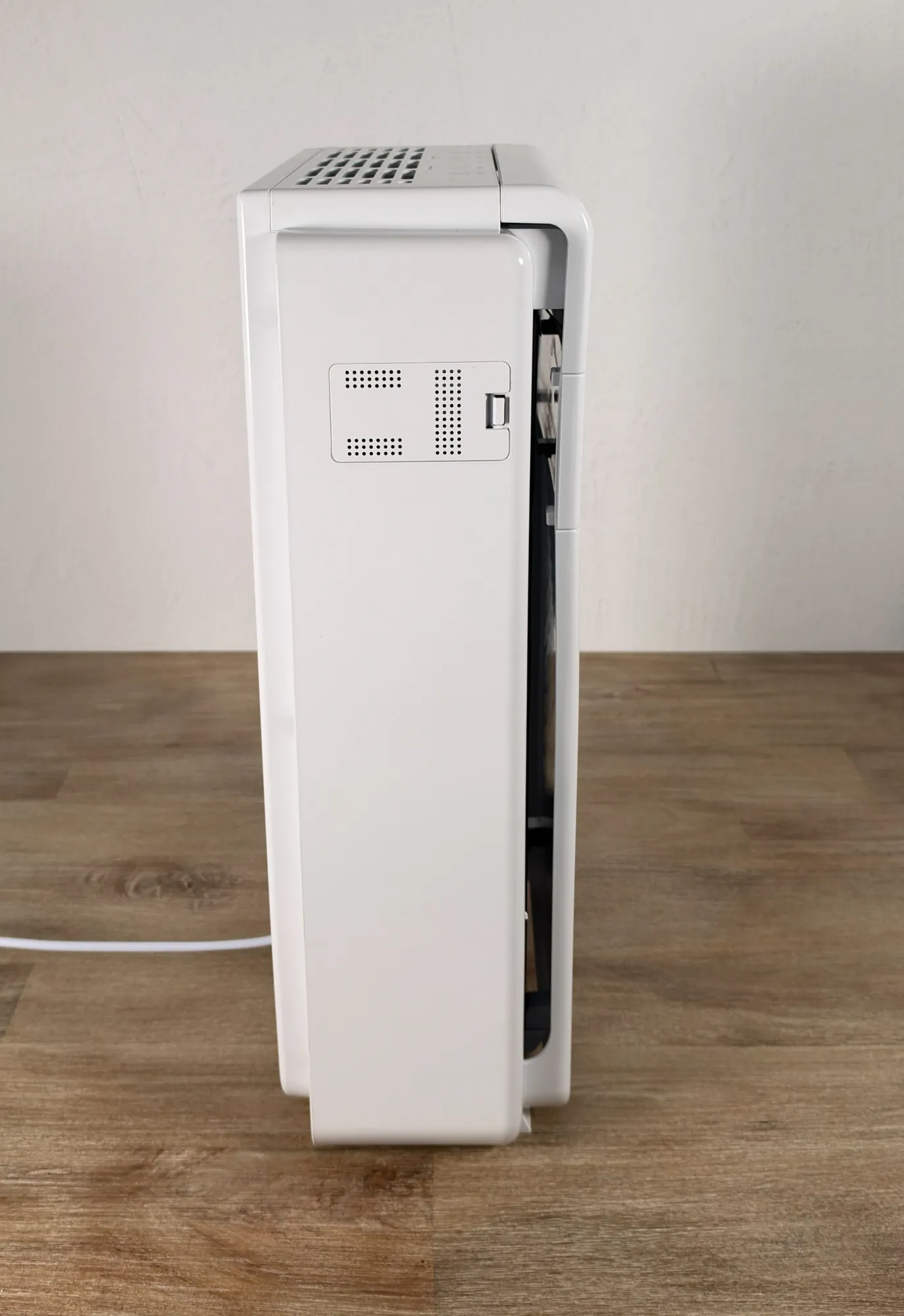
The Horizon has a narrow, upright body with a white front panel, intake openings around the front-cover area, and an outlet on top. It looks simple beside furniture and does not demand much floor depth. That shallow profile was one of the things I appreciated when placing it near my desk or moving it into a bedroom.
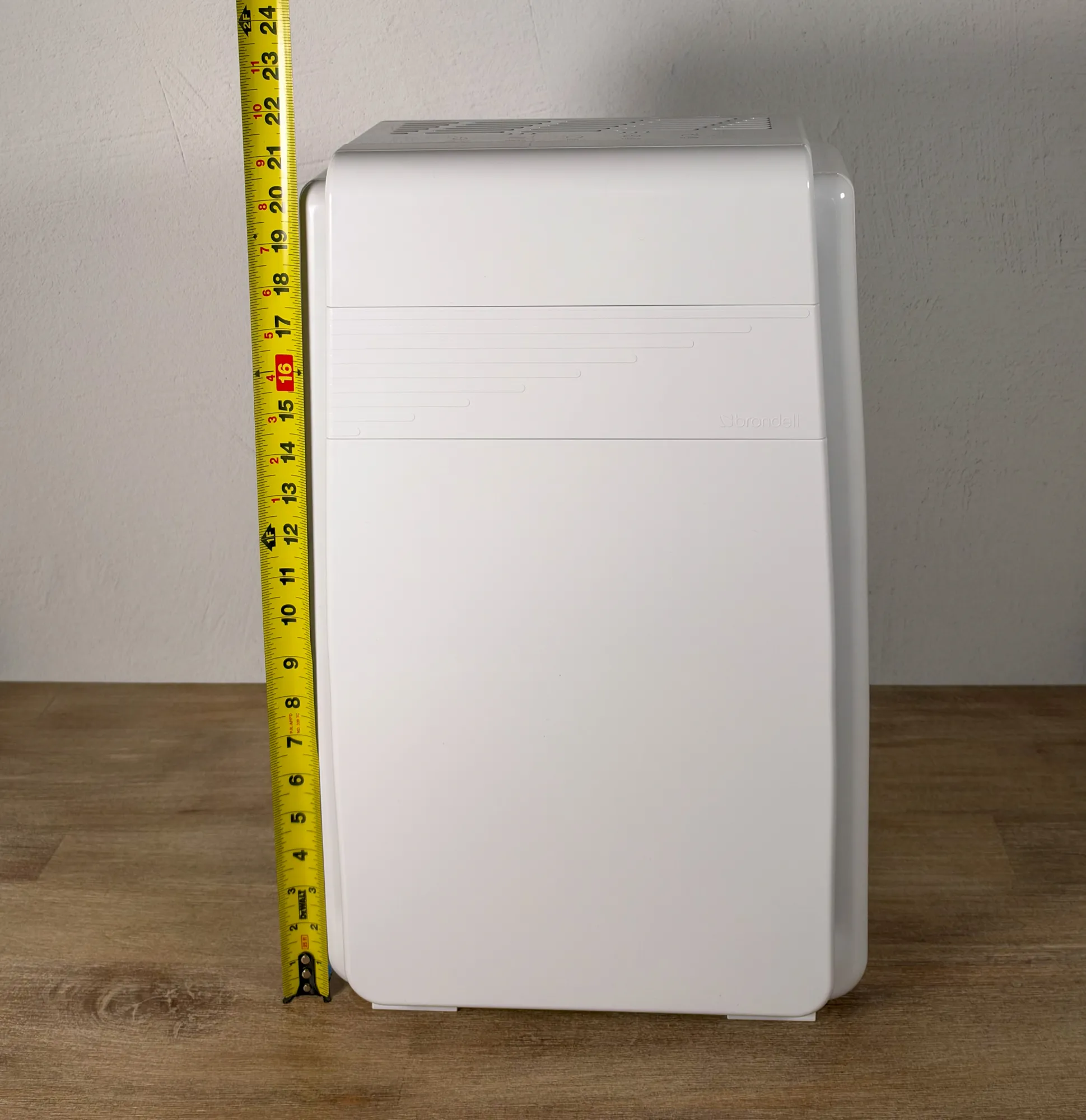
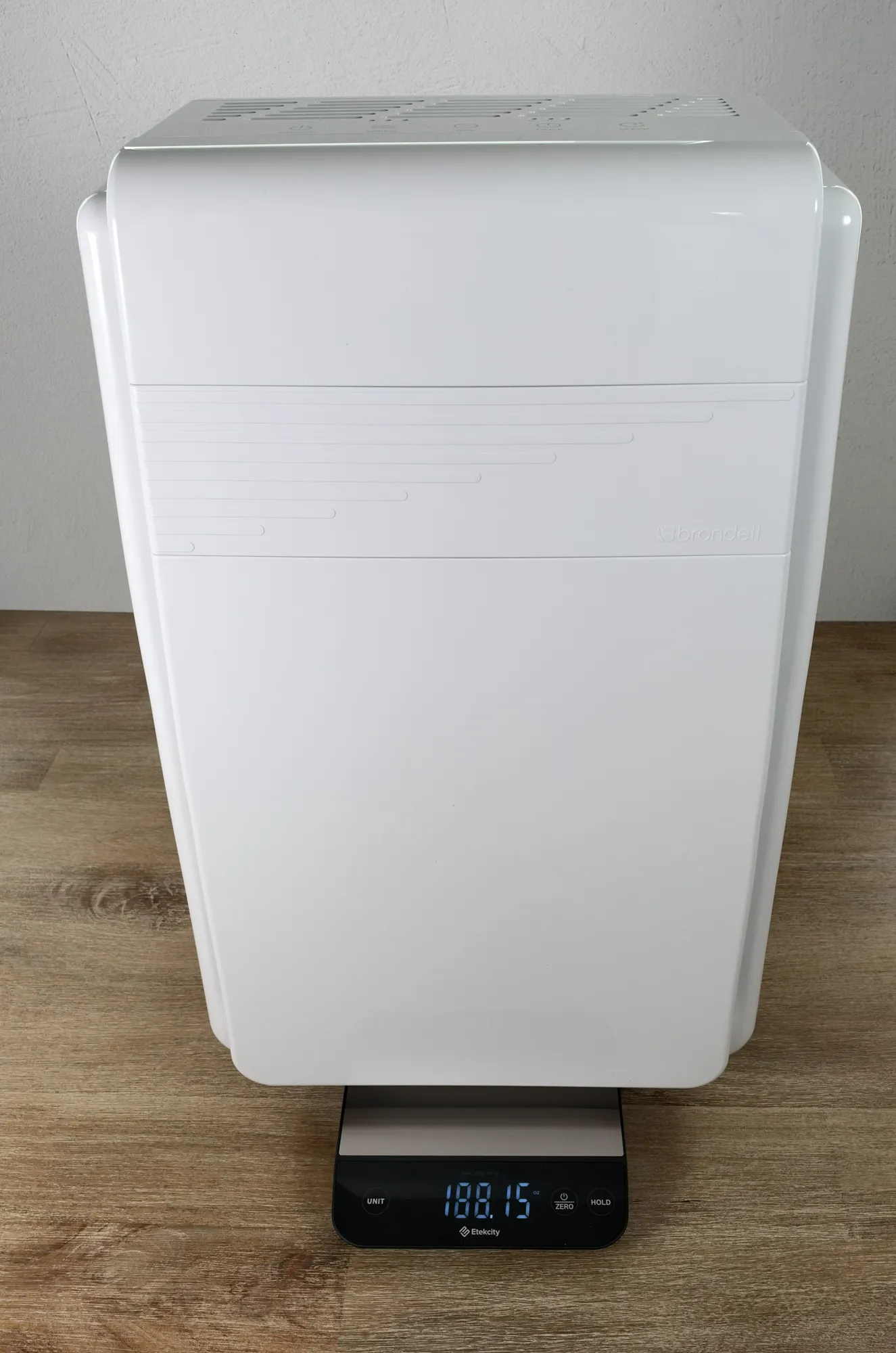
Measured values come from my sample. Published figures are shown separately so the difference stays visible.
My measurements and Brondell’s specifications
| Item | My sample or observation | Brondell specification |
|---|---|---|
| Model | Horizon P200, white | White variant listed as P200-W |
| Width × depth × height | 13.25 × 6.5 × 21 inches | 12 × 6.5 × 21.2 inches |
| Weight | 188.15 oz, approximately 11.76 lb | 11 lb |
| Maximum operating power | 53.4 W on speed 3 | 55 W rated |
| Replacement filter | PHZF-21 | PHZF-21 |
| Fan and timer settings | Three speeds plus Sleep; 1H, 2H, and 4H panel labels | Three fan speeds, Sleep mode, and 1-, 2-, or 4-hour shutoff timer |
Published dimensions, weight, and electrical specifications: Brondell Horizon specification sheet. Control operation: Horizon owner’s manual.
The weight on my scale was 188.15 ounces, which converts to just under 11 pounds 12 ounces. I found the purifier light enough to move easily. My measured width was larger than Brondell’s listed width, so I would use the 13.25-inch measurement when allowing room for a unit like my sample instead of planning around a tight 12-inch space.
The footprint is only part of placement. Brondell’s manual calls for at least 20 inches of clearance at the sides and 4 inches at the rear. Keep the top outlet open as well. A narrow body can be convenient near furniture, but it still needs breathing room around the intake and outlet. Brondell’s placement instructions are a better guide than whether the cabinet physically fits into a gap.
The front cover and finish were the weak points
The front cover uses clips at the top and locating tabs at the bottom. It does not use magnets. Removing it exposes a straightforward filter compartment, which I liked, but the panel on my sample had a slight gap and could rattle when I touched or moved it. That is the kind of detail I noticed each time I handled the purifier.
I also found a rough edge and plastic shavings along the top. These are observations about the sample I received, rather than evidence that every Horizon has the same finish. Still, they belong in the review because they affected my impression of the construction. The housing does its job as a lightweight shell, but my unit did not have an especially refined feel.
How I tested the Brondell Horizon P200
I used the Horizon over four weeks and recorded its dimensions, weight, operating sound, and power draw. I checked the control panel, removed and reinstalled the front cover and filter, and used it in my bedroom and office. For the cooking observation, I watched an independent IQAir AirVisual Pro instead of relying on a purifier display.
How the Review Was Built
Measured dimensions and weight, NIOSH Sound Level Meter app readings at 3 feet, and plug-in power-meter readings for each operating mode.
Four weeks of household use and an egg-cooking observation with an independent IQAir monitor, speed 3, Ion on, and the range hood on medium.
Bedroom and office use, moving the unit, operating the controls, sleeping with it running, front-cover fit, and filter access.
Filter specifications, room-coverage ratings, control operation, placement, filter care, and replacement guidance.
The bedroom and office space measures about 16.1 by 13.5 feet with a 9-foot ceiling, or approximately 217 square feet. These are the room measurements used in my IQAir AirVisual Pro review. I generally ran the Horizon on speed 2 there, where the monitor commonly showed AQI readings around 5 to 10 during my use.
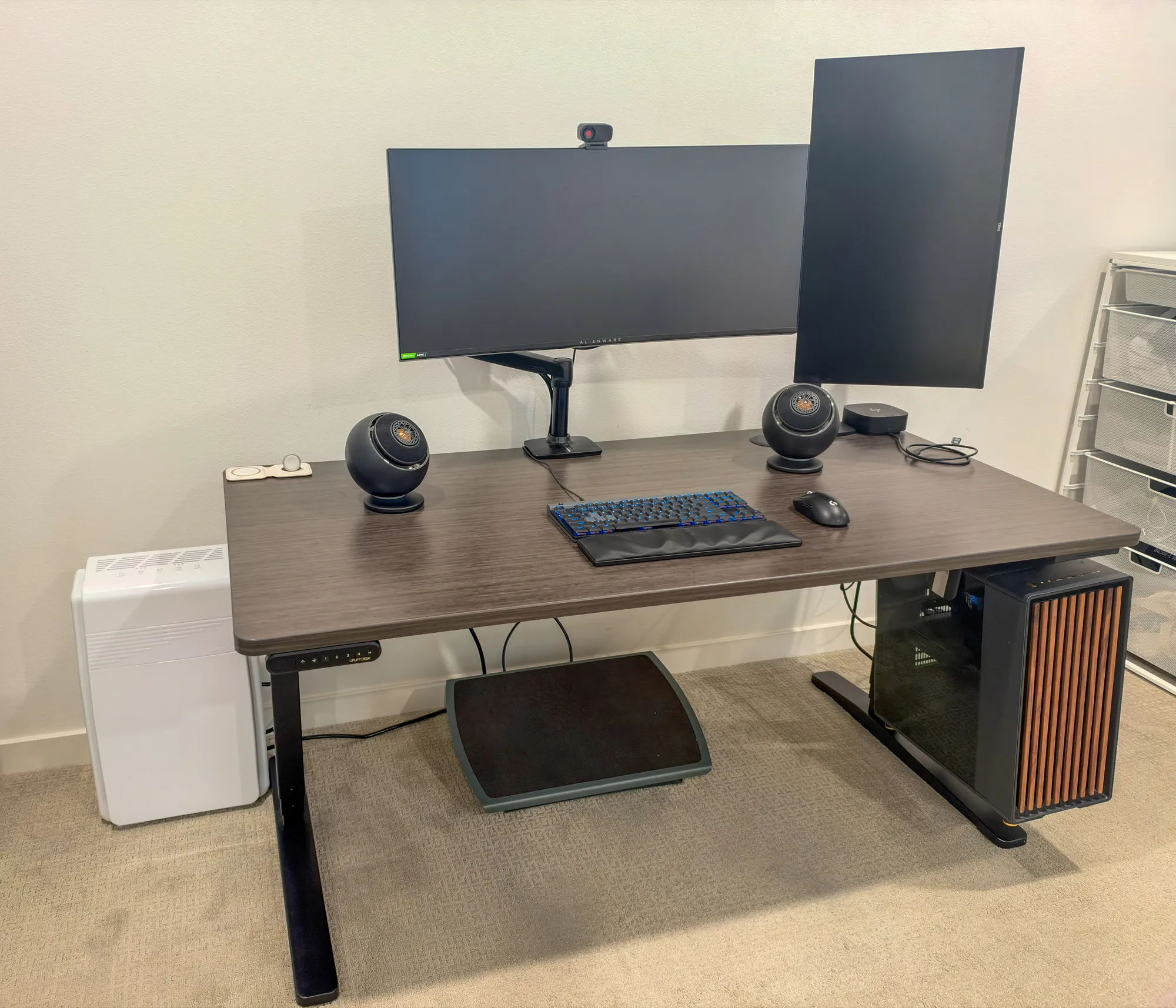
Those low readings describe the room conditions I observed. They are not a measurement of the Horizon’s clean-air delivery rate. For a buying decision, I would still size the purifier using Brondell’s published air-change figures, especially because this room is larger than the company’s 140-square-foot rating at four air changes per hour.
The Hearthful Assessment
These are editorial assessments informed by my sample, measurements, and Brondell’s documentation. The six factors carry equal weight under The Hearthful Standard.
Brondell Horizon P200
Good Value for Small Bedrooms and Offices
A good-value small-room option when the purchase price and replacement-filter budget fit your needs. Its portability, simple upkeep, and comfortable overnight operation outweigh the control and finish quirks for me. The six category scores total 48. Dividing by six gives 8.0 out of 10.
Controls and everyday use
The top panel has five labeled controls: On/Off, Speed, Ion, Timer, and Sleep. Small lights show the selected fan speed and timer setting. There is no app workflow to learn here; the day-to-day interaction is choosing a setting on the purifier itself.
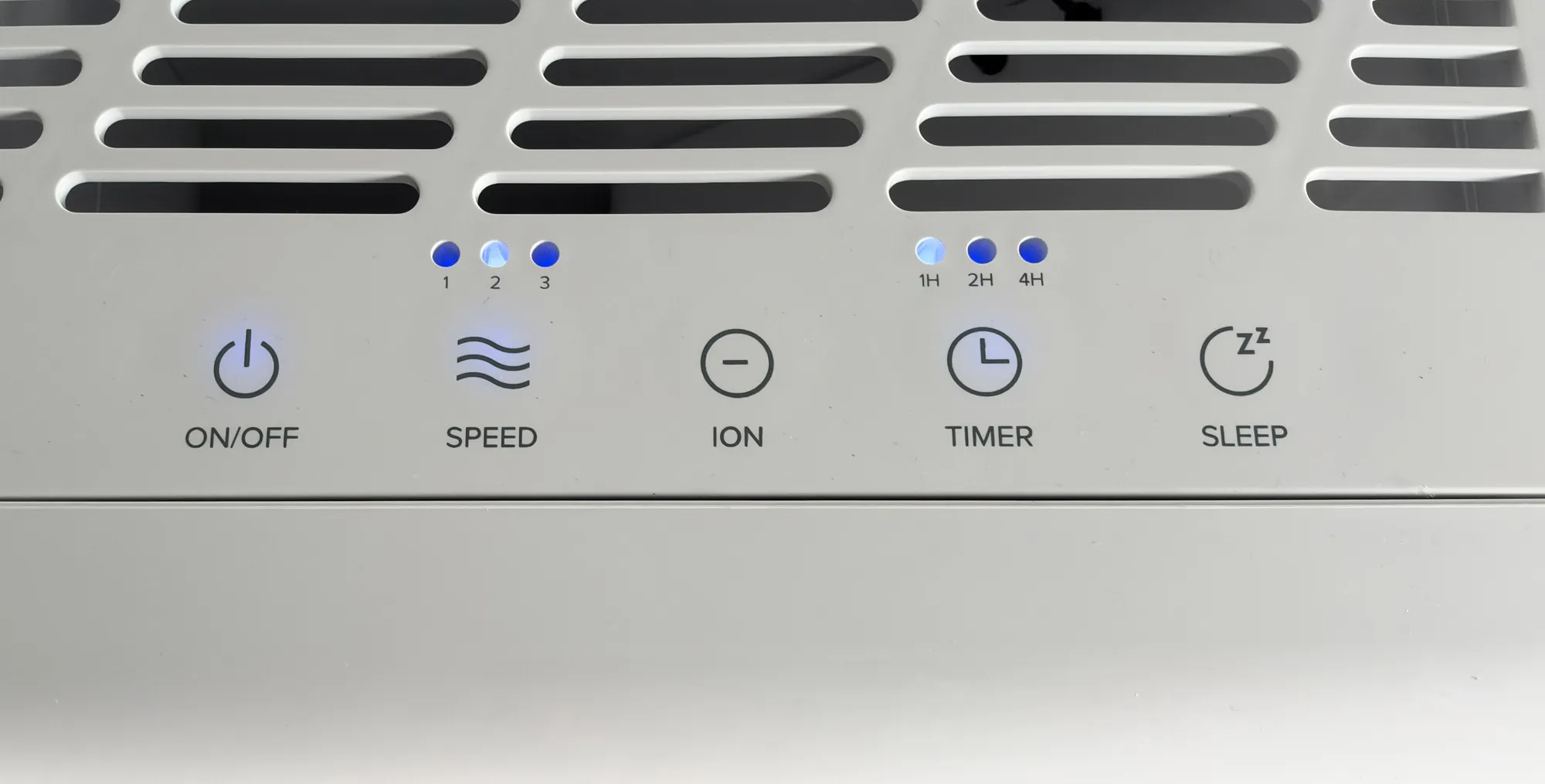
I liked being able to glance at the three speed indicators and understand the current setting. The main annoyance was the power button. I often had to tap a little above the printed On/Off symbol to get the response I expected. The other controls were more accurate in my use. It is a small interaction issue, but power is the button I reach for every time I move or restart the unit.
The timer provides a choice of one, two, or four hours before shutting the purifier off, according to the manual. That can be useful for a limited period of operation, while a room you occupy throughout the day may suit continuous use better. The timer is a countdown control, so it should not be confused with an app schedule. The manual explains the timer and fan controls.
Sleep mode was comfortable overnight
Sleep mode did not wake us during my use. Brondell describes it as the minimum fan setting with the other indicator lights switched off and the Sleep indicator remaining illuminated. That last detail matters if you prefer a completely dark appliance: Sleep mode reduces the panel lighting, but it does not make every indicator disappear. Brondell documents this light behavior in the manual.
My sound and power measurements also put Sleep close to speed 1. I would choose between them based on the lighting and how the purifier feels in the room, rather than expecting a large electricity saving from Sleep. Speed 2 was my usual bedroom and office setting while awake, with speed 3 available when I wanted the strongest fan setting.
For readers comparing control packages, our guide to air purifier features worth paying for can help separate the conveniences you will use from features that add little to your routine.
What is inside the Horizon filter, and what Ion adds
Brondell calls the Horizon a five-stage purifier. Four of those stages are part of the replaceable filter assembly: a prefilter, a HEPA-type layer, granular activated carbon, and a cold-catalyst layer. The fifth stage is the separately controlled ionizer. That means five stages does not mean five separate filters to remove or buy. Brondell’s product description outlines the system.
Pay attention to the HEPA-type specification
The current Horizon documentation describes an H12 HEPA-type filter with 98.45% efficiency at 0.3 microns. That is the figure I would use when comparing this particular model. I would not describe it as a True HEPA filter with 99.97% efficiency, because that is not the specification Brondell publishes for this filter. The model-specific specification sheet gives the efficiency claim.
That percentage describes a filter claim under the stated particle-size condition. Room performance also depends on how much air the purifier moves through the filter and how long it operates. A filter percentage and a room-coverage number answer different questions, so both deserve attention. Our explanation of what an air purifier’s HEPA filter captures covers that distinction in more detail.
The one-piece filter was easy to handle
My PHZF-21 filter had a blue face on one side and a white-to-gray face on the other, with foam around the outside of the frame. I could hear the loose granular material inside when handling it. The pull tabs made removal easy, and I liked having the filtration layers together instead of managing a separate prefilter panel.
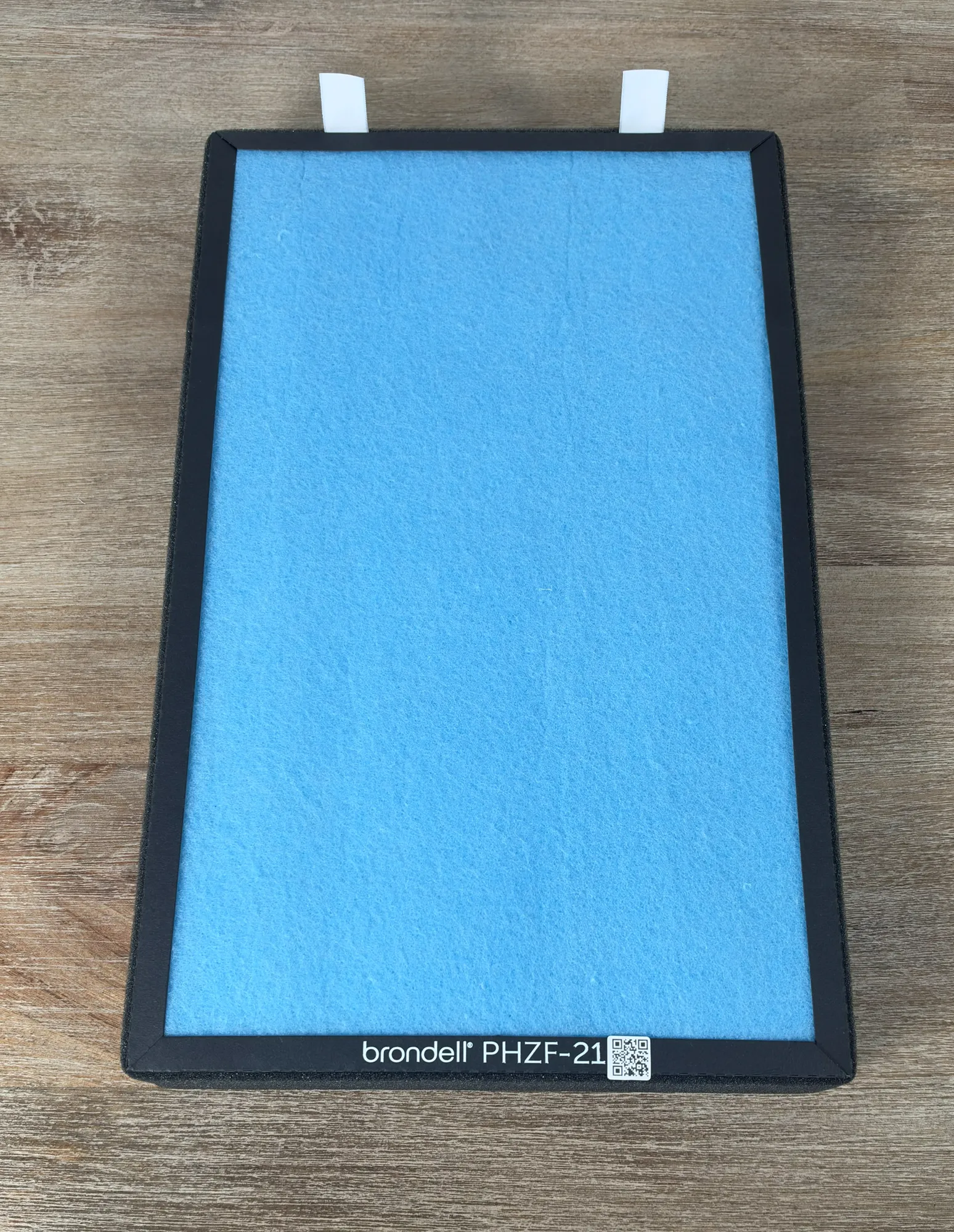
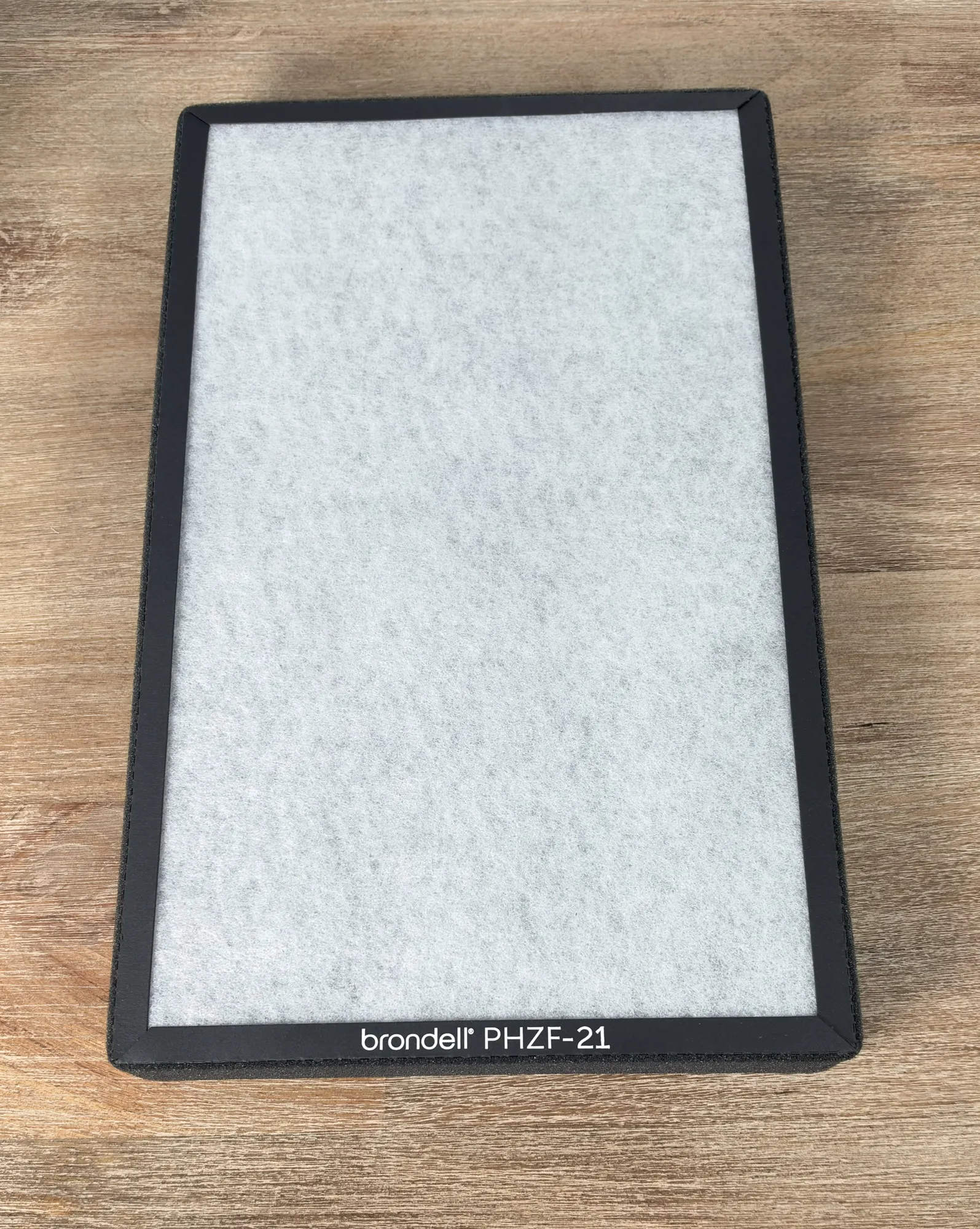
That convenience does not remove routine care. Brondell instructs owners to vacuum the filter faces every two to four weeks and to replace the assembly on the recommended schedule. During reinstallation, the blue side faces outward and the pull tabs remain accessible. The cover then locates at the bottom and clips into place at the top. The filter-care instructions show the orientation and sequence.
Ion is optional, and it deserves a separate decision
The Ion button lets you control the ionizer separately from the fan. I used Ion during the cooking observation described below. Turning it on did not produce an observable change on my power meter, but that reading does not establish the ionizer’s electrical consumption or its effect on particle removal.
Brondell’s air-filter FAQ says its ionizers can produce trace amounts of ozone. The P200 and P200-W appear in California’s certified air-cleaner directory as electronic air cleaners. That certification concerns the applicable ozone-emission limit of 0.050 parts per million; it is not a zero-ozone claim or an endorsement of cleaning performance. Brondell’s FAQ is the manufacturer’s explanation of the feature.
Ionizers charge airborne particles, which can affect where those particles collect. The EPA’s explanation of ionizers is useful if you are deciding whether to use that function. I would treat Ion as a distinct operating choice, rather than assume that enabling every stage automatically makes the purifier the best fit for every household.
Room coverage: start with the air-change rating
The largest coverage figure needs context. Brondell lists 140 square feet at four air changes per hour, 280 square feet at two, and 560 square feet at one. A 10-by-14-foot bedroom is 140 square feet. Open it to another room of the same size and the combined floor area is 280 square feet. At that size, Brondell lists two air changes per hour. These are manufacturer coverage figures; the Sleep-mode sound measurement below describes a different part of the buying decision. Brondell’s specification sheet publishes the three ratings.
Use the air-change figure alongside the area when comparing room-size claims.
How to read the published coverage
| Published area | Published air changes | Buying implication |
|---|---|---|
| 140 sq ft | 4 per hour | The most useful of these three figures when considering the Horizon for more frequent small-room air circulation. |
| 280 sq ft | 2 per hour | A larger area with half as many nominal air changes as the 140-square-foot rating. |
| 560 sq ft | 1 per hour | The broadest coverage claim, with much slower nominal turnover across that area. |
Manufacturer ratings. These are not measurements of cleaning speed in my home, and the listed coverage does not specify a ceiling height.
My approximately 217-square-foot bedroom and office is larger than the 140-square-foot figure, and its 9-foot ceiling adds volume. I was comfortable using the Horizon there, but I would not translate my experience into a recommendation that it will deliver four air changes per hour in that room. A quiet room with low starting particle levels can remain pleasant without demonstrating how a purifier would handle a sustained pollution load.
For a new purchase, I would match it first to a genuinely small enclosed room. If you want stronger circulation in a larger bedroom, or enough capacity to run a larger unit at a quieter speed, compare models using the CADR your room needs. Our air purifier buying guide is another place to compare room fit and everyday usability.
What happened during my egg-cooking observation
I used an egg-cooking event to observe the IQAir monitor while the Horizon ran in the kitchen and adjoining living area. I switched the Horizon on at speed 3 with Ion enabled when I began frying the egg. The range hood was on medium and remained on during the observation.
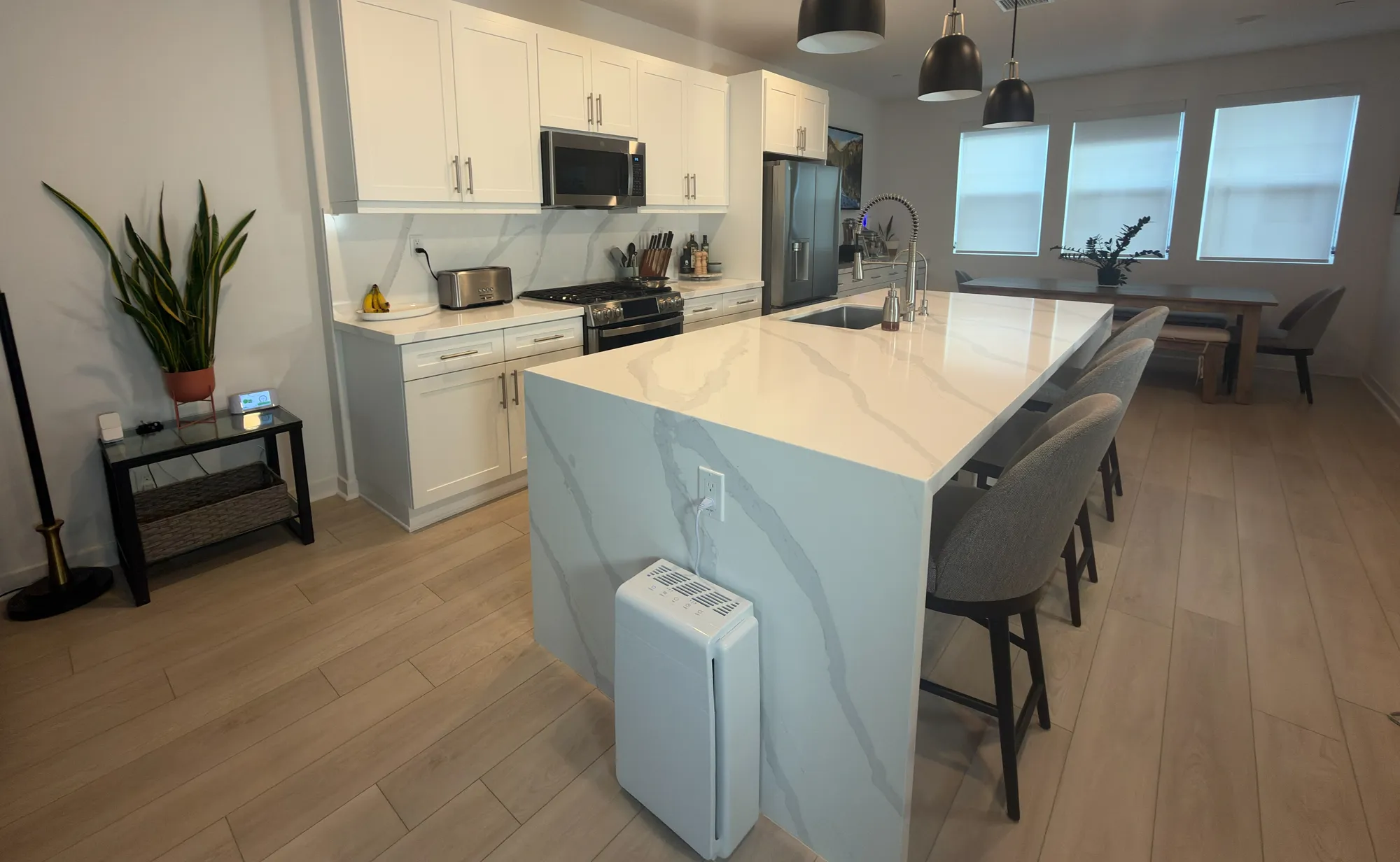
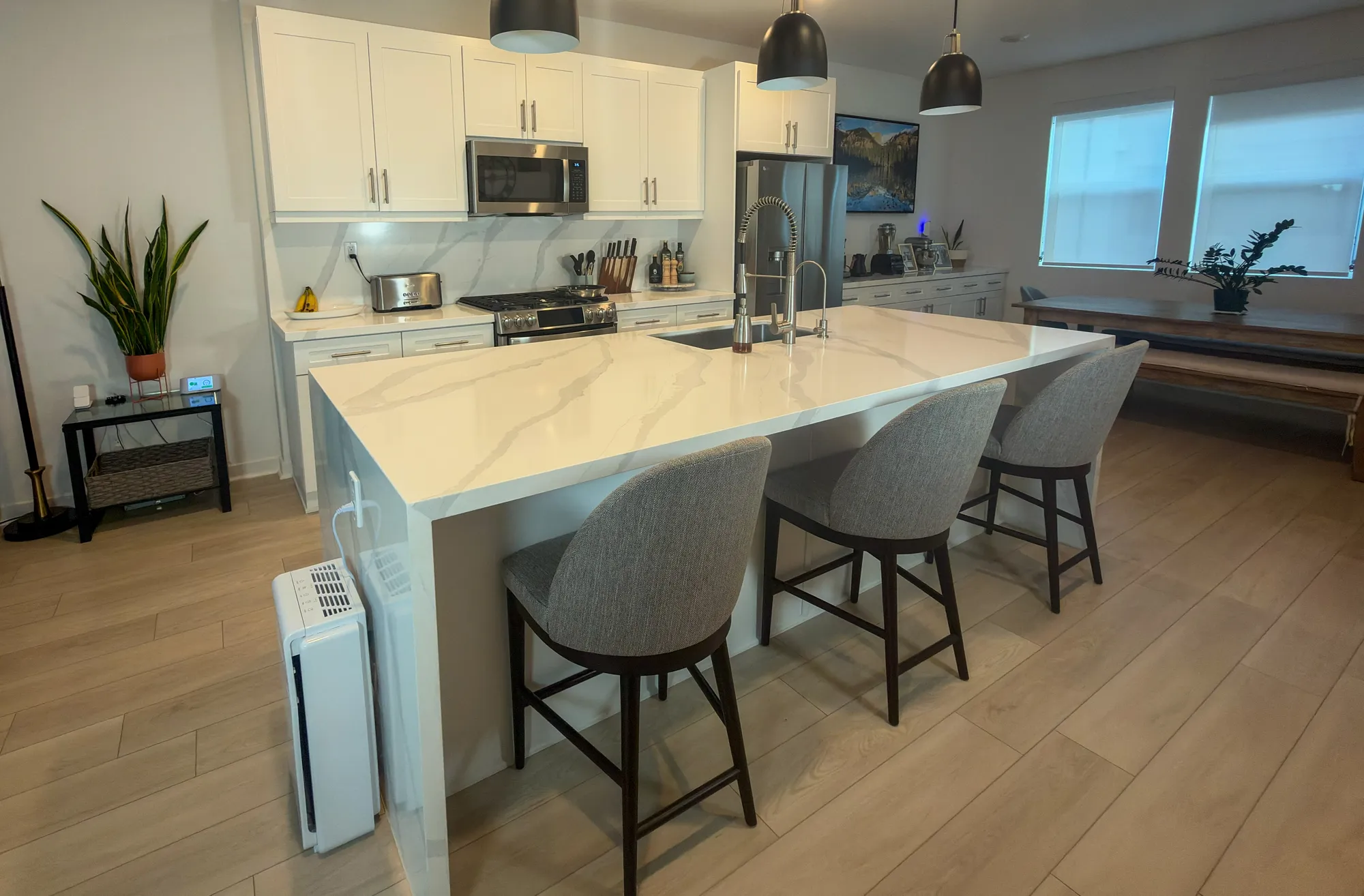
I began timing when the IQAir sensed the air change, then immediately discarded the egg. The recorded setup distances were approximately 7 feet for the IQAir monitor and 8 feet for the cooking area. The readings below show the starting room condition, the elevated reading, and the 15- and 30-minute observations from that timing point.
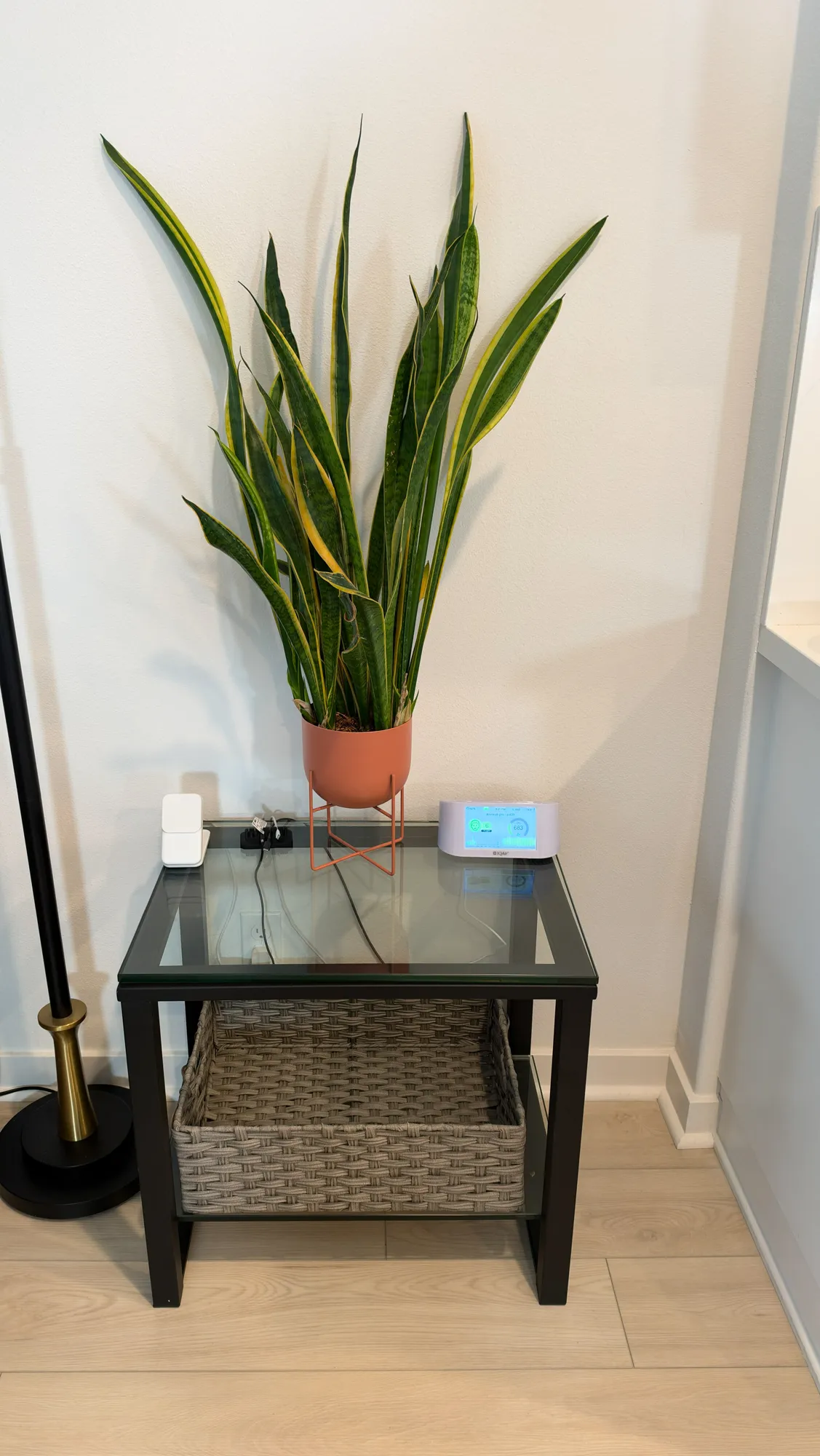
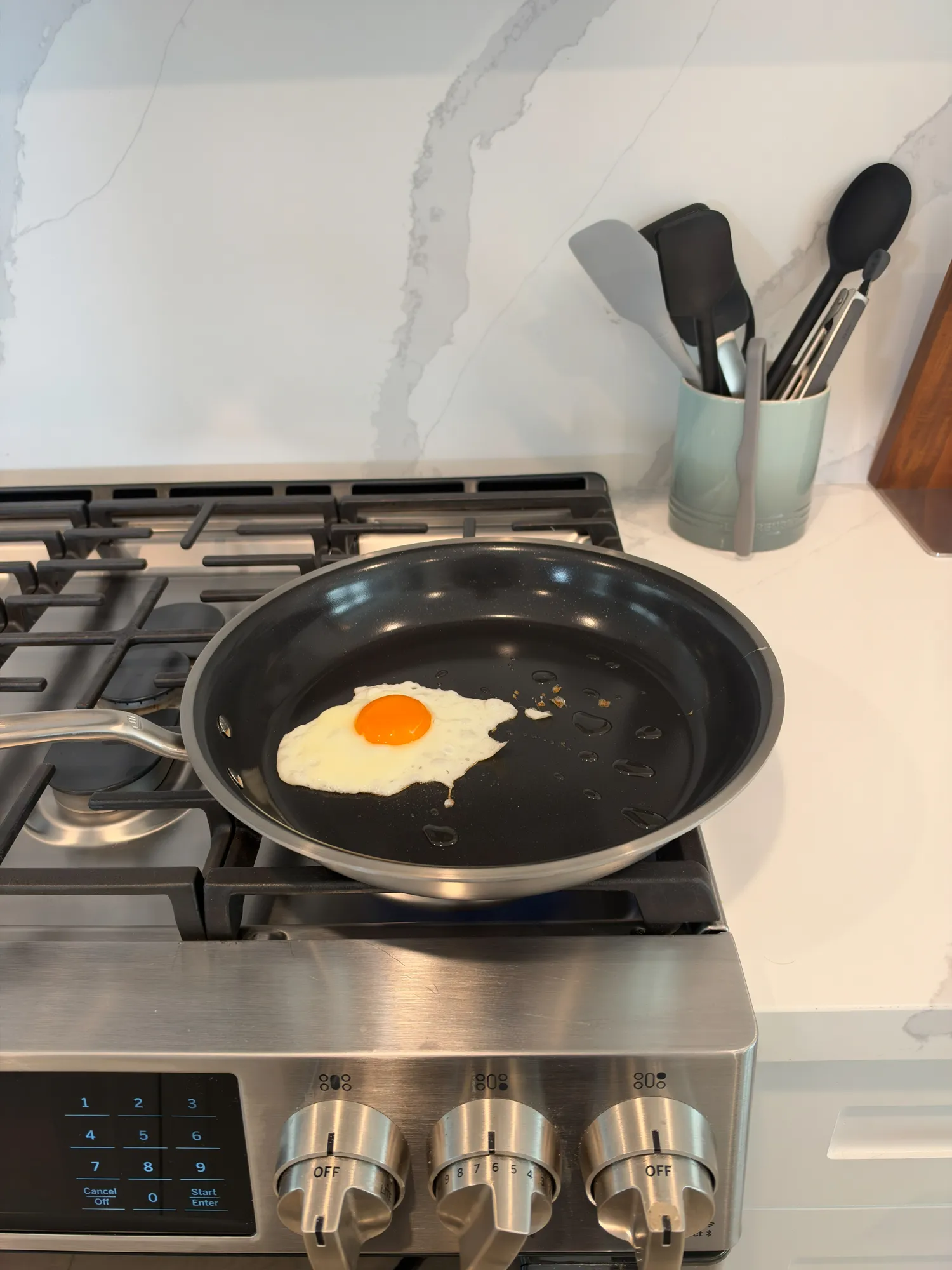
Horizon on speed 3 with Ion on; range hood on medium; the egg was discarded when timing began.
IQAir readings during the cooking observation
| Observation | AQI reading | PM2.5 reading |
|---|---|---|
| Before cooking | 6 | 1 µg/m³ |
| Elevated reading at the timing point | 99 | 35 µg/m³ |
| 15 minutes | 62 | 15 µg/m³ |
| 30 minutes | 22 | 4 µg/m³ |
AQI is the index displayed by the monitor. PM2.5 is the particle concentration in micrograms per cubic meter. They are different measurements and should not be interchanged.
The PM2.5 reading declined from 35 to 15 µg/m³ at 15 minutes and to 4 µg/m³ at 30 minutes. By the end, it was much closer to the 1 µg/m³ starting level, though it had not returned to that baseline. That gives a useful picture of the room settling after this cooking event.
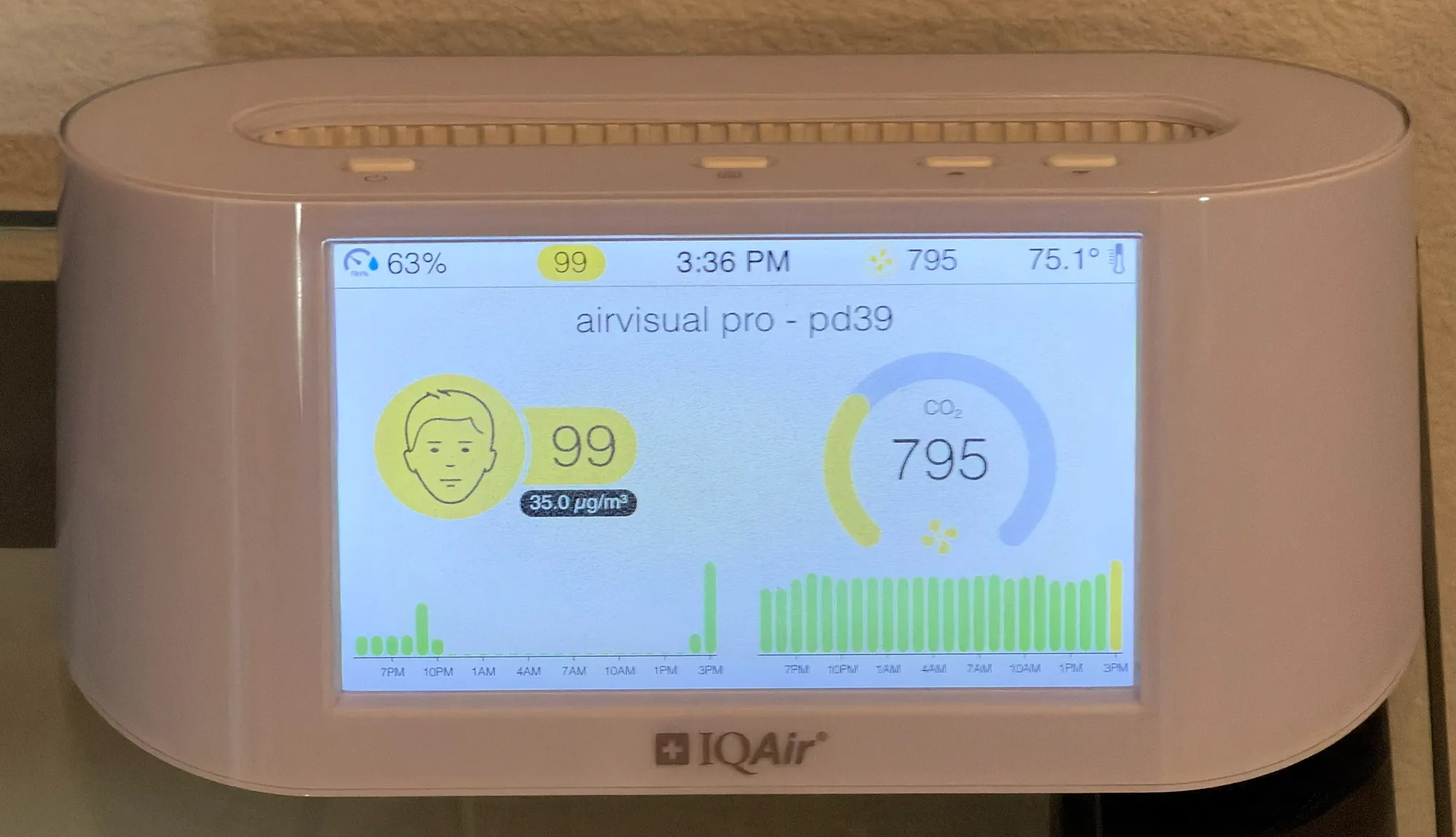
The range hood was running and the cooking source had been removed, so the decline reflects the whole setup. It cannot be assigned entirely to the Horizon or converted into an isolated cleaning-speed result.
I also felt that odors were reduced during household use. That was a personal impression, separate from the IQAir particle readings. The granular carbon is part of the design I liked, but a lower PM2.5 value does not measure odor removal or gas reduction. For that buying question, see our guide to air purifiers, VOCs, and odors.
How loud was the Horizon?
I measured sound from 3 feet away using the NIOSH Sound Level Meter app. The room baseline was 32.7 dB. These readings are useful for comparing the Horizon’s modes within my setup; the distance, room, and phone measurement method are part of the result.
NIOSH Sound Level Meter app, with a 32.7 dB room baseline.
Measured operating sound at 3 feet
| Mode | Recorded sound | How I would use it |
|---|---|---|
| Room baseline | 32.7 dB | Reference reading before operating-mode comparisons. |
| Sleep | 37.2 dB | My overnight choice; it did not wake us during use. |
| Speed 1 | 38.2 dB | A low setting with a reading close to Sleep. |
| Speed 2 | 48.9 dB | My usual awake bedroom and office setting. |
| Speed 3 | 57.3 dB | The strongest fan setting, used for the cooking observation. |
These are the recorded app readings in dB. They are not background-subtracted values or independently calibrated laboratory sound measurements.
The main practical split was between the two low settings and the higher fan speeds. Sleep measured only 1 dB below speed 1, while speed 2 was a much larger step up in the recorded level. Speed 3 was the loudest setting by a clear margin. I would choose a mode based on the activity in the room as well as the desired fan output.
For my own use, Sleep was comfortable overnight and speed 2 was workable during the day. Someone who needs near-background sound for concentrated work may prefer a lower setting. That also makes capacity relevant: a purifier that suits the room only on its highest setting may be harder to live with than its lowest advertised sound number suggests. Our guide to quiet air purifiers for bedrooms and offices explains that tradeoff.
Power use and the cost of keeping it running
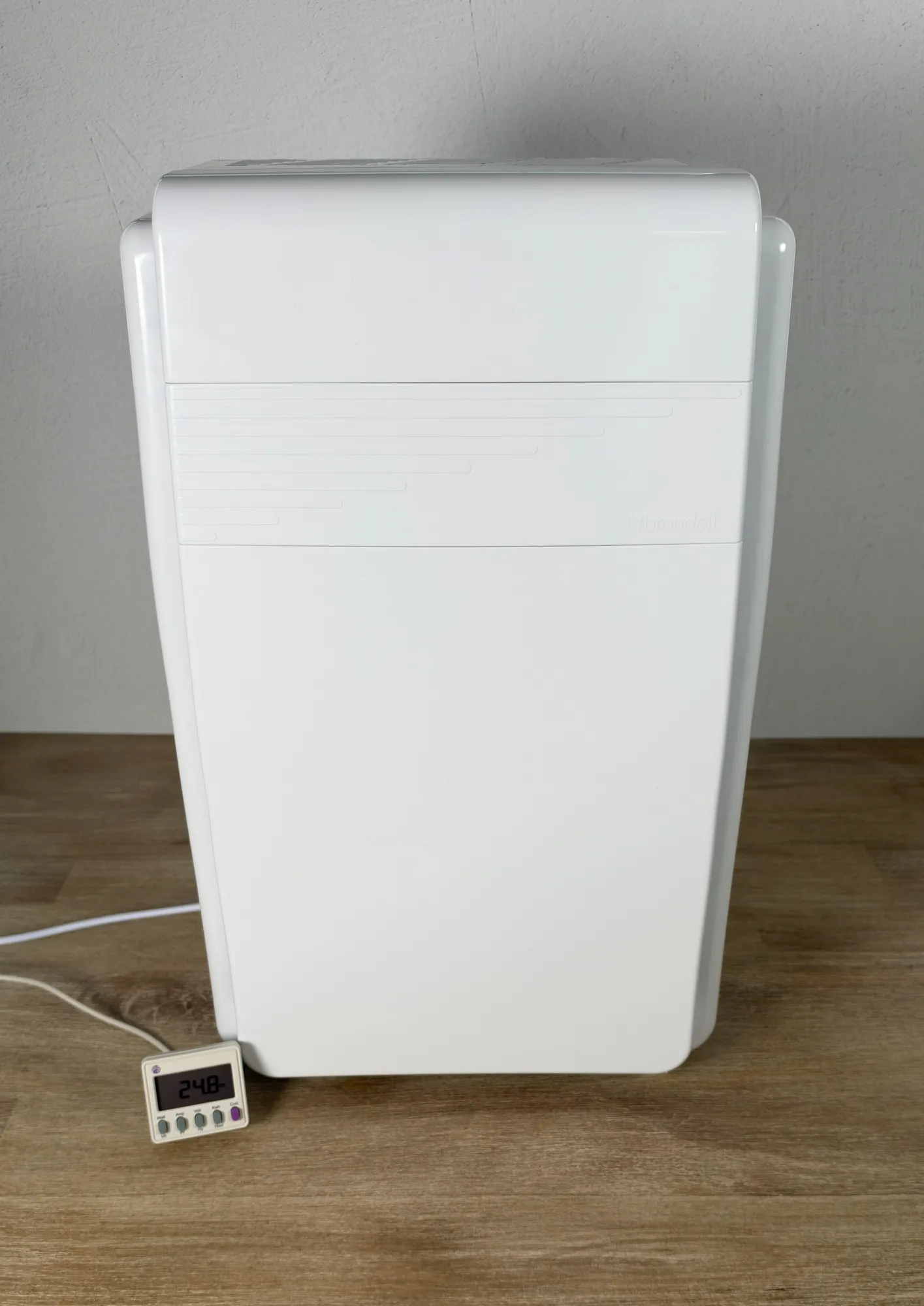
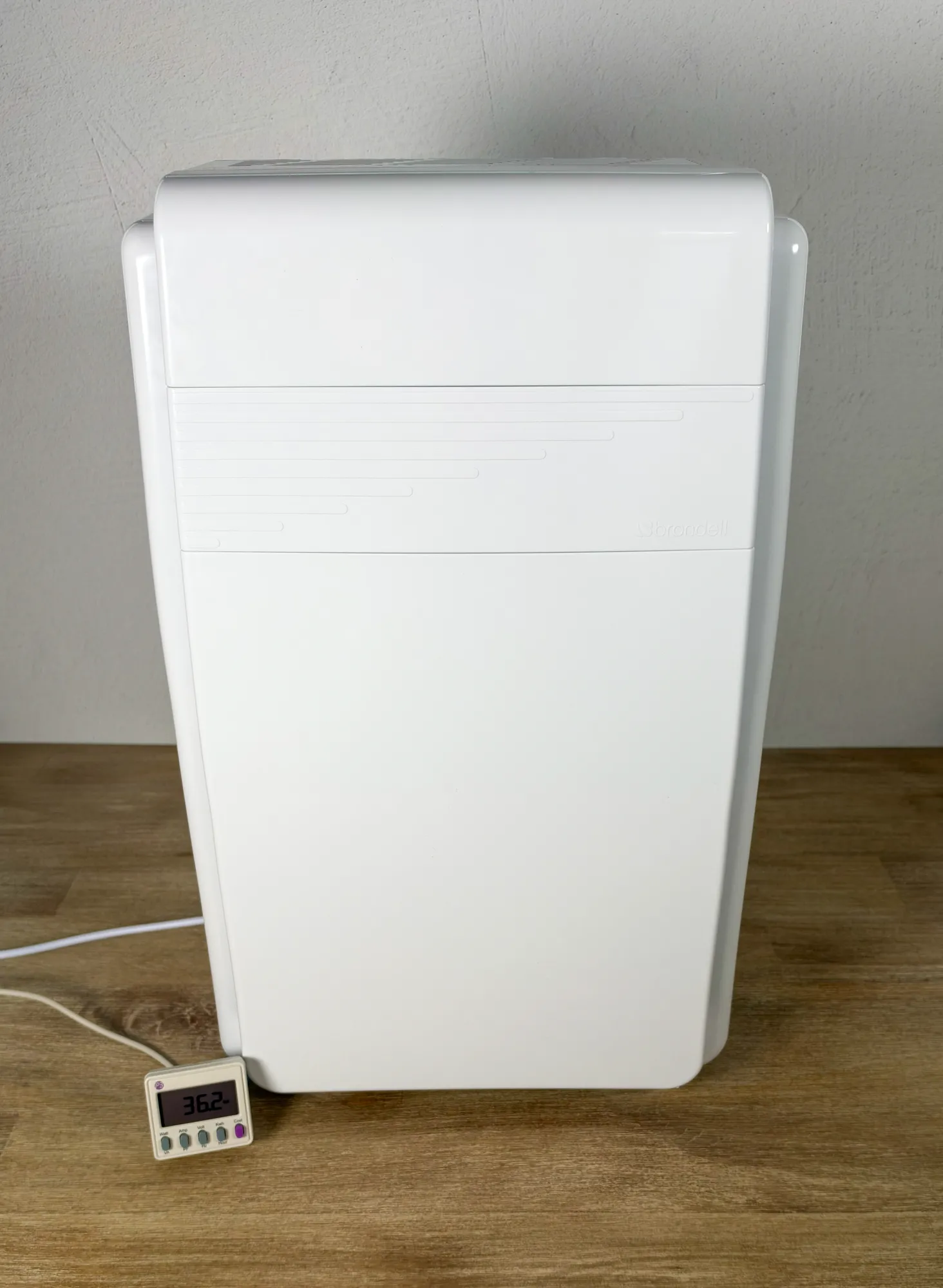
My power readings ranged from 24.3 watts in Sleep to 53.4 watts on speed 3. The maximum measured value was close to the unit’s 55-watt rating. Sleep and speed 1 were again very close, while speed 2 and speed 3 used progressively more power.
The cost column assumes 8 hours daily, 365 days a year, at $0.20 per kWh. It excludes replacement filters.
Measured power and an electricity example
| Mode | Measured draw | Estimated annual electricity |
|---|---|---|
| Sleep | 24.3 W | $14.19 |
| Speed 1 | 24.9 W | $14.54 |
| Speed 2 | 36.2 W | $21.14 |
| Speed 3 | 53.4 W | $31.19 |
Illustrative electricity costs calculated from my recorded wattage. Your utility rate and operating hours will change the result.
At those example inputs, moving from speed 2 to speed 3 adds about $10 per year in electricity. Running speed 2 continuously instead of eight hours per day raises its estimated annual electricity cost from about $21 to about $63. Those differences are useful to budget, but the filter can be a larger recurring expense.
Check the current PHZF-21 price before buying
My earlier value notes used approximately $140 for the purifier and $30 for a replacement filter. Those were the prices behind my initial impression. When checked on November 1, 2026, Brondell’s own listings showed the purifier at $79.99 on sale and the PHZF-21 at $49.99. These are manufacturer-store prices observed on that date, not a promise of the current Amazon price. The purifier listing and the PHZF-21 listing supplied that snapshot.
Brondell recommends replacing the filter every four to six months, depending on conditions, with approximately 3,500 operating hours also referenced in its guidance. At $49.99 each, two filters per year cost $99.98 and three cost $149.97. That is why I would compare the recurring filter bill alongside a discounted purchase price. The owner’s manual explains the replacement guidance.
Choose a mode and your daily use. Electricity uses my measured wattage; the filter budget uses your price and replacement interval.
Estimate your yearly running cost
Electricity is measured watts ÷ 1,000 × daily hours × 365 × your rate. The filter budget is price × 12 ÷ replacement months. This is a recurring ownership estimate, excluding the purifier purchase, tax, shipping, and any unmeasured standby use. Filter replacements follow the selected calendar schedule even if you reduce daily operating hours. Actual replacement timing depends on use and conditions.
For my usual speed 2, the calculator's eight-hour example comes to about $121 per year when a $49.99 filter is replaced every six months. With the same use and a four-month replacement interval, it becomes about $171. A longer filter interval should follow the product's guidance and actual conditions, rather than simply being chosen to make the annual number look better.
If you are comparing several purifiers, use the same hours and electricity rate for each one, then add each model's own replacement-filter schedule. Our guide to replacement filters and long-term purifier value explains why purchase price alone can be misleading.
Filter care, replacement, and ownership details
Filter access is one of the Horizon's better everyday features. With the unit switched off and unplugged, the front cover comes off and the filter pulls out using its tabs. It is easy to see which assembly you need to maintain and replace. The model number PHZF-21 is printed on the frame, which helps when checking a replacement listing.
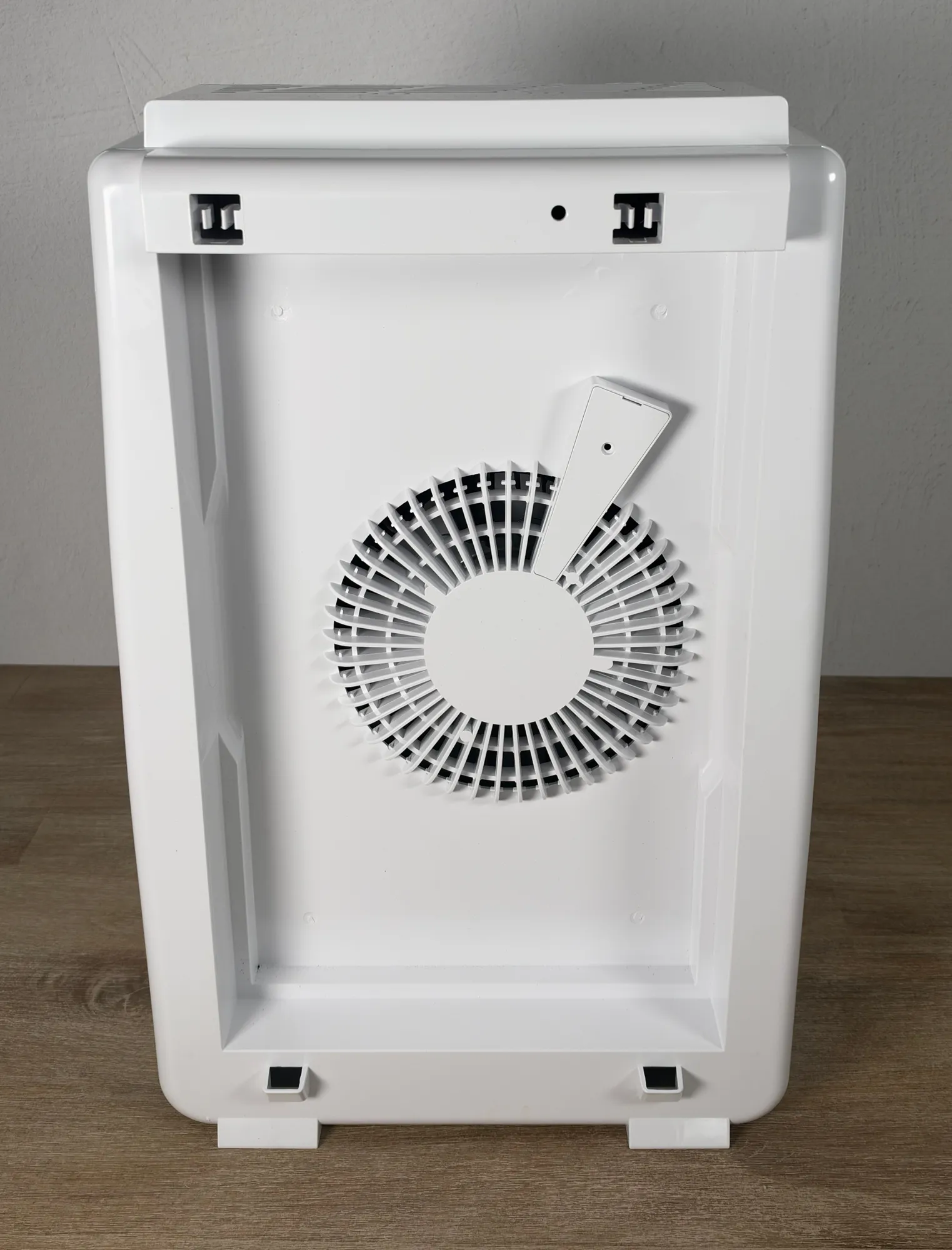
Brondell calls for vacuuming the blue and white sides every two to four weeks. Its instructions say not to wash the filter with water. This is useful maintenance to plan for even though the prefilter is incorporated into the same assembly. The single-piece design simplifies handling, but the whole assembly is replaced when it reaches the end of its service interval. Brondell's cleaning and replacement instructions provide the care limits.
The filter reminder uses the three timer lights. According to the manual, they flash when replacement is due; after replacing the filter, holding Speed and Timer together for three seconds resets the reminder. This is a reminder to manage maintenance, rather than a direct measurement of how much useful filter capacity remains.
Brondell lists a two-year limited warranty for the original purchaser, with filters excluded. Review the terms and keep your purchase documentation when buying a unit. My four-week experience is enough to comment on access, fit, and daily handling, while the warranty is a separate manufacturer commitment. The manual includes the limited warranty terms.
Who I would recommend the Horizon to
I would consider buying the Horizon for a small bedroom or office if I wanted simple manual operation and found it at a price that left room for the filter budget. Its shallow body, manageable weight, and easy filter removal suit someone who occasionally moves a purifier between rooms. Sleep mode was also a real positive in my use.
I would be more selective if it were intended for a larger room, if I expected to use the highest speed throughout the workday, or if a precise, responsive control panel were especially important. My sample's power-button target and front-cover fit are the two usability details I would want to know about before ordering.
The filter specification is another dividing line. If you are shopping specifically for a documented 99.97% HEPA filter, the Horizon's published 98.45% HEPA-type figure does not meet that criterion. If your priority is an uncomplicated small-room unit, compare its room rating, noise at the setting you expect to use, and total running cost with the alternatives on your list.
Brondell Horizon P200 FAQ
Does the Brondell Horizon P200 have a True HEPA filter?
Brondell currently specifies an H12 HEPA-type filter with 98.45% efficiency at 0.3 microns. I would use that model-specific description, rather than label it a 99.97% True HEPA filter. The distinction is stated in Brondell's Horizon specification sheet.
Is the Horizon quiet enough for a bedroom?
Sleep mode worked well for me and did not wake us. I recorded 37.2 dB in Sleep from 3 feet away with a 32.7 dB room baseline, using the NIOSH Sound Level Meter app. Speed 3 measured 57.3 dB in the same setup, so the selected mode makes a substantial difference to the bedroom experience.
Does Sleep mode turn off all the lights?
Brondell's manual says Sleep switches off the other indicators while leaving the Sleep indicator illuminated. It also runs the fan at the minimum setting. That is useful for reducing panel light at night, though it is not a completely dark display. See the manual's Sleep-mode instructions.
Can I run the Horizon without Ion?
Yes. Ion has its own control, separate from fan-speed selection, so you can leave it off. I had it enabled for the cooking observation in this review. Brondell discusses trace ozone from ionization in its air-filter FAQ.
Is it suitable for a 560-square-foot room?
Brondell's 560-square-foot figure is based on one air change per hour. Its four-air-change rating is 140 square feet. I would start with those air-change targets and your room volume when deciding on capacity, rather than treat the largest area as an equivalent small-room cleaning rate. The specification sheet lists all three coverage ratings.
Which replacement filter does the Horizon use?
The replacement is the PHZF-21. Brondell recommends replacement every four to six months depending on conditions, and routine vacuuming every two to four weeks. The filter was listed at $49.99 on Brondell's site when checked on November 1, 2026. Check the exact PHZF-21 identity when comparing listings.
How much electricity does it use?
My recorded draw was 24.3 W in Sleep, 24.9 W on speed 1, 36.2 W on speed 2, and 53.4 W on speed 3. At eight hours daily and $0.20 per kWh, that is approximately $14 to $31 annually for electricity. The calculator above adds your chosen replacement-filter budget.
My final take on the Brondell Horizon
After four weeks, the Horizon's appeal was clear to me: it is easy to move, easy to understand, and easy to open for filter maintenance. Sleep mode fit comfortably into my nights, and speed 2 became my usual daytime setting. Those qualities support my 8.0 overall assessment. The purchase becomes more appealing at a discounted price, provided the filter budget also works for you.
I would still buy with the room rating and replacement cost in view. The touch target for power, the front-cover fit, and the rough finish on my sample keep this from being an unqualified recommendation. For a small room at a competitive price, it is worth considering. For a larger room or a buyer prioritizing a more polished build, I would compare other options before committing.
Important: This article provides general information, not individualized medical, safety, installation, legal, or other professional advice. Product specifications, instructions, and safety information can change; verify current information with the manufacturer and consult an appropriately qualified professional when needed. See our Terms and Conditions for additional information.