
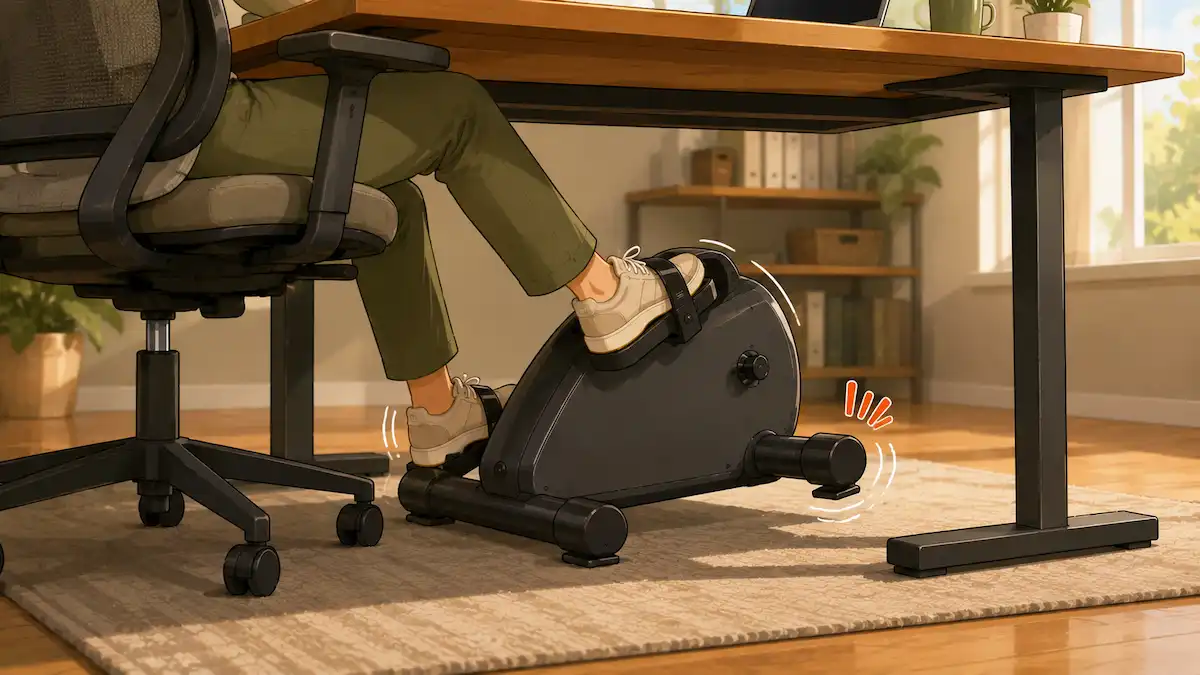
Before buying a mat or wheel stops, watch one chair caster and one front corner of the pedal device against a floor seam. Try a few gentle revolutions in your usual position. If only the caster moves, work on the chair. If the frame slides forward, check the floor contact and whether your stride is pushing the machine away.
Sliding occurs when the forward or sideways force entering the machine exceeds the grip available at its feet. Wobble occurs when the base is too narrow, the center of gravity sits too high, the floor contact is uneven, or the frame and stabilizers flex under alternating pedal force. Chair movement is separate again: a stable machine can still feel unstable when the user rolls backward with each stroke.
Before buying, check what the manufacturer’s non-slip claim actually describes. Useful evidence includes the full base width and depth, low-mounted weight, rubber end caps, adjustable floor stabilizers, rigid crossbars, secure pedals, product weight, chair compatibility, and proof that the machine stays planted at a slow work cadence as well as during harder pedaling.
Official product guidance shows why the complete setup matters. DeskCycle publishes a 20-inch front leg and low center of gravity as stability features. Sunny lists a floor stabilizer and non-slip end caps on its compact magnetic bike. Cubii says reclined posture and vigorous low-resistance pedaling can contribute to sliding. Those examples support evaluating the frame, floor, chair, and pedaling style together.
This guide covers circular-pedal exercisers, seated under-desk ellipticals, and motorized seated units. Their motions differ, but each needs to stay planted without forcing you to brace against the desk or keep repositioning the chair. For model recommendations and the broader buying process, see the under-desk bike buying guide.
First Separate Sliding, Wobbling, Chair Roll, and Foot Slip
Stability problems are easier to evaluate when you identify exactly what is moving. A product can perform well in one category and poorly in another, so do not treat every movement as evidence that the base itself is defective.
- Machine sliding: The entire bike or elliptical creeps forward, backward, or sideways across the floor.
- Frame wobble: One stabilizer lifts, the housing rocks, or the base twists while remaining in roughly the same location.
- Chair roll or rotation: The machine stays planted, but the chair moves backward, swivels, or changes angle under pedal force.
- Foot slip: The user’s shoes move across the pedals even though the machine and chair remain stable.
Machine sliding points toward floor grip, foot material, weight, or the direction of pedal force. Wobble points more toward base geometry, uneven feet, frame rigidity, or a high center of gravity. Chair movement depends on caster type, floor surface, posture, and whether the user is pushing forward rather than down.
Foot slip is controlled by pedal texture, platform size, straps, footwear, and pedal angle. Textured pedals can help keep the feet secure, but they do not prove that the machine’s base will grip the floor. Product pages may describe either the pedals or the floor feet as non-slip, so confirm which part the claim covers.
The strongest setup solves all four movement paths without relying on one improvised fix. A grippy mat cannot correct a narrow, flexible frame, and locking the chair does not make worn or poorly shaped machine feet more effective.
Check the Stability Risk Before You Buy
Use the tool below to screen the complete setup rather than judging the machine alone. It considers motion type, base design, floor surface, chair behavior, and the way you expect to pedal.
The result is not a laboratory stability score. It identifies stronger starting clues, combinations that need careful testing, and setups with a higher risk of sliding or wobble before the return period closes.
Under-Desk Bike Stability Finder and Buyer Checklist
Choose the motion type, base design, flooring, chair setup, and intended pedaling style. The tool identifies likely stability risks and the design details that still need a real setup test.
Choose the options that best match the setup, then select Evaluate Stability Risk.
| Stability Factor | Stronger Design Clue | Warning Sign | Why It Matters |
|---|---|---|---|
| Base width | A broad front stabilizer and enough rear support to keep the complete frame inside a wide footprint. | Narrow crossbars, small feet, or a tall housing centered over a compact base. | A wider support area gives the frame more room to resist side-to-side and fore-aft rocking. |
| Front-to-rear footprint | The frame extends far enough in both directions to support the pedal path and user force. | A long pedal motion mounted over a short base or rear feet positioned too close to the center. | Depth matters when force shifts forward and backward through the stroke. |
| Center of gravity | Heavy components sit low and near the middle of the support area. | A tall central housing, high handle, or top-heavy motor assembly over narrow stabilizers. | Low, centered mass reduces the tendency to rock when pedal force changes sides. |
| Machine weight | Useful mass is distributed over the feet without making the unit top-heavy. | A light frame with small hard feet, or a heavy housing concentrated high above the floor. | Weight can make sliding harder, but geometry and grip decide whether that weight improves stability. |
| Feet and end caps | Wide compliant rubber feet or replaceable non-slip end caps make full contact with the floor. | Small hard-plastic contact points, worn caps, or feet that touch only at an edge. | The floor interface determines how much horizontal force the base can resist before it moves. |
| Floor stabilizers | Adjustable or shaped stabilizers let all feet contact the surface evenly. | One corner lifts, the frame rocks when pressed by hand, or the floor is uneven with no adjustment. | A single unsupported corner can turn normal pedal force into a repeating wobble. |
| Frame rigidity | Rigid crossbars, secure joints, supported shafts, and tight stabilizer hardware. | Housing flex, loose bolts, twisting crossbars, or movement between the base and drivetrain. | Flex can feel like wobble even when the feet themselves do not slide. |
| Pedals and straps | Large textured pedals, secure straps, and minimal side play keep both feet in a repeatable position. | Feet migrate across the pedals, straps slap or loosen, or one pedal rocks laterally. | Changing foot position changes the direction and leverage of the force entering the machine. |
| Pedal or stride path | The base is designed around the machine’s full circular, elliptical, or powered motion. | A high or long pedal path is paired with a small base or visible frame movement. | Different motion paths create different fore-aft and side-to-side forces. |
| Chair and casters | A stable five-leg chair base with casters appropriate for the floor, or a controlled non-rolling setup. | The chair rolls backward, rotates, or scoots more easily than the machine. | The user and machine form one system; chair movement can be mistaken for bike instability. |
| Cadence and resistance | The machine stays planted at the slow work cadence and low-to-moderate resistance you expect to use. | Fast low-resistance pedaling or forceful high-resistance strokes make the unit or chair move. | Speed and load change the direction and size of the forces entering the base. |
| Assembly and support | Clear instructions, replaceable feet, accessible stabilizer hardware, warranty support, and a practical return period. | The listing promises stability but provides no dimensions, parts path, or way to correct a rocking foot. | Assembly tolerance and floor fit can change stability even when the underlying design is sound. |
This is a buyer-screening tool, not a standardized stability rating. Its design clues are grounded in DeskCycle’s wide-base and low-center-of-gravity description, Cubii’s sliding guidance on posture, cadence, and resistance, Sunny’s floor stabilizer and non-slip end caps, and OSHA’s chair-caster guidance for different floor surfaces.
Treat the result as a starting risk screen rather than proof that a product will stay planted. Manufacturing tolerance, assembly, floor condition, chair position, footwear, and individual pedaling style can change the result even when the published design looks promising.
A favorable result should still be tested at the exact desk, chair, floor, resistance, and cadence you plan to use. Watch both the machine and chair from the front and side so you can separate base movement from caster movement or frame flex.
Pedaling Direction, Posture, and Resistance Change Sliding Force
Each pedal stroke sends force into the machine. When more of that force is directed forward than downward, the bike is more likely to creep and a rolling chair is more likely to move backward.
Cubii advises using a more upright seated position because a strongly reclined position tends to push the machine forward with each stride. The company also recommends increasing resistance slightly and slowing the pace instead of pedaling extremely hard at a very low setting.
DeskCycle similarly tells users to apply force downward through the working portion of the pedal stroke. Its guidance notes that chair rotation or movement can indicate that the user is pushing forward rather than down.
That does not mean higher resistance always improves stability. Pedaling forcefully at high resistance can reveal frame flex, make a chair roll, or cause the user to brace against the desk. The useful range is the lowest resistance that keeps the cadence controlled without encouraging fast, forward-pushing strokes. See how much resistance an under-desk bike needs for a task-based way to find that range.
Circular-pedal bikes and seated ellipticals direct force differently. A circular bike moves through a full crank revolution, while an elliptical produces a longer forward-and-back path. Motorized units add powered starts, stops, and direction changes. The base must be designed around the exact motion rather than simply widened in one direction.
Before buying, look for demonstration videos filmed from the side and front at realistic work speeds. A product that appears stable only during fast spinning, with the user bracing, or on an undisclosed floor surface has not answered the stability question.
A Wide Base and Low Center of Gravity Reduce Rocking
A base resists rocking through the area enclosed by its floor-contact points. Wider front support helps with side-to-side force, while adequate front-to-rear depth helps when the pedal path pushes the load forward and backward.
DeskCycle publishes a 20-inch-wide front leg and says its low center of gravity and wide base keep the unit firmly on the ground. The exact dimensions are product-specific, but the design principle is broadly useful: a low machine supported over a broad footprint has more margin before alternating pedal force begins lifting or unloading one foot.
Width alone is not enough. A very wide front bar paired with closely spaced rear feet can still rock fore and aft. Likewise, a long elliptical frame can feel stable in one direction while twisting if its cross-members or rear supports are narrow.
Look at the complete footprint from above, not only the largest published width. Product images should reveal where each foot contacts the floor, how far those points sit from the crank or linkage, and whether the heavy drivetrain is centered inside that support area.
A tall display housing, upright handle, or high-mounted motor can raise the center of gravity. Those features are not automatically unstable, but they need enough base width and depth to prevent the upper mass from amplifying rocking.
When dimensions are missing, compare the frame with the visible pedal path. If the pedals extend well beyond the support points or the housing appears tall over narrow bars, require stronger testing evidence or a practical return policy.
Feet, End Caps, and Floor Stabilizers Determine Grip
The machine’s feet are the final connection between a promising frame and the actual floor. Their material, shape, contact area, condition, and ability to sit evenly determine whether the base can use its weight and footprint effectively.
Compliant rubber end caps generally provide a stronger starting clue than small, smooth hard-plastic points. Look for broad contact surfaces, visible texture, replaceable caps, and enough flexibility to conform to the floor without folding or rolling under the stabilizer.
Sunny’s current compact magnetic bike advertises a floor stabilizer and non-slip end caps, while its under-desk ellipticals use floor stabilizers for even placement. Those disclosures are useful because they identify the part intended to contact the floor rather than relying on a generic stability claim.
Adjustable stabilizers are especially useful on tile transitions, slightly uneven flooring, or frames that otherwise leave one corner unloaded. A machine that rocks when pressed by hand before pedaling will usually remain difficult to stabilize once alternating force is added.
A mat can improve grip on wood, laminate, or tile, but it should be dense, flat, and large enough to support every foot. A very soft rug may let the stabilizers sink unevenly and create wobble even while reducing sliding. Floor contact also affects vibration transfer, so see what makes an under-desk bike quiet enough for calls when the machine will be used during meetings.
Keep pedal grip separate from floor grip. Large textured pedals and straps help the user’s feet stay in position, but the product still needs rubber feet or stabilizers beneath the frame. Check both pedal grip and floor grip when evaluating stability.
Machine Weight Helps, but Distribution Matters More
More machine weight can make a unit harder to slide because the feet press more firmly into the floor, but weight is not a substitute for a well-shaped base or effective foot material. A heavy machine can still creep on smooth caps or rock when the mass sits high above narrow supports.
DeskCycle lists a product weight of 23 pounds. Sunny’s current magnetic mini bike lists 20.5 pounds, while its current under-desk ellipticals list about 25 pounds. Those examples show the general range without establishing a universal target.
Compare product weight rather than shipping weight, and consider where that mass is located. A low flywheel and drivetrain centered over the base usually contribute more useful stability than decorative or electronic mass mounted high on the housing.
Weight also creates a portability tradeoff. A heavier unit may stay planted more easily but become inconvenient to reposition, making it more likely to be stored away. A centered carrying handle and a frame that can be moved without pulling on the pedals are useful supporting details.
Motorized products may weigh more yet introduce powered acceleration, direction changes, and control inputs that manual bikes do not. Do not assume the heavier powered model will be more stable without testing starts, stops, and every intended speed.
Look for weight carried low over grippy feet and a rigid base that supports the full pedal path.
Frame Rigidity, Pedals, and Crank Geometry Affect Wobble
A machine can remain in the same place and still feel unstable when its crossbars, housing, pedal arms, stabilizer joints, or fasteners flex under load. That movement changes alignment and can create a repeating rock even when the floor feet are gripping well.
Look for rigid stabilizer bars, secure bolted joints, supported shafts, and a structural warranty that covers the frame rather than only the display. Assembly instructions should identify torque or tightening steps for the feet and pedals, and replacement hardware should be available.
Pedals influence stability through both grip and leverage. Large textured platforms and adjustable straps help keep each foot in a consistent location. A foot that migrates inward, outward, or forward changes the direction of force and can make one side of the machine feel less planted.
Side play at the pedal or crank is a warning sign because it adds movement outside the intended path. On an elliptical, loose pivots, uneven rollers, or misaligned rails can create a similar side-to-side sensation even when the base itself is broad.
Crank length, pedal height, and stride length change the leverage applied to the base. A larger motion path is not automatically unstable, but it needs a footprint and frame designed to manage the resulting fore-aft and side-to-side forces. Frame movement can also be mistaken for uneven pedal resistance, which is why our guide to what makes an under-desk bike pedal smoothly evaluates the drivetrain and structural support together.
When possible, test forward and reverse motion. A stable product should not introduce a new wobble, lift one foot, or twist the housing when the direction changes.
Chair and Caster Choice Are Part of Stability
The user, chair, and machine behave as one mechanical system. A bike can stay firmly planted while a free-rolling chair moves backward, making the experience feel as though the machine is sliding.
OSHA’s workstation guidance calls for a sturdy five-leg chair base and casters appropriate for the flooring. Its evaluation checklist specifically warns against casters that move so easily on tile or other hard surfaces that the chair scoots away.
A stable non-rolling chair can simplify the setup, while a rolling office chair may need floor-appropriate casters, locking casters, caster cups, or a chair-to-bike tether. Any control method should preserve a comfortable distance from the desk and should not force the user into a perched or unsupported position. Our guide to seat depth, lumbar support, and armrest fit explains how to keep the chair supportive while reaching the desk.
Chair rotation can also reveal asymmetrical pedaling. If the chair swivels with each stroke, the user may be pushing forward or applying more force on one side. A wider bike base cannot correct that movement by itself.
Recliners and sofas deserve extra caution. Cubii’s sliding guidance notes that a reclined posture tends to direct more force forward, while a more upright position directs more of the effort downward. The machine may need excellent floor grip and a slower, more controlled cadence in that setup.
Before buying accessories, identify which object is moving. Chair control is useful when the chair rolls; it will not correct an uneven machine foot, narrow base, or flexible stabilizer.
How to Evaluate Stability Before Buying
Product listings rarely provide one stability score, so evaluate the design in layers and then test the complete setup before the return window closes.
- Record the full footprint. Find the width, length, stabilizer spacing, and location of every floor-contact point, including those beyond the housing.
- Check the center of gravity visually. Prefer heavy components mounted low and between the feet rather than a tall housing over narrow bars.
- Identify the floor interface. Look for broad rubber feet, non-slip end caps, adjustable stabilizers, or a manufacturer-approved mat.
- Separate pedal grip from base grip. Confirm both textured or strapped pedals and a frame designed to resist movement on the floor.
- Compare product weight. Use the assembled product weight, then consider whether the mass is low and centered rather than simply high.
- Match the chair to the floor. Decide whether the chair is stationary, uses appropriate casters, or will need locks, cups, or a tether.
- Watch realistic demonstrations. Look for front and side views at slow work cadence, faster cadence, low resistance, higher resistance, and reverse motion when supported.
- Check assembly and parts support. Confirm that stabilizer bolts, pedals, feet, and end caps can be tightened or replaced and that the frame has meaningful warranty coverage.
- Mark the footprint before delivery. Use painter’s tape beneath the desk to confirm the base fits without colliding with desk legs, storage, chair casters, or cable hardware. Also verify the vertical pedal path using our guide to how much desk clearance an under-desk bike needs.
- Test the actual workstation. Use normal footwear, chair position, resistance, cadence, and work posture while watching both the machine and chair for movement.
- Test the floor twice. Try the unit on the intended surface and, when practical, on a dense stable mat to determine whether the problem is the machine or the floor interface.
- Use the return window. Return or exchange a unit that still rocks, creeps, or requires constant repositioning after correct assembly and a realistic setup test.
A short video filmed from the front and side can reveal movement that is difficult to feel from the chair. Watch the stabilizer feet, housing, pedals, chair casters, and desk objects separately.
The product passes when the machine stays planted, all feet remain loaded, the chair position remains consistent, and the user can pedal without bracing against the desk or repeatedly pulling the unit back into place.
The Bottom Line on Under-Desk Bike Stability
Under-desk bikes slide when horizontal pedal force exceeds the grip available at the machine or chair. They wobble when the footprint is too narrow, the center of gravity sits too high, the floor contact is uneven, or the frame and joints move under alternating load.
The strongest design combines a wide and adequately deep base, low-centered weight, broad rubber feet, floor stabilizers, rigid crossbars, secure pedals, and a motion path that stays inside the supported footprint. Product weight helps only when those features let the machine use it effectively.
The chair and user remain part of the result. Appropriate casters, an upright supported position, controlled cadence, and resistance that prevents free-spinning without requiring forceful strokes can reduce movement that the machine alone cannot solve.
Before buying, compare the base, feet, and stabilizers as well as pedal grip. Then test the exact chair, floor, resistance, cadence, and forward or reverse motion during the return period.
If you are still deciding whether the equipment would receive enough regular use to justify the space and setup, see whether under-desk bikes are worth it for sedentary work. Once the stability setup makes sense, the under-desk bike buying guide can help you compare complete products by clearance, resistance, smoothness, quietness, portability, and overall construction.
Important: This article provides general information, not individualized medical, safety, installation, legal, or other professional advice. Product specifications, instructions, and safety information can change; verify current information with the manufacturer and consult an appropriately qualified professional when needed. See our Terms and Conditions for additional information.