
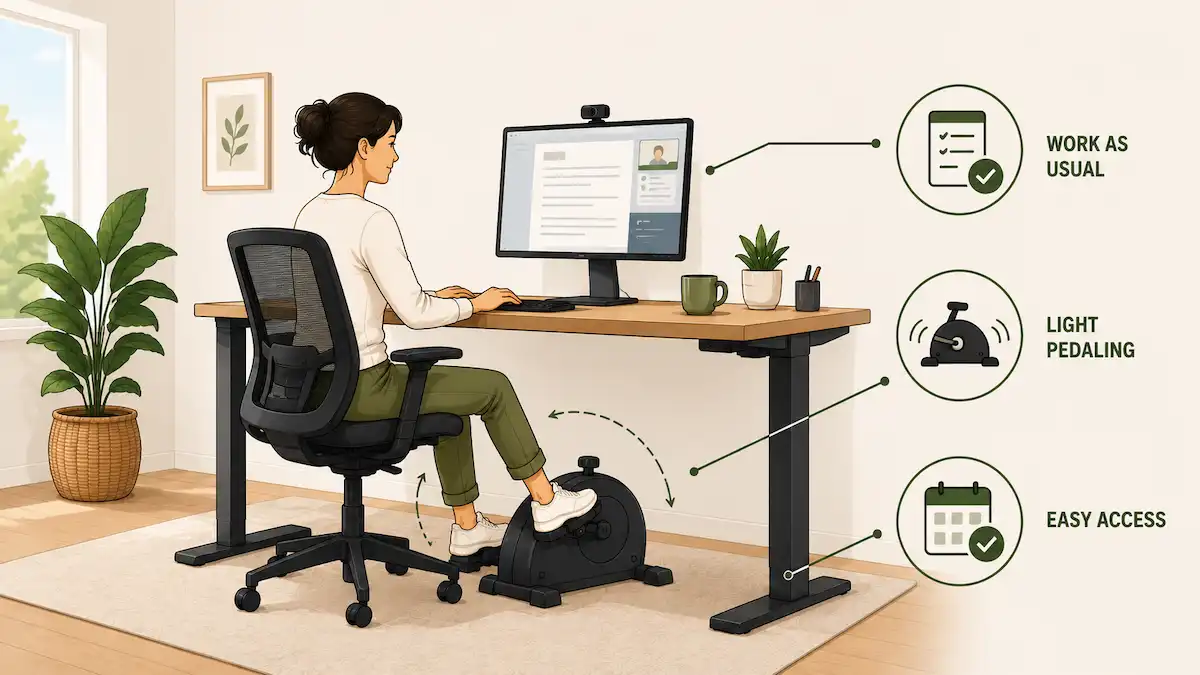
The everyday benefit of an under-desk bike is that you can pedal through some of the time you already spend sitting. Reading a long document or listening to a call gives you time to pedal without changing what you are doing. If your work calls for precise mouse movements or takes you away from the desk most of the day, you may get less use from one.
The answer depends less on advertised calorie burn or the number of resistance levels than on three practical questions: does it fit beneath your desk, can you pedal without disrupting your work, and will you keep it accessible enough to use regularly? A capable machine that makes your knees hit the desktop or has to be dragged out of a closet every time is unlikely to earn its space.
In this guide, under-desk bike includes both compact circular-pedal exercisers and seated under-desk ellipticals designed for use from a chair.
This guide explains what under-desk cycling research supports, what it does not prove, who is most likely to get value from one, and which setup details decide whether the purchase becomes a habit or forgotten equipment. For specific models and broader buying guidance, see the under-desk bike buying guide.
Are Under-Desk Bikes Worth It? What the Research Actually Supports
They can be worthwhile when the goal is light movement during work. Under-desk bikes are useful tools for adding light movement to desk time. They are not proven substitutes for regular aerobic activity, strength training, walking breaks, or a balanced movement routine.
Under-Desk Bike Evidence and Buyer Takeaways
| Question | What Research Suggests | What It Means Before Buying | Important Limit |
|---|---|---|---|
| Does it make desk time more active? | A review and meta-analysis of 22 cycle- and treadmill-desk studies found higher energy expenditure and heart rate than seated work. | Easy pedaling can add meaningful movement to time that would otherwise be nearly motionless. | The studies used different devices and protocols, so the result does not provide a universal calorie-burn number or prove weight loss. |
| Can routine work continue? | In a randomized experiment with 96 inactive adults, typing, reading, reasoning, and phone-task performance were equivalent at 17 and 25 watts compared with nonpedaling. The lower work rate felt more comfortable. | Light resistance is more likely to blend into normal office work than a pace that feels like training. | This was a controlled laboratory experiment, not proof that every person or every job will feel unaffected. |
| What about precise mouse work? | A 34-person mouse-dexterity study found lower accuracy during continuous tracking and steering tasks, although speed on a discrete aiming task was not reduced. | Pause pedaling for CAD, detailed design, photo editing, gaming, or other work that depends on continuous pointer precision. | The tests were simulated tasks. Typical email, reading, calls, and general office work may be less affected. |
| Can light pedaling change a post-meal response? | In a 12-person crossover pilot, two hours of self-paced pedal-desk use lowered the insulin response after a meal without changing glucose or reducing measured work skills. | Even an easy pace produced a measurable physiological change in this small study, although that does not establish a guaranteed benefit for every user. | The study was very small and short. It cannot establish a guaranteed long-term health result. |
| Are longer-term benefits possible? | A 12-week workplace study assigned 17 workers to use a portable pedal machine for 60 minutes per workday and compared them with 15 controls. The intervention group reduced sitting and improved several measured cardiometabolic markers. | Regular use over weeks matters far more than an impressive display, high resistance count, or a few enthusiastic first sessions. | The sample was small, and the findings should not be treated as a promise that a consumer device will produce the same changes. |
| Will people keep using one? | In an eight-week DeskCycle feasibility study with 78 office workers, use declined over time. Desk setup, typing, and critical-thinking demands were barriers; enjoyment and perceived mood benefits helped. | Clearance, task fit, storage, and ease of access determine value more reliably than novelty. | The participants were female workers in one academic office environment, so adherence will differ across people and workplaces. |
The evidence supports under-desk bikes as light-movement tools. It does not establish a predictable calorie burn, guaranteed weight loss, or equivalence to a complete exercise routine.
Taken together, the evidence supports a useful but measured conclusion: under-desk bikes can make part of a workday more active without automatically undermining routine work, but their value depends on light resistance, compatible tasks, and a setup that is easy to use. The studies do not justify treating one as a predictable weight-loss machine or a replacement for regular exercise.
The Real Benefit Is Replacing Still Time With Light Movement
An under-desk bike lets you move during time you already spend at your desk. A 20-minute call, 30 minutes of reading, and a routine inbox block can become three opportunities to pedal without extending the workday.
That movement is usually light. It may raise energy expenditure and keep the legs active compared with sitting motionless, but the goal should be accumulation rather than intensity. If the resistance is high enough to make your upper body rock, noticeably interfere with speech, or repeatedly pull attention away from work, the pace is too demanding for that work.
The World Health Organization emphasizes that all physical activity counts and that adults should limit sedentary time while still meeting weekly aerobic and muscle-strengthening recommendations. Under-desk cycling can contribute to a more active day, but easy desk pedaling should not automatically be treated as a complete workout.
The Health Evidence Is Promising but Still Limited
Research offers reasons to take these machines seriously, but not enough to promise a specific outcome. A review of cycle- and treadmill-desk studies found higher energy expenditure and heart rate than seated work. A small post-meal pedal-desk study found a lower insulin response during light pedaling, and a 12-week workplace intervention reported less sitting and improvements in several measured cardiometabolic markers.
The limitations matter. Many studies include small samples, controlled sessions, short follow-up, or active workstations that are not identical to a compact consumer bike. Results also vary across devices and workloads, so research cannot tell you exactly how many calories your machine will burn or guarantee weight loss, better bloodwork, less discomfort, or more energy.
Use the evidence to set the right expectation: an under-desk bike is a practical way to add light activity where there was previously very little. Its value grows when it is combined with standing, walking, dedicated aerobic exercise, and strength work rather than used as a reason to skip them.
Light Pedaling Can Fit Around Normal Office Work
In a randomized experiment involving 96 physically inactive adults, performance on typing, reading, logical reasoning, and phone tasks was equivalent during light pedaling at 17 and 25 watts and during seated nonpedaling. Participants reported better ergonomic comfort at the lower work rate, which is a useful clue: the pace that works best with a job is often easier than the pace that feels most like exercise.
Under-desk bikes tend to pair best with tasks that allow a steady background rhythm: calls, virtual meetings, reading, reviewing documents, watching training material, organizing email, and routine administrative work. The pedaling should become almost automatic after the first few minutes.
If you repeatedly notice your shoulders tensing, typing rhythm changing, chair drifting, or attention returning to the pedals, reduce the resistance or stop for that task. Our guide to how much resistance you need in an under-desk bike explains why useful desk pedaling depends more on smooth, controllable low-end resistance than on the highest available setting. Look for recurring tasks that are comfortable to do while pedaling, and pause for the rest.
Some Work Tasks Are Better Without Pedaling
Not every task is neutral. A mouse-dexterity study found that continuous tracking and steering accuracy declined while participants used a cycling workstation, even though speed on a simpler discrete aiming task did not. Practice across the study sessions did not eliminate the accuracy loss.
This matters for work such as CAD, detailed graphic design, photo retouching, timeline editing, precision spreadsheet manipulation, or any task in which small pointer errors create rework. In a separate real-world DeskCycle feasibility study, some workers also identified typing and difficult thinking as barriers during certain work periods.
A task-based routine solves most of this. Pedal during meetings, reading, email, or lower-precision work; pause during detailed mouse work, demanding writing, or moments when the movement competes with concentration. A bike can still be worth buying even if it is useful for only part of the day.
Desk and Chair Fit Decide Whether It Gets Used
An under-desk bike can be mechanically excellent and still fail because the workstation does not allow a natural pedal path. The important measurement is not only the machine’s height. It is how high your knee rises at the top of the stroke once the bike, chair, desk underside, desktop thickness, shoes, and your leg proportions are combined. Measure the setup using our guide to how much desk clearance an under-desk bike needs before comparing models.
If clearance is tight, people often raise the chair, slide farther from the desk, or recline to avoid striking the underside. Those workarounds can reduce foot support when you are not pedaling, increase reach to the keyboard, or create a posture that feels acceptable for five minutes but not for an afternoon.
The chair also has to stay put. Rolling casters may push backward with each stroke, while a light machine can creep forward on smooth flooring. Locking casters, a grippy mat, a tether, or a base designed for stronger floor contact can help. Our breakdown of why under-desk bikes slide or wobble explains which frame, stabilizer, foot, and floor-contact details affect stability. The best result is a setup that remains stable without constant repositioning.
Before buying, measure through the full pedal arc rather than checking only the resting position. Leave enough margin that shoes, small chair adjustments, and normal movement do not turn a technically compatible setup into a daily annoyance.
Convenience Determines Long-Term Value
Convenience matters after the initial interest wears off. In the eight-week feasibility study, use declined over time, and participants identified desk setup and task interference as barriers. Buying a machine does not ensure it will stay in regular use.
A bike is more likely to stay in use when it can remain under the desk, move with one hand, or store within easy reach. If every session requires pulling it from another room, moving cables, locking the chair, and readjusting the desk, the preparation may make it harder to keep using the bike.
Track minutes used or workdays used rather than trusting the calorie display. Calorie estimates on compact machines generally cannot account precisely for your actual workload, body, or pedaling efficiency. A simple target such as using the bike during one meeting and one reading block creates a clearer habit than chasing an impressive number.
This is also why quiet operation, smooth low-end resistance, a stable base, a low pedal path, and an accessible adjustment control usually matter more than apps, oversized displays, or a long feature list. If calls and meetings are central to your workday, see what makes an under-desk bike quiet enough for calls. For pedal feel, our guide to whether flywheel weight matters in an under-desk bike explains why one headline specification does not determine smoothness by itself. Features that make the bike easy to use during work are more useful than extras you rarely use.
Who Is Most Likely to Find an Under-Desk Bike Worth It
An under-desk bike is most likely to be worth it when it has a clear, repeatable job in your workday. Use these profiles as a practical screen before comparing models.
More Likely to Be Worth It
- You spend several predictable hours at a dedicated desk.
- Your day includes calls, reading, meetings, email, or routine administrative work.
- You want low-impact movement that can stay light enough for work.
- Your desk has enough knee clearance and your chair can remain stable.
- The bike can remain accessible instead of being stored in another room.
- You view it as one layer of a broader activity routine, not a replacement for exercise.
Less Likely to Be Worth It
- Your desk is low enough that your knees will approach or strike the underside.
- Nearly all of your work requires precise mouse control or uninterrupted deep concentration.
- You hot-desk, move locations frequently, or have no practical place to leave the machine.
- Your chair or flooring cannot be stabilized without a complicated setup.
- You expect vigorous cardio, a large calorie burn, or predictable weight loss while working.
- You already know repetitive pedaling will annoy you or that the unit will be put away after the novelty fades.
A machine does not need to work during every task to be worthwhile. It needs enough compatible time, enough physical clearance, and a simple enough setup to make regular use practical.
How to Decide Before You Buy
Run a workday audit before looking at product pages. This keeps the purchase tied to how you actually work instead of how you imagine you might work after new equipment arrives.
- Identify compatible time. Mark two or three recurring tasks during which light pedaling would not interfere with your hands or concentration.
- Measure the full pedal path. Include the bike, shoes, knee rise, desk underside, any crossbar, and the chair height you can comfortably maintain.
- Check chair and floor stability. Decide how you will prevent the chair from rolling backward and the machine from creeping forward.
- Plan where it will live. A permanent or one-step storage position is much more realistic than a setup that has to be rebuilt each day.
- Prioritize work-friendly design. Low pedal height, smooth resistance, quiet operation, a stable frame, and easy adjustment matter more than an elaborate display.
- Choose a success metric. Track minutes or workdays used rather than estimated calories.
A hypothetical $150 bike used four workdays per week for one year works out to about $0.72 per use-day. The same bike used five times before storage costs $30 per use-day. That contrast explains why compatibility and convenience matter more than buying the machine with the longest feature list.
If the setup passes those checks, compare models by the details that support actual use rather than by the largest claimed calorie number or the most resistance levels.
The Bottom Line on Under-Desk Bikes for Sedentary Work
Under-desk bikes are worth it for sedentary work when the goal is realistic: turn part of the day from motionless sitting into easy, repeatable movement without repeatedly disrupting your work.
They are less likely to be worth it when clearance is marginal, the chair and machine will not stay stable, nearly every task requires precision input, or the purchase is expected to replace exercise or produce predictable weight loss. In those situations, regular use is likely to be difficult.
Choose based on low pedal height, smooth and quiet resistance, stability, and how easily the bike can remain available. The right model should be easy to reach, comfortable to pedal, and useful during tasks you already do. The under-desk bike buying guide compares the broader product options once you know this type of equipment fits your routine.
Important: This article provides general information, not individualized medical, safety, installation, legal, or other professional advice. Product specifications, instructions, and safety information can change; verify current information with the manufacturer and consult an appropriately qualified professional when needed. See our Terms and Conditions for additional information.