
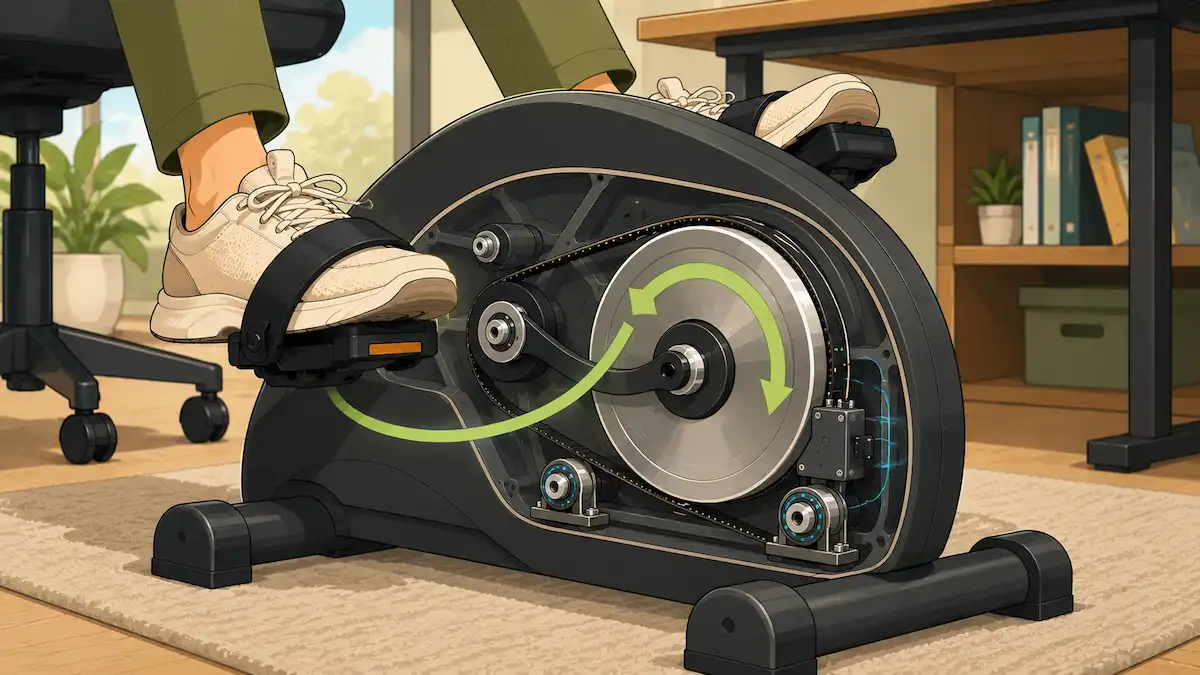
A smooth under-desk bike carries your feet evenly through a slow revolution, the pace you might use while reading. A pause on the first push feels different from a hitch that returns at the same point on every turn. Faster pedaling can hide that difference in a showroom.
Flywheel weight can contribute to that feel, but it is only one part of the system. Flywheel speed, mass distribution, pulley or gear ratio, belt design, bearings, shaft alignment, crank stiffness, resistance consistency, pedal geometry, and frame rigidity all influence what reaches your feet.
This is why two machines with similarly weighted flywheels can feel completely different. One may rotate its flywheel close to pedal speed, while another uses gearing to spin a smaller flywheel many times faster. One may support its shafts with precise sealed bearings and a rigid drive housing, while another allows enough flex, friction, or misalignment to create a noticeable pulse.
Official product specifications illustrate the difference. DeskCycle lists a roughly 3-pound flywheel that rotates about 13 times faster than its crankshaft, along with twin belts and eight sealed bearings. By comparison, current Sunny under-desk bikes and ellipticals commonly list flywheels around 3.3 to 3.52 pounds together with belt drive and magnetic resistance. The scale weight alone does not explain how those complete systems will feel.
In this guide, under-desk bike includes circular-pedal exercisers and seated under-desk ellipticals. Their mechanisms differ, but the same buyer question applies: does the complete motion system remain even, controlled, and unobtrusive at the pace you will actually use while working? For model recommendations and the broader buying process, see the under-desk bike buying guide.
What Smooth Pedaling Actually Feels Like
Smooth pedaling feels predictable. As one foot passes the top of the stroke and the other begins applying more force, the pedals continue moving without a pronounced dead spot, sudden release, catch, or change in resistance.
The easiest way to notice poor smoothness is to pedal slowly. Faster motion creates more momentum and can partially carry the system through an uneven portion of the rotation. At a slower work cadence, variations in the flywheel, resistance mechanism, belt, bearings, crank, or frame become easier to feel.
Several different sensations can all be described as rough, but they do not necessarily have the same cause:
- A repeating dead spot may indicate insufficient effective inertia, uneven resistance, or normal crank-position variation that the drivetrain does not smooth effectively.
- A surge after each push may come from a very light flywheel, belt slack, inconsistent braking force, or excessive pedal speed.
- A gritty or scraping feel points more toward bearings, alignment, rubbing surfaces, or damaged rotating parts.
- Side-to-side movement may come from pedal play, crank flex, linkage wear, or the frame moving beneath the drivetrain.
- A smooth motion that becomes uneven under load may indicate flex, belt slip, bearing drag, or resistance that is not applied consistently.
Smoothness, quietness, and stability are related but not interchangeable. A machine can be quiet yet have a noticeable dead spot, or it can rotate evenly while the base moves across the floor. See what makes an under-desk bike quiet enough for calls and why under-desk bikes slide or wobble for those separate buyer checks. Judge the pedal path itself before combining it with the rest of the workstation experience.
Check the Design Clues Behind Smooth Pedaling
Use the tool below while reviewing a product listing. It does not assign a numerical smoothness score because manufacturers do not report these systems on one standardized scale. Instead, it identifies which disclosed features provide useful evidence and which unanswered questions still need hands-on testing or a strong return policy.
Choose the product’s motion type, drive or resistance system, the level of mechanical detail provided by the manufacturer, and the way you intend to use the machine. Then evaluate the complete drivetrain rather than letting one flywheel number dominate the purchase.
Under-Desk Bike Smoothness Finder and Buyer Checklist
Choose the motion type, drive or resistance system, evidence shown in the listing, and intended use. The tool identifies which smoothness clues deserve the most weight before you buy.
Choose the options that best match the product listing, then select Evaluate Smoothness Clues.
| Design Factor | Stronger Evidence | Warning Sign | What It Changes |
|---|---|---|---|
| Effective rotational inertia | The maker explains flywheel speed, gearing, or how inertia is created, not only the flywheel’s scale weight. | A heavy-flywheel claim appears without speed, radius, drive, or low-cadence information. | Stored rotational energy helps carry the pedals through portions of the stroke where user torque naturally falls. |
| Flywheel speed and gearing | A disclosed pulley or gear ratio shows that the flywheel rotates faster than the crank. | The listing treats flywheel pounds as directly comparable across products with different drivetrains. | Flywheel speed can change how much momentum is available between pedal inputs. |
| Mass distribution | The flywheel is machined or designed with meaningful mass away from the axis. | Weight is listed with no information about flywheel diameter, shape, or construction. | Mass farther from the axis contributes more rotational inertia than the same mass concentrated near the center. |
| Belt and pulley drive | The maker identifies a belt drive, aligned pulleys, or a multi-belt system designed for continuous transmission. | Reviews describe slipping, surging, rubbing, or a changing feel as the pedals rotate. | The drive transfers pedal torque to the flywheel and can introduce or reduce vibration, slack, and pulsation. |
| Resistance mechanism | Contactless magnetic resistance remains even at the low settings used for work. | Resistance catches, pulses, or becomes smooth only when pedaling faster. | Uneven braking force can overpower the benefit of a good flywheel or belt system. |
| Bearings and alignment | Sealed bearings, supported shafts, and precise alignment are disclosed. | The crank feels rough, gritty, loose, or different at one point in each rotation. | Bearings support the rotating shafts; friction, play, or misalignment can create drag and vibration. |
| Cranks and pedals | Rigid crank arms, standard pedal threads, secure fasteners, and minimal side play. | A pedal rocks, a crank flexes, or one side tracks differently from the other. | Movement outside the intended pedal path can feel like drivetrain roughness even when the flywheel is sound. |
| Frame and base rigidity | The housing and base remain planted without twisting as resistance rises. | The frame rocks, the casing flexes, or the drive alignment changes under load. | A rigid support keeps shafts and pulleys aligned and prevents frame movement from being mistaken for uneven resistance. |
| Low-cadence proof | Testing, detailed reviews, or a useful return policy lets you evaluate slow pedaling at the intended resistance. | The only demonstration uses fast pedaling, high resistance, or vague smooth ride language. | Slow cadence exposes dead spots, surging, and linkage variation that faster motion can partially mask. |
The checklist is based on complete drivetrain evidence rather than flywheel weight alone. Examples include DeskCycle’s high-speed flywheel, twin-belt drive, and sealed bearings, Sunny’s belt-driven magnetic mini bike, Gates guidance on stable, smooth belt operation, and SKF guidance on low-friction, low-vibration sealed bearings.
Treat the result as a screening tool rather than proof of how a product will feel. Even a well-documented drivetrain can be affected by manufacturing tolerance, assembly, belt tension, bearing condition, or the way the complete frame behaves under your feet.
The final test is slow pedaling at the resistance you intend to use while working. If that cannot be tested before purchase, prioritize a realistic return window and reviews that specifically discuss low-speed pedal feel rather than relying on general statements that the machine is smooth.
Why Flywheel Weight Alone Can Mislead Buyers
A flywheel’s scale weight is not the same as its rotational inertia. Inertia also depends on the flywheel’s diameter, shape, and where its mass is positioned. Weight concentrated farther from the axis contributes more to resisting changes in rotational speed than the same weight concentrated near the center.
The flywheel’s rotational speed matters as well. A small flywheel driven many times faster than the pedals can store substantially more rotational energy than its physical weight might suggest. That stored energy can help carry the crank through portions of the stroke where the user is applying less torque.
This is the basis for DeskCycle’s distinction between actual and effective flywheel weight. Its published specifications describe a roughly 3-pound flywheel rotating about 13 times faster than the crank and label the result as an effective flywheel weight of 39 pounds. That manufacturer-specific figure helps explain its design, but it should not be compared directly with another company’s flywheel number unless the calculation method and drivetrain are also known.
Sunny, for example, lists compact bikes and ellipticals with physical flywheels around 3.3 to 3.52 pounds, belt drives, and magnetic resistance. Those listings do not use the same effective-weight calculation, so reading 3 pounds versus 3.5 pounds as a direct smoothness ranking would ignore how each flywheel is driven.
A controlled bicycle-ergometer study comparing a light and heavy flywheel found no statistically significant flywheel-weight effect on most measured physiological, subjective, and biomechanical outcomes under its test conditions, while pedaling frequency affected force effectiveness. The study used a full-size ergometer rather than compact under-desk machines, so it does not prove flywheel weight is irrelevant. It does reinforce that weight should not be treated as an independent prediction of the whole pedaling experience.
Flywheel Speed and Gearing Can Matter More Than Pounds
The pedal crank and flywheel do not have to rotate at the same speed. A belt-and-pulley or geared drivetrain can make the flywheel complete several rotations for each pedal revolution. Because rotational energy increases rapidly with rotational speed, that ratio can make a compact flywheel behave more like a larger source of momentum.
That momentum is especially useful near the top and bottom of a circular pedal stroke, where the user’s mechanical leverage naturally changes. The flywheel helps bridge those lower-torque positions instead of allowing the crank to slow sharply and accelerate again after each push.
A higher flywheel-speed ratio is not automatically better. The belt, pulleys, shafts, and bearings must remain aligned and efficient enough to transmit the motion without slip, drag, or vibration. A fast flywheel attached through a poorly controlled drive can still feel uneven.
Look for a disclosed flywheel-to-crank ratio, flywheel rotations per pedal revolution, or an explanation of how the product creates high inertia. A vague heavy flywheel statement provides much less information than an actual description of the complete drive system.
Also distinguish between a physical measurement and an effective measurement. Physical flywheel weight can be weighed directly. Effective weight is a design interpretation that depends on gearing, speed, and the manufacturer’s calculation, so it is not necessarily standardized among brands.
Belt Drive Can Smooth the Transfer of Pedal Force
The drive system connects the crank to the flywheel. A well-designed belt can transfer force continuously, reduce abrupt engagement, and help isolate some vibration between rotating components. That makes belt drive a useful clue, although the words belt drive alone do not establish quality.
Belt material, pulley shape, tension, alignment, and support all matter. A belt that is too loose may slip or create a surge after each pedal push. Excessive tension can add bearing load and drag. Misaligned pulleys can produce vibration, uneven wear, or a changing feel during the rotation.
Gates describes industrial belt systems designed for stable, smooth running, uniform loading, and resistance to vibration. Those engineering goals also explain what buyers should look for in a compact pedal machine: controlled tension, straight tracking, consistent pulley contact, and a housing rigid enough to maintain alignment.
A twin-belt system is not automatically smoother than a single belt, and a belt drive is not automatically smoother than every geared alternative. The benefit depends on how the specific system is designed and assembled. Treat the disclosure as one useful part of the evidence rather than a guarantee.
When reviews describe slipping, a delayed catch, periodic rubbing, or a sudden change in effort, the problem may lie in the drive rather than the flywheel itself. Those details are more informative than a general statement that the product feels solid.
Resistance Must Stay Even Through the Rotation
A flywheel can carry momentum through the pedal stroke only if the resistance mechanism applies a reasonably consistent opposing force. If braking force rises and falls sharply as the flywheel rotates, the pedals can still pulse even when the flywheel and belt are otherwise capable.
Contactless magnetic resistance is a strong starting clue because it does not require a pad or strap to rub directly against the rotating surface. DeskCycle describes its magnetic system as touch-free, while current Sunny under-desk bikes and ellipticals pair magnetic resistance with belt drives.
Magnetic resistance is not an automatic smoothness guarantee. Magnet placement, flywheel runout, resistance spacing, shaft alignment, and the shape of the magnetic field can still affect how evenly the load is applied. A machine may also feel nearly uncontrolled at its minimum setting or make too large a jump between its first two usable settings. Our guide to how much resistance an under-desk bike needs explains why low-end control and adjustment spacing matter more than the total number of levels.
Friction, strap, or pad systems can produce acceptable motion when carefully designed, but they introduce a contacting surface that may wear, heat, glaze, shift, or rub unevenly. Those systems deserve closer scrutiny when the intended use involves long, quiet work sessions at low resistance.
Motorized ellipticals require a different evaluation. Their pedal smoothness depends on motor control, gear reduction, linkage geometry, and how gradually the controller changes speed. A motor can maintain motion through a dead spot, but an abrupt controller or loose linkage can introduce its own pulsing.
Bearings, Shaft Alignment, and Crank Precision Matter
Bearings support the shafts that carry the crank, pulleys, and flywheel. Their job is not simply to let the parts rotate; they must also control position while keeping friction, play, noise, and vibration low.
SKF describes sealed deep-groove ball bearings as low-friction components optimized for low noise and low vibration. Integrated seals also keep lubricant in and contaminants out, which can help preserve consistent operation over time.
The number of bearings can provide useful context but does not prove quality by itself. DeskCycle lists eight sealed bearings within its double-axle, twin-belt drive, but bearing type, size, placement, alignment, preload, lubrication, and manufacturing tolerance still influence the result.
Alignment is especially important. Research on rotating gear-and-bearing systems shows that bearing-raceway misalignment can materially change support stiffness and vibration behavior. An under-desk bike is far less complex than industrial rotating machinery, but the same general mechanical principle applies: shafts and bearings that do not remain properly aligned can introduce uneven drag and vibration.
Cranks and pedals complete the path to the user. A loose pedal, bent crank arm, inconsistent pedal bearing, or side-to-side crank play can feel like a rough drivetrain even when the flywheel is operating normally. Assembly instructions should be followed carefully, including the reverse threading commonly used on the left pedal.
Before buying, look for sealed bearings, steel shafts or cranks, standard pedal threads, replacement-part support, and a meaningful mechanical warranty. After assembly, check that both pedals rotate freely, both crank arms track evenly, and no lateral movement appears under light hand pressure.
Frame Rigidity and Pedal Path Change What Your Feet Feel
The drivetrain does not operate in isolation. Its shafts, bearings, pulleys, resistance mechanism, and linkages are mounted to a housing and frame. If that structure twists or moves under pedal force, alignment can change during the stroke and the resulting movement can feel like uneven resistance.
A wide base and low center of gravity can help keep the machine planted, but the housing around the drive also needs enough rigidity to resist flex. DeskCycle specifically promotes a wide front leg and low center of gravity as part of its resistance to rocking. Those features primarily affect stability, but reduced frame movement can also make the pedal path feel more consistent.
Circular-pedal bikes and seated ellipticals create smoothness differently. A circular bike relies heavily on crank geometry, effective inertia, drive continuity, and even resistance through the full revolution. The top and bottom of the circle are especially revealing because leverage changes there.
A seated elliptical adds pivot arms, rollers, rails, or linked pedal mechanisms. Sunny’s compact ellipticals, for example, combine a belt-driven magnetic system with glide rails and a short elliptical stride. In that design, roller quality, rail alignment, pivot play, and whether both sides track symmetrically can be as important as flywheel weight.
A motorized elliptical adds a powered geartrain and controller. Evaluate whether starts, stops, direction changes, and speed changes occur gradually. A unit that feels smooth once fully moving may still be distracting if every transition begins with a jerk.
When testing any style, place one hand lightly on the housing while pedaling. Notice whether the casing twists, rocks, or vibrates in rhythm with the rough spot. That simple check can help separate internal drivetrain variation from movement of the complete machine.
How to Evaluate Smoothness Before Buying
Most listings will not provide every measurement needed to predict pedal feel. Use the available specifications to narrow the options, then look for evidence that addresses the slow, low-resistance use case rather than only vigorous exercise.
- Start with the intended cadence. If the machine will be used while typing, prioritize smoothness at a slow pace rather than demonstrations built around fast spinning.
- Find more than flywheel weight. Look for flywheel speed, pulley or gear ratio, diameter, mass distribution, or an explanation of how effective inertia is created.
- Identify the drive system. Confirm whether the machine uses one or more belts, gears, a direct linkage, or a motorized geartrain.
- Identify the resistance mechanism. Magnetic resistance is a useful clue, but also look for evidence that the lowest settings remain even and controllable.
- Look for bearing and shaft details. Sealed bearings, supported shafts, rigid cranks, and minimal pedal play provide stronger evidence than a generic premium construction claim.
- Check frame and linkage rigidity. Reviews that mention rocking, casing flex, loose pivot points, or changing alignment under load may reveal problems that flywheel specifications cannot.
- Watch a slow-cadence demonstration. Look for pauses, surges, pedal acceleration, linkage hesitation, or upper-body movement as the user completes each stroke.
- Read reviews for specific sensations. Smooth is less useful than descriptions such as no dead spot, even resistance, no belt slip, no pedal play, and consistent motion at low speed.
- Check forward and reverse operation. A machine advertised for both directions should feel consistent in each direction without a new catch, rub, or alignment problem.
- Use a realistic return option. Manufacturing tolerance, assembly, and individual sensitivity make pedal smoothness difficult to guarantee from specifications alone.
When testing the machine, begin at its lowest resistance and pedal slowly for at least several complete rotations. Increase resistance one step or a small knob turn at a time. The motion should remain even without requiring speed to carry the pedals through a rough section.
Then repeat the test while seated in the actual work position. A machine that feels smooth during a separate exercise session may feel different once chair distance, desk reach, footwear, and a slower work cadence are introduced. Confirm the physical setup using our guide to how much desk clearance an under-desk bike needs.
The Bottom Line on Smooth Under-Desk Pedaling
An under-desk bike pedals smoothly because its complete motion system keeps speed and resistance consistent through the stroke. Flywheel weight can help, but it cannot be separated from flywheel speed, mass distribution, gearing, belt design, bearings, alignment, resistance, crank construction, pedal path, and frame support.
A heavier physical flywheel is not automatically smoother, and a small flywheel is not automatically inferior. A compact flywheel rotating many times faster than the crank may create substantial effective inertia, while a heavier flywheel attached through a poor drive can still surge, drag, or pulse.
For work, prioritize low-cadence smoothness over maximum resistance or a dramatic fast-pedaling demonstration. Look for meaningful drivetrain disclosure, contactless and consistent resistance, a controlled belt or linkage system, sealed bearings, rigid cranks and housing, and evidence that the motion remains even at the pace you will actually maintain.
When those details are unavailable, a slow-speed test and realistic return policy are more valuable than another flywheel number. If you are still deciding whether this type of equipment would earn its place in your routine, see whether under-desk bikes are worth it for sedentary work.
Once the motion system makes sense, the under-desk bike buying guide can help you compare complete products by clearance, resistance, stability, noise, portability, and overall design.
Important: This article provides general information, not individualized medical, safety, installation, legal, or other professional advice. Product specifications, instructions, and safety information can change; verify current information with the manufacturer and consult an appropriately qualified professional when needed. See our Terms and Conditions for additional information.